Bhagavad Gita 16.3: meaning and translation
Chapter 16: Daivasura Sampad Vibhaga Yoga. Krishna says
Krishna ends the list: vigour (tejas), forgiveness, firmness, cleanness, not wishing harm to anyone, and no excess of pride.
Click or tap a word for its meaning and its dictionary page.
Text and layers
Text and layers
These choices stay in this browser.
Bhagavad Gita 16.3
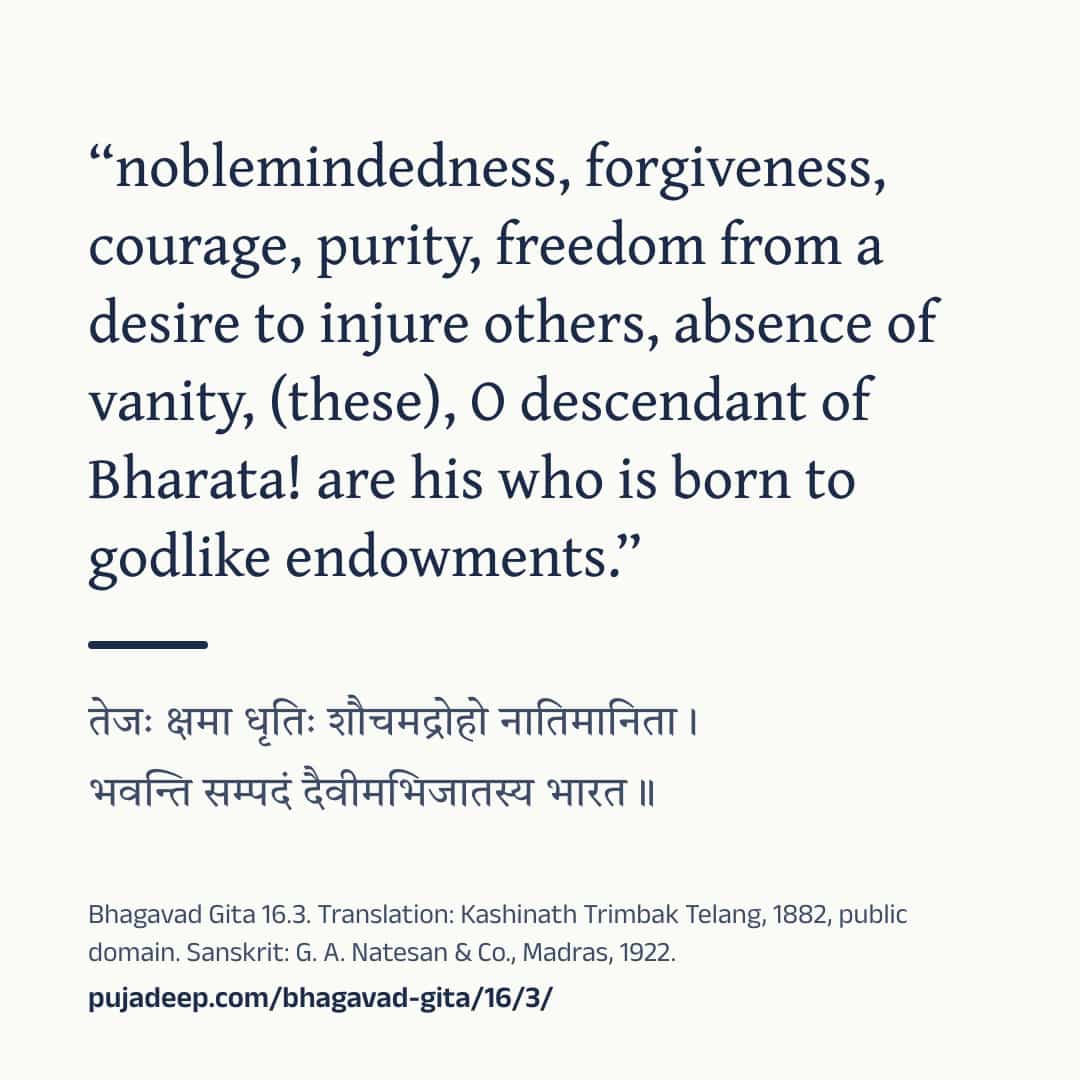
तेजः क्षमा धृतिः शौचमद्रोहो नातिमानिता ।भवन्ति सम्पदं दैवीमभिजातस्य भारत ॥
Tejah kshama dhritih shauchamadroho natimanitaBhavanti sampadam daivimabhijatasya bharata
tejaḥ kṣamā dhṛtiḥ śaucamadroho nātimānitā |bhavanti sampadaṃ daivīmabhijātasya bhārata ||
Our explanation Krishna ends the list: vigour (tejas), forgiveness, firmness, cleanness, not wishing harm to anyone, and no excess of pride. These, he tells Arjuna (Bharata), belong to one born to the divine endowment. The schools explain what this endowment is (see the views).
हिंदी अर्थ कृष्ण सूची पूरी करते हैं: तेज, क्षमा, धृति (धैर्य), शौच (पवित्रता), किसी से द्रोह न करना और अधिक अभिमान न होना। वे अर्जुन (भारत) से कहते हैं कि ये गुण उस व्यक्ति के होते हैं जो दैवी संपदा लेकर जन्मा है। यह संपदा क्या है, इसे परंपराएँ अलग-अलग ढंग से समझाती हैं।
Word by word
Every word, with its dictionary page
Word by word
- तेजः tejaḥ · vigour, radiance (noun (neuter), nominative singular) Dictionary: tejas, Monier-Williams 1899, p. 454, col. 2 “glow, glare, splendour, brilliance, light, fire”
- क्षमा kṣamā · forgiveness, patience (noun (feminine), nominative singular) Dictionary: kṣama, Monier-Williams 1899, p. 326, col. 2 “patience, forbearance, indulgence”
- धृतिः dhṛtiḥ · firmness, fortitude (noun (feminine), nominative singular) Dictionary: dhṛti, Monier-Williams 1899, p. 519, col. 3 “firmness, constancy, resolution”
- शौचम् śaucam · purity (noun (neuter), nominative singular) Dictionary: śauca, Monier-Williams 1899, p. 1092, col. 3 “cleanness, purity, purification”
- अद्रोहः adrohaḥ · freedom from malice (noun (masculine), nominative singular) Dictionary: a-droha, Monier-Williams 1899, p. 19, col. 2 “freedom from malice or treachery”
- न na · not (indeclinable) Dictionary: 2. na, Monier-Williams 1899, p. 523, col. 1 “not, no, nor, neither”
- अतिमानिता atimānitā · too much pride (noun (feminine), nominative singular) Dictionary: ati-mānitā, Monier-Williams 1899, p. 12, col. 3 “great haughtiness”
- भवन्ति bhavanti · are (found) (present, 3rd person plural) Dictionary: 1. bhū, Monier-Williams 1899, p. 760, col. 2 “to become, be”
- सम्पदम् sampadam · endowment, inheritance (noun (feminine), accusative singular) Dictionary: sampad, Monier-Williams 1899, p. 1172, col. 1 “fate, destiny”
- दैवीम् daivīm · divine (adjective (feminine), accusative singular) Dictionary: 1. daiva, Monier-Williams 1899, p. 497, col. 2 “belonging to or coming from the gods, divine, celestial”
- अभिजातस्य abhijātasya · of one born (to) (past participle (masculine), genitive singular) Dictionary: abhi-jāta, Monier-Williams 1899, p. 62, col. 2 “born, produced”
- भारत bhārata · O Bharata (Arjuna) (noun (masculine), vocative singular) Dictionary: bhārata, Monier-Williams 1899, p. 753, col. 1 “descended from Bharata or the Bharatas”
Old translations
Kashinath Trimbak Telang, 1882. Public domain. Page 114.
noblemindedness, forgiveness, courage, purity, freedom from a desire to injure others, absence of vanity, (these), O descendant of Bharata! are his who is born to godlike endowments.
This sentence begins in 16.1.
Compare 3 translations
Kashinath Trimbak Telang, 1882. Public domain. Page 114.
noblemindedness, forgiveness, courage, purity, freedom from a desire to injure others, absence of vanity, (these), O descendant of Bharata! are his who is born to godlike endowments.
This sentence begins in 16.1.
You are reading this one
Annie Besant, 1895. Public domain. Page 140.
Boldness, forgiveness, fortitude, uprightness, amity, absence of pride—these become his who is born with the divine properties, O Bhârata.
This sentence begins in 16.1.
You are reading this one
Swami Swarupananda, 1909 (first printed 1907). Public domain. Page 296.
Boldness, forgiveness, fortitude, purity, absence of hatred, absence of pride; these belong to one born for a divine state, O descendant of Bharata.
This sentence begins in 16.1.
You are reading this one
Cite this verse
The translation: K. T. Telang, The Bhagavadgîtâ (The Sacred Books of the East, vol. VIII, Oxford: Clarendon Press, 1882), p. 114. Bhagavad Gita 16.3.
The translation: Annie Besant, The Bhagavad Gîtâ, or The Lord's Song (London: Theosophical Publishing Society, 1895), p. 140. Bhagavad Gita 16.3.
The translation: Swami Swarupananda, Srimad-Bhagavad-Gita (Mayavati: Prabuddha Bharata Press, 1909; first printed in Prabuddha Bharata, 1907–1909), p. 296. Bhagavad Gita 16.3.
Our explanation: “Bhagavad Gita 16.3: meaning and translation.” Pujadeep. Updated October 25, 2026. https://pujadeep.com/bhagavad-gita/16/3/
Pujadeep’s explanations are free to quote with credit: name Pujadeep and link to the page. How to credit
Classical readings, by school
Each reading is named by its school. None is presented as the only meaning.
What Advaita, Vishishtadvaita and Dvaita teach, in short
Shankara Advaita
Shankara says tejas here means vigour, not a bright complexion. He separates forgiveness (staying unmoved when struck or insulted) from freedom from anger (checking anger once it arises). The qualities from 'fearlessness' to 'no excess of pride' belong to one born for a divine lot: one fit for the powers of the devas, for whom happiness lies ahead.
Source: The Bhagavad-Gita, with the commentary of Sri Sankaracharya, translated by A. Mahadeva Sastri (2nd ed., Mysore: G. T. A. Printing Works, 1901), commentary on 16.3, p. 374. Summarised in our own words; none of its text is reproduced.
Ramanuja Vishishtadvaita
Ramanuja says the divine endowment is the virtue of those who, like the devas, keep to the laws the Lord has made and walk in them. For him tejas is a radiant presence that is proof against the attacks of evil people, and adroha is not obstructing others in the paths they choose.
Source: Sri Bhagavad-Gita with Sri Ramanujacharya's Visishtadvaita commentary, translated by A. Govindacharya (Madras, 1898), commentary on 16.1–16.3, pp. 484–487. Summarised in our own words; none of its text is reproduced.
Share
Show the ways to share
Send one picture or the text to one chat. The picture names its source and the address of this page.
Drawing the picture
See the words
Bhagavad Gita 16.3

तेजः क्षमा धृतिः शौचमद्रोहो नातिमानिता ।
भवन्ति सम्पदं दैवीमभिजातस्य भारत ॥

“noblemindedness, forgiveness, courage, purity, freedom from a desire to injure others, absence of vanity, (these), O descendant of Bharata! are his who is born to godlike endowments.”
(K. T. Telang, The Bhagavadgîtâ (The Sacred Books of the East, vol. VIII, Oxford: Clarendon Press, 1882), p. 114, public domain)
This sentence begins in 16.1.

“Boldness, forgiveness, fortitude, uprightness, amity, absence of pride—these become his who is born with the divine properties, O Bhârata.”
(Annie Besant, The Bhagavad Gîtâ, or The Lord's Song (London: Theosophical Publishing Society, 1895), p. 140, public domain)
This sentence begins in 16.1.

“Boldness, forgiveness, fortitude, purity, absence of hatred, absence of pride; these belong to one born for a divine state, O descendant of Bharata.”
(Swami Swarupananda, Srimad-Bhagavad-Gita (Mayavati: Prabuddha Bharata Press, 1909; first printed in Prabuddha Bharata, 1907–1909), p. 296, public domain)
This sentence begins in 16.1.

Sanskrit: G. A. Natesan & Co., Madras, 1922.
https://pujadeep.com/bhagavad-gita/16/3/ Nothing is sent from this site. Your own app sends it, to the chat you choose. The picture quotes the translation you chose on this page, with its name and year.
Sanskrit text: The Bhagavad-Gita, or The Lord's Song, with the text in Devanagari and an English translation, 1922. Meanings: written for Pujadeep and checked against the cited edition. Source and changes
Questions families ask
Who speaks Bhagavad Gita 16.3?
Krishna speaks this verse, in chapter 16 (Daivasura Sampad Vibhaga Yoga).
Where does the Sanskrit text come from?
Sanskrit text: The Bhagavad-Gita, or The Lord's Song, with the text in Devanagari and an English translation, 1922. Meanings: written for Pujadeep and checked against the cited edition. See the source
Is the meaning on this page a translation?
Explanation written for this site from the sources listed here, and checked against the cited edition. It is not a translation and not the only way to read the text. Free to quote with credit.
Source and licence
- Sanskrit text
- The Bhagavad-Gita, or The Lord's Song, with the text in Devanagari and an English translation (Annie Besant, G. A. Natesan & Co., Madras, 1922). Public domain. The Sanskrit on these pages was read from this printing’s page images.
- Translation
- The Bhagavadgîtâ with the Sanatsugâtîya and the Anugîtâ, translated by Kâshinâth Trimbak Telang (The Sacred Books of the East, vol. VIII, ed. F. Max Müller) (Kashinath Trimbak Telang, F. Max Müller, Clarendon Press, Oxford, 1882). Public domain. Shown verbatim, as printed.
- Translation
- The Bhagavad Gîtâ, or The Lord's Song, translated by Annie Besant (Annie Besant, Theosophical Publishing Society, London, 1895). Public domain. Shown verbatim, as printed.
- Translation
- Srimad-Bhagavad-Gita, with Sanskrit Text; Paraphrase with Word-by-word Literal Translation; English Rendering and Comments, Index, &c., by the Swami Swarupananda (Himalayan Series, No. XX) (Swami Swarupananda, The Editors and Publishers, Advaita Ashrama, Mayavati, Prabuddha Bharata Press, Mayavati, Almora, Himalayas, 1909). Public domain. Shown verbatim, as printed.
- Commentary
- The Bhagavad-Gita, with the commentary of Sri Sankaracharya, translated by A. Mahadeva Sastri (2nd ed., Mysore: G. T. A. Printing Works, 1901) (Public-domain scan, University of California Libraries). Summarised in our own words; none of its text is reproduced.
- Commentary
- Sri Bhagavad-Gita with Sri Ramanujacharya's Visishtadvaita commentary, translated by A. Govindacharya (Madras, 1898) (Scan uploaded to archive.org (folkscanomy collection)). Summarised in our own words; none of its text is reproduced.
- Common wording
- In this text, 32 words follow today's common wording, checked against sanskritdocuments.org; Sanskrit Wikisource; Gita Press, Gorakhpur; GRETIL, Göttingen and Bhaktivedanta Book Trust.
- Our explanation
- Explanation written for this site from the sources listed here, and checked against the cited edition. It is not a translation and not the only way to read the text. Free to quote with credit.
- Checked
- Checked against the cited edition, October 14, 2026.
- Updated
- October 25, 2026