Bhagavad Gita 15.20: meaning and translation
Chapter 15: Purushottama Yoga. Krishna says
Krishna closes the chapter.
Click or tap a word for its meaning and its dictionary page.
Text and layers
Text and layers
These choices stay in this browser.
Bhagavad Gita 15.20
इति गुह्यतमं शास्त्रमिदमुक्तं मयाऽनघ ।एतद्बुद्ध्वा बुद्धिमान् स्यात्कृतकृत्यश्च भारत ॥
Iti guhyatamam shastramidamuktam mayanaghaEtadbuddhva buddhiman syatkritakrityashcha bharata
iti guhyatamaṃ śāstramidamuktaṃ mayā’nagha |etadbuddhvā buddhimān syātkṛtakṛtyaśca bhārata ||
Our explanation Krishna closes the chapter. He calls this the most secret teaching (śāstra) and says he has now told it to Arjuna, whom he calls sinless. Knowing it, he says, a person becomes wise and has done all there is to do, Bharata.
हिंदी अर्थ कृष्ण अध्याय पूरा करते हैं। वे इसे सबसे गुप्त शास्त्र कहते हैं और कहते हैं कि उन्होंने इसे निष्पाप अर्जुन को बता दिया है। वे कहते हैं कि हे भारत, इसे जानकर मनुष्य बुद्धिमान और कृतकृत्य (जिसने करने योग्य सब कर लिया) हो जाता है।
Word by word
Every word, with its dictionary page
Word by word
- इति iti · thus (indeclinable) Dictionary: 2. iti, Monier-Williams 1899, p. 165, col. 1 “in this manner, thus”
- गुह्यतमम् guhyatamam · most secret (superlative, nominative singular) Dictionary: guhya, Monier-Williams 1899, p. 360, col. 3 “private, secret, mysterious, mystical”; 2. tama, Monier-Williams 1899, p. 438, col. 2 “an affix forming the superl. degree of adjectives”
- शास्त्रम् śāstram · teaching (nominative singular) Dictionary: śāstra, Monier-Williams 1899, p. 1069, col. 1 “teaching, instruction, direction, advice, good counsel”
- इदम् idam · this (pronoun, nominative singular) Dictionary: 1. idam, Monier-Williams 1899, p. 165, col. 2 “this, this here, referring to something near the speaker”
- उक्तम् uktam · has been told (past participle, nominative singular) Dictionary: ukta, Monier-Williams 1899, p. 171, col. 3 “uttered, said, spoken”
- मया mayā · by "me" (Krishna) (pronoun, instrumental singular) Dictionary: 1. mad, Monier-Williams 1899, p. 777, col. 2 “base of the first pers. pron. in the sg. number (esp. in comp.)”
- अनघ anagha · O sinless one (Arjuna) (vocative singular) Dictionary: an-agha, Monier-Williams 1899, p. 24, col. 2 “sinless; faultless”
- एतत् etat · this (pronoun, accusative singular) Dictionary: etad, Monier-Williams 1899, p. 231, col. 2 “this, this here, here”
- बुद्ध्वा buddhvā · having understood (absolutive ('having done')) Dictionary: 1. budh, Monier-Williams 1899, p. 733, col. 2 “to perceive, notice, learn, understand, become or be aware of”
- बुद्धिमान् buddhimān · wise (nominative singular) Dictionary: buddhi-mat, Monier-Williams 1899, p. 734, col. 1 “endowed with understanding, intelligent, learned, wise”
- स्यात् syāt · would be, becomes (optative, 3rd person singular) Dictionary: 1. as, Monier-Williams 1899, p. 117, col. 2 “to be, live, exist, be present”
- कृतकृत्यः kṛtakṛtyaḥ · one who has done all to be done (compound, nominative singular) Dictionary: kṛta-kṛtya, Monier-Williams 1899, p. 302, col. 1 “one who has done his duty or accomplished a business”
- च ca · and (indeclinable) Dictionary: 2. ca, Monier-Williams 1899, p. 380, col. 1 “and, both, also, moreover, as well as”
- भारत bhārata · O descendant of Bharata (Arjuna) (vocative singular) Dictionary: bhārata, Monier-Williams 1899, p. 753, col. 1 “a descendant of Bharata”
3 printings differ
Edition differences. Another printing or text reads this place differently.
- The printed edition reads: इति गुह्यतमं शास्त्रमिदमुक्तं मयाऽनघ ।
एतद्बुध्वा बुद्धिमान् स्यात्कृतकृत्यश्च भारत ॥ The print shows एतद्बुध्वा, with no द before ध (the conjunct द्ध has lost its द); corrected to एतद्बुद्ध्वा, because the absolutive of budh is buddhvā (बुद्ध्वा), which both proofreading references read. The dot at the top of ध is part of this type's half-form ध् in the ligature ध्व, as in ऊर्ध्व (15.1) and ऊर्ध्वं (15.2); it is not an anusvara and not a speck. The rest of the line is as printed. - Spelling A digital text reads Same words. The 1922 edition marks the merged vowel with an avagraha (मयाऽनघ); this e-text does not.
- Spelling A digital text reads Same letters. The 1922 edition prints बुद्धिमान् स्यात् as two words; the e-text joins them.
Old translations
Kashinath Trimbak Telang, 1882. Public domain. Page 114.
Thus, O sinless one! have I proclaimed this most mysterious science. He who knows this, has done all he need do, and he becomes possessed of discernment.
Compare 3 translations
Kashinath Trimbak Telang, 1882. Public domain. Page 114.
Thus, O sinless one! have I proclaimed this most mysterious science. He who knows this, has done all he need do, and he becomes possessed of discernment.
You are reading this one
Annie Besant, 1895. Public domain. Page 139.
Thus by Me this eternal Secret hath been told, O sinless one. Having known this, he may become Buddhi-filled, and with all action accomplished, O Bhârata.
You are reading this one
Swami Swarupananda, 1909 (first printed 1907). Public domain. Page 293–294.
Thus, O sinless one, has this most profound teaching been imparted by Me. Knowing this, he attains the highest intelligence and the accomplishment of all his duties, O descendant of Bharata.
You are reading this one
Cite this verse
The translation: K. T. Telang, The Bhagavadgîtâ (The Sacred Books of the East, vol. VIII, Oxford: Clarendon Press, 1882), p. 114. Bhagavad Gita 15.20.
The translation: Annie Besant, The Bhagavad Gîtâ, or The Lord's Song (London: Theosophical Publishing Society, 1895), p. 139. Bhagavad Gita 15.20.
The translation: Swami Swarupananda, Srimad-Bhagavad-Gita (Mayavati: Prabuddha Bharata Press, 1909; first printed in Prabuddha Bharata, 1907–1909), pp. 293–294. Bhagavad Gita 15.20.
Our explanation: “Bhagavad Gita 15.20: meaning and translation.” Pujadeep. Updated October 25, 2026. https://pujadeep.com/bhagavad-gita/15/20/
Pujadeep’s explanations are free to quote with credit: name Pujadeep and link to the page. How to credit
Classical readings, by school
No readings by school on this verse yet.
Share
Show the ways to share
Send one picture or the text to one chat. The picture names its source and the address of this page.
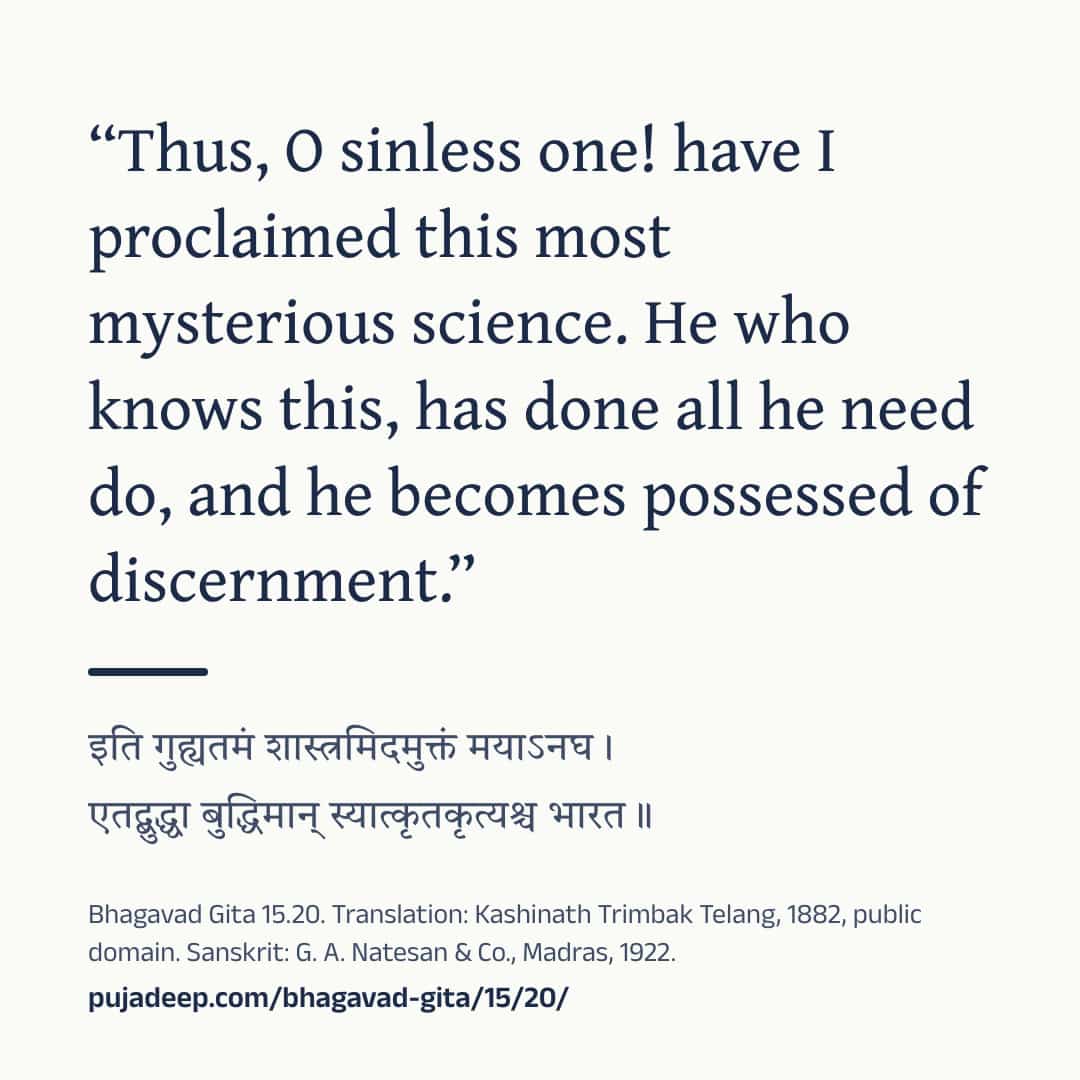
Drawing the picture
See the words
Bhagavad Gita 15.20

इति गुह्यतमं शास्त्रमिदमुक्तं मयाऽनघ ।
एतद्बुद्ध्वा बुद्धिमान् स्यात्कृतकृत्यश्च भारत ॥

“Thus, O sinless one! have I proclaimed this most mysterious science. He who knows this, has done all he need do, and he becomes possessed of discernment.”
(K. T. Telang, The Bhagavadgîtâ (The Sacred Books of the East, vol. VIII, Oxford: Clarendon Press, 1882), p. 114, public domain)

“Thus by Me this eternal Secret hath been told, O sinless one. Having known this, he may become Buddhi-filled, and with all action accomplished, O Bhârata.”
(Annie Besant, The Bhagavad Gîtâ, or The Lord's Song (London: Theosophical Publishing Society, 1895), p. 139, public domain)

“Thus, O sinless one, has this most profound teaching been imparted by Me. Knowing this, he attains the highest intelligence and the accomplishment of all his duties, O descendant of Bharata.”
(Swami Swarupananda, Srimad-Bhagavad-Gita (Mayavati: Prabuddha Bharata Press, 1909; first printed in Prabuddha Bharata, 1907–1909), pp. 293–294, public domain)

Sanskrit: G. A. Natesan & Co., Madras, 1922.
https://pujadeep.com/bhagavad-gita/15/20/ Nothing is sent from this site. Your own app sends it, to the chat you choose. The picture quotes the translation you chose on this page, with its name and year.
Sanskrit text: The Bhagavad-Gita, or The Lord's Song, with the text in Devanagari and an English translation, 1922. Meanings: written for Pujadeep and checked against the cited edition. Source and changes
Questions families ask
Who speaks Bhagavad Gita 15.20?
Krishna speaks this verse, in chapter 15 (Purushottama Yoga).
Where does the Sanskrit text come from?
Sanskrit text: The Bhagavad-Gita, or The Lord's Song, with the text in Devanagari and an English translation, 1922. Meanings: written for Pujadeep and checked against the cited edition. See the source
Is the meaning on this page a translation?
Explanation written for this site from the sources listed here, and checked against the cited edition. It is not a translation and not the only way to read the text. Free to quote with credit.
Source and licence
- Sanskrit text
- The Bhagavad-Gita, or The Lord's Song, with the text in Devanagari and an English translation (Annie Besant, G. A. Natesan & Co., Madras, 1922). Public domain. The Sanskrit on these pages was read from this printing’s page images.
- Translation
- The Bhagavadgîtâ with the Sanatsugâtîya and the Anugîtâ, translated by Kâshinâth Trimbak Telang (The Sacred Books of the East, vol. VIII, ed. F. Max Müller) (Kashinath Trimbak Telang, F. Max Müller, Clarendon Press, Oxford, 1882). Public domain. Shown verbatim, as printed.
- Translation
- The Bhagavad Gîtâ, or The Lord's Song, translated by Annie Besant (Annie Besant, Theosophical Publishing Society, London, 1895). Public domain. Shown verbatim, as printed.
- Translation
- Srimad-Bhagavad-Gita, with Sanskrit Text; Paraphrase with Word-by-word Literal Translation; English Rendering and Comments, Index, &c., by the Swami Swarupananda (Himalayan Series, No. XX) (Swami Swarupananda, The Editors and Publishers, Advaita Ashrama, Mayavati, Prabuddha Bharata Press, Mayavati, Almora, Himalayas, 1909). Public domain. Shown verbatim, as printed.
- Common wording
- In this text, 32 words follow today's common wording, checked against sanskritdocuments.org; Sanskrit Wikisource; Gita Press, Gorakhpur; GRETIL, Göttingen and Bhaktivedanta Book Trust.
- Our explanation
- Explanation written for this site from the sources listed here, and checked against the cited edition. It is not a translation and not the only way to read the text. Free to quote with credit.
- Checked
- Checked against the cited edition, October 15, 2026.
- Updated
- October 25, 2026