Bhagavad Gita 15.16: meaning and translation
Chapter 15: Purushottama Yoga. Krishna says
There are two persons (puruṣa) in the world, Krishna says, the perishable (kṣara) and the imperishable (akṣara).
Click or tap a word for its meaning and its dictionary page.
Text and layers
Text and layers
These choices stay in this browser.
Bhagavad Gita 15.16
द्वाविमौ पुरुषौ लोके क्षरश्चाक्षर एव च ।क्षरः सर्वाणि भूतानि कूटस्थोऽक्षर उच्यते ॥
Dvavimau purushau loke ksharashchakshara eva chaKsharah sarvani bhutani kutasthokshara uchyate
dvāvimau puruṣau loke kṣaraścākṣara eva ca |kṣaraḥ sarvāṇi bhūtāni kūṭastho’kṣara ucyate ||
Our explanation There are two persons (puruṣa) in the world, Krishna says, the perishable (kṣara) and the imperishable (akṣara). All beings are the perishable; the unchanging one (kūṭastha) is called the imperishable. The schools read these two very differently (see the views).
हिंदी अर्थ कृष्ण कहते हैं कि संसार में दो पुरुष हैं, क्षर (नाशवान) और अक्षर (अविनाशी)। सब प्राणी क्षर हैं; कूटस्थ (अविचल) को अक्षर कहा जाता है। परंपराएँ इन दोनों को बहुत अलग ढंग से समझती हैं।
Word by word
Every word, with its dictionary page
Word by word
- द्वौ dvau · two (nominative dual) Dictionary: dva, Monier-Williams 1899, p. 503, col. 2 “two”
- इमौ imau · these (pronoun, nominative dual) Dictionary: 1. idam, Monier-Williams 1899, p. 165, col. 2 “this, this here, referring to something near the speaker”
- पुरुषौ puruṣau · persons, Purushas (nominative dual) Dictionary: puruṣa, Monier-Williams 1899, p. 637, col. 1 “the personal and animating principle in men and other beings, the soul or spirit”
- लोके loke · in the world (locative singular) Dictionary: loka, Monier-Williams 1899, p. 906, col. 1 “the wide space or world”
- क्षरः kṣaraḥ · the perishable (nominative singular) Dictionary: kṣara, Monier-Williams 1899, p. 327, col. 1 “melting away, perishable”
- च ca · and (indeclinable) Dictionary: 2. ca, Monier-Williams 1899, p. 380, col. 1 “and, both, also, moreover, as well as”
- अक्षरः akṣaraḥ · the imperishable (nominative singular) Dictionary: a-kṣara, Monier-Williams 1899, p. 3, col. 2 “imperishable; unalterable”
- एव eva · also (indeclinable) Dictionary: 1. eva, Monier-Williams 1899, p. 232, col. 2 “indeed, truly, really”
- च ca · and (indeclinable) Dictionary: 2. ca, Monier-Williams 1899, p. 380, col. 1 “and, both, also, moreover, as well as”
- क्षरः kṣaraḥ · the perishable (nominative singular) Dictionary: kṣara, Monier-Williams 1899, p. 327, col. 1 “melting away, perishable”
- सर्वाणि sarvāṇi · all (nominative plural) Dictionary: sarva, Monier-Williams 1899, p. 1184, col. 3 “whole, entire, all, every”
- भूतानि bhūtāni · beings (nominative plural) Dictionary: bhūta, Monier-Williams 1899, p. 761, col. 3 “that which is or exists, any living being (divine, human, animal, and even vegetable)”
- कूटस्थः kūṭasthaḥ · the unchanging one (nominative singular) Dictionary: kūṭa-stha, Monier-Williams 1899, p. 299, col. 3 “(in phil.) immovable, uniform, unchangeable”
- अक्षरः akṣaraḥ · the imperishable (nominative singular) Dictionary: a-kṣara, Monier-Williams 1899, p. 3, col. 2 “imperishable; unalterable”
- उच्यते ucyate · is called (passive, present, 3rd person singular) Dictionary: vac, Monier-Williams 1899, p. 912, col. 1 “to be called or accounted, be regarded as”
Old translations
Kashinath Trimbak Telang, 1882. Public domain. Page 113.
There are these two beings in the world, the destructible and the indestructible1. The destructible (includes) all things. The unconcerned one is (what is) called the indestructible.
Footnotes (the translator’s own) - Cf. Svetâsvatara, p. 294. ↩
Compare 3 translations
Kashinath Trimbak Telang, 1882. Public domain. Page 113.
There are these two beings in the world, the destructible and the indestructible1. The destructible (includes) all things. The unconcerned one is (what is) called the indestructible.
Footnotes (the translator’s own) - Cf. Svetâsvatara, p. 294. ↩
You are reading this one
Annie Besant, 1895. Public domain. Page 138.
There are two Purushas in this world, one destructible and one indestructible; the destructible (is) all beings, the indestructible (is) called the Unchanging.
You are reading this one
Swami Swarupananda, 1909 (first printed 1907). Public domain. Page 291–292.
There are two Purushas in the world,—the Perishable and the Imperishable. All beings are the Perishable, and the Kutastha is called Imperishable.
You are reading this one
Cite this verse
The translation: K. T. Telang, The Bhagavadgîtâ (The Sacred Books of the East, vol. VIII, Oxford: Clarendon Press, 1882), p. 113. Bhagavad Gita 15.16.
The translation: Annie Besant, The Bhagavad Gîtâ, or The Lord's Song (London: Theosophical Publishing Society, 1895), p. 138. Bhagavad Gita 15.16.
The translation: Swami Swarupananda, Srimad-Bhagavad-Gita (Mayavati: Prabuddha Bharata Press, 1909; first printed in Prabuddha Bharata, 1907–1909), pp. 291–292. Bhagavad Gita 15.16.
Our explanation: “Bhagavad Gita 15.16: meaning and translation.” Pujadeep. Updated October 25, 2026. https://pujadeep.com/bhagavad-gita/15/16/
Pujadeep’s explanations are free to quote with credit: name Pujadeep and link to the page. How to credit
Classical readings, by school
Each reading is named by its school. None is presented as the only meaning.
What Advaita, Vishishtadvaita and Dvaita teach, in short
Shankara Advaita
Shankara says the perishable is the whole changing world, and the imperishable is the Lord's power of māyā, the seed from which perishable beings arise and which holds the impressions of their desires and actions. It is called kūṭastha because it stays unmoved like a heap, or because it shows itself in many deceptive forms, and imperishable because the seed of worldly life does not end.
Source: The Bhagavad-Gita, with the commentary of Sri Sankaracharya, translated by A. Mahadeva Sastri (2nd ed., Mysore: G. T. A. Printing Works, 1901), commentary on 15.16, pp. 367–368. Summarised in our own words; none of its text is reproduced.
Ramanuja Vishishtadvaita
Ramanuja says both are souls. The perishable is the whole body of souls bound to matter, from Brahmā down to a blade of grass. The imperishable, the 'unchanging' (kūṭastha), is the whole body of freed souls, free of matter and in their own nature; the word is singular but stands for many, since many have been freed (4.10).
Source: Sri Bhagavad-Gita with Sri Ramanujacharya's Visishtadvaita commentary, translated by A. Govindacharya (Madras, 1898), commentary on 15.16, pp. 476–477. Summarised in our own words; none of its text is reproduced.
Madhva Dvaita
Madhva says the perishable is all beings, who perish as far as their bodies go. The imperishable, which stays unchanging, is Prakṛti as a conscious being, the goddess Śrī.
Source: The Bhagavad-Gita: translation and commentaries in English according to Sri Madhwacharya's Bhashyas, by S. Subba Rau (Madras, 1906), commentary on 15.16, p. 278 (leaf n276). Summarised in our own words; none of its text is reproduced.
Share
Show the ways to share
Send one picture or the text to one chat. The picture names its source and the address of this page.
Drawing the picture
See the words
Bhagavad Gita 15.16

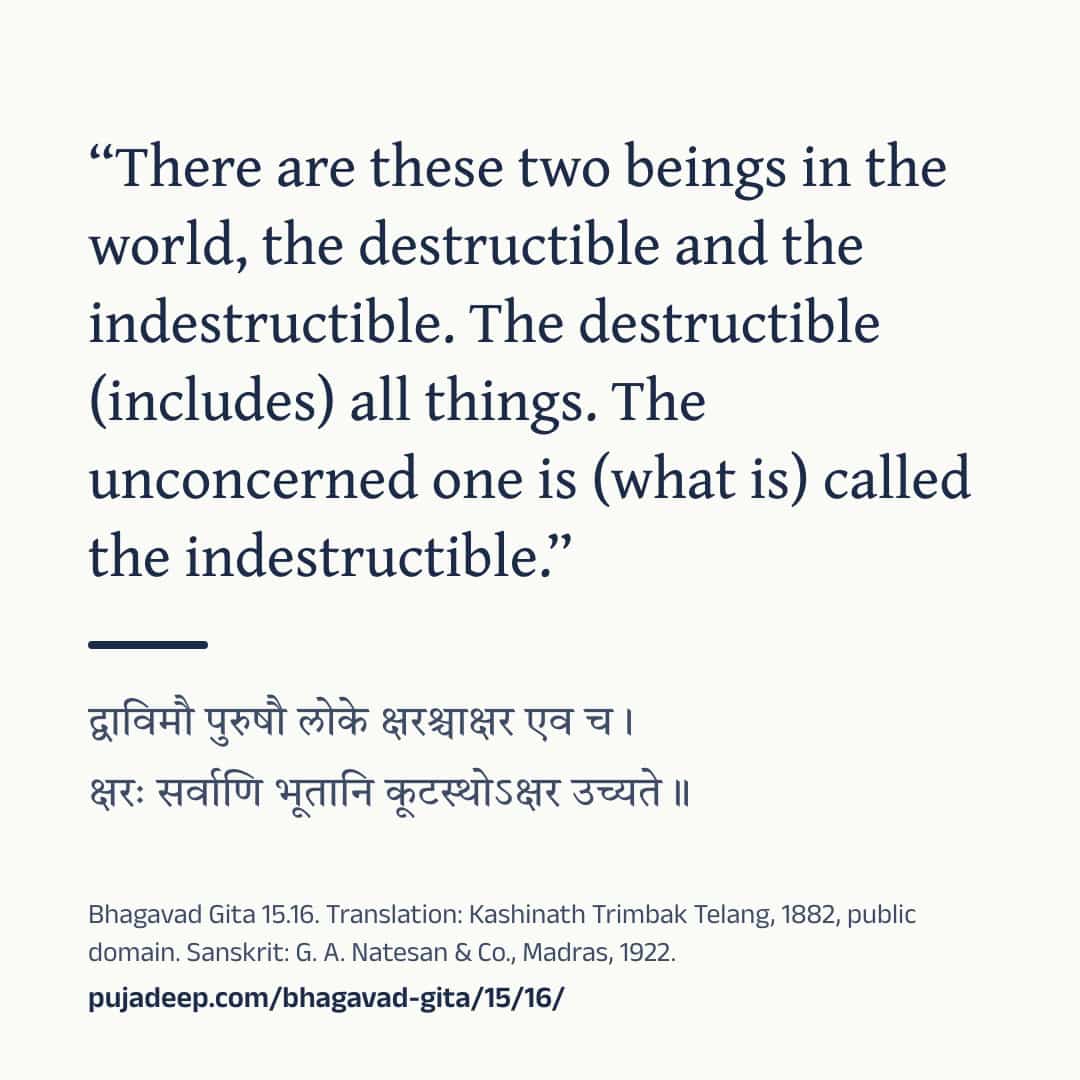
द्वाविमौ पुरुषौ लोके क्षरश्चाक्षर एव च ।
क्षरः सर्वाणि भूतानि कूटस्थोऽक्षर उच्यते ॥

“There are these two beings in the world, the destructible and the indestructible. The destructible (includes) all things. The unconcerned one is (what is) called the indestructible.”
(K. T. Telang, The Bhagavadgîtâ (The Sacred Books of the East, vol. VIII, Oxford: Clarendon Press, 1882), p. 113, public domain)

“There are two Purushas in this world, one destructible and one indestructible; the destructible (is) all beings, the indestructible (is) called the Unchanging.”
(Annie Besant, The Bhagavad Gîtâ, or The Lord's Song (London: Theosophical Publishing Society, 1895), p. 138, public domain)

“There are two Purushas in the world,—the Perishable and the Imperishable. All beings are the Perishable, and the Kutastha is called Imperishable.”
(Swami Swarupananda, Srimad-Bhagavad-Gita (Mayavati: Prabuddha Bharata Press, 1909; first printed in Prabuddha Bharata, 1907–1909), pp. 291–292, public domain)

Sanskrit: G. A. Natesan & Co., Madras, 1922.
https://pujadeep.com/bhagavad-gita/15/16/ Nothing is sent from this site. Your own app sends it, to the chat you choose. The picture quotes the translation you chose on this page, with its name and year.
Sanskrit text: The Bhagavad-Gita, or The Lord's Song, with the text in Devanagari and an English translation, 1922. Meanings: written for Pujadeep and checked against the cited edition. Source and changes
Questions families ask
Who speaks Bhagavad Gita 15.16?
Krishna speaks this verse, in chapter 15 (Purushottama Yoga).
Where does the Sanskrit text come from?
Sanskrit text: The Bhagavad-Gita, or The Lord's Song, with the text in Devanagari and an English translation, 1922. Meanings: written for Pujadeep and checked against the cited edition. See the source
Is the meaning on this page a translation?
Explanation written for this site from the sources listed here, and checked against the cited edition. It is not a translation and not the only way to read the text. Free to quote with credit.
Source and licence
- Sanskrit text
- The Bhagavad-Gita, or The Lord's Song, with the text in Devanagari and an English translation (Annie Besant, G. A. Natesan & Co., Madras, 1922). Public domain. The Sanskrit on these pages was read from this printing’s page images.
- Translation
- The Bhagavadgîtâ with the Sanatsugâtîya and the Anugîtâ, translated by Kâshinâth Trimbak Telang (The Sacred Books of the East, vol. VIII, ed. F. Max Müller) (Kashinath Trimbak Telang, F. Max Müller, Clarendon Press, Oxford, 1882). Public domain. Shown verbatim, as printed.
- Translation
- The Bhagavad Gîtâ, or The Lord's Song, translated by Annie Besant (Annie Besant, Theosophical Publishing Society, London, 1895). Public domain. Shown verbatim, as printed.
- Translation
- Srimad-Bhagavad-Gita, with Sanskrit Text; Paraphrase with Word-by-word Literal Translation; English Rendering and Comments, Index, &c., by the Swami Swarupananda (Himalayan Series, No. XX) (Swami Swarupananda, The Editors and Publishers, Advaita Ashrama, Mayavati, Prabuddha Bharata Press, Mayavati, Almora, Himalayas, 1909). Public domain. Shown verbatim, as printed.
- Commentary
- The Bhagavad-Gita, with the commentary of Sri Sankaracharya, translated by A. Mahadeva Sastri (2nd ed., Mysore: G. T. A. Printing Works, 1901) (Public-domain scan, University of California Libraries). Summarised in our own words; none of its text is reproduced.
- Commentary
- Sri Bhagavad-Gita with Sri Ramanujacharya's Visishtadvaita commentary, translated by A. Govindacharya (Madras, 1898) (Scan uploaded to archive.org (folkscanomy collection)). Summarised in our own words; none of its text is reproduced.
- Commentary
- The Bhagavad-Gita: translation and commentaries in English according to Sri Madhwacharya's Bhashyas, by S. Subba Rau (Madras, 1906) (Scan uploaded to archive.org (folkscanomy collection)). Summarised in our own words; none of its text is reproduced.
- Common wording
- In this text, 32 words follow today's common wording, checked against sanskritdocuments.org; Sanskrit Wikisource; Gita Press, Gorakhpur; GRETIL, Göttingen and Bhaktivedanta Book Trust.
- Our explanation
- Explanation written for this site from the sources listed here, and checked against the cited edition. It is not a translation and not the only way to read the text. Free to quote with credit.
- Checked
- Checked against the cited edition, October 15, 2026.
- Updated
- October 25, 2026