Bhagavad Gita 15.17: meaning and translation
Chapter 15: Purushottama Yoga. Krishna says
But the highest person (uttama puruṣa) is another, Krishna says, called the Supreme Self (paramātman): the imperishable Lord who enters the three worlds and upholds them.
Click or tap a word for its meaning and its dictionary page.
Text and layers
Text and layers
These choices stay in this browser.
Bhagavad Gita 15.17
उत्तमः पुरुषस्त्वन्यः परमात्मेत्युदाहृतः ।यो लोकत्रयमाविश्य बिभर्त्यव्यय ईश्वरः ॥
Uttamah purushastvanyah paramatmetyudahritahYo lokatrayamavishya bibhartyavyaya ishvarah
uttamaḥ puruṣastvanyaḥ paramātmetyudāhṛtaḥ |yo lokatrayamāviśya bibhartyavyaya īśvaraḥ ||
Our explanation But the highest person (uttama puruṣa) is another, Krishna says, called the Supreme Self (paramātman): the imperishable Lord who enters the three worlds and upholds them.
हिंदी अर्थ कृष्ण कहते हैं कि उत्तम पुरुष तो इनसे भिन्न है, जिसे परमात्मा कहा जाता है: वह अविनाशी ईश्वर जो तीनों लोकों में प्रवेश करके उन्हें धारण करता है।
Word by word
Every word, with its dictionary page
Word by word
- उत्तमः uttamaḥ · highest (nominative singular) Dictionary: ut-tama, Monier-Williams 1899, p. 177, col. 3 “uppermost, highest, chief; most elevated, principal; best, excellent”
- पुरुषः puruṣaḥ · Person, Purusha (nominative singular) Dictionary: puruṣa, Monier-Williams 1899, p. 637, col. 1 “the Supreme Being or Soul of the universe”
- तु tu · but (indeclinable) Dictionary: 2. tu, Monier-Williams 1899, p. 449, col. 3 “but; and; or”
- अन्यः anyaḥ · other (nominative singular) Dictionary: 2. anya, Monier-Williams 1899, p. 45, col. 2 “other, different”
- परमात्मा paramātmā · the Supreme Self (nominative singular) Dictionary: paramātman, Monier-Williams 1899, p. 588, col. 2 “the Supreme Spirit”
- इति iti · thus (as a name) (indeclinable) Dictionary: 2. iti, Monier-Williams 1899, p. 165, col. 1 “in this manner, thus”
- उदाहृतः udāhṛtaḥ · is named, is called (past participle, nominative singular) Dictionary: ud-āhṛta, Monier-Williams 1899, p. 185, col. 3 “said, declared, illustrated; called, named, entitled”
- यः yaḥ · who (relative pronoun, nominative singular) Dictionary: yad, Monier-Williams 1899, p. 844, col. 2 “who, which, what, whichever, whatever, that”
- लोकत्रयम् lokatrayam · the three worlds (compound, accusative singular) Dictionary: loka-traya, Monier-Williams 1899, p. 906, col. 2 “‘world-triad,’ the three w°s (heaven, earth and atmosphere, or h°, earth and lower regions)”
- आविश्य āviśya · having entered (absolutive ('having done')) Dictionary: ā-viś, Monier-Williams 1899, p. 155, col. 3 “to go or drive in or towards; to approach, enter”
- बिभर्ति bibharti · bears, sustains (present, 3rd person singular) Dictionary: 1. bhṛ, Monier-Williams 1899, p. 764, col. 3 “to support, maintain, cherish, foster”
- अव्ययः avyayaḥ · imperishable (nominative singular) Dictionary: 2. a-vyaya, Monier-Williams 1899, p. 111, col. 3 “not liable to change, imperishable, undecaying”
- ईश्वरः īśvaraḥ · the Lord (nominative singular) Dictionary: īśvara, Monier-Williams 1899, p. 171, col. 1 “God; the Supreme Being”
Old translations
Kashinath Trimbak Telang, 1882. Public domain. Page 113.
But the being supreme is yet another, called the highest self, who as the inexhaustible lord, pervading the three worlds, supports (them).
Compare 3 translations
Kashinath Trimbak Telang, 1882. Public domain. Page 113.
But the being supreme is yet another, called the highest self, who as the inexhaustible lord, pervading the three worlds, supports (them).
You are reading this one
Annie Besant, 1895. Public domain. Page 138.
The highest Purusha is verily Another, declared as the Supreme SELF. He who pervadeth and sustaineth the three worlds, the indestructible Îshvara.
You are reading this one
Swami Swarupananda, 1909 (first printed 1907). Public domain. Page 292.
But (there is) another, the Supreme Purusha, called the Highest Self,—He who, the Immutable Lord, pervading the three Worlds, sustains them.
You are reading this one
Cite this verse
The translation: K. T. Telang, The Bhagavadgîtâ (The Sacred Books of the East, vol. VIII, Oxford: Clarendon Press, 1882), p. 113. Bhagavad Gita 15.17.
The translation: Annie Besant, The Bhagavad Gîtâ, or The Lord's Song (London: Theosophical Publishing Society, 1895), p. 138. Bhagavad Gita 15.17.
The translation: Swami Swarupananda, Srimad-Bhagavad-Gita (Mayavati: Prabuddha Bharata Press, 1909; first printed in Prabuddha Bharata, 1907–1909), p. 292. Bhagavad Gita 15.17.
Our explanation: “Bhagavad Gita 15.17: meaning and translation.” Pujadeep. Updated October 25, 2026. https://pujadeep.com/bhagavad-gita/15/17/
Pujadeep’s explanations are free to quote with credit: name Pujadeep and link to the page. How to credit
Classical readings, by school
Each reading is named by its school. None is presented as the only meaning.
What Advaita, Vishishtadvaita and Dvaita teach, in short
Shankara Advaita
Shankara says the highest Person is distinct from both and untouched by these two limiting adjuncts; he is eternal, pure, conscious and free by nature. He is called the Supreme Self because he is higher than the 'selves' that ignorance sets up, such as the body, and is the inner consciousness of all beings. He is Nārāyaṇa, who pervades the three worlds by his power and upholds them by his mere presence.
Source: The Bhagavad-Gita, with the commentary of Sri Sankaracharya, translated by A. Mahadeva Sastri (2nd ed., Mysore: G. T. A. Printing Works, 1901), commentary on 15.17, pp. 368–369. Summarised in our own words; none of its text is reproduced.
Ramanuja Vishishtadvaita
Ramanuja says the Supreme Self is a third reality, distinct from both bound and freed souls. The 'three worlds' are inert matter, souls bound to matter, and freed souls; he pervades and upholds all three, and as their infinite ruler he is other than what he rules.
Source: Sri Bhagavad-Gita with Sri Ramanujacharya's Visishtadvaita commentary, translated by A. Govindacharya (Madras, 1898), commentary on 15.17, pp. 477–478. Summarised in our own words; none of its text is reproduced.
Madhva Dvaita
Madhva says the previous verse names the two persons only to set the Supreme apart from them; he stands high above both and is other than both. He is not the perishable self or the imperishable self but the Supreme Self (Paramātman), and that is why he is called Purushottama. He is imperishable because he does not decay with the world he pervades, and he is the Lord because his powers are beyond understanding.
Source: The Bhagavad-Gita: translation and commentaries in English according to Sri Madhwacharya's Bhashyas, by S. Subba Rau (Madras, 1906), commentary on 15.17, pp. 278–279 (leaves n276–n277). Summarised in our own words; none of its text is reproduced.
Share
Show the ways to share
Send one picture or the text to one chat. The picture names its source and the address of this page.
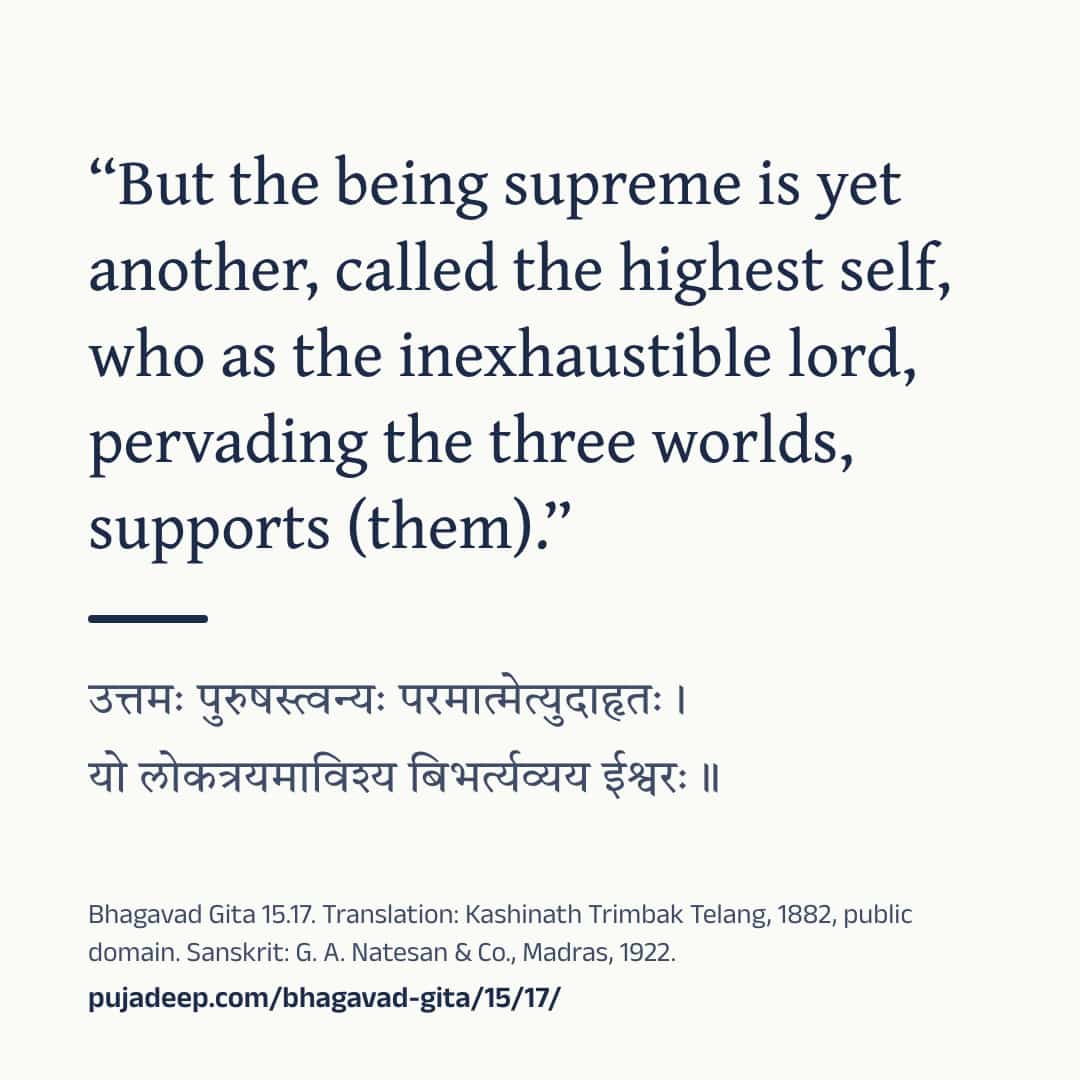
Drawing the picture
See the words
Bhagavad Gita 15.17

उत्तमः पुरुषस्त्वन्यः परमात्मेत्युदाहृतः ।
यो लोकत्रयमाविश्य बिभर्त्यव्यय ईश्वरः ॥

“But the being supreme is yet another, called the highest self, who as the inexhaustible lord, pervading the three worlds, supports (them).”
(K. T. Telang, The Bhagavadgîtâ (The Sacred Books of the East, vol. VIII, Oxford: Clarendon Press, 1882), p. 113, public domain)

“The highest Purusha is verily Another, declared as the Supreme SELF. He who pervadeth and sustaineth the three worlds, the indestructible Îshvara.”
(Annie Besant, The Bhagavad Gîtâ, or The Lord's Song (London: Theosophical Publishing Society, 1895), p. 138, public domain)

“But (there is) another, the Supreme Purusha, called the Highest Self,—He who, the Immutable Lord, pervading the three Worlds, sustains them.”
(Swami Swarupananda, Srimad-Bhagavad-Gita (Mayavati: Prabuddha Bharata Press, 1909; first printed in Prabuddha Bharata, 1907–1909), p. 292, public domain)

Sanskrit: G. A. Natesan & Co., Madras, 1922.
https://pujadeep.com/bhagavad-gita/15/17/ Nothing is sent from this site. Your own app sends it, to the chat you choose. The picture quotes the translation you chose on this page, with its name and year.
Sanskrit text: The Bhagavad-Gita, or The Lord's Song, with the text in Devanagari and an English translation, 1922. Meanings: written for Pujadeep and checked against the cited edition. Source and changes
Questions families ask
Who speaks Bhagavad Gita 15.17?
Krishna speaks this verse, in chapter 15 (Purushottama Yoga).
Where does the Sanskrit text come from?
Sanskrit text: The Bhagavad-Gita, or The Lord's Song, with the text in Devanagari and an English translation, 1922. Meanings: written for Pujadeep and checked against the cited edition. See the source
Is the meaning on this page a translation?
Explanation written for this site from the sources listed here, and checked against the cited edition. It is not a translation and not the only way to read the text. Free to quote with credit.
Source and licence
- Sanskrit text
- The Bhagavad-Gita, or The Lord's Song, with the text in Devanagari and an English translation (Annie Besant, G. A. Natesan & Co., Madras, 1922). Public domain. The Sanskrit on these pages was read from this printing’s page images.
- Translation
- The Bhagavadgîtâ with the Sanatsugâtîya and the Anugîtâ, translated by Kâshinâth Trimbak Telang (The Sacred Books of the East, vol. VIII, ed. F. Max Müller) (Kashinath Trimbak Telang, F. Max Müller, Clarendon Press, Oxford, 1882). Public domain. Shown verbatim, as printed.
- Translation
- The Bhagavad Gîtâ, or The Lord's Song, translated by Annie Besant (Annie Besant, Theosophical Publishing Society, London, 1895). Public domain. Shown verbatim, as printed.
- Translation
- Srimad-Bhagavad-Gita, with Sanskrit Text; Paraphrase with Word-by-word Literal Translation; English Rendering and Comments, Index, &c., by the Swami Swarupananda (Himalayan Series, No. XX) (Swami Swarupananda, The Editors and Publishers, Advaita Ashrama, Mayavati, Prabuddha Bharata Press, Mayavati, Almora, Himalayas, 1909). Public domain. Shown verbatim, as printed.
- Commentary
- The Bhagavad-Gita, with the commentary of Sri Sankaracharya, translated by A. Mahadeva Sastri (2nd ed., Mysore: G. T. A. Printing Works, 1901) (Public-domain scan, University of California Libraries). Summarised in our own words; none of its text is reproduced.
- Commentary
- Sri Bhagavad-Gita with Sri Ramanujacharya's Visishtadvaita commentary, translated by A. Govindacharya (Madras, 1898) (Scan uploaded to archive.org (folkscanomy collection)). Summarised in our own words; none of its text is reproduced.
- Commentary
- The Bhagavad-Gita: translation and commentaries in English according to Sri Madhwacharya's Bhashyas, by S. Subba Rau (Madras, 1906) (Scan uploaded to archive.org (folkscanomy collection)). Summarised in our own words; none of its text is reproduced.
- Common wording
- In this text, 32 words follow today's common wording, checked against sanskritdocuments.org; Sanskrit Wikisource; Gita Press, Gorakhpur; GRETIL, Göttingen and Bhaktivedanta Book Trust.
- Our explanation
- Explanation written for this site from the sources listed here, and checked against the cited edition. It is not a translation and not the only way to read the text. Free to quote with credit.
- Checked
- Checked against the cited edition, October 15, 2026.
- Updated
- October 25, 2026