Bhagavad Gita 15.11: meaning and translation
Chapter 15: Purushottama Yoga. Krishna says
Yogis who strive see it, Krishna says, present within themselves.
Click or tap a word for its meaning and its dictionary page.
Text and layers
Text and layers
These choices stay in this browser.
Bhagavad Gita 15.11
यतन्तो योगिनश्चैनं पश्यन्त्यात्मन्यवस्थितम् ।यतन्तोऽप्यकृतात्मानो नैनं पश्यन्त्यचेतसः ॥
Yatanto yoginashchainam pashyantyatmanyavasthitamYatantopyakritatmano nainam pashyantyachetasah
yatanto yoginaścainaṃ paśyantyātmanyavasthitam |yatanto’pyakṛtātmāno nainaṃ paśyantyacetasaḥ ||
Our explanation Yogis who strive see it, Krishna says, present within themselves. But those who are not inwardly prepared and lack understanding do not see it, even when they strive. Telang's note says Ramanuja and Shridhara read 'within themselves' (ātmani) as 'in their bodies', and Shankara as 'in their understanding'.
हिंदी अर्थ कृष्ण कहते हैं कि प्रयत्न करने वाले योगी इसे अपने भीतर स्थित देखते हैं। पर जिनका अंतःकरण तैयार नहीं हुआ और जिनमें विवेक नहीं, वे प्रयत्न करके भी इसे नहीं देखते। तेलंग की टिप्पणी बताती है कि रामानुजाचार्य और श्रीधर “अपने भीतर” (आत्मनि) का अर्थ “अपने शरीर में” लेते हैं, और शंकराचार्य “अपनी बुद्धि में”।
Word by word
Every word, with its dictionary page
Word by word
- यतन्तः yatantaḥ · striving (present participle, nominative plural) Dictionary: 2. yat, Monier-Williams 1899, p. 840, col. 3 “to exert one's self, take pains, endeavour, make effort, persevere”
- योगिनः yoginaḥ · yogis (nominative plural) Dictionary: yogin, Monier-Williams 1899, p. 857, col. 3 “a follower of the Yoga system, a Yogin (usually called Yogī) or contemplative saint”
- च ca · and (indeclinable) Dictionary: 2. ca, Monier-Williams 1899, p. 380, col. 1 “and, both, also, moreover, as well as”
- एनम् enam · this (Self) (pronoun, accusative singular) Dictionary: 1. ena, Monier-Williams 1899, p. 232, col. 1 “he, she, it; this, that”
- पश्यन्ति paśyanti · see (present, 3rd person plural) Dictionary: 1. paś, Monier-Williams 1899, p. 611, col. 2 “to see, behold, look at, observe, perceive, notice”
- आत्मनि ātmani · in the self, within (locative singular) Dictionary: ātman, Monier-Williams 1899, p. 135, col. 1 “the soul, principle of life and sensation; the individual soul, self”
- अवस्थितम् avasthitam · dwelling, present (past participle, accusative singular) Dictionary: ava-sthita, Monier-Williams 1899, p. 106, col. 1 “placed, having its place or abode”
- यतन्तः yatantaḥ · striving (present participle, nominative plural) Dictionary: 2. yat, Monier-Williams 1899, p. 840, col. 3 “to exert one's self, take pains, endeavour, make effort, persevere”
- अपि api · even (indeclinable) Dictionary: api, Monier-Williams 1899, p. 55, col. 1 “and, also, moreover, besides”
- अकृतात्मानः akṛtātmānaḥ · those whose minds are not made ready (compound, nominative plural) Dictionary: a-kṛtātman, Monier-Williams 1899, p. 2, col. 3 “having an unformed mind”
- न na · not (indeclinable) Dictionary: 2. na, Monier-Williams 1899, p. 523, col. 1 “not, no, nor, neither”
- एनम् enam · this (Self) (pronoun, accusative singular) Dictionary: 1. ena, Monier-Williams 1899, p. 232, col. 1 “he, she, it; this, that”
- पश्यन्ति paśyanti · see (present, 3rd person plural) Dictionary: 1. paś, Monier-Williams 1899, p. 611, col. 2 “to see, behold, look at, observe, perceive, notice”
- अचेतसः acetasaḥ · without understanding (nominative plural) Dictionary: a-cetas, Monier-Williams 1899, p. 9, col. 1 “unconscious, insensible”
Old translations
Kashinath Trimbak Telang, 1882. Public domain. Page 112.
Devotees making efforts perceive him abiding within their selfs1. But those whose selfs have not been refined, and who have no discernment, do not perceive him even (after) making efforts.
Footnotes (the translator’s own) - 'Selfs'=bodies, Râmânuga and Srîdhara; 'understandings,' Saṅkara. In the next sentence 'self' means mind. ↩
Compare 3 translations
Kashinath Trimbak Telang, 1882. Public domain. Page 112.
Devotees making efforts perceive him abiding within their selfs1. But those whose selfs have not been refined, and who have no discernment, do not perceive him even (after) making efforts.
Footnotes (the translator’s own) - 'Selfs'=bodies, Râmânuga and Srîdhara; 'understandings,' Saṅkara. In the next sentence 'self' means mind. ↩
You are reading this one
Annie Besant, 1895. Public domain. Page 137.
Subdued Yogîs perceive this, established in the SELF; but though subdued the unintelligent perceive it not, their Manas untrained.
You are reading this one
Swami Swarupananda, 1909 (first printed 1907). Public domain. Page 330.
The Yogis striving (for perfection) behold Him dwelling in themselves; but the unrefined and unintelligent, even though striving, see Him not.
You are reading this one
Cite this verse
The translation: K. T. Telang, The Bhagavadgîtâ (The Sacred Books of the East, vol. VIII, Oxford: Clarendon Press, 1882), p. 112. Bhagavad Gita 15.11.
The translation: Annie Besant, The Bhagavad Gîtâ, or The Lord's Song (London: Theosophical Publishing Society, 1895), p. 137. Bhagavad Gita 15.11.
The translation: Swami Swarupananda, Srimad-Bhagavad-Gita (Mayavati: Prabuddha Bharata Press, 1909; first printed in Prabuddha Bharata, 1907–1909), p. 330. Bhagavad Gita 15.11.
Our explanation: “Bhagavad Gita 15.11: meaning and translation.” Pujadeep. Updated October 25, 2026. https://pujadeep.com/bhagavad-gita/15/11/
Pujadeep’s explanations are free to quote with credit: name Pujadeep and link to the page. How to credit
Classical readings, by school
No readings by school on this verse yet.
Share
Show the ways to share
Send one picture or the text to one chat. The picture names its source and the address of this page.
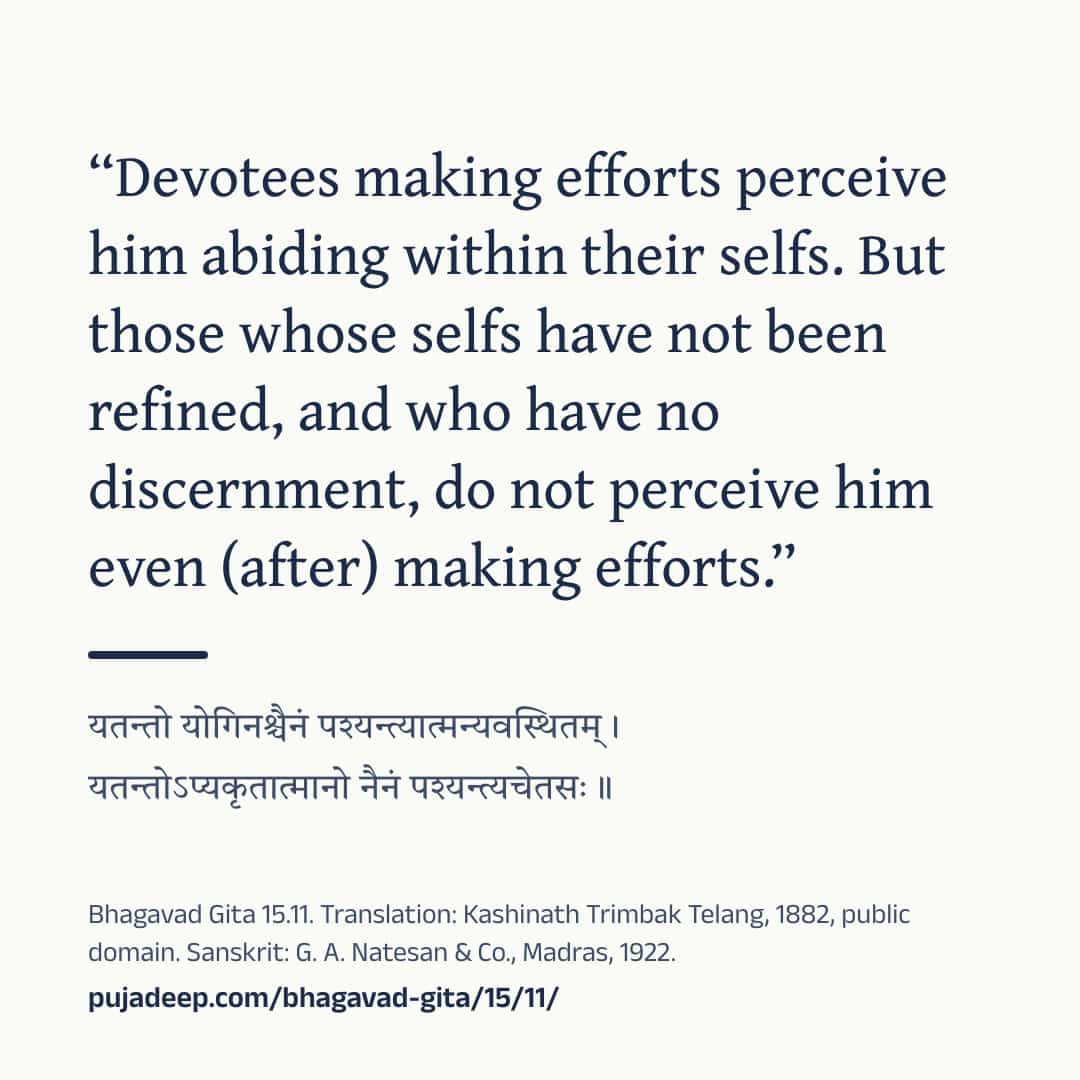
Drawing the picture
See the words
Bhagavad Gita 15.11

यतन्तो योगिनश्चैनं पश्यन्त्यात्मन्यवस्थितम् ।
यतन्तोऽप्यकृतात्मानो नैनं पश्यन्त्यचेतसः ॥

“Devotees making efforts perceive him abiding within their selfs. But those whose selfs have not been refined, and who have no discernment, do not perceive him even (after) making efforts.”
(K. T. Telang, The Bhagavadgîtâ (The Sacred Books of the East, vol. VIII, Oxford: Clarendon Press, 1882), p. 112, public domain)

“Subdued Yogîs perceive this, established in the SELF; but though subdued the unintelligent perceive it not, their Manas untrained.”
(Annie Besant, The Bhagavad Gîtâ, or The Lord's Song (London: Theosophical Publishing Society, 1895), p. 137, public domain)

“The Yogis striving (for perfection) behold Him dwelling in themselves; but the unrefined and unintelligent, even though striving, see Him not.”
(Swami Swarupananda, Srimad-Bhagavad-Gita (Mayavati: Prabuddha Bharata Press, 1909; first printed in Prabuddha Bharata, 1907–1909), p. 330, public domain)

Sanskrit: G. A. Natesan & Co., Madras, 1922.
https://pujadeep.com/bhagavad-gita/15/11/ Nothing is sent from this site. Your own app sends it, to the chat you choose. The picture quotes the translation you chose on this page, with its name and year.
Sanskrit text: The Bhagavad-Gita, or The Lord's Song, with the text in Devanagari and an English translation, 1922. Meanings: written for Pujadeep and checked against the cited edition. Source and changes
Questions families ask
Who speaks Bhagavad Gita 15.11?
Krishna speaks this verse, in chapter 15 (Purushottama Yoga).
Where does the Sanskrit text come from?
Sanskrit text: The Bhagavad-Gita, or The Lord's Song, with the text in Devanagari and an English translation, 1922. Meanings: written for Pujadeep and checked against the cited edition. See the source
Is the meaning on this page a translation?
Explanation written for this site from the sources listed here, and checked against the cited edition. It is not a translation and not the only way to read the text. Free to quote with credit.
Source and licence
- Sanskrit text
- The Bhagavad-Gita, or The Lord's Song, with the text in Devanagari and an English translation (Annie Besant, G. A. Natesan & Co., Madras, 1922). Public domain. The Sanskrit on these pages was read from this printing’s page images.
- Translation
- The Bhagavadgîtâ with the Sanatsugâtîya and the Anugîtâ, translated by Kâshinâth Trimbak Telang (The Sacred Books of the East, vol. VIII, ed. F. Max Müller) (Kashinath Trimbak Telang, F. Max Müller, Clarendon Press, Oxford, 1882). Public domain. Shown verbatim, as printed.
- Translation
- The Bhagavad Gîtâ, or The Lord's Song, translated by Annie Besant (Annie Besant, Theosophical Publishing Society, London, 1895). Public domain. Shown verbatim, as printed.
- Translation
- Srimad-Bhagavad-Gita, with Sanskrit Text; Paraphrase with Word-by-word Literal Translation; English Rendering and Comments, Index, &c., by the Swami Swarupananda (Himalayan Series, No. XX) (Swami Swarupananda, The Editors and Publishers, Advaita Ashrama, Mayavati, Prabuddha Bharata Press, Mayavati, Almora, Himalayas, 1909). Public domain. Shown verbatim, as printed.
- Common wording
- In this text, 32 words follow today's common wording, checked against sanskritdocuments.org; Sanskrit Wikisource; Gita Press, Gorakhpur; GRETIL, Göttingen and Bhaktivedanta Book Trust.
- Our explanation
- Explanation written for this site from the sources listed here, and checked against the cited edition. It is not a translation and not the only way to read the text. Free to quote with credit.
- Checked
- Checked against the cited edition, October 15, 2026.
- Updated
- October 25, 2026