Bhagavad Gita 15.3: meaning and translation
Chapter 15: Purushottama Yoga. Krishna says
Its real form is not seen here, Krishna says, nor its end, nor its beginning, nor what it rests on.
Click or tap a word for its meaning and its dictionary page.
Text and layers
Text and layers
These choices stay in this browser.
Bhagavad Gita 15.3
न रूपमस्येह तथोपलभ्यते नान्तो न चादिर्न च संप्रतिष्ठा ।अश्वत्थमेनं सुविरूढमूलमसङ्गशस्त्रेण दृढेन छित्त्वा ॥
Na rupamasyeha tathopalabhyate nanto na chadirna cha sampratishthaAshvatthamenam suvirudhamulamasangashastrena dridhena chhittva
na rūpamasyeha tathopalabhyate nānto na cādirna ca saṃpratiṣṭhā |aśvatthamenaṃ suvirūḍhamūlamasaṅgaśastreṇa dṛḍhena chittvā ||
Our explanation Its real form is not seen here, Krishna says, nor its end, nor its beginning, nor what it rests on. This firmly rooted tree is to be cut down with the strong weapon of non-attachment (asaṅga). The sentence goes on in the next verse.
हिंदी अर्थ कृष्ण कहते हैं कि यहाँ इसका असली रूप नहीं दिखता, न इसका अंत, न आरंभ, न इसका आधार। इस गहरी जड़ों वाले वृक्ष को असंग (अनासक्ति) के मज़बूत शस्त्र से काटना है। वाक्य अगले श्लोक में पूरा होता है।
Word by word
Every word, with its dictionary page
Word by word
- न na · not (indeclinable) Dictionary: 2. na, Monier-Williams 1899, p. 523, col. 1 “not, no, nor, neither”
- रूपम् rūpam · form (nominative singular) Dictionary: rūpa, Monier-Williams 1899, p. 885, col. 3 “any outward appearance or phenomenon or colour (often pl.), form, shape, figure”
- अस्य asya · its (pronoun, genitive singular) Dictionary: 1. idam, Monier-Williams 1899, p. 165, col. 2 “this, this here, referring to something near the speaker”
- इह iha · here, in this world (indeclinable) Dictionary: iha, Monier-Williams 1899, p. 169, col. 3 “in this place, here; to this place; in this world”
- तथा tathā · so, as such (indeclinable) Dictionary: tathā, Monier-Williams 1899, p. 433, col. 3 “in that manner, so, thus”
- उपलभ्यते upalabhyate · is perceived (passive, present, 3rd person singular) Dictionary: upa-labh, Monier-Williams 1899, p. 205, col. 3 “to perceive, behold, hear”
- न na · not (indeclinable) Dictionary: 2. na, Monier-Williams 1899, p. 523, col. 1 “not, no, nor, neither”
- अन्तः antaḥ · end (nominative singular) Dictionary: anta, Monier-Williams 1899, p. 42, col. 3 “end, limit, boundary, term”
- न na · not (indeclinable) Dictionary: 2. na, Monier-Williams 1899, p. 523, col. 1 “not, no, nor, neither”
- च ca · and (indeclinable) Dictionary: 2. ca, Monier-Williams 1899, p. 380, col. 1 “and, both, also, moreover, as well as”
- आदिः ādiḥ · beginning (nominative singular) Dictionary: 1. ādi, Monier-Williams 1899, p. 136, col. 3 “beginning, commencement”
- न na · not (indeclinable) Dictionary: 2. na, Monier-Williams 1899, p. 523, col. 1 “not, no, nor, neither”
- च ca · and (indeclinable) Dictionary: 2. ca, Monier-Williams 1899, p. 380, col. 1 “and, both, also, moreover, as well as”
- संप्रतिष्ठा saṃpratiṣṭhā · foundation, standing (nominative singular) Dictionary: sam-pratiṣṭhā, Monier-Williams 1899, p. 1174, col. 3 “permanence, continuance (as opp. to ‘beginning’ or ‘end’)”
- अश्वत्थम् aśvattham · the ashvattha tree (accusative singular) Dictionary: aśvattha, Monier-Williams 1899, p. 115, col. 3 “the holy fig tree, Ficus Religiosa”
- एनम् enam · this (pronoun, accusative singular) Dictionary: 1. ena, Monier-Williams 1899, p. 232, col. 1 “he, she, it; this, that”
- सुविरूढमूलम् suvirūḍhamūlam · firmly rooted (compound, accusative singular) Dictionary: su-virūḍha, Monier-Williams 1899, p. 1233, col. 3 “fully grown up or developed”; mūla, Monier-Williams 1899, p. 826, col. 2 “a root (of any plant or tree)”
- असङ्गशस्त्रेण asaṅgaśastreṇa · with the weapon of non-attachment (compound, instrumental singular) Dictionary: a-saṅga, Monier-Williams 1899, p. 118, col. 1 “having no attachment or inclination for or interest in”; 2. śastra, Monier-Williams 1899, p. 1060, col. 3 “an instrument for cutting or wounding, knife, sword, dagger, any weapon”
- दृढेन dṛḍhena · strong, firm (instrumental singular) Dictionary: dṛḍha, Monier-Williams 1899, p. 490, col. 2 “fixed, firm, hard, strong, solid, massive”
- छित्त्वा chittvā · having cut (absolutive ('having done')) Dictionary: 1. chid, Monier-Williams 1899, p. 406, col. 2 “to cut off, amputate, cut through, hew, chop, split, pierce”
2 printings differ
Edition differences. Another printing or text reads this place differently.
- Spelling A digital text reads Same word. The e-text writes the class nasal (सम्प्रतिष्ठा); the 1922 edition writes anusvara (संप्रतिष्ठा).
- Spelling A digital text reads Same words. The e-text ends the third quarter with anusvara (सुविरूढमूलं) and starts the fourth with असङ्ग, as another digital text does; the 1922 edition joins them in sandhi (सुविरूढमूलमसङ्ग…), broken across two printed lines with a hyphen.
Old translations
Kashinath Trimbak Telang, 1882. Public domain. Page 111.
Its form is not thus known here, nor (its) end, nor beginning, nor support. But having with the firm weapon of unconcern, cut this Asvattha, whose roots are firmly fixed,
This sentence goes on in 15.4.
Compare 3 translations
Kashinath Trimbak Telang, 1882. Public domain. Page 111.
Its form is not thus known here, nor (its) end, nor beginning, nor support. But having with the firm weapon of unconcern, cut this Asvattha, whose roots are firmly fixed,
This sentence goes on in 15.4.
You are reading this one
Annie Besant, 1895. Public domain. Page 135.
Nor here may be acquired knowledge of its form, nor its end, nor its origin, nor its nature; this strongly-rooted Asvattha having been cut down by the unswerving weapon of non-attachment,
This sentence goes on in 15.4.
You are reading this one
Swami Swarupananda, 1909 (first printed 1907). Public domain. Page 285.
Its form is not here perceived as such, neither its end, nor its origin, nor its existence. Having cut asunder this firm-rooted Ashvattha with the strong sword of non-attachment,—then that Goal is to be sought for, going whither they (the wise) do not return again. I seek refuge in that Primeval Purusha whence streamed forth the Eternal Activity.
This sentence covers verses 15.3 to 15.4.
You are reading this one
Cite this verse
The translation: K. T. Telang, The Bhagavadgîtâ (The Sacred Books of the East, vol. VIII, Oxford: Clarendon Press, 1882), p. 111. Bhagavad Gita 15.3.
The translation: Annie Besant, The Bhagavad Gîtâ, or The Lord's Song (London: Theosophical Publishing Society, 1895), p. 135. Bhagavad Gita 15.3.
The translation: Swami Swarupananda, Srimad-Bhagavad-Gita (Mayavati: Prabuddha Bharata Press, 1909; first printed in Prabuddha Bharata, 1907–1909), p. 285. Bhagavad Gita 15.3–4.
Our explanation: “Bhagavad Gita 15.3: meaning and translation.” Pujadeep. Updated October 25, 2026. https://pujadeep.com/bhagavad-gita/15/3/
Pujadeep’s explanations are free to quote with credit: name Pujadeep and link to the page. How to credit
Classical readings, by school
No readings by school on this verse yet.
Share
Show the ways to share
Send one picture or the text to one chat. The picture names its source and the address of this page.
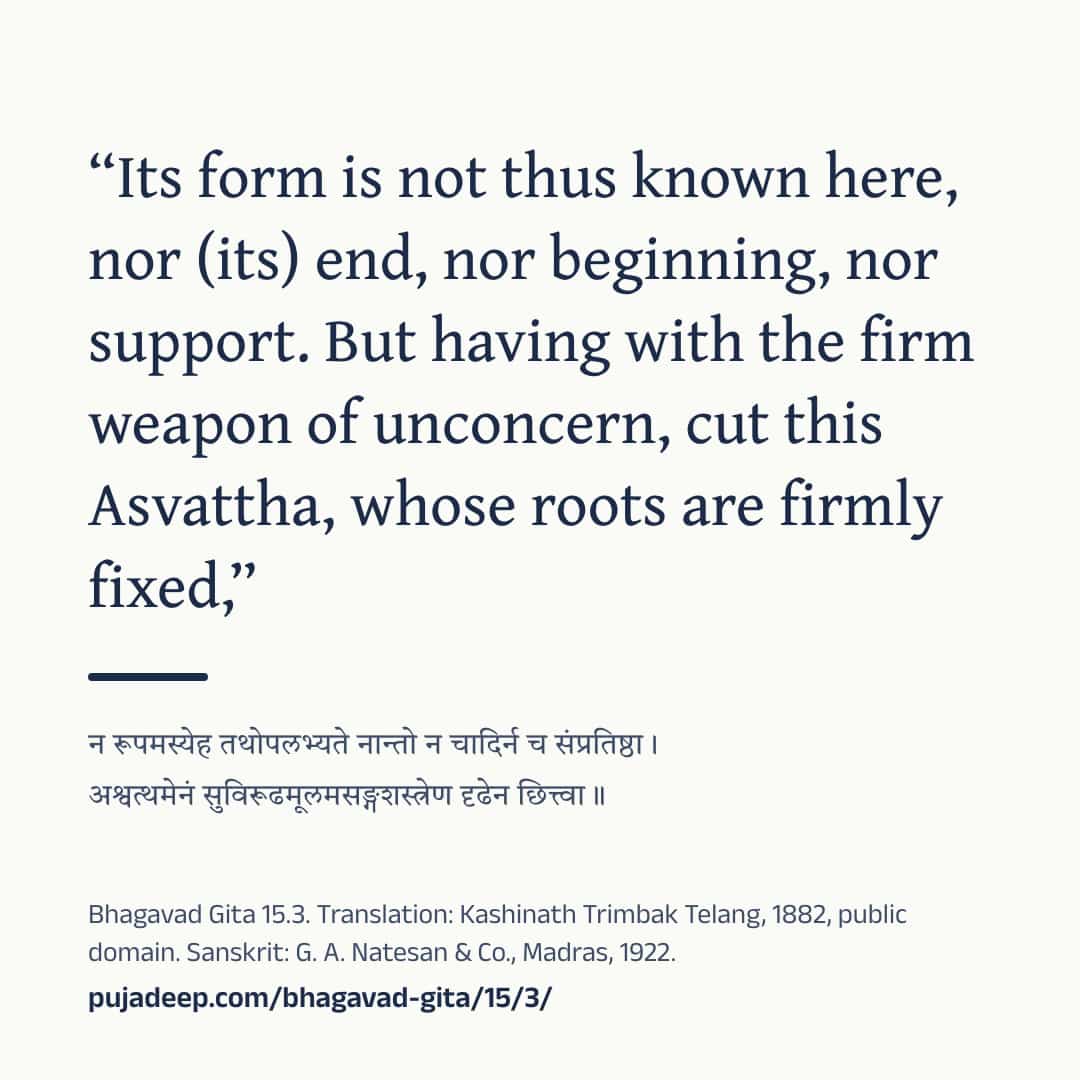
Drawing the picture
See the words
Bhagavad Gita 15.3

न रूपमस्येह तथोपलभ्यते नान्तो न चादिर्न च संप्रतिष्ठा ।
अश्वत्थमेनं सुविरूढमूलमसङ्गशस्त्रेण दृढेन छित्त्वा ॥

“Its form is not thus known here, nor (its) end, nor beginning, nor support. But having with the firm weapon of unconcern, cut this Asvattha, whose roots are firmly fixed,”
(K. T. Telang, The Bhagavadgîtâ (The Sacred Books of the East, vol. VIII, Oxford: Clarendon Press, 1882), p. 111, public domain)
This sentence goes on in 15.4.

“Nor here may be acquired knowledge of its form, nor its end, nor its origin, nor its nature; this strongly-rooted Asvattha having been cut down by the unswerving weapon of non-attachment,”
(Annie Besant, The Bhagavad Gîtâ, or The Lord's Song (London: Theosophical Publishing Society, 1895), p. 135, public domain)
This sentence goes on in 15.4.

“Its form is not here perceived as such, neither its end, nor its origin, nor its existence. Having cut asunder this firm-rooted Ashvattha with the strong sword of non-attachment,—then that Goal is to be sought for, going whither they (the wise) do not return again. I seek refuge in that Primeval Purusha whence streamed forth the Eternal Activity.”
(Swami Swarupananda, Srimad-Bhagavad-Gita (Mayavati: Prabuddha Bharata Press, 1909; first printed in Prabuddha Bharata, 1907–1909), p. 285, public domain)
This sentence covers verses 15.3 to 15.4.

Sanskrit: G. A. Natesan & Co., Madras, 1922.
https://pujadeep.com/bhagavad-gita/15/3/ Nothing is sent from this site. Your own app sends it, to the chat you choose. The picture quotes the translation you chose on this page, with its name and year.
Sanskrit text: The Bhagavad-Gita, or The Lord's Song, with the text in Devanagari and an English translation, 1922. Meanings: written for Pujadeep and checked against the cited edition. Source and changes
Questions families ask
Who speaks Bhagavad Gita 15.3?
Krishna speaks this verse, in chapter 15 (Purushottama Yoga).
Where does the Sanskrit text come from?
Sanskrit text: The Bhagavad-Gita, or The Lord's Song, with the text in Devanagari and an English translation, 1922. Meanings: written for Pujadeep and checked against the cited edition. See the source
Is the meaning on this page a translation?
Explanation written for this site from the sources listed here, and checked against the cited edition. It is not a translation and not the only way to read the text. Free to quote with credit.
Source and licence
- Sanskrit text
- The Bhagavad-Gita, or The Lord's Song, with the text in Devanagari and an English translation (Annie Besant, G. A. Natesan & Co., Madras, 1922). Public domain. The Sanskrit on these pages was read from this printing’s page images.
- Translation
- The Bhagavadgîtâ with the Sanatsugâtîya and the Anugîtâ, translated by Kâshinâth Trimbak Telang (The Sacred Books of the East, vol. VIII, ed. F. Max Müller) (Kashinath Trimbak Telang, F. Max Müller, Clarendon Press, Oxford, 1882). Public domain. Shown verbatim, as printed.
- Translation
- The Bhagavad Gîtâ, or The Lord's Song, translated by Annie Besant (Annie Besant, Theosophical Publishing Society, London, 1895). Public domain. Shown verbatim, as printed.
- Translation
- Srimad-Bhagavad-Gita, with Sanskrit Text; Paraphrase with Word-by-word Literal Translation; English Rendering and Comments, Index, &c., by the Swami Swarupananda (Himalayan Series, No. XX) (Swami Swarupananda, The Editors and Publishers, Advaita Ashrama, Mayavati, Prabuddha Bharata Press, Mayavati, Almora, Himalayas, 1909). Public domain. Shown verbatim, as printed.
- Common wording
- In this text, 32 words follow today's common wording, checked against sanskritdocuments.org; Sanskrit Wikisource; Gita Press, Gorakhpur; GRETIL, Göttingen and Bhaktivedanta Book Trust.
- Our explanation
- Explanation written for this site from the sources listed here, and checked against the cited edition. It is not a translation and not the only way to read the text. Free to quote with credit.
- Checked
- Checked against the cited edition, October 15, 2026.
- Updated
- October 25, 2026