Bhagavad Gita 15.5: meaning and translation
Chapter 15: Purushottama Yoga. Krishna says
Those who are free from pride and delusion, Krishna says, who have overcome the fault of attachment, who stay always with the inner self (adhyātma), whose desires have fallen away, and who are free from the pairs called pleasure and pain, go undeluded to that imperishable place.
Click or tap a word for its meaning and its dictionary page.
Text and layers
Text and layers
These choices stay in this browser.
Bhagavad Gita 15.5
निर्मानमोहा जितसङ्गदोषाः अध्यात्मनित्या विनिवृत्तकामाः ।द्वन्द्वैर्विमुक्ताः सुखदुःखसंज्ञैर्गच्छन्त्यमूढाः पदमव्ययं तत् ॥
Nirmanamoha jitasangadoshah adhyatmanitya vinivrittakamahDvandvairvimuktah sukhaduhkhasanjnairgachchhantyamudhah padamavyayam tat
nirmānamohā jitasaṅgadoṣāḥ adhyātmanityā vinivṛttakāmāḥ |dvandvairvimuktāḥ sukhaduḥkhasaṃjñairgacchantyamūḍhāḥ padamavyayaṃ tat ||
Our explanation Those who are free from pride and delusion, Krishna says, who have overcome the fault of attachment, who stay always with the inner self (adhyātma), whose desires have fallen away, and who are free from the pairs called pleasure and pain, go undeluded to that imperishable place.
हिंदी अर्थ कृष्ण कहते हैं कि जो मान और मोह से मुक्त हैं, जिन्होंने आसक्ति के दोष को जीत लिया है, जो सदा अध्यात्म में लगे रहते हैं, जिनकी कामनाएँ छूट गई हैं, और जो सुख-दुःख नाम के द्वंद्वों से मुक्त हैं, वे मोह से रहित होकर उस अविनाशी पद को जाते हैं।
Word by word
Every word, with its dictionary page
Word by word
- निर्मानमोहाः nirmānamohāḥ · free from pride and delusion (compound, nominative plural) Dictionary: nir-māna, Monier-Williams 1899, p. 541, col. 3 “without self-confidence, free from pride”; moha, Monier-Williams 1899, p. 836, col. 1 “loss of consciousness, bewilderment, perplexity, distraction, infatuation, delusion”
- जितसङ्गदोषाः jitasaṅgadoṣāḥ · who have overcome the fault of attachment (compound, nominative plural) Dictionary: jita, Monier-Williams 1899, p. 420, col. 3 “won, acquired, conquered, subdued”; saṅga, Monier-Williams 1899, p. 1132, col. 3 “(esp.) worldly or selfish attachment or affection, desire”; 2. doṣa, Monier-Williams 1899, p. 498, col. 2 “fault, vice, deficiency, want, inconvenience, disadvantage”
- अध्यात्मनित्याः adhyātmanityāḥ · ever dwelling on the Self (compound, nominative plural) Dictionary: adhy-ātma, Monier-Williams 1899, p. 23, col. 2 “the Supreme Spirit”; nitya, Monier-Williams 1899, p. 547, col. 2 “ifc. constantly dwelling or engaged in”
- विनिवृत्तकामाः vinivṛttakāmāḥ · with desires turned away (compound, nominative plural) Dictionary: vi-nivṛtta-kāma, Monier-Williams 1899, p. 971, col. 2 “one whose desires have ceased”
- द्वन्द्वैः dvandvaiḥ · from the pairs (of opposites) (instrumental plural) Dictionary: dvaṃdva, Monier-Williams 1899, p. 503, col. 2 “a pair of opposites (e.g. heat and cold, joy and sorrow &c.)”
- विमुक्ताः vimuktāḥ · freed (past participle, nominative plural) Dictionary: vi-mukta, Monier-Williams 1899, p. 980, col. 2 “set free, liberated (esp. from mundane existence), freed or delivered”
- सुखदुःखसंज्ञैः sukhaduḥkhasaṃjñaiḥ · known as pleasure and pain (compound, instrumental plural) Dictionary: sukha-duḥkha, Monier-Williams 1899, p. 1221, col. 1 “pleasure and pain, joy and sorrow”; 2. saṃ-jña, Monier-Williams 1899, p. 1133, col. 3 “ifc. for saṃ-jñā”
- गच्छन्ति gacchanti · go, reach (present, 3rd person plural) Dictionary: 1. gam, Monier-Williams 1899, p. 347, col. 1 “to go, move, go away, set out, come”
- अमूढाः amūḍhāḥ · the undeluded, the wise (nominative plural) Dictionary: a-mūḍha, Monier-Williams 1899, p. 82, col. 1 “not infatuated, not perplexed”
- पदम् padam · place, state (accusative singular) Dictionary: pada, Monier-Williams 1899, p. 583, col. 1 “a footing, standpoint; position, rank, station, site, abode, home”
- अव्ययम् avyayam · imperishable (accusative singular) Dictionary: 2. a-vyaya, Monier-Williams 1899, p. 111, col. 3 “not liable to change, imperishable, undecaying”
- तत् tat · that (pronoun, accusative singular) Dictionary: tad, Monier-Williams 1899, p. 434, col. 1 “m. he, f. she, n. it, that, this”
1 printing differs
Edition differences. Another printing or text reads this place differently.
- Spelling A digital text reads Same words. The 1922 edition prints the visarga at the end of the first quarter (जितसङ्गदोषाः, at the end of the printed line); the e-text, and another digital text, write जितसङ्गदोषा in sandhi with अध्यात्म….
Old translations
Kashinath Trimbak Telang, 1882. Public domain. Page 111–112.
Those who are free from pride and delusion, who have overcome the evils of attachment, who are constant in (contemplating) the relation of the supreme and individual self, from whom desire has departed, who are free from the pairs (of opposites) called pleasure and pain, go undeluded to that imperishable seat1.
Footnotes (the translator’s own) - Asvattha stands here for the course of worldly life. Its roots are above, viz. the supreme being; its boughs are Hiranyagarbha and others of the higher beings. The Vedas are its leaves, preserving it as leaves preserve trees (another interpretation is that they are the causes of the fruit which the tree bears, i. e. salvation, &c.) Upwards and downwards, from the highest to the lowest of created things. Enlarged=the qualities manifesting themselves, as body, senses, &c.; objects of sense are sprouts as they are attached to the senses, which are the tips of the branches above stated. The roots which extend downwards are the desires for various enjoyments. Its form not thus known here, i.e. to those who live and move in this world, thus viz. as above described. The man who knows the tree thus is said to know the Vedas, because knowledge of it is knowledge of the substance of the Vedas, which is, that the course of worldly life springs from the supreme, is kept up by Vedic rites, and destroyed by knowledge of the supreme. As to freedom from pride, cf. Sutta Nipâta, p. 4. ↩
Compare 3 translations
Kashinath Trimbak Telang, 1882. Public domain. Page 111–112.
Those who are free from pride and delusion, who have overcome the evils of attachment, who are constant in (contemplating) the relation of the supreme and individual self, from whom desire has departed, who are free from the pairs (of opposites) called pleasure and pain, go undeluded to that imperishable seat1.
Footnotes (the translator’s own) - Asvattha stands here for the course of worldly life. Its roots are above, viz. the supreme being; its boughs are Hiranyagarbha and others of the higher beings. The Vedas are its leaves, preserving it as leaves preserve trees (another interpretation is that they are the causes of the fruit which the tree bears, i. e. salvation, &c.) Upwards and downwards, from the highest to the lowest of created things. Enlarged=the qualities manifesting themselves, as body, senses, &c.; objects of sense are sprouts as they are attached to the senses, which are the tips of the branches above stated. The roots which extend downwards are the desires for various enjoyments. Its form not thus known here, i.e. to those who live and move in this world, thus viz. as above described. The man who knows the tree thus is said to know the Vedas, because knowledge of it is knowledge of the substance of the Vedas, which is, that the course of worldly life springs from the supreme, is kept up by Vedic rites, and destroyed by knowledge of the supreme. As to freedom from pride, cf. Sutta Nipâta, p. 4. ↩
You are reading this one
Annie Besant, 1895. Public domain. Page 136.
Without pride and delusion, victorious over the evil of attachment, dwelling constantly in Adhyâtmâ, desire having come to an end, liberated from the pairs of opposites known as pleasure and pain, they tread, undeluded, the indestructible Path.
You are reading this one
Swami Swarupananda, 1909 (first printed 1907). Public domain. Page 286.
Free from pride and delusion, with the evil of attachment conquered, ever dwelling in the Self, with desires completely receded, liberated from the pairs of opposites known as pleasure and pain, the undeluded reach that Goal Eternal.
You are reading this one
Cite this verse
The translation: K. T. Telang, The Bhagavadgîtâ (The Sacred Books of the East, vol. VIII, Oxford: Clarendon Press, 1882), pp. 111–112. Bhagavad Gita 15.5.
The translation: Annie Besant, The Bhagavad Gîtâ, or The Lord's Song (London: Theosophical Publishing Society, 1895), p. 136. Bhagavad Gita 15.5.
The translation: Swami Swarupananda, Srimad-Bhagavad-Gita (Mayavati: Prabuddha Bharata Press, 1909; first printed in Prabuddha Bharata, 1907–1909), p. 286. Bhagavad Gita 15.5.
Our explanation: “Bhagavad Gita 15.5: meaning and translation.” Pujadeep. Updated October 25, 2026. https://pujadeep.com/bhagavad-gita/15/5/
Pujadeep’s explanations are free to quote with credit: name Pujadeep and link to the page. How to credit
Classical readings, by school
No readings by school on this verse yet.
Share
Show the ways to share
Send one picture or the text to one chat. The picture names its source and the address of this page.
Drawing the picture
See the words
Bhagavad Gita 15.5

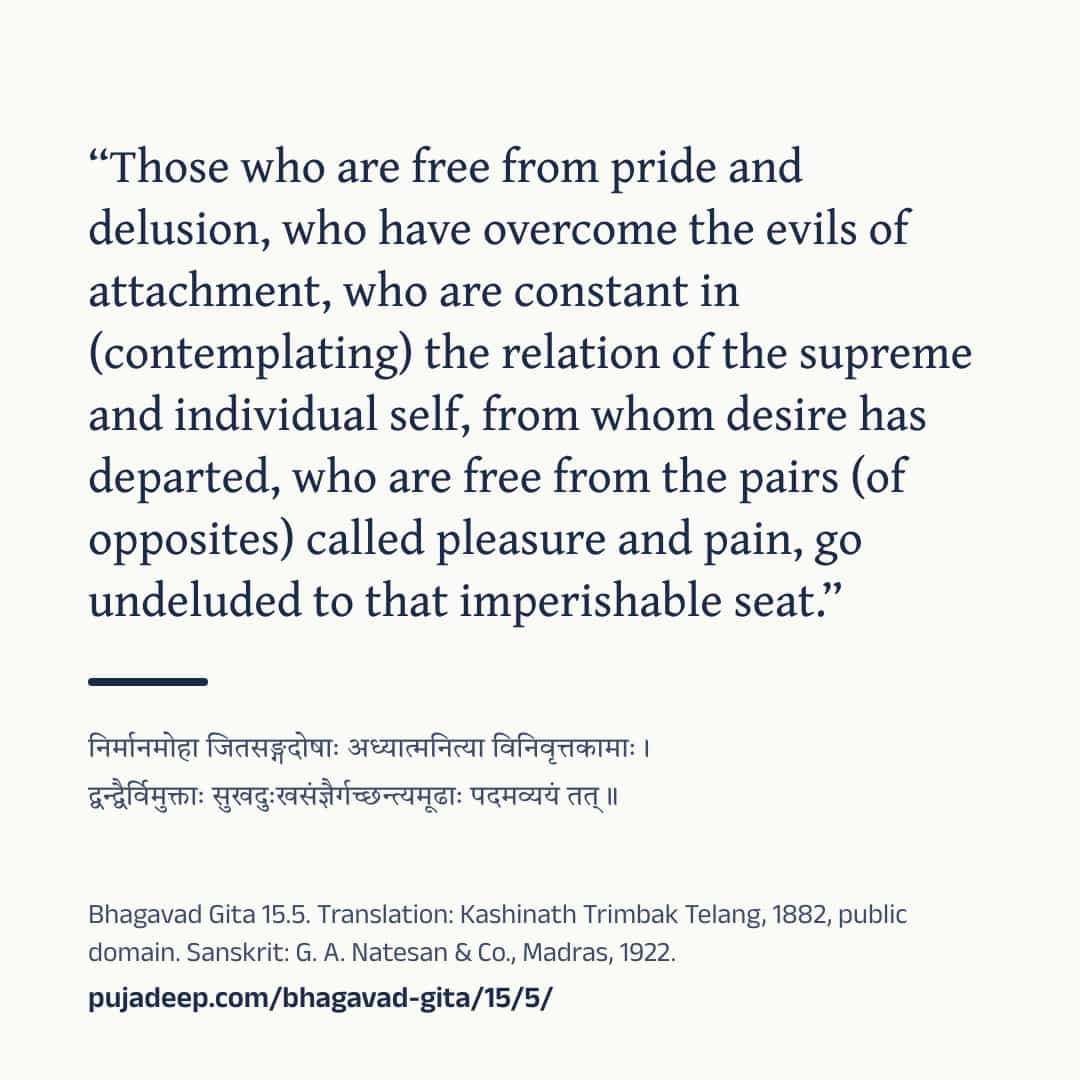
निर्मानमोहा जितसङ्गदोषाः अध्यात्मनित्या विनिवृत्तकामाः ।
द्वन्द्वैर्विमुक्ताः सुखदुःखसंज्ञैर्गच्छन्त्यमूढाः पदमव्ययं तत् ॥

“Those who are free from pride and delusion, who have overcome the evils of attachment, who are constant in (contemplating) the relation of the supreme and individual self, from whom desire has departed, who are free from the pairs (of opposites) called pleasure and pain, go undeluded to that imperishable seat.”
(K. T. Telang, The Bhagavadgîtâ (The Sacred Books of the East, vol. VIII, Oxford: Clarendon Press, 1882), pp. 111–112, public domain)

“Without pride and delusion, victorious over the evil of attachment, dwelling constantly in Adhyâtmâ, desire having come to an end, liberated from the pairs of opposites known as pleasure and pain, they tread, undeluded, the indestructible Path.”
(Annie Besant, The Bhagavad Gîtâ, or The Lord's Song (London: Theosophical Publishing Society, 1895), p. 136, public domain)

“Free from pride and delusion, with the evil of attachment conquered, ever dwelling in the Self, with desires completely receded, liberated from the pairs of opposites known as pleasure and pain, the undeluded reach that Goal Eternal.”
(Swami Swarupananda, Srimad-Bhagavad-Gita (Mayavati: Prabuddha Bharata Press, 1909; first printed in Prabuddha Bharata, 1907–1909), p. 286, public domain)

Sanskrit: G. A. Natesan & Co., Madras, 1922.
https://pujadeep.com/bhagavad-gita/15/5/ Nothing is sent from this site. Your own app sends it, to the chat you choose. The picture quotes the translation you chose on this page, with its name and year.
Sanskrit text: The Bhagavad-Gita, or The Lord's Song, with the text in Devanagari and an English translation, 1922. Meanings: written for Pujadeep and checked against the cited edition. Source and changes
Questions families ask
Who speaks Bhagavad Gita 15.5?
Krishna speaks this verse, in chapter 15 (Purushottama Yoga).
Where does the Sanskrit text come from?
Sanskrit text: The Bhagavad-Gita, or The Lord's Song, with the text in Devanagari and an English translation, 1922. Meanings: written for Pujadeep and checked against the cited edition. See the source
Is the meaning on this page a translation?
Explanation written for this site from the sources listed here, and checked against the cited edition. It is not a translation and not the only way to read the text. Free to quote with credit.
Source and licence
- Sanskrit text
- The Bhagavad-Gita, or The Lord's Song, with the text in Devanagari and an English translation (Annie Besant, G. A. Natesan & Co., Madras, 1922). Public domain. The Sanskrit on these pages was read from this printing’s page images.
- Translation
- The Bhagavadgîtâ with the Sanatsugâtîya and the Anugîtâ, translated by Kâshinâth Trimbak Telang (The Sacred Books of the East, vol. VIII, ed. F. Max Müller) (Kashinath Trimbak Telang, F. Max Müller, Clarendon Press, Oxford, 1882). Public domain. Shown verbatim, as printed.
- Translation
- The Bhagavad Gîtâ, or The Lord's Song, translated by Annie Besant (Annie Besant, Theosophical Publishing Society, London, 1895). Public domain. Shown verbatim, as printed.
- Translation
- Srimad-Bhagavad-Gita, with Sanskrit Text; Paraphrase with Word-by-word Literal Translation; English Rendering and Comments, Index, &c., by the Swami Swarupananda (Himalayan Series, No. XX) (Swami Swarupananda, The Editors and Publishers, Advaita Ashrama, Mayavati, Prabuddha Bharata Press, Mayavati, Almora, Himalayas, 1909). Public domain. Shown verbatim, as printed.
- Common wording
- In this text, 32 words follow today's common wording, checked against sanskritdocuments.org; Sanskrit Wikisource; Gita Press, Gorakhpur; GRETIL, Göttingen and Bhaktivedanta Book Trust.
- Our explanation
- Explanation written for this site from the sources listed here, and checked against the cited edition. It is not a translation and not the only way to read the text. Free to quote with credit.
- Checked
- Checked against the cited edition, October 15, 2026.
- Updated
- October 25, 2026