भगवद्गीता 15.5: अर्थ और अनुवाद
अध्याय 15: पुरुषोत्तमयोग। कृष्ण कहते हैं
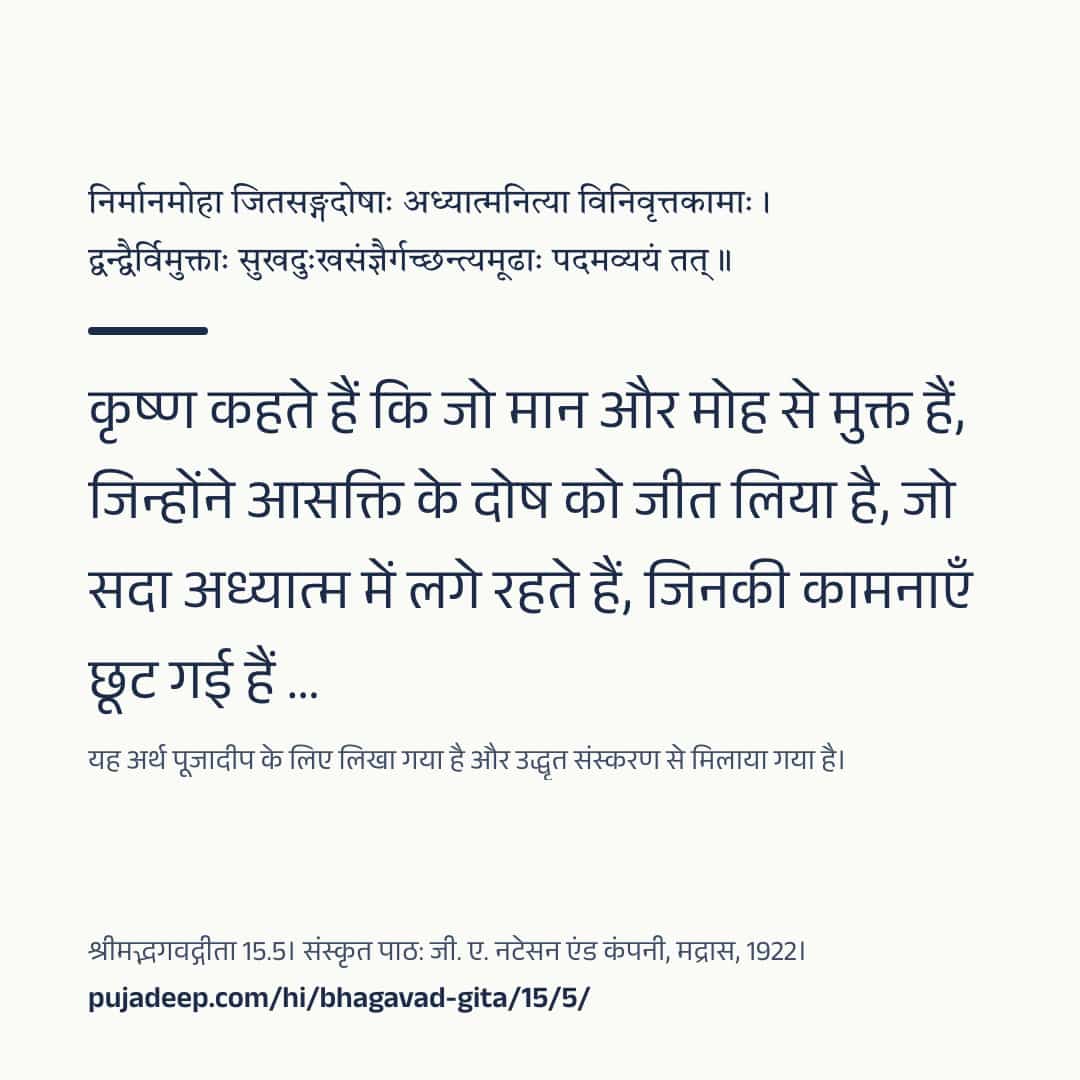
श्रीमद्भगवद्गीता (Bhagavad Gita) 15.5: कृष्ण कहते हैं कि जो मान और मोह से मुक्त हैं, जिन्होंने आसक्ति के दोष को जीत लिया है, जो सदा अध्यात्म में लगे रहते हैं, जिनकी कामनाएँ छूट गई हैं, और जो सुख-दुःख नाम के द्वंद्वों से मुक्त हैं, वे मोह से रहित होकर उस अविनाशी पद को जाते हैं।
किसी शब्द पर क्लिक करें या उसे छुएँ, उसका अर्थ और कोश का पृष्ठ देखें।
दिखावट
दिखावट
ये चुनाव इसी ब्राउज़र में रहते हैं।
श्रीमद्भगवद्गीता 15.5
निर्मानमोहा जितसङ्गदोषाः अध्यात्मनित्या विनिवृत्तकामाः ।द्वन्द्वैर्विमुक्ताः सुखदुःखसंज्ञैर्गच्छन्त्यमूढाः पदमव्ययं तत् ॥
Nirmanamoha jitasangadoshah adhyatmanitya vinivrittakamahDvandvairvimuktah sukhaduhkhasanjnairgachchhantyamudhah padamavyayam tat
nirmānamohā jitasaṅgadoṣāḥ adhyātmanityā vinivṛttakāmāḥ |dvandvairvimuktāḥ sukhaduḥkhasaṃjñairgacchantyamūḍhāḥ padamavyayaṃ tat ||
भावार्थ कृष्ण कहते हैं कि जो मान और मोह से मुक्त हैं, जिन्होंने आसक्ति के दोष को जीत लिया है, जो सदा अध्यात्म में लगे रहते हैं, जिनकी कामनाएँ छूट गई हैं, और जो सुख-दुःख नाम के द्वंद्वों से मुक्त हैं, वे मोह से रहित होकर उस अविनाशी पद को जाते हैं।
English meaning Those who are free from pride and delusion, Krishna says, who have overcome the fault of attachment, who stay always with the inner self (adhyātma), whose desires have fallen away, and who are free from the pairs called pleasure and pain, go undeluded to that imperishable place.
शब्दार्थ
हर शब्द, शब्दकोश के पृष्ठ के साथ
शब्दार्थ
- निर्मानमोहाः nirmānamohāḥ · मान और मोह से रहित (समास, प्रथमा बहुवचन) शब्दकोश: nir-māna, मोनियर-विलियम्स 1899, पृ. 541, स्तंभ 3
without self-confidence, free from pride
; moha, मोनियर-विलियम्स 1899, पृ. 836, स्तंभ 1loss of consciousness, bewilderment, perplexity, distraction, infatuation, delusion
- जितसङ्गदोषाः jitasaṅgadoṣāḥ · आसक्ति के दोष को जीत चुके (समास, प्रथमा बहुवचन) शब्दकोश: jita, मोनियर-विलियम्स 1899, पृ. 420, स्तंभ 3
won, acquired, conquered, subdued
; saṅga, मोनियर-विलियम्स 1899, पृ. 1132, स्तंभ 3(esp.) worldly or selfish attachment or affection, desire
; 2. doṣa, मोनियर-विलियम्स 1899, पृ. 498, स्तंभ 2fault, vice, deficiency, want, inconvenience, disadvantage
- अध्यात्मनित्याः adhyātmanityāḥ · सदा अध्यात्म में स्थित (समास, प्रथमा बहुवचन) शब्दकोश: adhy-ātma, मोनियर-विलियम्स 1899, पृ. 23, स्तंभ 2
the Supreme Spirit
; nitya, मोनियर-विलियम्स 1899, पृ. 547, स्तंभ 2ifc. constantly dwelling or engaged in
- विनिवृत्तकामाः vinivṛttakāmāḥ · कामनाओं से निवृत्त (समास, प्रथमा बहुवचन) शब्दकोश: vi-nivṛtta-kāma, मोनियर-विलियम्स 1899, पृ. 971, स्तंभ 2
one whose desires have ceased
- द्वन्द्वैः dvandvaiḥ · द्वंद्वों से (तृतीया बहुवचन) शब्दकोश: dvaṃdva, मोनियर-विलियम्स 1899, पृ. 503, स्तंभ 2
a pair of opposites (e.g. heat and cold, joy and sorrow &c.)
- विमुक्ताः vimuktāḥ · मुक्त (भूतकालिक कृदन्त, प्रथमा बहुवचन) शब्दकोश: vi-mukta, मोनियर-विलियम्स 1899, पृ. 980, स्तंभ 2
set free, liberated (esp. from mundane existence), freed or delivered
- सुखदुःखसंज्ञैः sukhaduḥkhasaṃjñaiḥ · सुख-दुःख नाम वाले (समास, तृतीया बहुवचन) शब्दकोश: sukha-duḥkha, मोनियर-विलियम्स 1899, पृ. 1221, स्तंभ 1
pleasure and pain, joy and sorrow
; 2. saṃ-jña, मोनियर-विलियम्स 1899, पृ. 1133, स्तंभ 3ifc. for saṃ-jñā
- गच्छन्ति gacchanti · जाते हैं, पहुँचते हैं (वर्तमान काल, प्रथम पुरुष बहुवचन) शब्दकोश: 1. gam, मोनियर-विलियम्स 1899, पृ. 347, स्तंभ 1
to go, move, go away, set out, come
- अमूढाः amūḍhāḥ · मोह रहित, ज्ञानी (प्रथमा बहुवचन) शब्दकोश: a-mūḍha, मोनियर-विलियम्स 1899, पृ. 82, स्तंभ 1
not infatuated, not perplexed
- पदम् padam · पद (द्वितीया एकवचन) शब्दकोश: pada, मोनियर-विलियम्स 1899, पृ. 583, स्तंभ 1
a footing, standpoint; position, rank, station, site, abode, home
- अव्ययम् avyayam · अविनाशी (द्वितीया एकवचन) शब्दकोश: 2. a-vyaya, मोनियर-विलियम्स 1899, पृ. 111, स्तंभ 3
not liable to change, imperishable, undecaying
- तत् tat · उस (सर्वनाम, द्वितीया एकवचन) शब्दकोश: tad, मोनियर-विलियम्स 1899, पृ. 434, स्तंभ 1
m. he, f. she, n. it, that, this
1 छपाई में पाठभेद
संस्करणों के अंतर। कोई दूसरा मुद्रण या पाठ इस स्थान को अलग ढंग से पढ़ता है।
- वर्तनी एक डिजिटल प्रति में पाठ है शब्द वही हैं। 1922 का संस्करण पहले चरण के अंत में विसर्ग छापता है (जितसङ्गदोषाः, छपी पंक्ति के अंत में); यह डिजिटल प्रति, और एक दूसरी डिजिटल प्रति, अध्यात्म… के साथ संधि में जितसङ्गदोषा लिखती हैं।
पुराने अंग्रेज़ी अनुवाद
Kashinath Trimbak Telang, 1882। सार्वजनिक डोमेन (कॉपीराइट-मुक्त)। पृष्ठ 111–112।
Those who are free from pride and delusion, who have overcome the evils of attachment, who are constant in (contemplating) the relation of the supreme and individual self, from whom desire has departed, who are free from the pairs (of opposites) called pleasure and pain, go undeluded to that imperishable seat1.
पाद-टिप्पणियाँ (अनुवादक की अपनी) - Asvattha stands here for the course of worldly life. Its roots are above, viz. the supreme being; its boughs are Hiranyagarbha and others of the higher beings. The Vedas are its leaves, preserving it as leaves preserve trees (another interpretation is that they are the causes of the fruit which the tree bears, i. e. salvation, &c.) Upwards and downwards, from the highest to the lowest of created things. Enlarged=the qualities manifesting themselves, as body, senses, &c.; objects of sense are sprouts as they are attached to the senses, which are the tips of the branches above stated. The roots which extend downwards are the desires for various enjoyments. Its form not thus known here, i.e. to those who live and move in this world, thus viz. as above described. The man who knows the tree thus is said to know the Vedas, because knowledge of it is knowledge of the substance of the Vedas, which is, that the course of worldly life springs from the supreme, is kept up by Vedic rites, and destroyed by knowledge of the supreme. As to freedom from pride, cf. Sutta Nipâta, p. 4. ↩
3 अनुवादों की तुलना करें
Kashinath Trimbak Telang, 1882। सार्वजनिक डोमेन (कॉपीराइट-मुक्त)। पृष्ठ 111–112।
Those who are free from pride and delusion, who have overcome the evils of attachment, who are constant in (contemplating) the relation of the supreme and individual self, from whom desire has departed, who are free from the pairs (of opposites) called pleasure and pain, go undeluded to that imperishable seat1.
पाद-टिप्पणियाँ (अनुवादक की अपनी) - Asvattha stands here for the course of worldly life. Its roots are above, viz. the supreme being; its boughs are Hiranyagarbha and others of the higher beings. The Vedas are its leaves, preserving it as leaves preserve trees (another interpretation is that they are the causes of the fruit which the tree bears, i. e. salvation, &c.) Upwards and downwards, from the highest to the lowest of created things. Enlarged=the qualities manifesting themselves, as body, senses, &c.; objects of sense are sprouts as they are attached to the senses, which are the tips of the branches above stated. The roots which extend downwards are the desires for various enjoyments. Its form not thus known here, i.e. to those who live and move in this world, thus viz. as above described. The man who knows the tree thus is said to know the Vedas, because knowledge of it is knowledge of the substance of the Vedas, which is, that the course of worldly life springs from the supreme, is kept up by Vedic rites, and destroyed by knowledge of the supreme. As to freedom from pride, cf. Sutta Nipâta, p. 4. ↩
आप यही पढ़ रहे हैं
Annie Besant, 1895। सार्वजनिक डोमेन (कॉपीराइट-मुक्त)। पृष्ठ 136।
Without pride and delusion, victorious over the evil of attachment, dwelling constantly in Adhyâtmâ, desire having come to an end, liberated from the pairs of opposites known as pleasure and pain, they tread, undeluded, the indestructible Path.
आप यही पढ़ रहे हैं
Swami Swarupananda, 1909 (पहली बार 1907 में छपा)। सार्वजनिक डोमेन (कॉपीराइट-मुक्त)। पृष्ठ 286।
Free from pride and delusion, with the evil of attachment conquered, ever dwelling in the Self, with desires completely receded, liberated from the pairs of opposites known as pleasure and pain, the undeluded reach that Goal Eternal.
आप यही पढ़ रहे हैं
इस श्लोक का हवाला दें
अनुवाद: K. T. Telang, The Bhagavadgîtâ (The Sacred Books of the East, vol. VIII, Oxford: Clarendon Press, 1882), पृष्ठ 111–112। भगवद्गीता 15.5।
अनुवाद: Annie Besant, The Bhagavad Gîtâ, or The Lord's Song (London: Theosophical Publishing Society, 1895), पृष्ठ 136। भगवद्गीता 15.5।
अनुवाद: Swami Swarupananda, Srimad-Bhagavad-Gita (Mayavati: Prabuddha Bharata Press, 1909; first printed in Prabuddha Bharata, 1907–1909), पृष्ठ 286। भगवद्गीता 15.5।
हमारी व्याख्या: “भगवद्गीता 15.5: अर्थ और अनुवाद”। पूजादीप। अद्यतन 25 अक्टूबर 2026। https://pujadeep.com/hi/bhagavad-gita/15/5/
पूजादीप की व्याख्याएँ श्रेय देकर उद्धृत की जा सकती हैं: पूजादीप का नाम और पृष्ठ का लिंक दें। श्रेय कैसे दें
शास्त्रीय व्याख्याएँ, संप्रदाय के अनुसार
इस श्लोक पर अभी संप्रदायों की व्याख्या नहीं है।
भेजें
साझा करने के तरीके दिखाएँ
एक तस्वीर या पाठ एक चैट में भेजें। तस्वीर पर उसका स्रोत और इस पृष्ठ का पता लिखा है।
तस्वीर बन रही है
शब्द देखें
श्रीमद्भगवद्गीता 15.5

निर्मानमोहा जितसङ्गदोषाः अध्यात्मनित्या विनिवृत्तकामाः ।
द्वन्द्वैर्विमुक्ताः सुखदुःखसंज्ञैर्गच्छन्त्यमूढाः पदमव्ययं तत् ॥

“Those who are free from pride and delusion, who have overcome the evils of attachment, who are constant in (contemplating) the relation of the supreme and individual self, from whom desire has departed, who are free from the pairs (of opposites) called pleasure and pain, go undeluded to that imperishable seat.”
(K. T. Telang, The Bhagavadgîtâ (The Sacred Books of the East, vol. VIII, Oxford: Clarendon Press, 1882), pp. 111–112, public domain)

“Without pride and delusion, victorious over the evil of attachment, dwelling constantly in Adhyâtmâ, desire having come to an end, liberated from the pairs of opposites known as pleasure and pain, they tread, undeluded, the indestructible Path.”
(Annie Besant, The Bhagavad Gîtâ, or The Lord's Song (London: Theosophical Publishing Society, 1895), p. 136, public domain)

“Free from pride and delusion, with the evil of attachment conquered, ever dwelling in the Self, with desires completely receded, liberated from the pairs of opposites known as pleasure and pain, the undeluded reach that Goal Eternal.”
(Swami Swarupananda, Srimad-Bhagavad-Gita (Mayavati: Prabuddha Bharata Press, 1909; first printed in Prabuddha Bharata, 1907–1909), p. 286, public domain)

संस्कृत पाठ: जी. ए. नटेसन एंड कंपनी, मद्रास, 1922।
https://pujadeep.com/hi/bhagavad-gita/15/5/
इस साइट से कुछ नहीं भेजा जाता। आपका अपना ऐप उसे आपकी चुनी हुई चैट में भेजता है। तस्वीर में वही अनुवाद है जो आपने इस पृष्ठ पर चुना है, उसके नाम और वर्ष के साथ।
संस्कृत पाठ: 1922 का मद्रास मुद्रण। अर्थ: पूजादीप के लिए लिखे और जाँचे गए। स्रोत और बदलाव
परिवारों के प्रश्न
गीता 15.5 कौन कहता है?
यह श्लोक कृष्ण कहते हैं, अध्याय 15 (पुरुषोत्तमयोग) में।
संस्कृत पाठ कहाँ से लिया गया है?
संस्कृत पाठ: 1922 का मद्रास मुद्रण। अर्थ: पूजादीप के लिए लिखे और जाँचे गए। स्रोत देखें
क्या इस पृष्ठ का अर्थ अनुवाद है?
इस साइट के लिए यहाँ दिए स्रोतों के आधार पर लिखी और उद्धृत संस्करण से मिलाई गई व्याख्या। यह अनुवाद नहीं है, और पाठ को पढ़ने का एकमात्र तरीका भी नहीं है। श्रेय देकर आप इसे उद्धृत कर सकते हैं।
स्रोत और लाइसेंस
- संस्कृत पाठ
- The Bhagavad-Gita, or The Lord's Song, with the text in Devanagari and an English translation (Annie Besant, G. A. Natesan & Co., Madras, 1922). सार्वजनिक डोमेन (कॉपीराइट-मुक्त)। इन पृष्ठों का संस्कृत पाठ इसी मुद्रण के पृष्ठ-चित्रों से पढ़ा गया है।
- अनुवाद
- The Bhagavadgîtâ with the Sanatsugâtîya and the Anugîtâ, translated by Kâshinâth Trimbak Telang (The Sacred Books of the East, vol. VIII, ed. F. Max Müller) (Kashinath Trimbak Telang, F. Max Müller, Clarendon Press, Oxford, 1882). सार्वजनिक डोमेन (कॉपीराइट-मुक्त)। जैसा छपा है, वैसा ही दिखाया गया।
- अनुवाद
- The Bhagavad Gîtâ, or The Lord's Song, translated by Annie Besant (Annie Besant, Theosophical Publishing Society, London, 1895). सार्वजनिक डोमेन (कॉपीराइट-मुक्त)। जैसा छपा है, वैसा ही दिखाया गया।
- अनुवाद
- Srimad-Bhagavad-Gita, with Sanskrit Text; Paraphrase with Word-by-word Literal Translation; English Rendering and Comments, Index, &c., by the Swami Swarupananda (Himalayan Series, No. XX) (Swami Swarupananda, The Editors and Publishers, Advaita Ashrama, Mayavati, Prabuddha Bharata Press, Mayavati, Almora, Himalayas, 1909). सार्वजनिक डोमेन (कॉपीराइट-मुक्त)। जैसा छपा है, वैसा ही दिखाया गया।
- प्रचलित पाठ
- इस पाठ में 32 शब्द आज के प्रचलित रूप में हैं; इन्हें sanskritdocuments.org; संस्कृत विकिस्रोत; गीता प्रेस, गोरखपुर; ग्रेटिल, गॉटिंगेन और भक्तिवेदांत बुक ट्रस्ट के पाठ से मिलाकर जाँचा गया।
- हमारी व्याख्या
- इस साइट के लिए यहाँ दिए स्रोतों के आधार पर लिखी और उद्धृत संस्करण से मिलाई गई व्याख्या। यह अनुवाद नहीं है, और पाठ को पढ़ने का एकमात्र तरीका भी नहीं है। श्रेय देकर आप इसे उद्धृत कर सकते हैं।
- जाँच
- उद्धृत संस्करण से मिलाया गया, 15 अक्टूबर 2026।
- अद्यतन
- 25 अक्टूबर 2026