Bhagavad Gita 15.6: meaning and translation
Chapter 15: Purushottama Yoga. Krishna says
Neither the sun, nor the moon, nor fire lights that place, Krishna says.
Click or tap a word for its meaning and its dictionary page.
Text and layers
Text and layers
These choices stay in this browser.
Bhagavad Gita 15.6
न तद्भासयते सूर्यो न शशाङ्को न पावकः ।यद्गत्वा न निवर्तन्ते तद्धाम परमं मम ॥
Na tadbhasayate suryo na shashanko na pavakahYadgatva na nivartante taddhama paramam mama
na tadbhāsayate sūryo na śaśāṅko na pāvakaḥ |yadgatvā na nivartante taddhāma paramaṃ mama ||
Our explanation Neither the sun, nor the moon, nor fire lights that place, Krishna says. Those who go there do not return; it is his highest abode (dhāma). The schools read this verse differently (see the views).
हिंदी अर्थ कृष्ण कहते हैं कि उस स्थान को न सूर्य प्रकाशित करता है, न चंद्रमा, न अग्नि। जो वहाँ जाते हैं, वे लौटते नहीं; वह उनका परम धाम है। परंपराएँ इस श्लोक को अलग-अलग ढंग से पढ़ती हैं।
Word by word
Every word, with its dictionary page
Word by word
- न na · not (indeclinable) Dictionary: 2. na, Monier-Williams 1899, p. 523, col. 1 “not, no, nor, neither”
- तत् tat · that (pronoun, accusative singular) Dictionary: tad, Monier-Williams 1899, p. 434, col. 1 “m. he, f. she, n. it, that, this”
- भासयते bhāsayate · lights up (causative present, 3rd person singular) Dictionary: 1. bhās, Monier-Williams 1899, p. 756, col. 1 “to make shine, illuminate”
- सूर्यः sūryaḥ · the sun (nominative singular) Dictionary: sūrya, Monier-Williams 1899, p. 1243, col. 1 “the sun or its deity”
- न na · not (indeclinable) Dictionary: 2. na, Monier-Williams 1899, p. 523, col. 1 “not, no, nor, neither”
- शशाङ्कः śaśāṅkaḥ · the moon (nominative singular) Dictionary: śaśāṅka, Monier-Williams 1899, p. 1060, col. 1 “‘hare-marked,’ the moon”
- न na · not (indeclinable) Dictionary: 2. na, Monier-Williams 1899, p. 523, col. 1 “not, no, nor, neither”
- पावकः pāvakaḥ · fire (nominative singular) Dictionary: pāvaka, Monier-Williams 1899, p. 623, col. 2 “fire or the god of fire”
- यत् yat · which (relative pronoun, accusative singular) Dictionary: yad, Monier-Williams 1899, p. 844, col. 2 “who, which, what, whichever, whatever, that”
- गत्वा gatvā · having gone, having reached (absolutive ('having done')) Dictionary: 1. gam, Monier-Williams 1899, p. 347, col. 1 “to go, move, go away, set out, come”
- न na · not (indeclinable) Dictionary: 2. na, Monier-Williams 1899, p. 523, col. 1 “not, no, nor, neither”
- निवर्तन्ते nivartante · return (present, 3rd person plural) Dictionary: ni-vṛt, Monier-Williams 1899, p. 560, col. 1 “to turn back, stop; to return from”
- तत् tat · that (pronoun, nominative singular) Dictionary: tad, Monier-Williams 1899, p. 434, col. 1 “m. he, f. she, n. it, that, this”
- धाम dhāma · abode (nominative singular) Dictionary: dhāman, Monier-Williams 1899, p. 514, col. 3 “dwelling-place, house, abode, domain”
- परमम् paramam · supreme (nominative singular) Dictionary: parama, Monier-Williams 1899, p. 588, col. 1 “chief, highest, primary, most prominent or conspicuous”
- मम mama · "my" (Krishna's) (pronoun, genitive singular) Dictionary: 1. mad, Monier-Williams 1899, p. 777, col. 2 “base of the first pers. pron. in the sg. number (esp. in comp.)”
Old translations
Kashinath Trimbak Telang, 1882. Public domain. Page 111–112.
The sun does not light it, nor the moon, nor fire1. That is my highest abode, going to which none returns.
Footnotes (the translator’s own) - Cf. Kathopanishad, p. 142; Mundaka, p. 304; Nrisimha-tâpinî, p. 106; Svetâsvatara, p. 110. ↩
Compare 3 translations
Kashinath Trimbak Telang, 1882. Public domain. Page 111–112.
The sun does not light it, nor the moon, nor fire1. That is my highest abode, going to which none returns.
Footnotes (the translator’s own) - Cf. Kathopanishad, p. 142; Mundaka, p. 304; Nrisimha-tâpinî, p. 106; Svetâsvatara, p. 110. ↩
You are reading this one
Annie Besant, 1895. Public domain. Page 136.
Nor doth the sun lighten there, nor moon, nor fire; having gone thither they return not; that is My supreme Dwelling-place.
You are reading this one
Swami Swarupananda, 1909 (first printed 1907). Public domain. Page 286.
That, the sun illumines not, nor the moon, nor fire; That is My Supreme Abode, going whither they return not.
You are reading this one
Cite this verse
The translation: K. T. Telang, The Bhagavadgîtâ (The Sacred Books of the East, vol. VIII, Oxford: Clarendon Press, 1882), pp. 111–112. Bhagavad Gita 15.6.
The translation: Annie Besant, The Bhagavad Gîtâ, or The Lord's Song (London: Theosophical Publishing Society, 1895), p. 136. Bhagavad Gita 15.6.
The translation: Swami Swarupananda, Srimad-Bhagavad-Gita (Mayavati: Prabuddha Bharata Press, 1909; first printed in Prabuddha Bharata, 1907–1909), p. 286. Bhagavad Gita 15.6.
Our explanation: “Bhagavad Gita 15.6: meaning and translation.” Pujadeep. Updated October 25, 2026. https://pujadeep.com/bhagavad-gita/15/6/
Pujadeep’s explanations are free to quote with credit: name Pujadeep and link to the page. How to credit
Classical readings, by school
Each reading is named by its school. None is presented as the only meaning.
What Advaita, Vishishtadvaita and Dvaita teach, in short
Shankara Advaita
Shankara says this is the goal named in the verses before it, the highest abode of Viṣṇu. It is an abode of light that the sun and the other lights do not light up, and those who reach it do not return.
Source: The Bhagavad-Gita, with the commentary of Sri Sankaracharya, translated by A. Mahadeva Sastri (2nd ed., Mysore: G. T. A. Printing Works, 1901), commentary on 15.6, p. 360. Summarised in our own words; none of its text is reproduced.
Ramanuja Vishishtadvaita
Ramanuja takes the light here to be the self's own light of consciousness. The sun, moon and fire cannot light it; they only remove the darkness between the senses and their objects. This light is the Lord's, a portion of his splendour, and it is revealed through yoga.
Source: Sri Bhagavad-Gita with Sri Ramanujacharya's Visishtadvaita commentary, translated by A. Govindacharya (Madras, 1898), commentary on 15.6, pp. 469–470. Summarised in our own words; none of its text is reproduced.
Share
Show the ways to share
Send one picture or the text to one chat. The picture names its source and the address of this page.
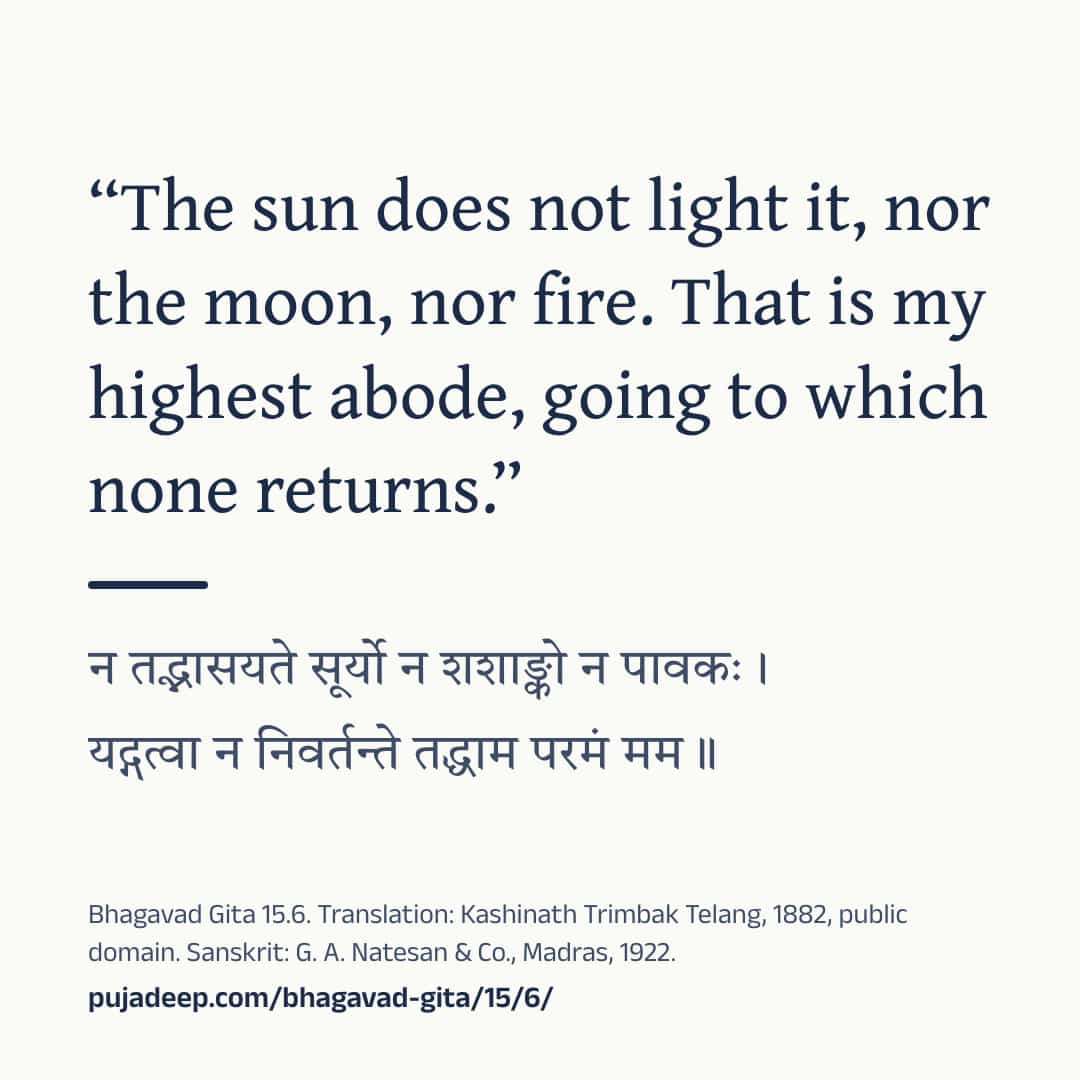
Drawing the picture
See the words
Bhagavad Gita 15.6

न तद्भासयते सूर्यो न शशाङ्को न पावकः ।
यद्गत्वा न निवर्तन्ते तद्धाम परमं मम ॥

“The sun does not light it, nor the moon, nor fire. That is my highest abode, going to which none returns.”
(K. T. Telang, The Bhagavadgîtâ (The Sacred Books of the East, vol. VIII, Oxford: Clarendon Press, 1882), pp. 111–112, public domain)

“Nor doth the sun lighten there, nor moon, nor fire; having gone thither they return not; that is My supreme Dwelling-place.”
(Annie Besant, The Bhagavad Gîtâ, or The Lord's Song (London: Theosophical Publishing Society, 1895), p. 136, public domain)

“That, the sun illumines not, nor the moon, nor fire; That is My Supreme Abode, going whither they return not.”
(Swami Swarupananda, Srimad-Bhagavad-Gita (Mayavati: Prabuddha Bharata Press, 1909; first printed in Prabuddha Bharata, 1907–1909), p. 286, public domain)

Sanskrit: G. A. Natesan & Co., Madras, 1922.
https://pujadeep.com/bhagavad-gita/15/6/ Nothing is sent from this site. Your own app sends it, to the chat you choose. The picture quotes the translation you chose on this page, with its name and year.
Sanskrit text: The Bhagavad-Gita, or The Lord's Song, with the text in Devanagari and an English translation, 1922. Meanings: written for Pujadeep and checked against the cited edition. Source and changes
Questions families ask
Who speaks Bhagavad Gita 15.6?
Krishna speaks this verse, in chapter 15 (Purushottama Yoga).
Where does the Sanskrit text come from?
Sanskrit text: The Bhagavad-Gita, or The Lord's Song, with the text in Devanagari and an English translation, 1922. Meanings: written for Pujadeep and checked against the cited edition. See the source
Is the meaning on this page a translation?
Explanation written for this site from the sources listed here, and checked against the cited edition. It is not a translation and not the only way to read the text. Free to quote with credit.
Source and licence
- Sanskrit text
- The Bhagavad-Gita, or The Lord's Song, with the text in Devanagari and an English translation (Annie Besant, G. A. Natesan & Co., Madras, 1922). Public domain. The Sanskrit on these pages was read from this printing’s page images.
- Translation
- The Bhagavadgîtâ with the Sanatsugâtîya and the Anugîtâ, translated by Kâshinâth Trimbak Telang (The Sacred Books of the East, vol. VIII, ed. F. Max Müller) (Kashinath Trimbak Telang, F. Max Müller, Clarendon Press, Oxford, 1882). Public domain. Shown verbatim, as printed.
- Translation
- The Bhagavad Gîtâ, or The Lord's Song, translated by Annie Besant (Annie Besant, Theosophical Publishing Society, London, 1895). Public domain. Shown verbatim, as printed.
- Translation
- Srimad-Bhagavad-Gita, with Sanskrit Text; Paraphrase with Word-by-word Literal Translation; English Rendering and Comments, Index, &c., by the Swami Swarupananda (Himalayan Series, No. XX) (Swami Swarupananda, The Editors and Publishers, Advaita Ashrama, Mayavati, Prabuddha Bharata Press, Mayavati, Almora, Himalayas, 1909). Public domain. Shown verbatim, as printed.
- Commentary
- The Bhagavad-Gita, with the commentary of Sri Sankaracharya, translated by A. Mahadeva Sastri (2nd ed., Mysore: G. T. A. Printing Works, 1901) (Public-domain scan, University of California Libraries). Summarised in our own words; none of its text is reproduced.
- Commentary
- Sri Bhagavad-Gita with Sri Ramanujacharya's Visishtadvaita commentary, translated by A. Govindacharya (Madras, 1898) (Scan uploaded to archive.org (folkscanomy collection)). Summarised in our own words; none of its text is reproduced.
- Common wording
- In this text, 32 words follow today's common wording, checked against sanskritdocuments.org; Sanskrit Wikisource; Gita Press, Gorakhpur; GRETIL, Göttingen and Bhaktivedanta Book Trust.
- Our explanation
- Explanation written for this site from the sources listed here, and checked against the cited edition. It is not a translation and not the only way to read the text. Free to quote with credit.
- Checked
- Checked against the cited edition, October 15, 2026.
- Updated
- October 25, 2026