Bhagavad Gita 15.19: meaning and translation
Chapter 15: Purushottama Yoga. Krishna says
Whoever, free from delusion, knows him in this way as Purushottama, Krishna says, knows all and worships him with his whole being, Bharata.
Click or tap a word for its meaning and its dictionary page.
Text and layers
Text and layers
These choices stay in this browser.
Bhagavad Gita 15.19
यो मामेवमसंमूढो जानाति पुरुषोत्तमम् ।स सर्वविद्भजति मां सर्वभावेन भारत ॥
Yo mamevamasammudho janati purushottamamSa sarvavidbhajati mam sarvabhavena bharata
yo māmevamasaṃmūḍho jānāti puruṣottamam |sa sarvavidbhajati māṃ sarvabhāvena bhārata ||
Our explanation Whoever, free from delusion, knows him in this way as Purushottama, Krishna says, knows all and worships him with his whole being, Bharata.
हिंदी अर्थ कृष्ण कहते हैं कि हे भारत, जो मोह से रहित होकर उन्हें इस प्रकार पुरुषोत्तम जानता है, वह सब जानता है और पूरे भाव से उनका भजन करता है।
Word by word
Every word, with its dictionary page
Word by word
- यः yaḥ · who (relative pronoun, nominative singular) Dictionary: yad, Monier-Williams 1899, p. 844, col. 2 “who, which, what, whichever, whatever, that”
- माम् mām · "me" (Krishna) (pronoun, accusative singular) Dictionary: 1. mad, Monier-Williams 1899, p. 777, col. 2 “base of the first pers. pron. in the sg. number (esp. in comp.)”
- एवम् evam · thus (indeclinable) Dictionary: evam, Monier-Williams 1899, p. 232, col. 2 “thus, in this way, in such a manner, such”
- असंमूढः asaṃmūḍhaḥ · undeluded (past participle, nominative singular) Dictionary: a-saṃmūḍha, Monier-Williams 1899, p. 119, col. 3 “not confused, deliberate”
- जानाति jānāti · knows (present, 3rd person singular) Dictionary: 1. jñā, Monier-Williams 1899, p. 425, col. 3 “to know, have knowledge, become acquainted with”
- पुरुषोत्तमम् puruṣottamam · as the Supreme Person (compound, accusative singular) Dictionary: puruṣottama, Monier-Williams 1899, p. 637, col. 3 “the highest being, Supreme Spirit, N. of Vishṇu or Kṛishṇa”
- सः saḥ · he (pronoun, nominative singular) Dictionary: tad, Monier-Williams 1899, p. 434, col. 1 “m. he, f. she, n. it, that, this”
- सर्ववित् sarvavit · knowing all (compound, nominative singular) Dictionary: sarva-vid, Monier-Williams 1899, p. 1187, col. 2 “all-knowing, omniscient”
- भजति bhajati · worships (present, 3rd person singular) Dictionary: bhaj, Monier-Williams 1899, p. 743, col. 1 “to serve, honour, revere, love, adore”
- माम् mām · "me" (Krishna) (pronoun, accusative singular) Dictionary: 1. mad, Monier-Williams 1899, p. 777, col. 2 “base of the first pers. pron. in the sg. number (esp. in comp.)”
- सर्वभावेन sarvabhāvena · with his whole being (compound, instrumental singular) Dictionary: sarva-bhāva, Monier-Williams 1899, p. 1186, col. 2 “with all one's thoughts, with one's whole soul”
- भारत bhārata · O descendant of Bharata (Arjuna) (vocative singular) Dictionary: bhārata, Monier-Williams 1899, p. 753, col. 1 “a descendant of Bharata”
1 printing differs
Edition differences. Another printing or text reads this place differently.
- Spelling A digital text reads Same word. The e-text writes the class nasal (असम्मूढो); the 1922 edition writes anusvara (असंमूढो).
Old translations
Kashinath Trimbak Telang, 1882. Public domain. Page 114.
He who, undeluded, thus knows me the best of beings, worships me every way1, O descendant of Bharata! knowing everything.
Footnotes (the translator’s own) - Cf. p. 129 infra. Here Saṅkara paraphrases it by 'thinking me to be the soul of everything.' ↩
Compare 3 translations
Kashinath Trimbak Telang, 1882. Public domain. Page 114.
He who, undeluded, thus knows me the best of beings, worships me every way1, O descendant of Bharata! knowing everything.
Footnotes (the translator’s own) - Cf. p. 129 infra. Here Saṅkara paraphrases it by 'thinking me to be the soul of everything.' ↩
You are reading this one
Annie Besant, 1895. Public domain. Page 139.
He who undeluded knoweth Me thus as Purushottama, he, all-knowing, worshippeth Me with his whole being, O Bhârata.
You are reading this one
Swami Swarupananda, 1909 (first printed 1907). Public domain. Page 293.
He who, free from delusion thus knows Me as the Supreme Purusha, he, knowing all, worships Me as the All-being, O descendant of Bharata.
You are reading this one
Cite this verse
The translation: K. T. Telang, The Bhagavadgîtâ (The Sacred Books of the East, vol. VIII, Oxford: Clarendon Press, 1882), p. 114. Bhagavad Gita 15.19.
The translation: Annie Besant, The Bhagavad Gîtâ, or The Lord's Song (London: Theosophical Publishing Society, 1895), p. 139. Bhagavad Gita 15.19.
The translation: Swami Swarupananda, Srimad-Bhagavad-Gita (Mayavati: Prabuddha Bharata Press, 1909; first printed in Prabuddha Bharata, 1907–1909), p. 293. Bhagavad Gita 15.19.
Our explanation: “Bhagavad Gita 15.19: meaning and translation.” Pujadeep. Updated October 25, 2026. https://pujadeep.com/bhagavad-gita/15/19/
Pujadeep’s explanations are free to quote with credit: name Pujadeep and link to the page. How to credit
Classical readings, by school
No readings by school on this verse yet.
Share
Show the ways to share
Send one picture or the text to one chat. The picture names its source and the address of this page.
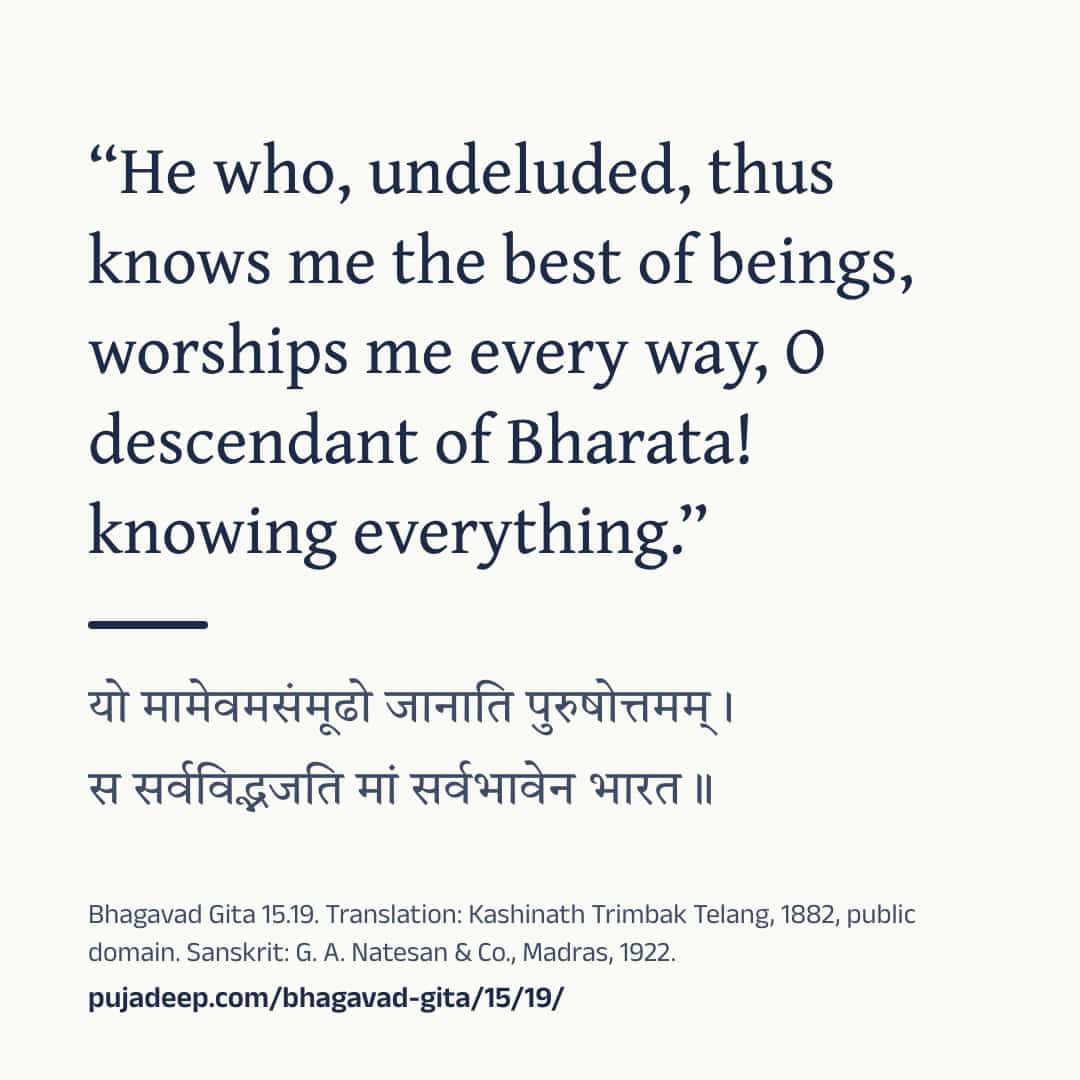
Drawing the picture
See the words
Bhagavad Gita 15.19

यो मामेवमसंमूढो जानाति पुरुषोत्तमम् ।
स सर्वविद्भजति मां सर्वभावेन भारत ॥

“He who, undeluded, thus knows me the best of beings, worships me every way, O descendant of Bharata! knowing everything.”
(K. T. Telang, The Bhagavadgîtâ (The Sacred Books of the East, vol. VIII, Oxford: Clarendon Press, 1882), p. 114, public domain)

“He who undeluded knoweth Me thus as Purushottama, he, all-knowing, worshippeth Me with his whole being, O Bhârata.”
(Annie Besant, The Bhagavad Gîtâ, or The Lord's Song (London: Theosophical Publishing Society, 1895), p. 139, public domain)

“He who, free from delusion thus knows Me as the Supreme Purusha, he, knowing all, worships Me as the All-being, O descendant of Bharata.”
(Swami Swarupananda, Srimad-Bhagavad-Gita (Mayavati: Prabuddha Bharata Press, 1909; first printed in Prabuddha Bharata, 1907–1909), p. 293, public domain)

Sanskrit: G. A. Natesan & Co., Madras, 1922.
https://pujadeep.com/bhagavad-gita/15/19/ Nothing is sent from this site. Your own app sends it, to the chat you choose. The picture quotes the translation you chose on this page, with its name and year.
Sanskrit text: The Bhagavad-Gita, or The Lord's Song, with the text in Devanagari and an English translation, 1922. Meanings: written for Pujadeep and checked against the cited edition. Source and changes
Questions families ask
Who speaks Bhagavad Gita 15.19?
Krishna speaks this verse, in chapter 15 (Purushottama Yoga).
Where does the Sanskrit text come from?
Sanskrit text: The Bhagavad-Gita, or The Lord's Song, with the text in Devanagari and an English translation, 1922. Meanings: written for Pujadeep and checked against the cited edition. See the source
Is the meaning on this page a translation?
Explanation written for this site from the sources listed here, and checked against the cited edition. It is not a translation and not the only way to read the text. Free to quote with credit.
Source and licence
- Sanskrit text
- The Bhagavad-Gita, or The Lord's Song, with the text in Devanagari and an English translation (Annie Besant, G. A. Natesan & Co., Madras, 1922). Public domain. The Sanskrit on these pages was read from this printing’s page images.
- Translation
- The Bhagavadgîtâ with the Sanatsugâtîya and the Anugîtâ, translated by Kâshinâth Trimbak Telang (The Sacred Books of the East, vol. VIII, ed. F. Max Müller) (Kashinath Trimbak Telang, F. Max Müller, Clarendon Press, Oxford, 1882). Public domain. Shown verbatim, as printed.
- Translation
- The Bhagavad Gîtâ, or The Lord's Song, translated by Annie Besant (Annie Besant, Theosophical Publishing Society, London, 1895). Public domain. Shown verbatim, as printed.
- Translation
- Srimad-Bhagavad-Gita, with Sanskrit Text; Paraphrase with Word-by-word Literal Translation; English Rendering and Comments, Index, &c., by the Swami Swarupananda (Himalayan Series, No. XX) (Swami Swarupananda, The Editors and Publishers, Advaita Ashrama, Mayavati, Prabuddha Bharata Press, Mayavati, Almora, Himalayas, 1909). Public domain. Shown verbatim, as printed.
- Common wording
- In this text, 32 words follow today's common wording, checked against sanskritdocuments.org; Sanskrit Wikisource; Gita Press, Gorakhpur; GRETIL, Göttingen and Bhaktivedanta Book Trust.
- Our explanation
- Explanation written for this site from the sources listed here, and checked against the cited edition. It is not a translation and not the only way to read the text. Free to quote with credit.
- Checked
- Checked against the cited edition, October 15, 2026.
- Updated
- October 25, 2026