Bhagavad Gita 15.12: meaning and translation
Chapter 15: Purushottama Yoga. Krishna says
The light in the sun that lights the whole world, Krishna says, and the light in the moon and in fire, know that light to be his.
Click or tap a word for its meaning and its dictionary page.
Text and layers
Text and layers
These choices stay in this browser.
Bhagavad Gita 15.12
यदादित्यगतं तेजो जगद्भासयतेऽखिलम् ।यच्चन्द्रमसि यच्चाग्नौ तत्तेजो विद्धि मामकम् ॥
Yadadityagatam tejo jagadbhasayatekhilamYachchandramasi yachchagnau tattejo viddhi mamakam
yadādityagataṃ tejo jagadbhāsayate’khilam |yaccandramasi yaccāgnau tattejo viddhi māmakam ||
Our explanation The light in the sun that lights the whole world, Krishna says, and the light in the moon and in fire, know that light to be his. Telang's note links this verse back to verse 6.
हिंदी अर्थ कृष्ण कहते हैं कि सूर्य में जो तेज पूरे जगत को प्रकाशित करता है, और जो तेज चंद्रमा और अग्नि में है, उस तेज को उनका ही जानो। तेलंग की टिप्पणी इस श्लोक को श्लोक 6 से जोड़ती है।
Word by word
Every word, with its dictionary page
Word by word
- यत् yat · which (relative pronoun, nominative singular) Dictionary: yad, Monier-Williams 1899, p. 844, col. 2 “who, which, what, whichever, whatever, that”
- आदित्यगतम् ādityagatam · present in the sun (compound, nominative singular) Dictionary: 1. āditya, Monier-Williams 1899, p. 137, col. 2 “especially of Sūrya (the sun)”; gata, Monier-Williams 1899, p. 347, col. 1 “gone to any state or condition”
- तेजः tejaḥ · light, radiance (nominative singular) Dictionary: tejas, Monier-Williams 1899, p. 454, col. 2 “glow, glare, splendour, brilliance, light, fire”
- जगत् jagat · the world (accusative singular) Dictionary: jagat, Monier-Williams 1899, p. 408, col. 1 “the world, esp. this world, earth”
- भासयते bhāsayate · lights up (causative present, 3rd person singular) Dictionary: 1. bhās, Monier-Williams 1899, p. 756, col. 1 “to make shine, illuminate”
- अखिलम् akhilam · whole, entire (accusative singular) Dictionary: a-khila, Monier-Williams 1899, p. 4, col. 2 “without a gap, complete, whole”
- यत् yat · which (relative pronoun, nominative singular) Dictionary: yad, Monier-Williams 1899, p. 844, col. 2 “who, which, what, whichever, whatever, that”
- चन्द्रमसि candramasi · in the moon (locative singular) Dictionary: candra-mas, Monier-Williams 1899, p. 387, col. 2 “the moon, deity of the moon”
- यत् yat · which (relative pronoun, nominative singular) Dictionary: yad, Monier-Williams 1899, p. 844, col. 2 “who, which, what, whichever, whatever, that”
- च ca · and (indeclinable) Dictionary: 2. ca, Monier-Williams 1899, p. 380, col. 1 “and, both, also, moreover, as well as”
- अग्नौ agnau · in fire (locative singular) Dictionary: agni, Monier-Williams 1899, p. 5, col. 1 “fire; sacrificial fire”
- तत् tat · that (pronoun, accusative singular) Dictionary: tad, Monier-Williams 1899, p. 434, col. 1 “m. he, f. she, n. it, that, this”
- तेजः tejaḥ · light, radiance (accusative singular) Dictionary: tejas, Monier-Williams 1899, p. 454, col. 2 “glow, glare, splendour, brilliance, light, fire”
- विद्धि viddhi · know (imperative, 2nd person singular) Dictionary: 1. vid, Monier-Williams 1899, p. 963, col. 2 “to know, understand, perceive, learn”
- मामकम् māmakam · as "mine" (Krishna's) (accusative singular) Dictionary: māmaka, Monier-Williams 1899, p. 810, col. 3 “my, mine”
1 printing differs
Edition differences. Another printing or text reads this place differently.
- The printed edition reads: यदादित्यगत तेजो जगद्भासयतेऽखिलम् ।
यच्चन्द्रमसि यच्चाग्नौ तत्तेजो विद्धि मामकम् ॥ The print has no anusvara on गत (यदादित्यगत तेजो); corrected to यदादित्यगतं, because the word agrees with the neuter तेजः ('the light that is in the sun') and needs the ending -ṃ. Both proofreading references read यदादित्यगतं.
Old translations
Kashinath Trimbak Telang, 1882. Public domain. Page 112–113.
Know that glory (to be) mine which, dwelling in the sun, lights up the whole world, or in the moon or fire1.
Footnotes (the translator’s own) - Cf. Maitrî-upanishad, p. 142. This sentence continues what has been stated at the top of the page. The intervening portion explains how souls do come back in some cases. As a general rule, 'all going ends in returning.' But the soul is an exception in some cases, as the 'going' to the Brahman is going to the fountain-head. Then the question arises, How does the severance come off at all? And that is what the lines up to this explain. ↩
Compare 3 translations
Kashinath Trimbak Telang, 1882. Public domain. Page 112–113.
Know that glory (to be) mine which, dwelling in the sun, lights up the whole world, or in the moon or fire1.
Footnotes (the translator’s own) - Cf. Maitrî-upanishad, p. 142. This sentence continues what has been stated at the top of the page. The intervening portion explains how souls do come back in some cases. As a general rule, 'all going ends in returning.' But the soul is an exception in some cases, as the 'going' to the Brahman is going to the fountain-head. Then the question arises, How does the severance come off at all? And that is what the lines up to this explain. ↩
You are reading this one
Annie Besant, 1895. Public domain. Page 137.
That splendour issuing from the sun that enlighteneth the whole world, that which is in the moon and in fire, that splendour know as from Me.
You are reading this one
Swami Swarupananda, 1909 (first printed 1907). Public domain. Page 330.
The light which residing in the sun, in the moon, in the fire, illumines the whole world—know that light to be Mine.
You are reading this one
Cite this verse
The translation: K. T. Telang, The Bhagavadgîtâ (The Sacred Books of the East, vol. VIII, Oxford: Clarendon Press, 1882), pp. 112–113. Bhagavad Gita 15.12.
The translation: Annie Besant, The Bhagavad Gîtâ, or The Lord's Song (London: Theosophical Publishing Society, 1895), p. 137. Bhagavad Gita 15.12.
The translation: Swami Swarupananda, Srimad-Bhagavad-Gita (Mayavati: Prabuddha Bharata Press, 1909; first printed in Prabuddha Bharata, 1907–1909), p. 330. Bhagavad Gita 15.12.
Our explanation: “Bhagavad Gita 15.12: meaning and translation.” Pujadeep. Updated October 25, 2026. https://pujadeep.com/bhagavad-gita/15/12/
Pujadeep’s explanations are free to quote with credit: name Pujadeep and link to the page. How to credit
Classical readings, by school
No readings by school on this verse yet.
Share
Show the ways to share
Send one picture or the text to one chat. The picture names its source and the address of this page.
Drawing the picture
See the words
Bhagavad Gita 15.12

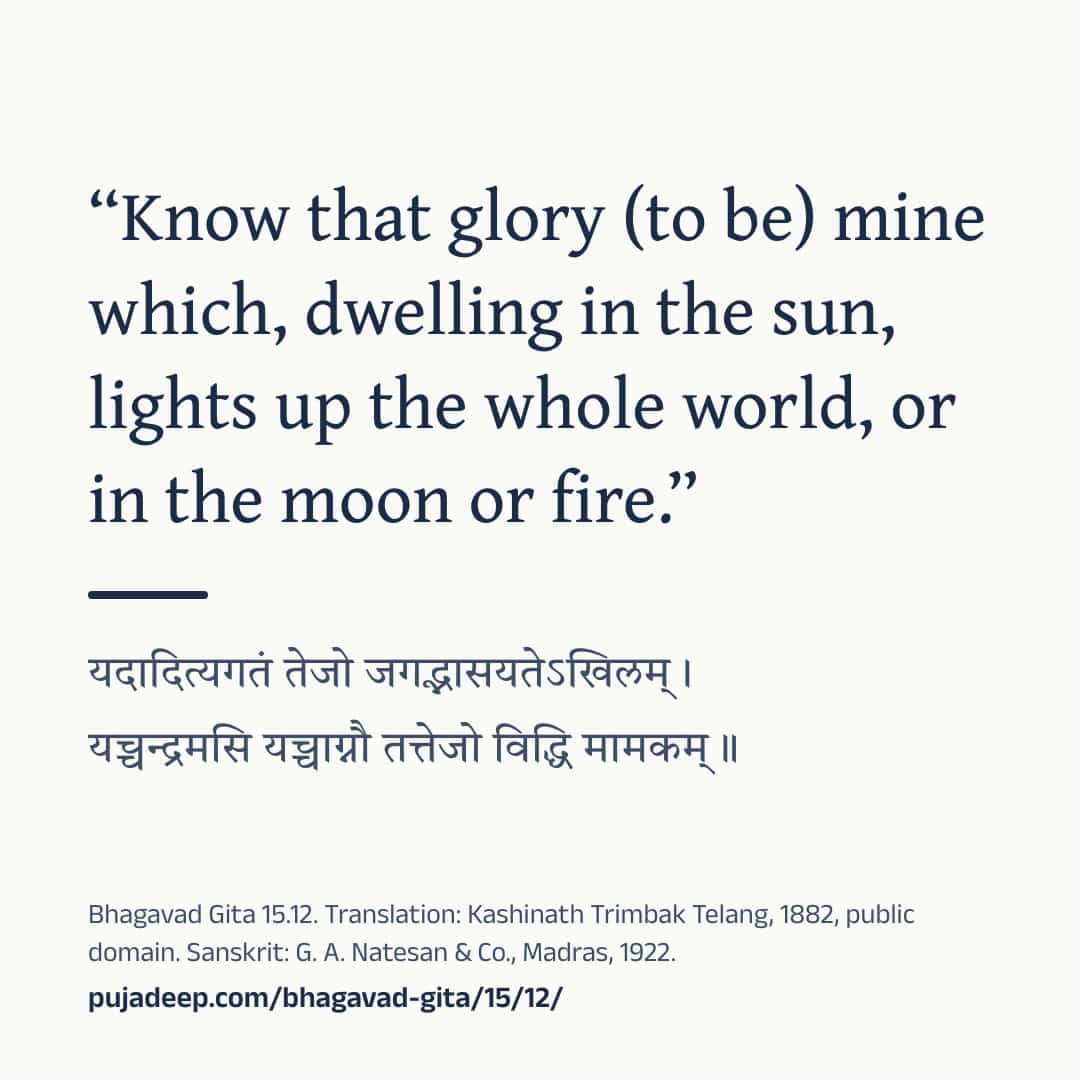
यदादित्यगतं तेजो जगद्भासयतेऽखिलम् ।
यच्चन्द्रमसि यच्चाग्नौ तत्तेजो विद्धि मामकम् ॥

“Know that glory (to be) mine which, dwelling in the sun, lights up the whole world, or in the moon or fire.”
(K. T. Telang, The Bhagavadgîtâ (The Sacred Books of the East, vol. VIII, Oxford: Clarendon Press, 1882), pp. 112–113, public domain)

“That splendour issuing from the sun that enlighteneth the whole world, that which is in the moon and in fire, that splendour know as from Me.”
(Annie Besant, The Bhagavad Gîtâ, or The Lord's Song (London: Theosophical Publishing Society, 1895), p. 137, public domain)

“The light which residing in the sun, in the moon, in the fire, illumines the whole world—know that light to be Mine.”
(Swami Swarupananda, Srimad-Bhagavad-Gita (Mayavati: Prabuddha Bharata Press, 1909; first printed in Prabuddha Bharata, 1907–1909), p. 330, public domain)

Sanskrit: G. A. Natesan & Co., Madras, 1922.
https://pujadeep.com/bhagavad-gita/15/12/ Nothing is sent from this site. Your own app sends it, to the chat you choose. The picture quotes the translation you chose on this page, with its name and year.
Sanskrit text: The Bhagavad-Gita, or The Lord's Song, with the text in Devanagari and an English translation, 1922. Meanings: written for Pujadeep and checked against the cited edition. Source and changes
Questions families ask
Who speaks Bhagavad Gita 15.12?
Krishna speaks this verse, in chapter 15 (Purushottama Yoga).
Where does the Sanskrit text come from?
Sanskrit text: The Bhagavad-Gita, or The Lord's Song, with the text in Devanagari and an English translation, 1922. Meanings: written for Pujadeep and checked against the cited edition. See the source
Is the meaning on this page a translation?
Explanation written for this site from the sources listed here, and checked against the cited edition. It is not a translation and not the only way to read the text. Free to quote with credit.
Source and licence
- Sanskrit text
- The Bhagavad-Gita, or The Lord's Song, with the text in Devanagari and an English translation (Annie Besant, G. A. Natesan & Co., Madras, 1922). Public domain. The Sanskrit on these pages was read from this printing’s page images.
- Translation
- The Bhagavadgîtâ with the Sanatsugâtîya and the Anugîtâ, translated by Kâshinâth Trimbak Telang (The Sacred Books of the East, vol. VIII, ed. F. Max Müller) (Kashinath Trimbak Telang, F. Max Müller, Clarendon Press, Oxford, 1882). Public domain. Shown verbatim, as printed.
- Translation
- The Bhagavad Gîtâ, or The Lord's Song, translated by Annie Besant (Annie Besant, Theosophical Publishing Society, London, 1895). Public domain. Shown verbatim, as printed.
- Translation
- Srimad-Bhagavad-Gita, with Sanskrit Text; Paraphrase with Word-by-word Literal Translation; English Rendering and Comments, Index, &c., by the Swami Swarupananda (Himalayan Series, No. XX) (Swami Swarupananda, The Editors and Publishers, Advaita Ashrama, Mayavati, Prabuddha Bharata Press, Mayavati, Almora, Himalayas, 1909). Public domain. Shown verbatim, as printed.
- Common wording
- In this text, 32 words follow today's common wording, checked against sanskritdocuments.org; Sanskrit Wikisource; Gita Press, Gorakhpur; GRETIL, Göttingen and Bhaktivedanta Book Trust.
- Our explanation
- Explanation written for this site from the sources listed here, and checked against the cited edition. It is not a translation and not the only way to read the text. Free to quote with credit.
- Checked
- Checked against the cited edition, October 15, 2026.
- Updated
- October 25, 2026