Bhagavad Gita 15.4: meaning and translation
Chapter 15: Purushottama Yoga. Krishna says
Then, Krishna says, one should seek that place from which those who reach it do not return, taking refuge in that first Person (puruṣa) from whom the ancient flow of the world came forth.
Click or tap a word for its meaning and its dictionary page.
Text and layers
Text and layers
These choices stay in this browser.
Bhagavad Gita 15.4
ततः पदं तत्परिमार्गितव्यम् यस्मिन्गता न निवर्तन्ति भूयः ।तमेव चाद्यं पुरुषं प्रपद्ये यतः प्रवृत्तिः प्रसृता पुराणी ॥
Tatah padam tatparimargitavyam yasmingata na nivartanti bhuyahTameva chadyam purusham prapadye yatah pravrittih prasrita purani
tataḥ padaṃ tatparimārgitavyam yasmingatā na nivartanti bhūyaḥ |tameva cādyaṃ puruṣaṃ prapadye yataḥ pravṛttiḥ prasṛtā purāṇī ||
Our explanation Then, Krishna says, one should seek that place from which those who reach it do not return, taking refuge in that first Person (puruṣa) from whom the ancient flow of the world came forth. In the verse the seeker says this of himself (prapadye, a first-person verb meaning "take refuge").
हिंदी अर्थ कृष्ण कहते हैं कि तब उस पद को खोजना चाहिए जहाँ पहुँचकर लोग लौटते नहीं, और उस आदि पुरुष की शरण लेनी चाहिए जिससे संसार का यह पुराना प्रवाह निकला है। श्लोक में खोजने वाला यह बात अपने बारे में कहता है (“प्रपद्ये”, उत्तम पुरुष की क्रिया, अर्थ “शरण लेना”)।
Word by word
Every word, with its dictionary page
Word by word
- ततः tataḥ · then (indeclinable) Dictionary: tatas, Monier-Williams 1899, p. 432, col. 2 “thereupon, then, after that, afterwards”
- पदम् padam · the place, the state (nominative singular) Dictionary: pada, Monier-Williams 1899, p. 583, col. 1 “a footing, standpoint; position, rank, station, site, abode, home”
- तत् tat · that (pronoun, nominative singular) Dictionary: tad, Monier-Williams 1899, p. 434, col. 1 “m. he, f. she, n. it, that, this”
- परिमार्गितव्यम् parimārgitavyam · is to be sought (gerundive ("to be done"), nominative singular) Dictionary: pari-mārgitavya, Monier-Williams 1899, p. 599, col. 1 “to be sought after”
- यस्मिन् yasmin · where, in which (relative pronoun, locative singular) Dictionary: yad, Monier-Williams 1899, p. 844, col. 2 “who, which, what, whichever, whatever, that”
- गताः gatāḥ · having gone (past participle, nominative plural) Dictionary: gata, Monier-Williams 1899, p. 347, col. 1 “gone to any state or condition”
- न na · not (indeclinable) Dictionary: 2. na, Monier-Williams 1899, p. 523, col. 1 “not, no, nor, neither”
- निवर्तन्ति nivartanti · return (present, 3rd person plural) Dictionary: ni-vṛt, Monier-Williams 1899, p. 560, col. 1 “to turn back, stop; to return from”
- भूयः bhūyaḥ · again (adverb) Dictionary: bhūyas, Monier-Williams 1899, p. 763, col. 3 “once more, again, anew”
- तम् tam · to that (pronoun, accusative singular) Dictionary: tad, Monier-Williams 1899, p. 434, col. 1 “m. he, f. she, n. it, that, this”
- एव eva · indeed (indeclinable) Dictionary: 1. eva, Monier-Williams 1899, p. 232, col. 2 “indeed, truly, really”
- च ca · and (indeclinable) Dictionary: 2. ca, Monier-Williams 1899, p. 380, col. 1 “and, both, also, moreover, as well as”
- आद्यम् ādyam · first, primal (accusative singular) Dictionary: 1. ādya, Monier-Williams 1899, p. 137, col. 1 “being at the beginning, first, primitive”
- पुरुषम् puruṣam · Person, Purusha (accusative singular) Dictionary: puruṣa, Monier-Williams 1899, p. 637, col. 1 “the Supreme Being or Soul of the universe”
- प्रपद्ये prapadye · "I take refuge" (present, 1st person singular) Dictionary: 1. pra-pad, Monier-Williams 1899, p. 682, col. 1 “to fly to for succour, take refuge with”
- यतः yataḥ · from whom (indeclinable) Dictionary: yatas, Monier-Williams 1899, p. 841, col. 2 “from which or what, whence, whereof, wherefrom”
- प्रवृत्तिः pravṛttiḥ · the flow, the coming forth (nominative singular) Dictionary: pra-vṛtti, Monier-Williams 1899, p. 694, col. 1 “moving onwards, advance, progress; coming forth, appearance, manifestation”
- प्रसृता prasṛtā · has spread out (past participle, nominative singular (feminine)) Dictionary: pra-sṛta, Monier-Williams 1899, p. 698, col. 2 “wide-spreading”
- पुराणी purāṇī · ancient (nominative singular (feminine)) Dictionary: purāṇa, Monier-Williams 1899, p. 635, col. 1 “belonging to ancient or olden times, ancient, old”
1 printing differs
Edition differences. Another printing or text reads this place differently.
- Spelling A digital text reads Same words. The e-text writes anusvara at the end of the first quarter (परिमार्गितव्यं), as another digital text does; the 1922 edition prints म् at the end of the printed line (परिमार्गितव्यम्). The e-text also prints a danda after प्रपद्ये.
Old translations
Kashinath Trimbak Telang, 1882. Public domain. Page 111.
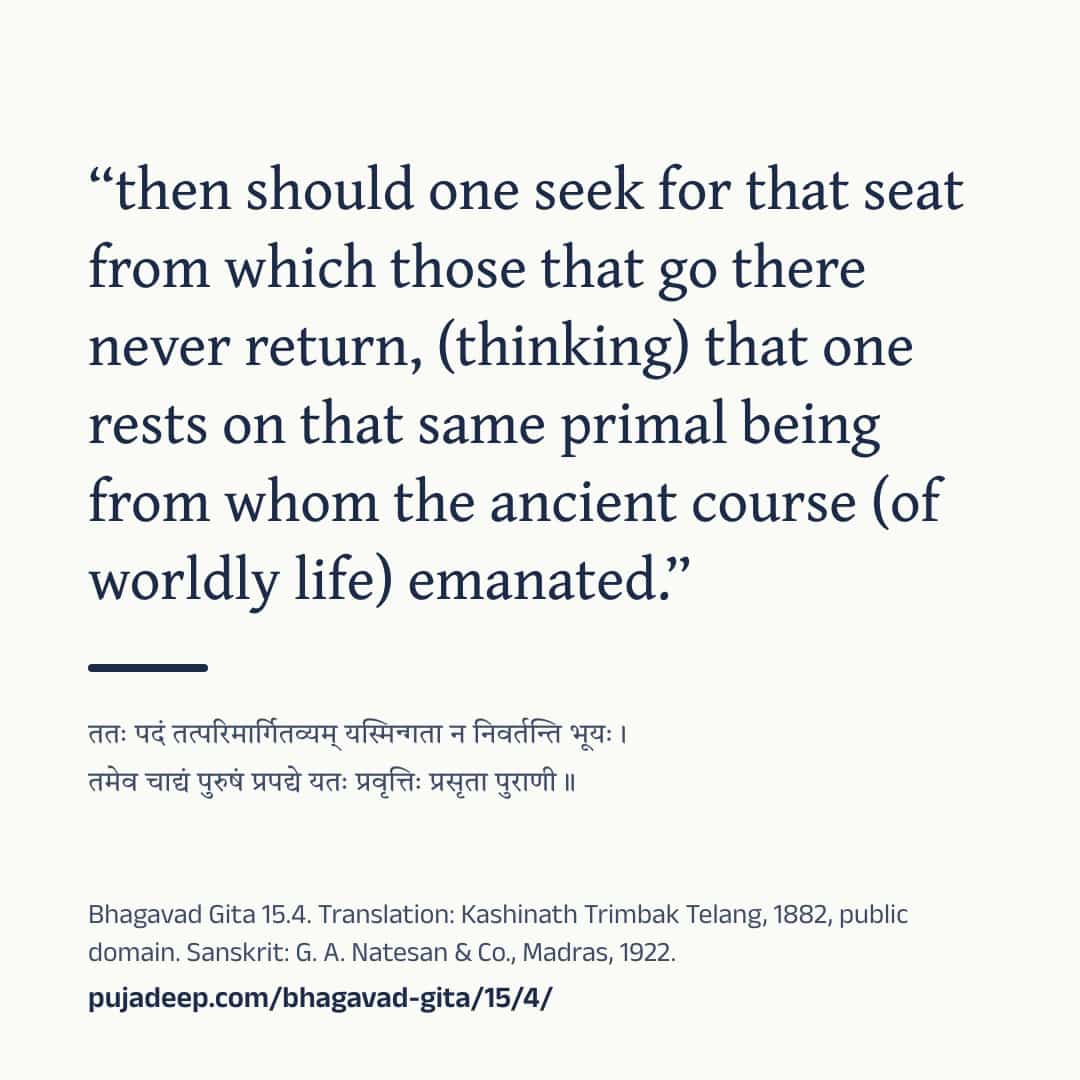
then should one seek for that seat from which those that go there never return, (thinking) that one rests on that same primal being from whom the ancient course (of worldly life) emanated.
This sentence begins in 15.3.
Compare 3 translations
Kashinath Trimbak Telang, 1882. Public domain. Page 111.
then should one seek for that seat from which those that go there never return, (thinking) that one rests on that same primal being from whom the ancient course (of worldly life) emanated.
This sentence begins in 15.3.
You are reading this one
Annie Besant, 1895. Public domain. Page 135–136.
Then that Path may be sought, treading which there is no return; going indeed to that original Purusha whence the ancient forthstreaming sprang.
This sentence begins in 15.3.
You are reading this one
Swami Swarupananda, 1909 (first printed 1907). Public domain.
Swarupananda renders verses 3 and 4 together; see 15.3. Read it at 15.3
You are reading this one
Cite this verse
The translation: K. T. Telang, The Bhagavadgîtâ (The Sacred Books of the East, vol. VIII, Oxford: Clarendon Press, 1882), p. 111. Bhagavad Gita 15.4.
The translation: Annie Besant, The Bhagavad Gîtâ, or The Lord's Song (London: Theosophical Publishing Society, 1895), pp. 135–136. Bhagavad Gita 15.4.
The translation: Swami Swarupananda, Srimad-Bhagavad-Gita (Mayavati: Prabuddha Bharata Press, 1909; first printed in Prabuddha Bharata, 1907–1909), p. 285. Bhagavad Gita 15.3–4.
Our explanation: “Bhagavad Gita 15.4: meaning and translation.” Pujadeep. Updated October 25, 2026. https://pujadeep.com/bhagavad-gita/15/4/
Pujadeep’s explanations are free to quote with credit: name Pujadeep and link to the page. How to credit
Classical readings, by school
No readings by school on this verse yet.
Share
Show the ways to share
Send one picture or the text to one chat. The picture names its source and the address of this page.
Drawing the picture
See the words
Bhagavad Gita 15.4

ततः पदं तत्परिमार्गितव्यम् यस्मिन्गता न निवर्तन्ति भूयः ।
तमेव चाद्यं पुरुषं प्रपद्ये यतः प्रवृत्तिः प्रसृता पुराणी ॥

“then should one seek for that seat from which those that go there never return, (thinking) that one rests on that same primal being from whom the ancient course (of worldly life) emanated.”
(K. T. Telang, The Bhagavadgîtâ (The Sacred Books of the East, vol. VIII, Oxford: Clarendon Press, 1882), p. 111, public domain)
This sentence begins in 15.3.

“Then that Path may be sought, treading which there is no return; going indeed to that original Purusha whence the ancient forthstreaming sprang.”
(Annie Besant, The Bhagavad Gîtâ, or The Lord's Song (London: Theosophical Publishing Society, 1895), pp. 135–136, public domain)
This sentence begins in 15.3.

Sanskrit: G. A. Natesan & Co., Madras, 1922.
https://pujadeep.com/bhagavad-gita/15/4/ Nothing is sent from this site. Your own app sends it, to the chat you choose. The picture quotes the translation you chose on this page, with its name and year.
Sanskrit text: The Bhagavad-Gita, or The Lord's Song, with the text in Devanagari and an English translation, 1922. Meanings: written for Pujadeep and checked against the cited edition. Source and changes
Questions families ask
Who speaks Bhagavad Gita 15.4?
Krishna speaks this verse, in chapter 15 (Purushottama Yoga).
Where does the Sanskrit text come from?
Sanskrit text: The Bhagavad-Gita, or The Lord's Song, with the text in Devanagari and an English translation, 1922. Meanings: written for Pujadeep and checked against the cited edition. See the source
Is the meaning on this page a translation?
Explanation written for this site from the sources listed here, and checked against the cited edition. It is not a translation and not the only way to read the text. Free to quote with credit.
Source and licence
- Sanskrit text
- The Bhagavad-Gita, or The Lord's Song, with the text in Devanagari and an English translation (Annie Besant, G. A. Natesan & Co., Madras, 1922). Public domain. The Sanskrit on these pages was read from this printing’s page images.
- Translation
- The Bhagavadgîtâ with the Sanatsugâtîya and the Anugîtâ, translated by Kâshinâth Trimbak Telang (The Sacred Books of the East, vol. VIII, ed. F. Max Müller) (Kashinath Trimbak Telang, F. Max Müller, Clarendon Press, Oxford, 1882). Public domain. Shown verbatim, as printed.
- Translation
- The Bhagavad Gîtâ, or The Lord's Song, translated by Annie Besant (Annie Besant, Theosophical Publishing Society, London, 1895). Public domain. Shown verbatim, as printed.
- Translation
- Srimad-Bhagavad-Gita, with Sanskrit Text; Paraphrase with Word-by-word Literal Translation; English Rendering and Comments, Index, &c., by the Swami Swarupananda (Himalayan Series, No. XX) (Swami Swarupananda, The Editors and Publishers, Advaita Ashrama, Mayavati, Prabuddha Bharata Press, Mayavati, Almora, Himalayas, 1909). Public domain. Shown verbatim, as printed.
- Common wording
- In this text, 32 words follow today's common wording, checked against sanskritdocuments.org; Sanskrit Wikisource; Gita Press, Gorakhpur; GRETIL, Göttingen and Bhaktivedanta Book Trust.
- Our explanation
- Explanation written for this site from the sources listed here, and checked against the cited edition. It is not a translation and not the only way to read the text. Free to quote with credit.
- Checked
- Checked against the cited edition, October 15, 2026.
- Updated
- October 25, 2026