Bhagavad Gita 15.8: meaning and translation
Chapter 15: Purushottama Yoga. Krishna says
When the lord of the body (īśvara) takes a body and when he leaves it, Krishna says, he takes these senses and the mind with him, as the wind carries scents from their place.
Click or tap a word for its meaning and its dictionary page.
Text and layers
Text and layers
These choices stay in this browser.
Bhagavad Gita 15.8
शरीरं यदवाप्नोति यच्चाप्युत्क्रामतीश्वरः ।गृहीत्वैतानि संयाति वायुर्गन्धानिवाशयात् ॥
Shariram yadavapnoti yachchapyutkramatishvarahGrihitvaitani sanyati vayurgandhanivashayat
śarīraṃ yadavāpnoti yaccāpyutkrāmatīśvaraḥ |gṛhītvaitāni saṃyāti vāyurgandhānivāśayāt ||
Our explanation When the lord of the body (īśvara) takes a body and when he leaves it, Krishna says, he takes these senses and the mind with him, as the wind carries scents from their place. Telang renders īśvara here as 'the ruler (of the bodily frame)', that is, the embodied self.
हिंदी अर्थ कृष्ण कहते हैं कि जब शरीर का स्वामी (ईश्वर) शरीर पाता है और जब उसे छोड़ता है, तब वह इन इंद्रियों और मन को साथ ले जाता है, जैसे हवा गंध को उसके स्थान से ले जाती है। तेलंग यहाँ “ईश्वर” का अनुवाद “शरीर का शासक” करते हैं, यानी देहधारी जीव।
Word by word
Every word, with its dictionary page
Word by word
- शरीरम् śarīram · a body (accusative singular) Dictionary: śarīra, Monier-Williams 1899, p. 1057, col. 3 “the body, bodily frame, solid parts of the body”
- यत् yat · when (indeclinable) Dictionary: yad, Monier-Williams 1899, p. 844, col. 2 “who, which, what, whichever, whatever, that”
- अवाप्नोति avāpnoti · takes on, obtains (present, 3rd person singular) Dictionary: avāp, Monier-Williams 1899, p. 107, col. 1 “to reach, attain, obtain, gain, get”
- यत् yat · when (indeclinable) Dictionary: yad, Monier-Williams 1899, p. 844, col. 2 “who, which, what, whichever, whatever, that”
- च ca · and (indeclinable) Dictionary: 2. ca, Monier-Williams 1899, p. 380, col. 1 “and, both, also, moreover, as well as”
- अपि api · also (indeclinable) Dictionary: api, Monier-Williams 1899, p. 55, col. 1 “and, also, moreover, besides”
- उत्क्रामति utkrāmati · leaves, goes out (present, 3rd person singular) Dictionary: ut-kram, Monier-Williams 1899, p. 176, col. 3 “to step out, go out or away; to pass away, die”
- ईश्वरः īśvaraḥ · the lord (of the body) (nominative singular) Dictionary: īśvara, Monier-Williams 1899, p. 171, col. 1 “master, lord, prince, king”
- गृहीत्वा gṛhītvā · having taken (absolutive ('having done')) Dictionary: grah, Monier-Williams 1899, p. 371, col. 3 “to seize, take”
- एतानि etāni · these (pronoun, accusative plural) Dictionary: etad, Monier-Williams 1899, p. 231, col. 2 “this, this here, here”
- संयाति saṃyāti · goes along (present, 3rd person singular) Dictionary: saṃ-yā, Monier-Williams 1899, p. 1112, col. 1 “to go or proceed together, go, wander, travel”
- वायुः vāyuḥ · the wind (nominative singular) Dictionary: 1. vāyu, Monier-Williams 1899, p. 942, col. 2 “wind, air (as one of the 5 elements)”
- गन्धान् gandhān · scents (accusative plural) Dictionary: gandha, Monier-Williams 1899, p. 345, col. 1 “smell, odour”
- इव iva · like, as (indeclinable) Dictionary: iva, Monier-Williams 1899, p. 168, col. 3 “like, in the same manner as”
- आशयात् āśayāt · from their seat, their source (ablative singular) Dictionary: ā-śaya, Monier-Williams 1899, p. 157, col. 3 “resting-place, bed; seat, place”
Old translations
Kashinath Trimbak Telang, 1882. Public domain. Page 112.
Whenever the ruler (of the bodily frame) obtains or quits a body, he goes taking these (with him) as the wind (takes) perfumes from (their) seats1.
Footnotes (the translator’s own) - Cf. Kaushîtaki-upanishad, pp. 86, 87. ↩
Compare 3 translations
Kashinath Trimbak Telang, 1882. Public domain. Page 112.
Whenever the ruler (of the bodily frame) obtains or quits a body, he goes taking these (with him) as the wind (takes) perfumes from (their) seats1.
Footnotes (the translator’s own) - Cf. Kaushîtaki-upanishad, pp. 86, 87. ↩
You are reading this one
Annie Besant, 1895. Public domain. Page 136.
When the Lord acquireth a body and when He abandoneth it, He seizeth these and goeth with them, as the wind (takes) fragrances from their retreats.
You are reading this one
Swami Swarupananda, 1909 (first printed 1907). Public domain. Page 287.
When the Lord obtains a body and when He leaves it He takes these and goes, as the wind takes the scents from their seats (the flowers).
You are reading this one
Cite this verse
The translation: K. T. Telang, The Bhagavadgîtâ (The Sacred Books of the East, vol. VIII, Oxford: Clarendon Press, 1882), p. 112. Bhagavad Gita 15.8.
The translation: Annie Besant, The Bhagavad Gîtâ, or The Lord's Song (London: Theosophical Publishing Society, 1895), p. 136. Bhagavad Gita 15.8.
The translation: Swami Swarupananda, Srimad-Bhagavad-Gita (Mayavati: Prabuddha Bharata Press, 1909; first printed in Prabuddha Bharata, 1907–1909), p. 287. Bhagavad Gita 15.8.
Our explanation: “Bhagavad Gita 15.8: meaning and translation.” Pujadeep. Updated October 25, 2026. https://pujadeep.com/bhagavad-gita/15/8/
Pujadeep’s explanations are free to quote with credit: name Pujadeep and link to the page. How to credit
Classical readings, by school
No readings by school on this verse yet.
Share
Show the ways to share
Send one picture or the text to one chat. The picture names its source and the address of this page.
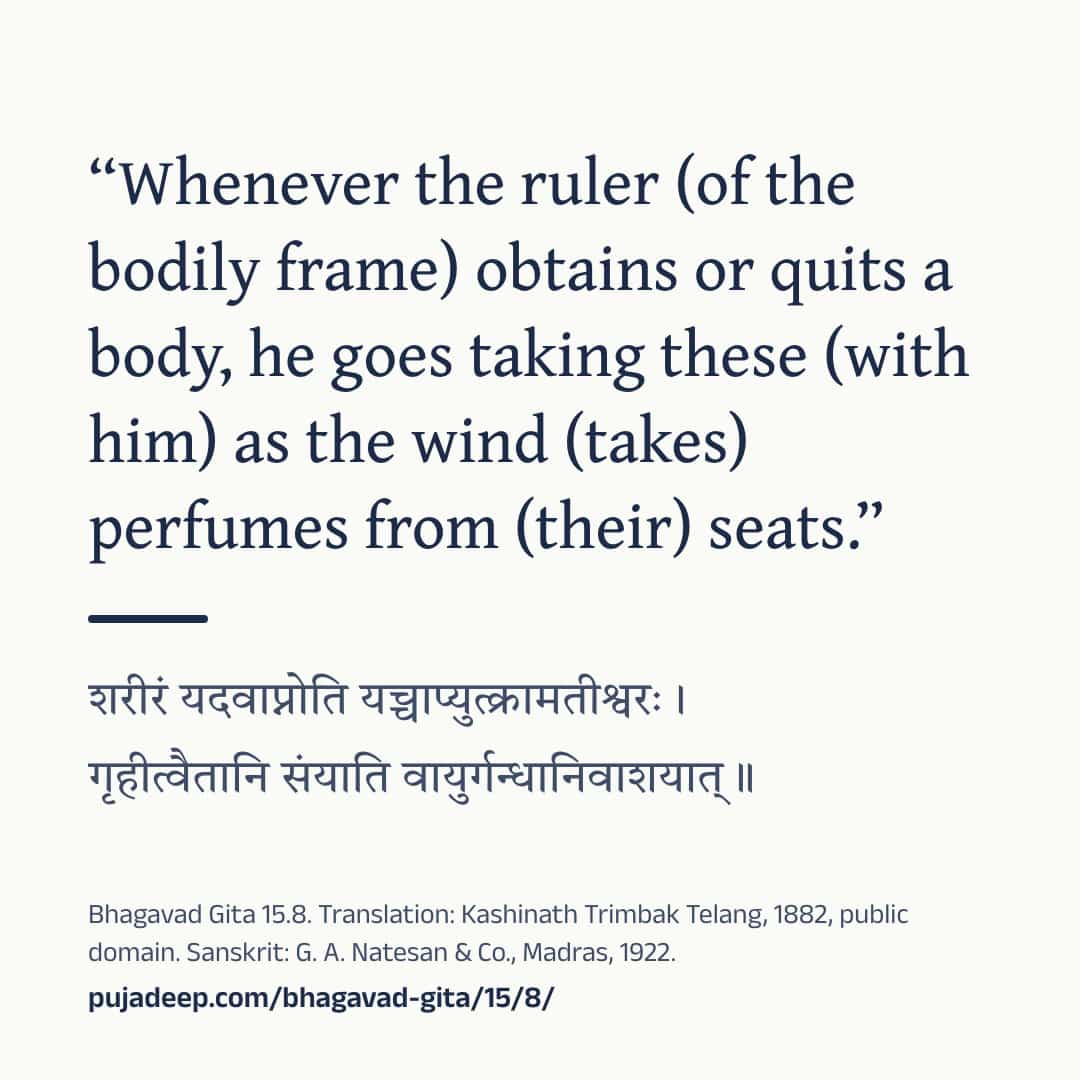
Drawing the picture
See the words
Bhagavad Gita 15.8

शरीरं यदवाप्नोति यच्चाप्युत्क्रामतीश्वरः ।
गृहीत्वैतानि संयाति वायुर्गन्धानिवाशयात् ॥

“Whenever the ruler (of the bodily frame) obtains or quits a body, he goes taking these (with him) as the wind (takes) perfumes from (their) seats.”
(K. T. Telang, The Bhagavadgîtâ (The Sacred Books of the East, vol. VIII, Oxford: Clarendon Press, 1882), p. 112, public domain)

“When the Lord acquireth a body and when He abandoneth it, He seizeth these and goeth with them, as the wind (takes) fragrances from their retreats.”
(Annie Besant, The Bhagavad Gîtâ, or The Lord's Song (London: Theosophical Publishing Society, 1895), p. 136, public domain)

“When the Lord obtains a body and when He leaves it He takes these and goes, as the wind takes the scents from their seats (the flowers).”
(Swami Swarupananda, Srimad-Bhagavad-Gita (Mayavati: Prabuddha Bharata Press, 1909; first printed in Prabuddha Bharata, 1907–1909), p. 287, public domain)

Sanskrit: G. A. Natesan & Co., Madras, 1922.
https://pujadeep.com/bhagavad-gita/15/8/ Nothing is sent from this site. Your own app sends it, to the chat you choose. The picture quotes the translation you chose on this page, with its name and year.
Sanskrit text: The Bhagavad-Gita, or The Lord's Song, with the text in Devanagari and an English translation, 1922. Meanings: written for Pujadeep and checked against the cited edition. Source and changes
Questions families ask
Who speaks Bhagavad Gita 15.8?
Krishna speaks this verse, in chapter 15 (Purushottama Yoga).
Where does the Sanskrit text come from?
Sanskrit text: The Bhagavad-Gita, or The Lord's Song, with the text in Devanagari and an English translation, 1922. Meanings: written for Pujadeep and checked against the cited edition. See the source
Is the meaning on this page a translation?
Explanation written for this site from the sources listed here, and checked against the cited edition. It is not a translation and not the only way to read the text. Free to quote with credit.
Source and licence
- Sanskrit text
- The Bhagavad-Gita, or The Lord's Song, with the text in Devanagari and an English translation (Annie Besant, G. A. Natesan & Co., Madras, 1922). Public domain. The Sanskrit on these pages was read from this printing’s page images.
- Translation
- The Bhagavadgîtâ with the Sanatsugâtîya and the Anugîtâ, translated by Kâshinâth Trimbak Telang (The Sacred Books of the East, vol. VIII, ed. F. Max Müller) (Kashinath Trimbak Telang, F. Max Müller, Clarendon Press, Oxford, 1882). Public domain. Shown verbatim, as printed.
- Translation
- The Bhagavad Gîtâ, or The Lord's Song, translated by Annie Besant (Annie Besant, Theosophical Publishing Society, London, 1895). Public domain. Shown verbatim, as printed.
- Translation
- Srimad-Bhagavad-Gita, with Sanskrit Text; Paraphrase with Word-by-word Literal Translation; English Rendering and Comments, Index, &c., by the Swami Swarupananda (Himalayan Series, No. XX) (Swami Swarupananda, The Editors and Publishers, Advaita Ashrama, Mayavati, Prabuddha Bharata Press, Mayavati, Almora, Himalayas, 1909). Public domain. Shown verbatim, as printed.
- Common wording
- In this text, 32 words follow today's common wording, checked against sanskritdocuments.org; Sanskrit Wikisource; Gita Press, Gorakhpur; GRETIL, Göttingen and Bhaktivedanta Book Trust.
- Our explanation
- Explanation written for this site from the sources listed here, and checked against the cited edition. It is not a translation and not the only way to read the text. Free to quote with credit.
- Checked
- Checked against the cited edition, October 15, 2026.
- Updated
- October 25, 2026