Bhagavad Gita 15.10: meaning and translation
Chapter 15: Purushottama Yoga. Krishna says
The deluded do not see this self, Krishna says, whether it is leaving the body, staying in it, or enjoying, joined with the guṇas.
Click or tap a word for its meaning and its dictionary page.
Text and layers
Text and layers
These choices stay in this browser.
Bhagavad Gita 15.10
उत्क्रामन्तं स्थितं वापि भुञ्जानं वा गुणान्वितम् ।विमूढा नानुपश्यन्ति पश्यन्ति ज्ञानचक्षुषः ॥
Utkramantam sthitam vapi bhunjanam va gunanvitamVimudha nanupashyanti pashyanti jnanachakshushah
utkrāmantaṃ sthitaṃ vāpi bhuñjānaṃ vā guṇānvitam |vimūḍhā nānupaśyanti paśyanti jñānacakṣuṣaḥ ||
Our explanation The deluded do not see this self, Krishna says, whether it is leaving the body, staying in it, or enjoying, joined with the guṇas. Those who have the eye of knowledge see it.
हिंदी अर्थ कृष्ण कहते हैं कि शरीर छोड़ते, उसमें रहते, या गुणों से जुड़कर भोग करते हुए इस जीव को मूढ़ लोग नहीं देखते। जिनके पास ज्ञान की आँख है, वे देखते हैं।
Word by word
Every word, with its dictionary page
Word by word
- उत्क्रामन्तम् utkrāmantam · leaving (the body) (present participle, accusative singular) Dictionary: ut-kram, Monier-Williams 1899, p. 176, col. 3 “to step out, go out or away; to pass away, die”
- स्थितम् sthitam · staying (past participle, accusative singular) Dictionary: sthita, Monier-Williams 1899, p. 1264, col. 1 “standing, staying, situated, resting or abiding or remaining in”
- वा vā · or (indeclinable) Dictionary: 1. vā, Monier-Williams 1899, p. 934, col. 2 “or”
- अपि api · also (indeclinable) Dictionary: api, Monier-Williams 1899, p. 55, col. 1 “and, also, moreover, besides”
- भुञ्जानम् bhuñjānam · experiencing, enjoying (present participle, accusative singular) Dictionary: 3. bhuj, Monier-Williams 1899, p. 759, col. 3 “to suffer, experience, undergo”
- वा vā · or (indeclinable) Dictionary: 1. vā, Monier-Williams 1899, p. 934, col. 2 “or”
- गुणान्वितम् guṇānvitam · joined with the guṇas (compound, accusative singular) Dictionary: guṇa, Monier-Williams 1899, p. 357, col. 1 “a quality, peculiarity, attribute or property”; anv-ita, Monier-Williams 1899, p. 47, col. 2 “gone along with; joined, attended, accompanied by, connected with”
- विमूढाः vimūḍhāḥ · the deluded (past participle, nominative plural) Dictionary: vi-mūḍha, Monier-Williams 1899, p. 980, col. 3; vi-mugdha, Monier-Williams 1899, p. 980, col. 3 “confused, bewildered, infatuated”
- न na · not (indeclinable) Dictionary: 2. na, Monier-Williams 1899, p. 523, col. 1 “not, no, nor, neither”
- अनुपश्यन्ति anupaśyanti · perceive (present, 3rd person plural) Dictionary: anu-paś, Monier-Williams 1899, p. 35, col. 1 “to look at, perceive, notice, discover”
- पश्यन्ति paśyanti · see (present, 3rd person plural) Dictionary: 1. paś, Monier-Williams 1899, p. 611, col. 2 “to see, behold, look at, observe, perceive, notice”
- ज्ञानचक्षुषः jñānacakṣuṣaḥ · those with the eye of knowledge (compound, nominative plural) Dictionary: jñāna-cakṣus, Monier-Williams 1899, p. 426, col. 1 “the eye of intelligence, inner eye, intellectual vision”
Old translations
Kashinath Trimbak Telang, 1882. Public domain. Page 112.
Those who are deluded do not see (him) remaining in or quitting (a body), enjoying or joined to the qualities1; they see, who have eyes of knowledge.
Footnotes (the translator’s own) - Perceiving objects of sense, or feeling pleasure, pain, &c. ↩
Compare 3 translations
Kashinath Trimbak Telang, 1882. Public domain. Page 112.
Those who are deluded do not see (him) remaining in or quitting (a body), enjoying or joined to the qualities1; they see, who have eyes of knowledge.
Footnotes (the translator’s own) - Perceiving objects of sense, or feeling pleasure, pain, &c. ↩
You are reading this one
Annie Besant, 1895. Public domain. Page 137.
The deluded do not perceive Him when He departeth or stayeth, or guided by the Gunas, enjoyeth; the eyes of wisdom perceive.
You are reading this one
Swami Swarupananda, 1909 (first printed 1907). Public domain. Page 288.
Transmigrating from one body to another, or residing (in the same) or experiencing,—as He is united with the Gunas,—the deluded do not see Him, but those who have the eye of wisdom behold Him.
You are reading this one
Cite this verse
The translation: K. T. Telang, The Bhagavadgîtâ (The Sacred Books of the East, vol. VIII, Oxford: Clarendon Press, 1882), p. 112. Bhagavad Gita 15.10.
The translation: Annie Besant, The Bhagavad Gîtâ, or The Lord's Song (London: Theosophical Publishing Society, 1895), p. 137. Bhagavad Gita 15.10.
The translation: Swami Swarupananda, Srimad-Bhagavad-Gita (Mayavati: Prabuddha Bharata Press, 1909; first printed in Prabuddha Bharata, 1907–1909), p. 288. Bhagavad Gita 15.10.
Our explanation: “Bhagavad Gita 15.10: meaning and translation.” Pujadeep. Updated October 25, 2026. https://pujadeep.com/bhagavad-gita/15/10/
Pujadeep’s explanations are free to quote with credit: name Pujadeep and link to the page. How to credit
Classical readings, by school
No readings by school on this verse yet.
Share
Show the ways to share
Send one picture or the text to one chat. The picture names its source and the address of this page.
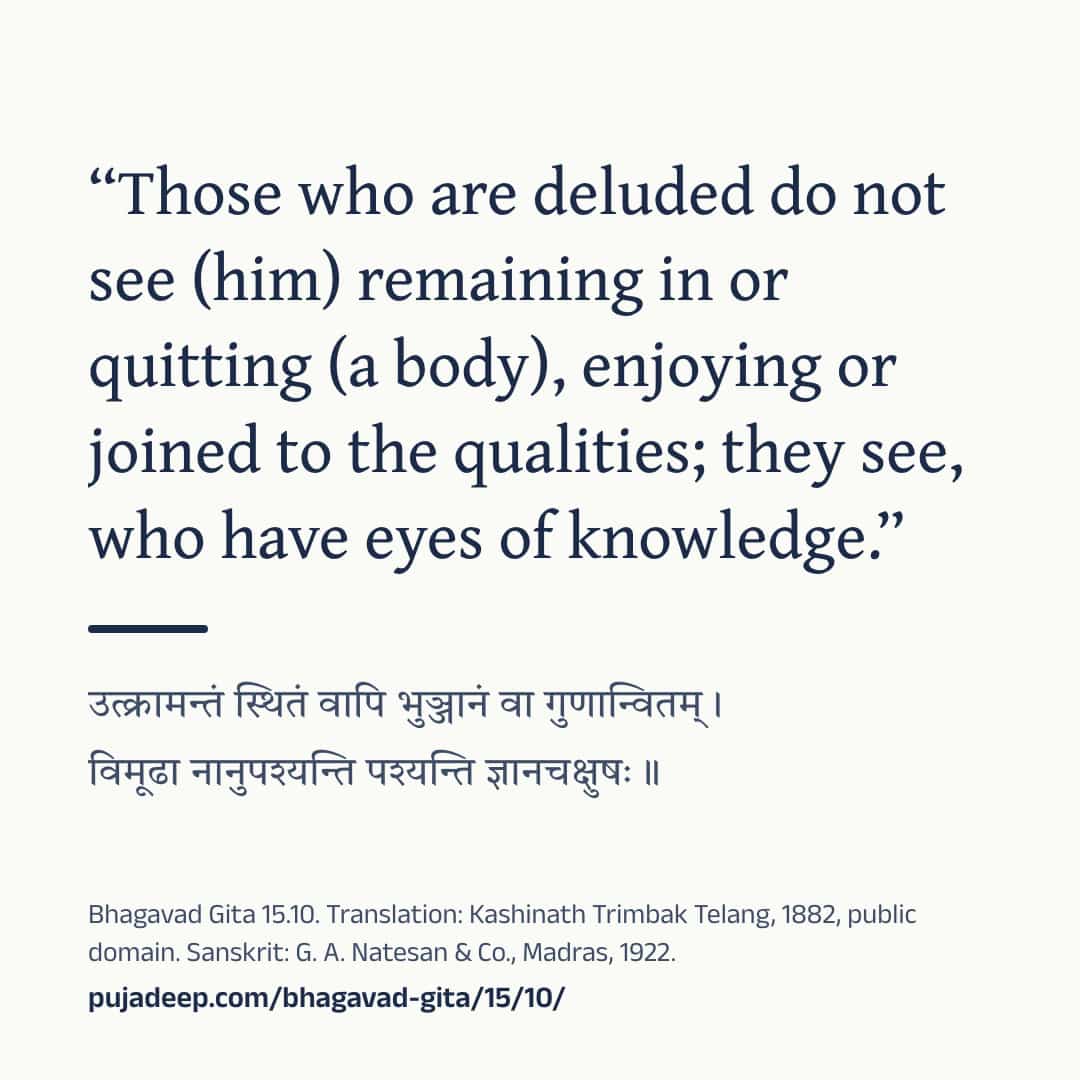
Drawing the picture
See the words
Bhagavad Gita 15.10

उत्क्रामन्तं स्थितं वापि भुञ्जानं वा गुणान्वितम् ।
विमूढा नानुपश्यन्ति पश्यन्ति ज्ञानचक्षुषः ॥

“Those who are deluded do not see (him) remaining in or quitting (a body), enjoying or joined to the qualities; they see, who have eyes of knowledge.”
(K. T. Telang, The Bhagavadgîtâ (The Sacred Books of the East, vol. VIII, Oxford: Clarendon Press, 1882), p. 112, public domain)

“The deluded do not perceive Him when He departeth or stayeth, or guided by the Gunas, enjoyeth; the eyes of wisdom perceive.”
(Annie Besant, The Bhagavad Gîtâ, or The Lord's Song (London: Theosophical Publishing Society, 1895), p. 137, public domain)

“Transmigrating from one body to another, or residing (in the same) or experiencing,—as He is united with the Gunas,—the deluded do not see Him, but those who have the eye of wisdom behold Him.”
(Swami Swarupananda, Srimad-Bhagavad-Gita (Mayavati: Prabuddha Bharata Press, 1909; first printed in Prabuddha Bharata, 1907–1909), p. 288, public domain)

Sanskrit: G. A. Natesan & Co., Madras, 1922.
https://pujadeep.com/bhagavad-gita/15/10/ Nothing is sent from this site. Your own app sends it, to the chat you choose. The picture quotes the translation you chose on this page, with its name and year.
Sanskrit text: The Bhagavad-Gita, or The Lord's Song, with the text in Devanagari and an English translation, 1922. Meanings: written for Pujadeep and checked against the cited edition. Source and changes
Questions families ask
Who speaks Bhagavad Gita 15.10?
Krishna speaks this verse, in chapter 15 (Purushottama Yoga).
Where does the Sanskrit text come from?
Sanskrit text: The Bhagavad-Gita, or The Lord's Song, with the text in Devanagari and an English translation, 1922. Meanings: written for Pujadeep and checked against the cited edition. See the source
Is the meaning on this page a translation?
Explanation written for this site from the sources listed here, and checked against the cited edition. It is not a translation and not the only way to read the text. Free to quote with credit.
Source and licence
- Sanskrit text
- The Bhagavad-Gita, or The Lord's Song, with the text in Devanagari and an English translation (Annie Besant, G. A. Natesan & Co., Madras, 1922). Public domain. The Sanskrit on these pages was read from this printing’s page images.
- Translation
- The Bhagavadgîtâ with the Sanatsugâtîya and the Anugîtâ, translated by Kâshinâth Trimbak Telang (The Sacred Books of the East, vol. VIII, ed. F. Max Müller) (Kashinath Trimbak Telang, F. Max Müller, Clarendon Press, Oxford, 1882). Public domain. Shown verbatim, as printed.
- Translation
- The Bhagavad Gîtâ, or The Lord's Song, translated by Annie Besant (Annie Besant, Theosophical Publishing Society, London, 1895). Public domain. Shown verbatim, as printed.
- Translation
- Srimad-Bhagavad-Gita, with Sanskrit Text; Paraphrase with Word-by-word Literal Translation; English Rendering and Comments, Index, &c., by the Swami Swarupananda (Himalayan Series, No. XX) (Swami Swarupananda, The Editors and Publishers, Advaita Ashrama, Mayavati, Prabuddha Bharata Press, Mayavati, Almora, Himalayas, 1909). Public domain. Shown verbatim, as printed.
- Common wording
- In this text, 32 words follow today's common wording, checked against sanskritdocuments.org; Sanskrit Wikisource; Gita Press, Gorakhpur; GRETIL, Göttingen and Bhaktivedanta Book Trust.
- Our explanation
- Explanation written for this site from the sources listed here, and checked against the cited edition. It is not a translation and not the only way to read the text. Free to quote with credit.
- Checked
- Checked against the cited edition, October 15, 2026.
- Updated
- October 25, 2026