Bhagavad Gita 15.7: meaning and translation
Chapter 15: Purushottama Yoga. Krishna says
Krishna says that an eternal portion (aṃśa) of himself becomes the living self (jīva) in the world of living beings.
Click or tap a word for its meaning and its dictionary page.
Text and layers
Text and layers
These choices stay in this browser.
Bhagavad Gita 15.7
ममैवांशो जीवलोके जीवभूतः सनातनः ।मनःषष्ठानीन्द्रियाणि प्रकृतिस्थानि कर्षति ॥
Mamaivansho jivaloke jivabhutah sanatanahManahshashthanindriyani prakritisthani karshati
mamaivāṃśo jīvaloke jīvabhūtaḥ sanātanaḥ |manaḥṣaṣṭhānīndriyāṇi prakṛtisthāni karṣati ||
Our explanation Krishna says that an eternal portion (aṃśa) of himself becomes the living self (jīva) in the world of living beings. It draws to itself the mind and the five senses, which rest in nature (prakṛti). The schools differ on what 'portion' means here (see the views).
हिंदी अर्थ कृष्ण कहते हैं कि उनका ही एक सनातन अंश जीव-लोक में जीव बनता है। वह मन और पाँच इंद्रियों को, जो प्रकृति में स्थित हैं, अपनी ओर खींचता है। यहाँ “अंश” का क्या अर्थ है, इस पर परंपराओं में मतभेद है।
Word by word
Every word, with its dictionary page
Word by word
- मम mama · "my" (Krishna's) (pronoun, genitive singular) Dictionary: 1. mad, Monier-Williams 1899, p. 777, col. 2 “base of the first pers. pron. in the sg. number (esp. in comp.)”
- एव eva · indeed (indeclinable) Dictionary: 1. eva, Monier-Williams 1899, p. 232, col. 2 “indeed, truly, really”
- अंशः aṃśaḥ · part, portion (nominative singular) Dictionary: aṃśa, Monier-Williams 1899, p. 1, col. 1 “a share, portion, part, party”
- जीवलोके jīvaloke · in the world of the living (compound, locative singular) Dictionary: jīva-loka, Monier-Williams 1899, p. 423, col. 1 “the world of living beings”
- जीवभूतः jīvabhūtaḥ · having become a living being (compound, nominative singular) Dictionary: jīva-bhūta, Monier-Williams 1899, p. 422, col. 3 “become alive, endowed with life”
- सनातनः sanātanaḥ · eternal (nominative singular) Dictionary: sanātana, Monier-Williams 1899, p. 1141, col. 1 “eternal, perpetual, permanent, everlasting, primeval, ancient”
- मनःषष्ठानि manaḥṣaṣṭhāni · with the mind as the sixth (compound, accusative plural) Dictionary: manas, Monier-Williams 1899, p. 783, col. 3 “mind (in its widest sense as applied to all the mental powers)”; ṣaṣṭha, Monier-Williams 1899, p. 1110, col. 1 “sixth, the sixth”
- इन्द्रियाणि indriyāṇi · the senses (accusative plural) Dictionary: indriya, Monier-Williams 1899, p. 167, col. 2 “faculty of sense, sense, organ of sense”
- प्रकृतिस्थानि prakṛtisthāni · resting in nature (prakṛti) (compound, accusative plural) Dictionary: prakṛti-stha, Monier-Williams 1899, p. 654, col. 2 “inherent, innate, incidental to nature”
- कर्षति karṣati · draws (to itself) (present, 3rd person singular) Dictionary: 1. kṛṣ, Monier-Williams 1899, p. 306, col. 1 “to draw, draw to one's self, drag, pull”
Old translations
Kashinath Trimbak Telang, 1882. Public domain. Page 112.
An eternal portion of me it is, which, becoming an individual soul in the mortal world, draws (to itself) the senses with the mind as the sixth1.
Footnotes (the translator’s own) - Five senses and the mind issue from nature, in which they are absorbed during sleep or at a dissolution of the world. Cf. Sutta Nipâta, p. 44. ↩
Compare 3 translations
Kashinath Trimbak Telang, 1882. Public domain. Page 112.
An eternal portion of me it is, which, becoming an individual soul in the mortal world, draws (to itself) the senses with the mind as the sixth1.
Footnotes (the translator’s own) - Five senses and the mind issue from nature, in which they are absorbed during sleep or at a dissolution of the world. Cf. Sutta Nipâta, p. 44. ↩
You are reading this one
Annie Besant, 1895. Public domain. Page 136.
An immemorial portion of Myself, in the world of life a living being, draweth round Itself the senses of which Manas is the sixth, placed in Prakriti.
You are reading this one
Swami Swarupananda, 1909 (first printed 1907). Public domain. Page 287.
An eternal portion of Myself, having become a living Soul in the world of life, draws (to Itself) the (five) senses with mind for the sixth, abiding in Prakriti.
You are reading this one
Cite this verse
The translation: K. T. Telang, The Bhagavadgîtâ (The Sacred Books of the East, vol. VIII, Oxford: Clarendon Press, 1882), p. 112. Bhagavad Gita 15.7.
The translation: Annie Besant, The Bhagavad Gîtâ, or The Lord's Song (London: Theosophical Publishing Society, 1895), p. 136. Bhagavad Gita 15.7.
The translation: Swami Swarupananda, Srimad-Bhagavad-Gita (Mayavati: Prabuddha Bharata Press, 1909; first printed in Prabuddha Bharata, 1907–1909), p. 287. Bhagavad Gita 15.7.
Our explanation: “Bhagavad Gita 15.7: meaning and translation.” Pujadeep. Updated October 25, 2026. https://pujadeep.com/bhagavad-gita/15/7/
Pujadeep’s explanations are free to quote with credit: name Pujadeep and link to the page. How to credit
Classical readings, by school
Each reading is named by its school. None is presented as the only meaning.
What Advaita, Vishishtadvaita and Dvaita teach, in short
Shankara Advaita
Shankara says the jīva is a portion of the Supreme Self only 'as it were': an imagined portion, marked off by the limiting adjunct (upādhi) that ignorance sets up, since the Self has no parts. It is like the sun reflected in water, or the space inside a jar, which is one with all space when the jar is gone. So the one who reaches that abode does not return.
Source: The Bhagavad-Gita, with the commentary of Sri Sankaracharya, translated by A. Mahadeva Sastri (2nd ed., Mysore: G. T. A. Printing Works, 1901), commentary on 15.7, pp. 361–362. Summarised in our own words; none of its text is reproduced.
Ramanuja Vishishtadvaita
Ramanuja says the self, which is eternal, is a portion of the Lord. Caught in beginningless karma and ignorance, it becomes a living being in bodies such as those of gods and humans, and draws the senses and the mind to itself. When it follows the path of 15.4–15.5, it is freed and regains its own nature.
Source: Sri Bhagavad-Gita with Sri Ramanujacharya's Visishtadvaita commentary, translated by A. Govindacharya (Madras, 1898), commentary on 15.7, pp. 470–471. Summarised in our own words; none of its text is reproduced.
Madhva Dvaita
Madhva says the souls are separate portions of the Lord, not portions of his own being. Forms such as Matsya, Kūrma and Rāma are portions one with the Lord; souls are called portions only because they bear some small likeness to him. They have some power to act, but little, and so, in his reading, refuge is to be taken in the Lord alone.
Source: The Bhagavad-Gita: translation and commentaries in English according to Sri Madhwacharya's Bhashyas, by S. Subba Rau (Madras, 1906), commentary on 15.7, p. 275 (leaf n273). Summarised in our own words; none of its text is reproduced.
Share
Show the ways to share
Send one picture or the text to one chat. The picture names its source and the address of this page.
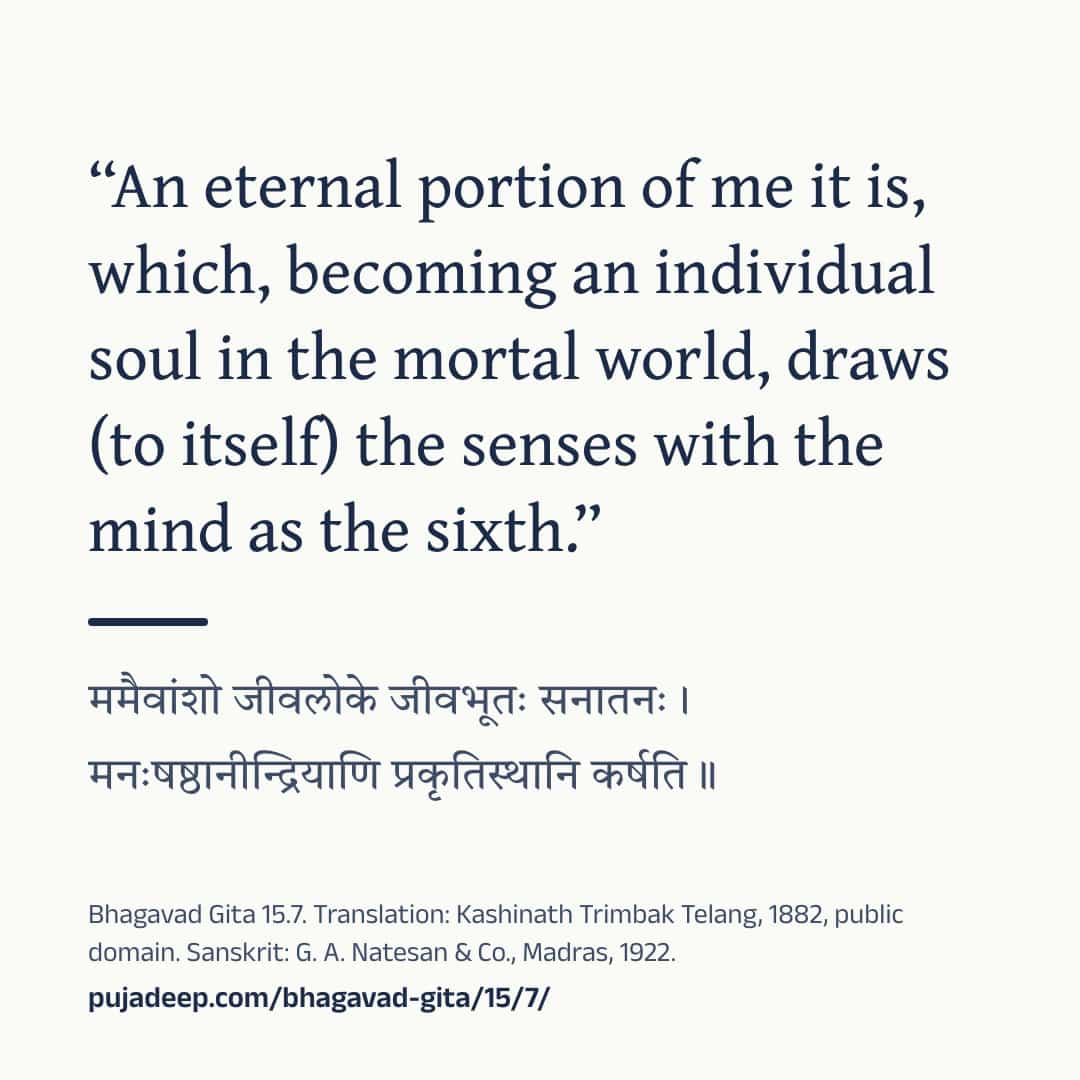
Drawing the picture
See the words
Bhagavad Gita 15.7

ममैवांशो जीवलोके जीवभूतः सनातनः ।
मनःषष्ठानीन्द्रियाणि प्रकृतिस्थानि कर्षति ॥

“An eternal portion of me it is, which, becoming an individual soul in the mortal world, draws (to itself) the senses with the mind as the sixth.”
(K. T. Telang, The Bhagavadgîtâ (The Sacred Books of the East, vol. VIII, Oxford: Clarendon Press, 1882), p. 112, public domain)

“An immemorial portion of Myself, in the world of life a living being, draweth round Itself the senses of which Manas is the sixth, placed in Prakriti.”
(Annie Besant, The Bhagavad Gîtâ, or The Lord's Song (London: Theosophical Publishing Society, 1895), p. 136, public domain)

“An eternal portion of Myself, having become a living Soul in the world of life, draws (to Itself) the (five) senses with mind for the sixth, abiding in Prakriti.”
(Swami Swarupananda, Srimad-Bhagavad-Gita (Mayavati: Prabuddha Bharata Press, 1909; first printed in Prabuddha Bharata, 1907–1909), p. 287, public domain)

Sanskrit: G. A. Natesan & Co., Madras, 1922.
https://pujadeep.com/bhagavad-gita/15/7/ Nothing is sent from this site. Your own app sends it, to the chat you choose. The picture quotes the translation you chose on this page, with its name and year.
Sanskrit text: The Bhagavad-Gita, or The Lord's Song, with the text in Devanagari and an English translation, 1922. Meanings: written for Pujadeep and checked against the cited edition. Source and changes
Questions families ask
Who speaks Bhagavad Gita 15.7?
Krishna speaks this verse, in chapter 15 (Purushottama Yoga).
Where does the Sanskrit text come from?
Sanskrit text: The Bhagavad-Gita, or The Lord's Song, with the text in Devanagari and an English translation, 1922. Meanings: written for Pujadeep and checked against the cited edition. See the source
Is the meaning on this page a translation?
Explanation written for this site from the sources listed here, and checked against the cited edition. It is not a translation and not the only way to read the text. Free to quote with credit.
Source and licence
- Sanskrit text
- The Bhagavad-Gita, or The Lord's Song, with the text in Devanagari and an English translation (Annie Besant, G. A. Natesan & Co., Madras, 1922). Public domain. The Sanskrit on these pages was read from this printing’s page images.
- Translation
- The Bhagavadgîtâ with the Sanatsugâtîya and the Anugîtâ, translated by Kâshinâth Trimbak Telang (The Sacred Books of the East, vol. VIII, ed. F. Max Müller) (Kashinath Trimbak Telang, F. Max Müller, Clarendon Press, Oxford, 1882). Public domain. Shown verbatim, as printed.
- Translation
- The Bhagavad Gîtâ, or The Lord's Song, translated by Annie Besant (Annie Besant, Theosophical Publishing Society, London, 1895). Public domain. Shown verbatim, as printed.
- Translation
- Srimad-Bhagavad-Gita, with Sanskrit Text; Paraphrase with Word-by-word Literal Translation; English Rendering and Comments, Index, &c., by the Swami Swarupananda (Himalayan Series, No. XX) (Swami Swarupananda, The Editors and Publishers, Advaita Ashrama, Mayavati, Prabuddha Bharata Press, Mayavati, Almora, Himalayas, 1909). Public domain. Shown verbatim, as printed.
- Commentary
- The Bhagavad-Gita, with the commentary of Sri Sankaracharya, translated by A. Mahadeva Sastri (2nd ed., Mysore: G. T. A. Printing Works, 1901) (Public-domain scan, University of California Libraries). Summarised in our own words; none of its text is reproduced.
- Commentary
- Sri Bhagavad-Gita with Sri Ramanujacharya's Visishtadvaita commentary, translated by A. Govindacharya (Madras, 1898) (Scan uploaded to archive.org (folkscanomy collection)). Summarised in our own words; none of its text is reproduced.
- Commentary
- The Bhagavad-Gita: translation and commentaries in English according to Sri Madhwacharya's Bhashyas, by S. Subba Rau (Madras, 1906) (Scan uploaded to archive.org (folkscanomy collection)). Summarised in our own words; none of its text is reproduced.
- Common wording
- In this text, 32 words follow today's common wording, checked against sanskritdocuments.org; Sanskrit Wikisource; Gita Press, Gorakhpur; GRETIL, Göttingen and Bhaktivedanta Book Trust.
- Our explanation
- Explanation written for this site from the sources listed here, and checked against the cited edition. It is not a translation and not the only way to read the text. Free to quote with credit.
- Checked
- Checked against the cited edition, October 15, 2026.
- Updated
- October 25, 2026