Bhagavad Gita 15.14: meaning and translation
Chapter 15: Purushottama Yoga. Krishna says
Becoming Vaiśvānara, the fire of life in the bodies of living beings, Krishna says, and joined with the in-breath and out-breath (prāṇa and apāna), he digests the four kinds of food.
Click or tap a word for its meaning and its dictionary page.
Text and layers
Text and layers
These choices stay in this browser.
Bhagavad Gita 15.14
अहं वैश्वानरो भूत्वा प्राणिनां देहमाश्रितः ।प्राणापानसमायुक्तः पचाम्यन्नं चतुर्विधम् ॥
Aham vaishvanaro bhutva praninam dehamashritahPranapanasamayuktah pachamyannam chaturvidham
ahaṃ vaiśvānaro bhūtvā prāṇināṃ dehamāśritaḥ |prāṇāpānasamāyuktaḥ pacāmyannaṃ caturvidham ||
Our explanation Becoming Vaiśvānara, the fire of life in the bodies of living beings, Krishna says, and joined with the in-breath and out-breath (prāṇa and apāna), he digests the four kinds of food. Telang's note names them: what is drunk, what is licked, what is chewed, and what is swallowed without chewing. Today some ashrams chant this chapter before meals. It is a custom, not an instruction in the text.
हिंदी अर्थ कृष्ण कहते हैं कि वे वैश्वानर, यानी प्राणियों के शरीर में रहने वाली जीवन-अग्नि, बनकर, प्राण और अपान से जुड़कर, चार प्रकार के अन्न को पचाते हैं। तेलंग की टिप्पणी ये चार बताती है: जो पिया जाता है, जो चाटा जाता है, जो दाँतों से चबाया जाता है, और जो बिना चबाए खाया जाता है। आज कुछ आश्रमों में भोजन से पहले यह अध्याय गाया जाता है। यह एक परंपरा है, पाठ का कोई आदेश नहीं।
Word by word
Every word, with its dictionary page
Word by word
- अहम् aham · "I" (Krishna) (pronoun, nominative singular) Dictionary: aham, Monier-Williams 1899, p. 124, col. 2 “nom. sg. ‘I,’”
- वैश्वानरः vaiśvānaraḥ · Vaishvanara, the fire of digestion (nominative singular) Dictionary: vaiśvānara, Monier-Williams 1899, p. 1027, col. 1 “N. of Agni or Fire; the fire of digestion”
- भूत्वा bhūtvā · having become (absolutive ('having done')) Dictionary: 1. bhū, Monier-Williams 1899, p. 760, col. 2 “to become, be”
- प्राणिनाम् prāṇinām · of living beings (genitive plural) Dictionary: prāṇin, Monier-Williams 1899, p. 706, col. 1 “breathing, living, alive; m. a living or sentient being”
- देहम् deham · the body (accusative singular) Dictionary: deha, Monier-Williams 1899, p. 496, col. 3 “the body”
- आश्रितः āśritaḥ · dwelling in (past participle, nominative singular) Dictionary: ā-śrita, Monier-Williams 1899, p. 158, col. 3 “inhabiting, dwelling in, resting on”
- प्राणापानसमायुक्तः prāṇāpānasamāyuktaḥ · joined with the in- and out-breath (compound, nominative singular) Dictionary: 2. prāṇa, Monier-Williams 1899, p. 705, col. 1 “the breath of life, breath, respiration, spirit, vitality”; apāna, Monier-Williams 1899, p. 54, col. 2 “that of the five vital airs which goes downwards”; sam-āyukta, Monier-Williams 1899, p. 1161, col. 3 “joined, prepared, ready; furnished or supplied or provided with”
- पचामि pacāmi · digest, cook (present, 1st person singular) Dictionary: 2. pac, Monier-Williams 1899, p. 575, col. 1 “to cook, bake”
- अन्नम् annam · food (accusative singular) Dictionary: anna, Monier-Williams 1899, p. 45, col. 1 “food or victuals, especially boiled rice”
- चतुर्विधम् caturvidham · of four kinds (compound, accusative singular) Dictionary: catur-vidha, Monier-Williams 1899, p. 385, col. 1 “fourfold, of 4 sorts or kinds”
Old translations
Kashinath Trimbak Telang, 1882. Public domain. Page 113.
I becoming the fire, and dwelling in the bodies of (all) creatures, and united with the upward and downward life-breaths, cause digestion of the fourfold food1.
Footnotes (the translator’s own) - I. e. what is drunk, what is licked, what is powdered with the teeth, and what is eaten without such powdering. ↩
Compare 3 translations
Kashinath Trimbak Telang, 1882. Public domain. Page 113.
I becoming the fire, and dwelling in the bodies of (all) creatures, and united with the upward and downward life-breaths, cause digestion of the fourfold food1.
Footnotes (the translator’s own) - I. e. what is drunk, what is licked, what is powdered with the teeth, and what is eaten without such powdering. ↩
You are reading this one
Annie Besant, 1895. Public domain. Page 137–138.
I, having become Vaishvânara, take possession of the bodies of breathing things, and united with Prâna and Apâna, I cook the four kinds of food.1
Footnotes (the translator’s own) - The fire of digestion. ↩
You are reading this one
Swami Swarupananda, 1909 (first printed 1907). Public domain. Page 290.
Abiding in the body of living beings as (the fire) Vaishvânara, I, associated with Prâna and Apâna, digest the fourfold food.
You are reading this one
Cite this verse
The translation: K. T. Telang, The Bhagavadgîtâ (The Sacred Books of the East, vol. VIII, Oxford: Clarendon Press, 1882), p. 113. Bhagavad Gita 15.14.
The translation: Annie Besant, The Bhagavad Gîtâ, or The Lord's Song (London: Theosophical Publishing Society, 1895), pp. 137–138. Bhagavad Gita 15.14.
The translation: Swami Swarupananda, Srimad-Bhagavad-Gita (Mayavati: Prabuddha Bharata Press, 1909; first printed in Prabuddha Bharata, 1907–1909), p. 290. Bhagavad Gita 15.14.
Our explanation: “Bhagavad Gita 15.14: meaning and translation.” Pujadeep. Updated October 25, 2026. https://pujadeep.com/bhagavad-gita/15/14/
Pujadeep’s explanations are free to quote with credit: name Pujadeep and link to the page. How to credit
Classical readings, by school
No readings by school on this verse yet.
Share
Show the ways to share
Send one picture or the text to one chat. The picture names its source and the address of this page.
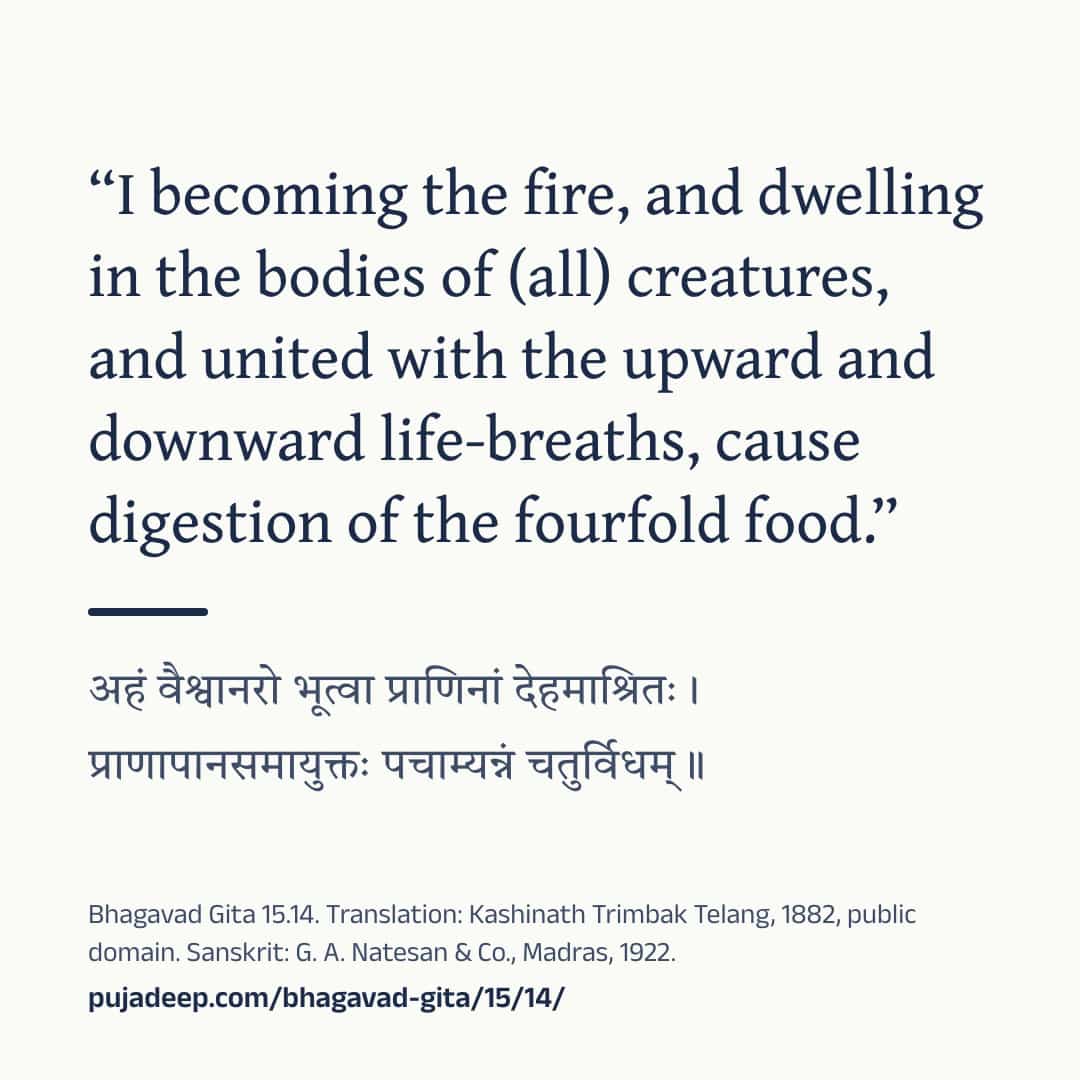
Drawing the picture
See the words
Bhagavad Gita 15.14

अहं वैश्वानरो भूत्वा प्राणिनां देहमाश्रितः ।
प्राणापानसमायुक्तः पचाम्यन्नं चतुर्विधम् ॥

“I becoming the fire, and dwelling in the bodies of (all) creatures, and united with the upward and downward life-breaths, cause digestion of the fourfold food.”
(K. T. Telang, The Bhagavadgîtâ (The Sacred Books of the East, vol. VIII, Oxford: Clarendon Press, 1882), p. 113, public domain)

“I, having become Vaishvânara, take possession of the bodies of breathing things, and united with Prâna and Apâna, I cook the four kinds of food.”
(Annie Besant, The Bhagavad Gîtâ, or The Lord's Song (London: Theosophical Publishing Society, 1895), pp. 137–138, public domain)

“Abiding in the body of living beings as (the fire) Vaishvânara, I, associated with Prâna and Apâna, digest the fourfold food.”
(Swami Swarupananda, Srimad-Bhagavad-Gita (Mayavati: Prabuddha Bharata Press, 1909; first printed in Prabuddha Bharata, 1907–1909), p. 290, public domain)

Sanskrit: G. A. Natesan & Co., Madras, 1922.
https://pujadeep.com/bhagavad-gita/15/14/ Nothing is sent from this site. Your own app sends it, to the chat you choose. The picture quotes the translation you chose on this page, with its name and year.
Sanskrit text: The Bhagavad-Gita, or The Lord's Song, with the text in Devanagari and an English translation, 1922. Meanings: written for Pujadeep and checked against the cited edition. Source and changes
Questions families ask
Who speaks Bhagavad Gita 15.14?
Krishna speaks this verse, in chapter 15 (Purushottama Yoga).
Where does the Sanskrit text come from?
Sanskrit text: The Bhagavad-Gita, or The Lord's Song, with the text in Devanagari and an English translation, 1922. Meanings: written for Pujadeep and checked against the cited edition. See the source
Is the meaning on this page a translation?
Explanation written for this site from the sources listed here, and checked against the cited edition. It is not a translation and not the only way to read the text. Free to quote with credit.
Source and licence
- Sanskrit text
- The Bhagavad-Gita, or The Lord's Song, with the text in Devanagari and an English translation (Annie Besant, G. A. Natesan & Co., Madras, 1922). Public domain. The Sanskrit on these pages was read from this printing’s page images.
- Translation
- The Bhagavadgîtâ with the Sanatsugâtîya and the Anugîtâ, translated by Kâshinâth Trimbak Telang (The Sacred Books of the East, vol. VIII, ed. F. Max Müller) (Kashinath Trimbak Telang, F. Max Müller, Clarendon Press, Oxford, 1882). Public domain. Shown verbatim, as printed.
- Translation
- The Bhagavad Gîtâ, or The Lord's Song, translated by Annie Besant (Annie Besant, Theosophical Publishing Society, London, 1895). Public domain. Shown verbatim, as printed.
- Translation
- Srimad-Bhagavad-Gita, with Sanskrit Text; Paraphrase with Word-by-word Literal Translation; English Rendering and Comments, Index, &c., by the Swami Swarupananda (Himalayan Series, No. XX) (Swami Swarupananda, The Editors and Publishers, Advaita Ashrama, Mayavati, Prabuddha Bharata Press, Mayavati, Almora, Himalayas, 1909). Public domain. Shown verbatim, as printed.
- Common wording
- In this text, 32 words follow today's common wording, checked against sanskritdocuments.org; Sanskrit Wikisource; Gita Press, Gorakhpur; GRETIL, Göttingen and Bhaktivedanta Book Trust.
- Our explanation
- Explanation written for this site from the sources listed here, and checked against the cited edition. It is not a translation and not the only way to read the text. Free to quote with credit.
- Checked
- Checked against the cited edition, October 15, 2026.
- Updated
- October 25, 2026