Bhagavad Gita 15.9: meaning and translation
Chapter 15: Purushottama Yoga. Krishna says
Using the ear, the eye, touch, taste and smell, and the mind, Krishna says, this self enjoys the objects of the senses.
Click or tap a word for its meaning and its dictionary page.
Text and layers
Text and layers
These choices stay in this browser.
Bhagavad Gita 15.9
श्रोत्रं चक्षुः स्पर्शनं च रसनं घ्राणमेव च ।अधिष्ठाय मनश्चायं विषयानुपसेवते ॥
Shrotram chakshuh sparshanam cha rasanam ghranameva chaAdhishthaya manashchayam vishayanupasevate
śrotraṃ cakṣuḥ sparśanaṃ ca rasanaṃ ghrāṇameva ca |adhiṣṭhāya manaścāyaṃ viṣayānupasevate ||
Our explanation Using the ear, the eye, touch, taste and smell, and the mind, Krishna says, this self enjoys the objects of the senses.
हिंदी अर्थ कृष्ण कहते हैं कि कान, आँख, त्वचा, जीभ, नाक और मन का सहारा लेकर यह जीव विषयों का भोग करता है।
Word by word
Every word, with its dictionary page
Word by word
- श्रोत्रम् śrotram · the ear, hearing (accusative singular) Dictionary: śrotra, Monier-Williams 1899, p. 1103, col. 1 “the organ of hearing, ear, auricle”
- चक्षुः cakṣuḥ · the eye, sight (accusative singular) Dictionary: cakṣus, Monier-Williams 1899, p. 382, col. 2 “the eye”
- स्पर्शनम् sparśanam · the skin, touch (accusative singular) Dictionary: sparśana, Monier-Williams 1899, p. 1269, col. 2 “sensation, sense of touch, organ of sensation or feeling”
- च ca · and (indeclinable) Dictionary: 2. ca, Monier-Williams 1899, p. 380, col. 1 “and, both, also, moreover, as well as”
- रसनम् rasanam · the tongue, taste (accusative singular) Dictionary: 2. rasana, Monier-Williams 1899, p. 870, col. 3 “the tongue as organ of taste”
- घ्राणम् ghrāṇam · the nose, smell (accusative singular) Dictionary: ghrāṇa, Monier-Williams 1899, p. 379, col. 3 “the nose”
- एव eva · also (indeclinable) Dictionary: 1. eva, Monier-Williams 1899, p. 232, col. 2 “indeed, truly, really”
- च ca · and (indeclinable) Dictionary: 2. ca, Monier-Williams 1899, p. 380, col. 1 “and, both, also, moreover, as well as”
- अधिष्ठाय adhiṣṭhāya · presiding over, using (absolutive ('having done')) Dictionary: adhi-ṣṭhā, Monier-Williams 1899, p. 22, col. 2 “to stand over; to superintend, govern”
- मनः manaḥ · the mind (accusative singular) Dictionary: manas, Monier-Williams 1899, p. 783, col. 3 “mind (in its widest sense as applied to all the mental powers)”
- च ca · and (indeclinable) Dictionary: 2. ca, Monier-Williams 1899, p. 380, col. 1 “and, both, also, moreover, as well as”
- अयम् ayam · this (one) (pronoun, nominative singular) Dictionary: 1. idam, Monier-Williams 1899, p. 165, col. 2 “this, this here, referring to something near the speaker”
- विषयान् viṣayān · objects of the senses (accusative plural) Dictionary: viṣaya, Monier-Williams 1899, p. 997, col. 1 “an object of sense”
- उपसेवते upasevate · enjoys, experiences (present, 3rd person singular) Dictionary: upa-sev, Monier-Williams 1899, p. 210, col. 3 “to practise, pursue, cultivate, study, make use of”
Old translations
Kashinath Trimbak Telang, 1882. Public domain. Page 112.
And presiding over the senses of hearing and seeing, and touch, and taste, and smell, and the mind, he enjoys sensuous objects.
Compare 3 translations
Kashinath Trimbak Telang, 1882. Public domain. Page 112.
And presiding over the senses of hearing and seeing, and touch, and taste, and smell, and the mind, he enjoys sensuous objects.
You are reading this one
Annie Besant, 1895. Public domain. Page 136–137.
Taking possession of the ear, the eye, the touch, the taste and the smell, and of Manas also, He enjoyeth the objects of the senses.
You are reading this one
Swami Swarupananda, 1909 (first printed 1907). Public domain. Page 288.
Presiding over the ear, the eye, the touch, taste and smell, as also the mind, He experiences objects.
You are reading this one
Cite this verse
The translation: K. T. Telang, The Bhagavadgîtâ (The Sacred Books of the East, vol. VIII, Oxford: Clarendon Press, 1882), p. 112. Bhagavad Gita 15.9.
The translation: Annie Besant, The Bhagavad Gîtâ, or The Lord's Song (London: Theosophical Publishing Society, 1895), pp. 136–137. Bhagavad Gita 15.9.
The translation: Swami Swarupananda, Srimad-Bhagavad-Gita (Mayavati: Prabuddha Bharata Press, 1909; first printed in Prabuddha Bharata, 1907–1909), p. 288. Bhagavad Gita 15.9.
Our explanation: “Bhagavad Gita 15.9: meaning and translation.” Pujadeep. Updated October 25, 2026. https://pujadeep.com/bhagavad-gita/15/9/
Pujadeep’s explanations are free to quote with credit: name Pujadeep and link to the page. How to credit
Classical readings, by school
No readings by school on this verse yet.
Share
Show the ways to share
Send one picture or the text to one chat. The picture names its source and the address of this page.
Drawing the picture
See the words
Bhagavad Gita 15.9

श्रोत्रं चक्षुः स्पर्शनं च रसनं घ्राणमेव च ।
अधिष्ठाय मनश्चायं विषयानुपसेवते ॥

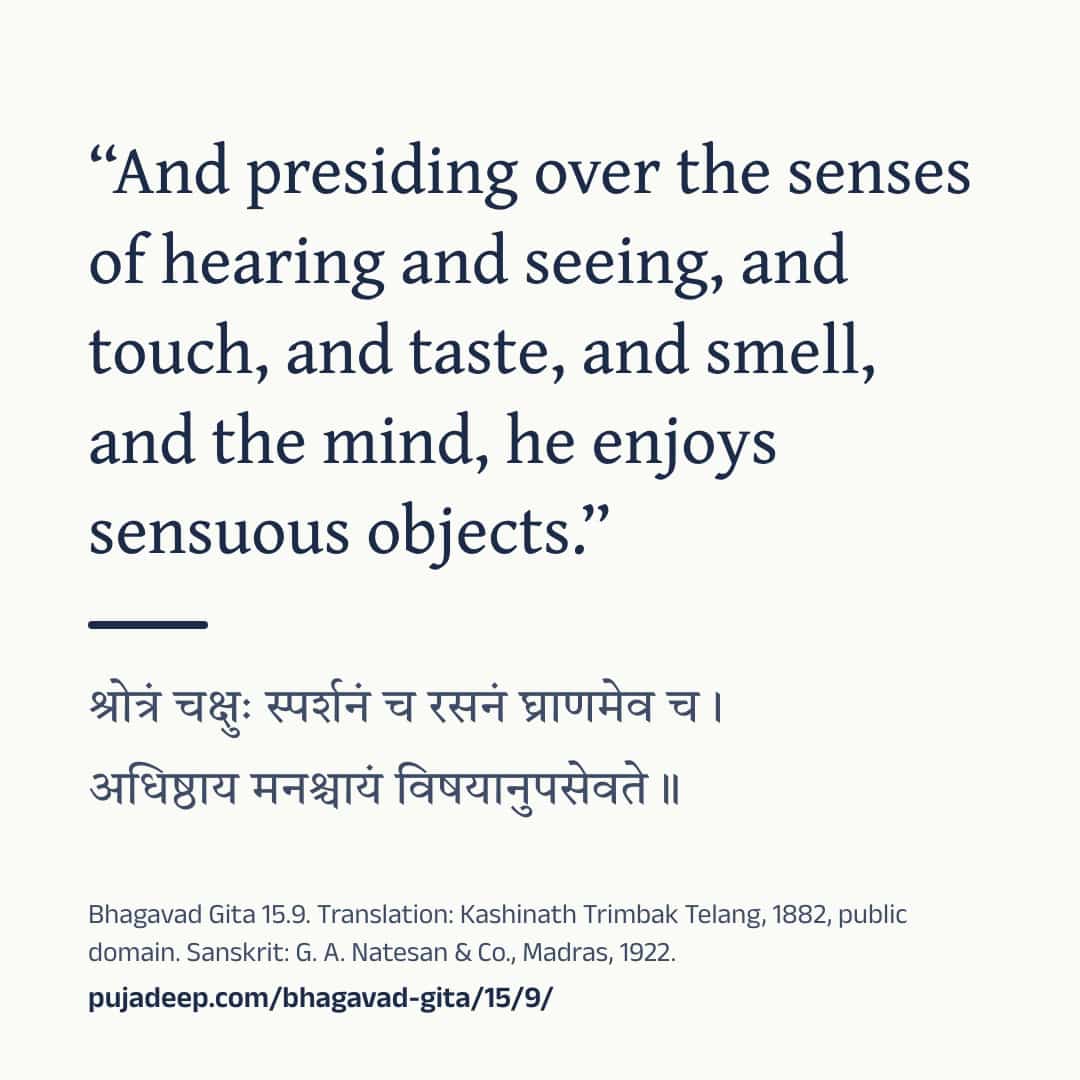
“And presiding over the senses of hearing and seeing, and touch, and taste, and smell, and the mind, he enjoys sensuous objects.”
(K. T. Telang, The Bhagavadgîtâ (The Sacred Books of the East, vol. VIII, Oxford: Clarendon Press, 1882), p. 112, public domain)

“Taking possession of the ear, the eye, the touch, the taste and the smell, and of Manas also, He enjoyeth the objects of the senses.”
(Annie Besant, The Bhagavad Gîtâ, or The Lord's Song (London: Theosophical Publishing Society, 1895), pp. 136–137, public domain)

“Presiding over the ear, the eye, the touch, taste and smell, as also the mind, He experiences objects.”
(Swami Swarupananda, Srimad-Bhagavad-Gita (Mayavati: Prabuddha Bharata Press, 1909; first printed in Prabuddha Bharata, 1907–1909), p. 288, public domain)

Sanskrit: G. A. Natesan & Co., Madras, 1922.
https://pujadeep.com/bhagavad-gita/15/9/ Nothing is sent from this site. Your own app sends it, to the chat you choose. The picture quotes the translation you chose on this page, with its name and year.
Sanskrit text: The Bhagavad-Gita, or The Lord's Song, with the text in Devanagari and an English translation, 1922. Meanings: written for Pujadeep and checked against the cited edition. Source and changes
Questions families ask
Who speaks Bhagavad Gita 15.9?
Krishna speaks this verse, in chapter 15 (Purushottama Yoga).
Where does the Sanskrit text come from?
Sanskrit text: The Bhagavad-Gita, or The Lord's Song, with the text in Devanagari and an English translation, 1922. Meanings: written for Pujadeep and checked against the cited edition. See the source
Is the meaning on this page a translation?
Explanation written for this site from the sources listed here, and checked against the cited edition. It is not a translation and not the only way to read the text. Free to quote with credit.
Source and licence
- Sanskrit text
- The Bhagavad-Gita, or The Lord's Song, with the text in Devanagari and an English translation (Annie Besant, G. A. Natesan & Co., Madras, 1922). Public domain. The Sanskrit on these pages was read from this printing’s page images.
- Translation
- The Bhagavadgîtâ with the Sanatsugâtîya and the Anugîtâ, translated by Kâshinâth Trimbak Telang (The Sacred Books of the East, vol. VIII, ed. F. Max Müller) (Kashinath Trimbak Telang, F. Max Müller, Clarendon Press, Oxford, 1882). Public domain. Shown verbatim, as printed.
- Translation
- The Bhagavad Gîtâ, or The Lord's Song, translated by Annie Besant (Annie Besant, Theosophical Publishing Society, London, 1895). Public domain. Shown verbatim, as printed.
- Translation
- Srimad-Bhagavad-Gita, with Sanskrit Text; Paraphrase with Word-by-word Literal Translation; English Rendering and Comments, Index, &c., by the Swami Swarupananda (Himalayan Series, No. XX) (Swami Swarupananda, The Editors and Publishers, Advaita Ashrama, Mayavati, Prabuddha Bharata Press, Mayavati, Almora, Himalayas, 1909). Public domain. Shown verbatim, as printed.
- Common wording
- In this text, 32 words follow today's common wording, checked against sanskritdocuments.org; Sanskrit Wikisource; Gita Press, Gorakhpur; GRETIL, Göttingen and Bhaktivedanta Book Trust.
- Our explanation
- Explanation written for this site from the sources listed here, and checked against the cited edition. It is not a translation and not the only way to read the text. Free to quote with credit.
- Checked
- Checked against the cited edition, October 15, 2026.
- Updated
- October 25, 2026