Bhagavad Gita 15.18: meaning and translation
Chapter 15: Purushottama Yoga. Krishna says
Because he is beyond the perishable and higher even than the imperishable, Krishna says, he is known in the world and in the Veda as Purushottama, the Supreme Person.
Click or tap a word for its meaning and its dictionary page.
Text and layers
Text and layers
These choices stay in this browser.
Bhagavad Gita 15.18
यस्मात्क्षरमतीतोऽहमक्षरादपि चोत्तमः ।अतोऽस्मि लोके वेदे च प्रथितः पुरुषोत्तमः ॥
Yasmatksharamatitohamaksharadapi chottamahAtosmi loke vede cha prathitah purushottamah
yasmātkṣaramatīto’hamakṣarādapi cottamaḥ |ato’smi loke vede ca prathitaḥ puruṣottamaḥ ||
Our explanation Because he is beyond the perishable and higher even than the imperishable, Krishna says, he is known in the world and in the Veda as Purushottama, the Supreme Person. The chapter takes its name from this word. The schools explain 'in the world' (loka) differently (see the views).
हिंदी अर्थ कृष्ण कहते हैं कि क्योंकि वे क्षर से परे हैं और अक्षर से भी उत्तम हैं, इसलिए लोक और वेद में वे पुरुषोत्तम नाम से प्रसिद्ध हैं। अध्याय का नाम इसी शब्द से है। “लोक” का अर्थ परंपराएँ अलग-अलग बताती हैं।
Word by word
Every word, with its dictionary page
Word by word
- यस्मात् yasmāt · because (indeclinable) Dictionary: yad, Monier-Williams 1899, p. 844, col. 2 “who, which, what, whichever, whatever, that”
- क्षरम् kṣaram · the perishable (accusative singular) Dictionary: kṣara, Monier-Williams 1899, p. 327, col. 1 “melting away, perishable”
- अतीतः atītaḥ · beyond (past participle, nominative singular) Dictionary: atīta, Monier-Williams 1899, p. 16, col. 2 “one who has gone through or got over or beyond”
- अहम् aham · "I" (Krishna) (pronoun, nominative singular) Dictionary: aham, Monier-Williams 1899, p. 124, col. 2 “nom. sg. ‘I,’”
- अक्षरात् akṣarāt · than the imperishable (ablative singular) Dictionary: a-kṣara, Monier-Williams 1899, p. 3, col. 2 “imperishable; unalterable”
- अपि api · also (indeclinable) Dictionary: api, Monier-Williams 1899, p. 55, col. 1 “and, also, moreover, besides”
- च ca · and (indeclinable) Dictionary: 2. ca, Monier-Williams 1899, p. 380, col. 1 “and, both, also, moreover, as well as”
- उत्तमः uttamaḥ · higher, highest (nominative singular) Dictionary: ut-tama, Monier-Williams 1899, p. 177, col. 3 “uppermost, highest, chief; most elevated, principal; best, excellent”
- अतः ataḥ · therefore (indeclinable) Dictionary: atas, Monier-Williams 1899, p. 12, col. 1 “from this, than this; hence; henceforth”
- अस्मि asmi · am (present, 1st person singular) Dictionary: 1. as, Monier-Williams 1899, p. 117, col. 2 “to be, live, exist, be present”
- लोके loke · in the world (locative singular) Dictionary: loka, Monier-Williams 1899, p. 906, col. 1 “the wide space or world”
- वेदे vede · in the Veda (locative singular) Dictionary: 1. veda, Monier-Williams 1899, p. 1015, col. 1 “knowledge, true or sacred knowledge or lore”
- च ca · and (indeclinable) Dictionary: 2. ca, Monier-Williams 1899, p. 380, col. 1 “and, both, also, moreover, as well as”
- प्रथितः prathitaḥ · known, renowned (past participle, nominative singular) Dictionary: prathita, Monier-Williams 1899, p. 678, col. 3 “divulged, displayed, published, known, celebrated”
- पुरुषोत्तमः puruṣottamaḥ · the Supreme Person (compound, nominative singular) Dictionary: puruṣottama, Monier-Williams 1899, p. 637, col. 3 “the highest being, Supreme Spirit, N. of Vishṇu or Kṛishṇa”
Old translations
Kashinath Trimbak Telang, 1882. Public domain. Page 113–114.
And since I transcend the destructible, and since I am higher also than the indestructible1, therefore am I celebrated in the world and in the Vedas as the best of beings.
Footnotes (the translator’s own) - The two are the whole collection of things as they appear and their material cause. The supreme being is a third principle. ↩
Compare 3 translations
Kashinath Trimbak Telang, 1882. Public domain. Page 113–114.
And since I transcend the destructible, and since I am higher also than the indestructible1, therefore am I celebrated in the world and in the Vedas as the best of beings.
Footnotes (the translator’s own) - The two are the whole collection of things as they appear and their material cause. The supreme being is a third principle. ↩
You are reading this one
Annie Besant, 1895. Public domain. Page 138.
Since I excel the destructible, and am more excellent also than the indestructible, in the world and in the Veda I am proclaimed Purushottama.1
Footnotes (the translator’s own) - The highest Purusha. ↩
You are reading this one
Swami Swarupananda, 1909 (first printed 1907). Public domain. Page 293.
As I transcend the Perishable, and am above even the Imperishable, therefore am I in the world and in the Veda celebrated as the Purushottama, (the Highest Purusha).
You are reading this one
Cite this verse
The translation: K. T. Telang, The Bhagavadgîtâ (The Sacred Books of the East, vol. VIII, Oxford: Clarendon Press, 1882), pp. 113–114. Bhagavad Gita 15.18.
The translation: Annie Besant, The Bhagavad Gîtâ, or The Lord's Song (London: Theosophical Publishing Society, 1895), p. 138. Bhagavad Gita 15.18.
The translation: Swami Swarupananda, Srimad-Bhagavad-Gita (Mayavati: Prabuddha Bharata Press, 1909; first printed in Prabuddha Bharata, 1907–1909), p. 293. Bhagavad Gita 15.18.
Our explanation: “Bhagavad Gita 15.18: meaning and translation.” Pujadeep. Updated October 25, 2026. https://pujadeep.com/bhagavad-gita/15/18/
Pujadeep’s explanations are free to quote with credit: name Pujadeep and link to the page. How to credit
Classical readings, by school
Each reading is named by its school. None is presented as the only meaning.
What Advaita, Vishishtadvaita and Dvaita teach, in short
Shankara Advaita
Shankara says the perishable that Krishna transcends is the tree of illusory worldly life, the aśvattha of 15.1, and the imperishable is its seed. 'In the world' means among people; devotees know him as Purushottama, and poets use the name in their works.
Source: The Bhagavad-Gita, with the commentary of Sri Sankaracharya, translated by A. Mahadeva Sastri (2nd ed., Mysore: G. T. A. Printing Works, 1901), commentary on 15.18, p. 369. Summarised in our own words; none of its text is reproduced.
Ramanuja Vishishtadvaita
Ramanuja says Krishna is beyond the bound souls and higher even than the freed souls, and so is the highest Person. He takes loka ('world') to mean the smṛti texts, which explain the meaning of the Vedas; so the name is famous in both smṛti and Veda.
Source: Sri Bhagavad-Gita with Sri Ramanujacharya's Visishtadvaita commentary, translated by A. Govindacharya (Madras, 1898), commentary on 15.18, p. 478. Summarised in our own words; none of its text is reproduced.
Madhva Dvaita
Madhva reads the verse as Krishna making clear that he himself is Purushottama. He takes loka ('world') to mean the books that holy people in this world have written; the Veda he calls the eternal authority.
Source: The Bhagavad-Gita: translation and commentaries in English according to Sri Madhwacharya's Bhashyas, by S. Subba Rau (Madras, 1906), commentary on 15.18, p. 279 (leaf n277). Summarised in our own words; none of its text is reproduced.
Share
Show the ways to share
Send one picture or the text to one chat. The picture names its source and the address of this page.
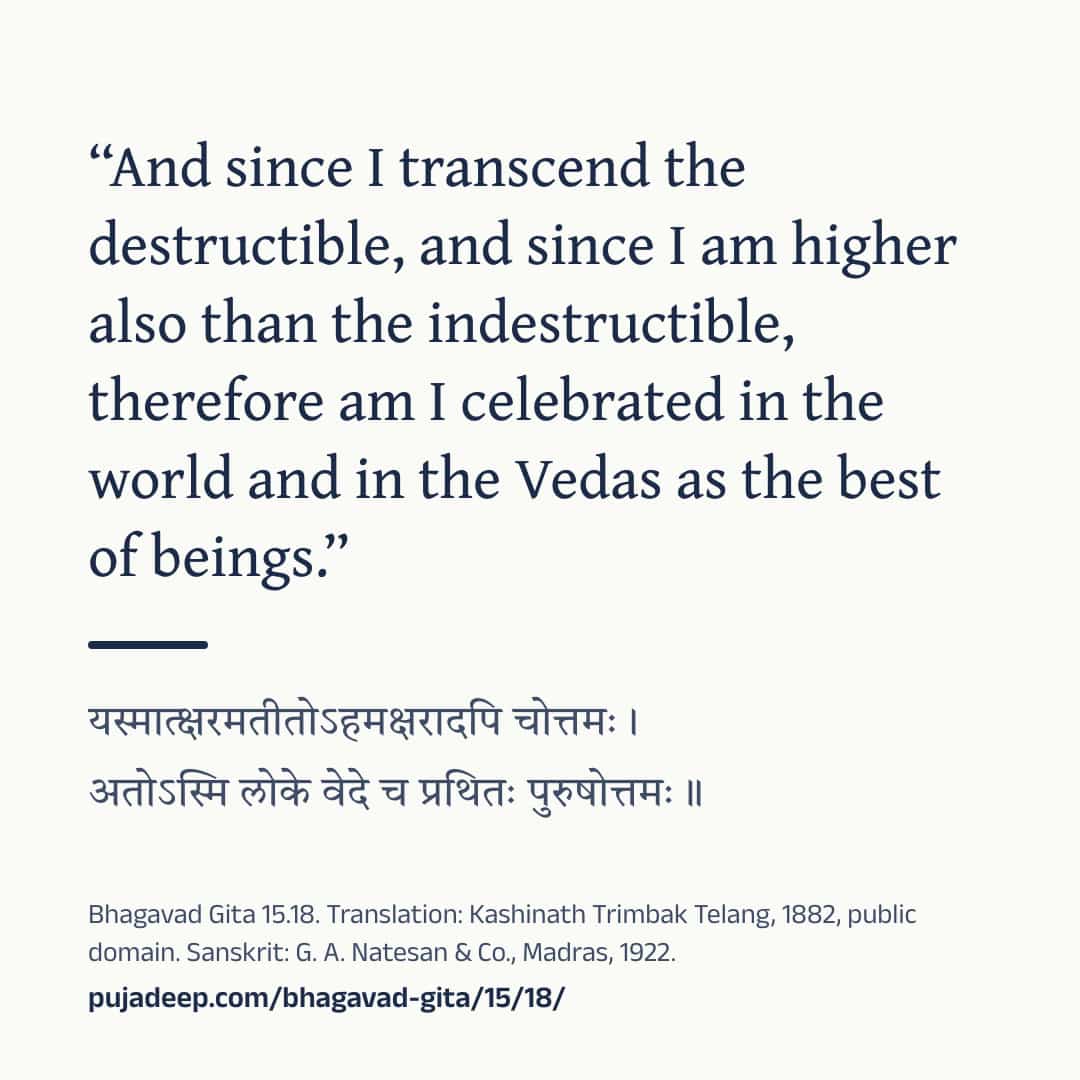
Drawing the picture
See the words
Bhagavad Gita 15.18

यस्मात्क्षरमतीतोऽहमक्षरादपि चोत्तमः ।
अतोऽस्मि लोके वेदे च प्रथितः पुरुषोत्तमः ॥

“And since I transcend the destructible, and since I am higher also than the indestructible, therefore am I celebrated in the world and in the Vedas as the best of beings.”
(K. T. Telang, The Bhagavadgîtâ (The Sacred Books of the East, vol. VIII, Oxford: Clarendon Press, 1882), pp. 113–114, public domain)

“Since I excel the destructible, and am more excellent also than the indestructible, in the world and in the Veda I am proclaimed Purushottama.”
(Annie Besant, The Bhagavad Gîtâ, or The Lord's Song (London: Theosophical Publishing Society, 1895), p. 138, public domain)

“As I transcend the Perishable, and am above even the Imperishable, therefore am I in the world and in the Veda celebrated as the Purushottama, (the Highest Purusha).”
(Swami Swarupananda, Srimad-Bhagavad-Gita (Mayavati: Prabuddha Bharata Press, 1909; first printed in Prabuddha Bharata, 1907–1909), p. 293, public domain)

Sanskrit: G. A. Natesan & Co., Madras, 1922.
https://pujadeep.com/bhagavad-gita/15/18/ Nothing is sent from this site. Your own app sends it, to the chat you choose. The picture quotes the translation you chose on this page, with its name and year.
Sanskrit text: The Bhagavad-Gita, or The Lord's Song, with the text in Devanagari and an English translation, 1922. Meanings: written for Pujadeep and checked against the cited edition. Source and changes
Questions families ask
Who speaks Bhagavad Gita 15.18?
Krishna speaks this verse, in chapter 15 (Purushottama Yoga).
Where does the Sanskrit text come from?
Sanskrit text: The Bhagavad-Gita, or The Lord's Song, with the text in Devanagari and an English translation, 1922. Meanings: written for Pujadeep and checked against the cited edition. See the source
Is the meaning on this page a translation?
Explanation written for this site from the sources listed here, and checked against the cited edition. It is not a translation and not the only way to read the text. Free to quote with credit.
Source and licence
- Sanskrit text
- The Bhagavad-Gita, or The Lord's Song, with the text in Devanagari and an English translation (Annie Besant, G. A. Natesan & Co., Madras, 1922). Public domain. The Sanskrit on these pages was read from this printing’s page images.
- Translation
- The Bhagavadgîtâ with the Sanatsugâtîya and the Anugîtâ, translated by Kâshinâth Trimbak Telang (The Sacred Books of the East, vol. VIII, ed. F. Max Müller) (Kashinath Trimbak Telang, F. Max Müller, Clarendon Press, Oxford, 1882). Public domain. Shown verbatim, as printed.
- Translation
- The Bhagavad Gîtâ, or The Lord's Song, translated by Annie Besant (Annie Besant, Theosophical Publishing Society, London, 1895). Public domain. Shown verbatim, as printed.
- Translation
- Srimad-Bhagavad-Gita, with Sanskrit Text; Paraphrase with Word-by-word Literal Translation; English Rendering and Comments, Index, &c., by the Swami Swarupananda (Himalayan Series, No. XX) (Swami Swarupananda, The Editors and Publishers, Advaita Ashrama, Mayavati, Prabuddha Bharata Press, Mayavati, Almora, Himalayas, 1909). Public domain. Shown verbatim, as printed.
- Commentary
- The Bhagavad-Gita, with the commentary of Sri Sankaracharya, translated by A. Mahadeva Sastri (2nd ed., Mysore: G. T. A. Printing Works, 1901) (Public-domain scan, University of California Libraries). Summarised in our own words; none of its text is reproduced.
- Commentary
- Sri Bhagavad-Gita with Sri Ramanujacharya's Visishtadvaita commentary, translated by A. Govindacharya (Madras, 1898) (Scan uploaded to archive.org (folkscanomy collection)). Summarised in our own words; none of its text is reproduced.
- Commentary
- The Bhagavad-Gita: translation and commentaries in English according to Sri Madhwacharya's Bhashyas, by S. Subba Rau (Madras, 1906) (Scan uploaded to archive.org (folkscanomy collection)). Summarised in our own words; none of its text is reproduced.
- Common wording
- In this text, 32 words follow today's common wording, checked against sanskritdocuments.org; Sanskrit Wikisource; Gita Press, Gorakhpur; GRETIL, Göttingen and Bhaktivedanta Book Trust.
- Our explanation
- Explanation written for this site from the sources listed here, and checked against the cited edition. It is not a translation and not the only way to read the text. Free to quote with credit.
- Checked
- Checked against the cited edition, October 15, 2026.
- Updated
- October 25, 2026