Bhagavad Gita 15.13: meaning and translation
Chapter 15: Purushottama Yoga. Krishna says
Entering the earth, Krishna says, he holds up all beings by his strength (ojas), and becoming Soma, full of sap (rasa), he nourishes all plants.
Click or tap a word for its meaning and its dictionary page.
Text and layers
Text and layers
These choices stay in this browser.
Bhagavad Gita 15.13
गामाविश्य च भूतानि धारयाम्यहमोजसा ।पुष्णामि चौषधीः सर्वाः सोमो भूत्वा रसात्मकः ॥
Gamavishya cha bhutani dharayamyahamojasaPushnami chaushadhih sarvah somo bhutva rasatmakah
gāmāviśya ca bhūtāni dhārayāmyahamojasā |puṣṇāmi cauṣadhīḥ sarvāḥ somo bhūtvā rasātmakaḥ ||
Our explanation Entering the earth, Krishna says, he holds up all beings by his strength (ojas), and becoming Soma, full of sap (rasa), he nourishes all plants. Telang translates Soma as 'the juicy moon'; Besant keeps 'Soma' and notes that 'the watery Moon' is the accepted translation.
हिंदी अर्थ कृष्ण कहते हैं कि वे पृथ्वी में प्रवेश करके अपने ओज से सब प्राणियों को धारण करते हैं, और रस से भरा सोम बनकर सब वनस्पतियों का पोषण करते हैं। तेलंग “सोम” का अनुवाद “रस भरा चंद्रमा” करते हैं; बेसेंट “सोम” शब्द रखती हैं और लिखती हैं कि “जलमय चंद्रमा” प्रचलित अनुवाद है।
Word by word
Every word, with its dictionary page
Word by word
- गाम् gām · the earth (accusative singular) Dictionary: go, Monier-Williams 1899, p. 363, col. 3 “the earth (as the milk-cow of kings)”
- आविश्य āviśya · having entered (absolutive ('having done')) Dictionary: ā-viś, Monier-Williams 1899, p. 155, col. 3 “to go or drive in or towards; to approach, enter”
- च ca · and (indeclinable) Dictionary: 2. ca, Monier-Williams 1899, p. 380, col. 1 “and, both, also, moreover, as well as”
- भूतानि bhūtāni · beings (accusative plural) Dictionary: bhūta, Monier-Williams 1899, p. 761, col. 3 “that which is or exists, any living being (divine, human, animal, and even vegetable)”
- धारयामि dhārayāmi · uphold, sustain (causative present, 1st person singular) Dictionary: dhṛ, Monier-Williams 1899, p. 519, col. 1 “to hold, bear (also = bring forth), carry, maintain, preserve”
- अहम् aham · "I" (Krishna) (pronoun, nominative singular) Dictionary: aham, Monier-Williams 1899, p. 124, col. 2 “nom. sg. ‘I,’”
- ओजसा ojasā · by strength, with vigour (instrumental singular) Dictionary: ojas, Monier-Williams 1899, p. 235, col. 2 “bodily strength, vigour, energy, ability, power”
- पुष्णामि puṣṇāmi · nourish (present, 1st person singular) Dictionary: 2. puṣ, Monier-Williams 1899, p. 638, col. 2 “to cause to thrive or prosper, nourish, foster, augment, increase”
- च ca · and (indeclinable) Dictionary: 2. ca, Monier-Williams 1899, p. 380, col. 1 “and, both, also, moreover, as well as”
- ओषधीः oṣadhīḥ · plants, herbs (accusative plural) Dictionary: oṣa-dhi, Monier-Williams 1899, p. 236, col. 1 “a herb, plant, simple, esp. any medicinal herb”
- सर्वाः sarvāḥ · all (accusative plural (feminine)) Dictionary: sarva, Monier-Williams 1899, p. 1184, col. 3 “whole, entire, all, every”
- सोमः somaḥ · Soma (the moon, the sap) (nominative singular) Dictionary: 1. soma, Monier-Williams 1899, p. 1249, col. 3 “juice, extract, (esp.) the juice of the Soma plant”
- भूत्वा bhūtvā · having become (absolutive ('having done')) Dictionary: 1. bhū, Monier-Williams 1899, p. 760, col. 2 “to become, be”
- रसात्मकः rasātmakaḥ · whose nature is sap (compound, nominative singular) Dictionary: rasātmaka, Monier-Williams 1899, p. 870, col. 2 “having juice for its essence, consisting of nectar (as the moon)”
Old translations
Kashinath Trimbak Telang, 1882. Public domain. Page 113.
Entering the earth1, I by my power support all things; and becoming the juicy moon, I nourish all herbs.
Footnotes (the translator’s own) - 'Entering in the form of the goddess earth,' say Ânandagiri and Madhusûdana. Support, i. e. by keeping the earth from falling or crumbling away. The moon is said to nourish herbs by communicating to them some of her 'juice.' The moon, it may be noted, is called 'watery star' by Shakespeare. As to her relation to the vegetable kingdom, see Matsya-purâna XXIII, stanza 10 seq. ↩
Compare 3 translations
Kashinath Trimbak Telang, 1882. Public domain. Page 113.
Entering the earth1, I by my power support all things; and becoming the juicy moon, I nourish all herbs.
Footnotes (the translator’s own) - 'Entering in the form of the goddess earth,' say Ânandagiri and Madhusûdana. Support, i. e. by keeping the earth from falling or crumbling away. The moon is said to nourish herbs by communicating to them some of her 'juice.' The moon, it may be noted, is called 'watery star' by Shakespeare. As to her relation to the vegetable kingdom, see Matsya-purâna XXIII, stanza 10 seq. ↩
You are reading this one
Annie Besant, 1895. Public domain. Page 137.
Permeating the soil, I am the support of beings by My vital energy, and having become the fragrant Soma1 I nourish all plants.
Footnotes (the translator’s own) - "Having become the watery Moon" is the accepted translation. ↩
You are reading this one
Swami Swarupananda, 1909 (first printed 1907). Public domain. Page 290.
Entering the earth with My energy, I support all beings, and I nourish all the herbs, becoming the watery moon.
You are reading this one
Cite this verse
The translation: K. T. Telang, The Bhagavadgîtâ (The Sacred Books of the East, vol. VIII, Oxford: Clarendon Press, 1882), p. 113. Bhagavad Gita 15.13.
The translation: Annie Besant, The Bhagavad Gîtâ, or The Lord's Song (London: Theosophical Publishing Society, 1895), p. 137. Bhagavad Gita 15.13.
The translation: Swami Swarupananda, Srimad-Bhagavad-Gita (Mayavati: Prabuddha Bharata Press, 1909; first printed in Prabuddha Bharata, 1907–1909), p. 290. Bhagavad Gita 15.13.
Our explanation: “Bhagavad Gita 15.13: meaning and translation.” Pujadeep. Updated October 25, 2026. https://pujadeep.com/bhagavad-gita/15/13/
Pujadeep’s explanations are free to quote with credit: name Pujadeep and link to the page. How to credit
Classical readings, by school
No readings by school on this verse yet.
Share
Show the ways to share
Send one picture or the text to one chat. The picture names its source and the address of this page.
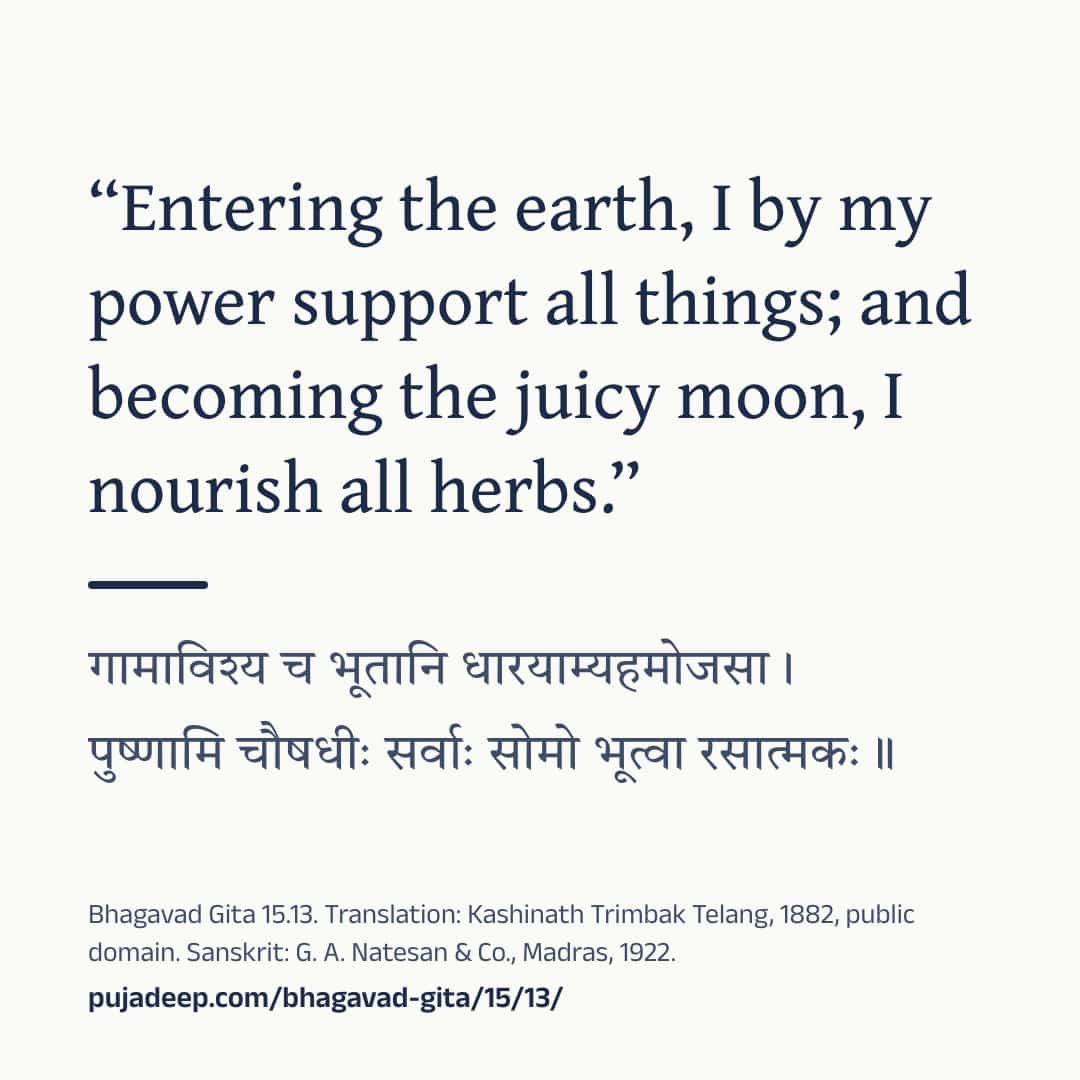
Drawing the picture
See the words
Bhagavad Gita 15.13

गामाविश्य च भूतानि धारयाम्यहमोजसा ।
पुष्णामि चौषधीः सर्वाः सोमो भूत्वा रसात्मकः ॥

“Entering the earth, I by my power support all things; and becoming the juicy moon, I nourish all herbs.”
(K. T. Telang, The Bhagavadgîtâ (The Sacred Books of the East, vol. VIII, Oxford: Clarendon Press, 1882), p. 113, public domain)

“Permeating the soil, I am the support of beings by My vital energy, and having become the fragrant Soma I nourish all plants.”
(Annie Besant, The Bhagavad Gîtâ, or The Lord's Song (London: Theosophical Publishing Society, 1895), p. 137, public domain)

“Entering the earth with My energy, I support all beings, and I nourish all the herbs, becoming the watery moon.”
(Swami Swarupananda, Srimad-Bhagavad-Gita (Mayavati: Prabuddha Bharata Press, 1909; first printed in Prabuddha Bharata, 1907–1909), p. 290, public domain)

Sanskrit: G. A. Natesan & Co., Madras, 1922.
https://pujadeep.com/bhagavad-gita/15/13/ Nothing is sent from this site. Your own app sends it, to the chat you choose. The picture quotes the translation you chose on this page, with its name and year.
Sanskrit text: The Bhagavad-Gita, or The Lord's Song, with the text in Devanagari and an English translation, 1922. Meanings: written for Pujadeep and checked against the cited edition. Source and changes
Questions families ask
Who speaks Bhagavad Gita 15.13?
Krishna speaks this verse, in chapter 15 (Purushottama Yoga).
Where does the Sanskrit text come from?
Sanskrit text: The Bhagavad-Gita, or The Lord's Song, with the text in Devanagari and an English translation, 1922. Meanings: written for Pujadeep and checked against the cited edition. See the source
Is the meaning on this page a translation?
Explanation written for this site from the sources listed here, and checked against the cited edition. It is not a translation and not the only way to read the text. Free to quote with credit.
Source and licence
- Sanskrit text
- The Bhagavad-Gita, or The Lord's Song, with the text in Devanagari and an English translation (Annie Besant, G. A. Natesan & Co., Madras, 1922). Public domain. The Sanskrit on these pages was read from this printing’s page images.
- Translation
- The Bhagavadgîtâ with the Sanatsugâtîya and the Anugîtâ, translated by Kâshinâth Trimbak Telang (The Sacred Books of the East, vol. VIII, ed. F. Max Müller) (Kashinath Trimbak Telang, F. Max Müller, Clarendon Press, Oxford, 1882). Public domain. Shown verbatim, as printed.
- Translation
- The Bhagavad Gîtâ, or The Lord's Song, translated by Annie Besant (Annie Besant, Theosophical Publishing Society, London, 1895). Public domain. Shown verbatim, as printed.
- Translation
- Srimad-Bhagavad-Gita, with Sanskrit Text; Paraphrase with Word-by-word Literal Translation; English Rendering and Comments, Index, &c., by the Swami Swarupananda (Himalayan Series, No. XX) (Swami Swarupananda, The Editors and Publishers, Advaita Ashrama, Mayavati, Prabuddha Bharata Press, Mayavati, Almora, Himalayas, 1909). Public domain. Shown verbatim, as printed.
- Common wording
- In this text, 32 words follow today's common wording, checked against sanskritdocuments.org; Sanskrit Wikisource; Gita Press, Gorakhpur; GRETIL, Göttingen and Bhaktivedanta Book Trust.
- Our explanation
- Explanation written for this site from the sources listed here, and checked against the cited edition. It is not a translation and not the only way to read the text. Free to quote with credit.
- Checked
- Checked against the cited edition, October 15, 2026.
- Updated
- October 25, 2026