Bhagavad Gita 15.1: meaning and translation
Chapter 15: Purushottama Yoga. Krishna says
Krishna speaks.
Click or tap a word for its meaning and its dictionary page.
Text and layers
Text and layers
These choices stay in this browser.
Bhagavad Gita 15.1
श्रीभगवानुवाच ।
ऊर्ध्वमूलमधःशाखमश्वत्थं प्राहुरव्ययम् ।छन्दांसि यस्य पर्णानि यस्तं वेद स वेदवित् ॥
Urdhvamulamadhahshakhamashvattham prahuravyayamChhandansi yasya parnani yastam veda sa vedavit
ūrdhvamūlamadhaḥśākhamaśvatthaṃ prāhuravyayam |chandāṃsi yasya parṇāni yastaṃ veda sa vedavit ||
Our explanation Krishna speaks. He tells of an aśvattha, a sacred fig tree, with its roots above and its branches below. People call it imperishable, he says; its leaves are the Vedic hymns (chandas), and whoever knows this tree knows the Veda. Telang's note on 15.5 reads the tree as the course of worldly life, rooted in the Supreme.
हिंदी अर्थ कृष्ण बोलते हैं। वे एक अश्वत्थ (पीपल) वृक्ष की बात करते हैं, जिसकी जड़ें ऊपर हैं और शाखाएँ नीचे। वे कहते हैं कि इसे अविनाशी कहा जाता है; वेद के छंद इसके पत्ते हैं, और जो इस वृक्ष को जानता है, वह वेद को जानता है। तेलंग की टिप्पणी (15.5 पर) इस वृक्ष को संसार का चक्र बताती है, जिसकी जड़ परमात्मा में है।
Word by word
Every word, with its dictionary page
Word by word
- ऊर्ध्वमूलम् ūrdhvamūlam · with its roots above (compound, accusative singular) Dictionary: ūrdhva, Monier-Williams 1899, p. 222, col. 1 “rising or tending upwards, raised, elevated, erected, erect, upright, high, above”; mūla, Monier-Williams 1899, p. 826, col. 2 “a root (of any plant or tree)”
- अधःशाखम् adhaḥśākham · with its branches below (compound, accusative singular) Dictionary: adhas, Monier-Williams 1899, p. 20, col. 1 “below, down; in the lower region; beneath, under”; śākhā, Monier-Williams 1899, p. 1062, col. 3 “a branch (lit. and fig.)”
- अश्वत्थम् aśvattham · the ashvattha, the sacred fig tree (accusative singular) Dictionary: aśvattha, Monier-Williams 1899, p. 115, col. 3 “the holy fig tree, Ficus Religiosa”
- प्राहुः prāhuḥ · they call, they say (perfect form, present sense, 3rd person plural) Dictionary: 1. ah, Monier-Williams 1899, p. 124, col. 1 “to say, speak”
- अव्ययम् avyayam · imperishable (accusative singular) Dictionary: 2. a-vyaya, Monier-Williams 1899, p. 111, col. 3 “not liable to change, imperishable, undecaying”
- छन्दांसि chandāṃsi · the Vedic hymns (nominative plural) Dictionary: 2. chandas, Monier-Williams 1899, p. 405, col. 1 “the sacred text of the Vedic hymns”
- यस्य yasya · whose (relative pronoun, genitive singular) Dictionary: yad, Monier-Williams 1899, p. 844, col. 2 “who, which, what, whichever, whatever, that”
- पर्णानि parṇāni · leaves (nominative plural) Dictionary: parṇa, Monier-Williams 1899, p. 606, col. 2 “a leaf (regarded as the plumage of a tree)”
- यः yaḥ · who (relative pronoun, nominative singular) Dictionary: yad, Monier-Williams 1899, p. 844, col. 2 “who, which, what, whichever, whatever, that”
- तम् tam · it, that (tree) (pronoun, accusative singular) Dictionary: tad, Monier-Williams 1899, p. 434, col. 1 “m. he, f. she, n. it, that, this”
- वेद veda · knows (perfect form, present sense, 3rd person singular) Dictionary: 1. vid, Monier-Williams 1899, p. 963, col. 2 “to know, understand, perceive, learn”
- सः saḥ · he (pronoun, nominative singular) Dictionary: tad, Monier-Williams 1899, p. 434, col. 1 “m. he, f. she, n. it, that, this”
- वेदवित् vedavit · knower of the Veda (compound, nominative singular) Dictionary: veda-vid, Monier-Williams 1899, p. 1016, col. 1 “knowing the V°, conversant with it”
Old translations
Kashinath Trimbak Telang, 1882. Public domain. Page 111.
The Deity said:
They say the inexhaustible Asvattha1 has (its) roots above, (its) branches below; the Khandas are its leaves. He who knows it knows the Vedas.
Footnotes (the translator’s own) - Cf. Kathopanishad, p. 70, and Sutta Nipâta, p. 76. ↩
Compare 3 translations
Kashinath Trimbak Telang, 1882. Public domain. Page 111.
The Deity said:
They say the inexhaustible Asvattha1 has (its) roots above, (its) branches below; the Khandas are its leaves. He who knows it knows the Vedas.
Footnotes (the translator’s own) - Cf. Kathopanishad, p. 70, and Sutta Nipâta, p. 76. ↩
You are reading this one
Annie Besant, 1895. Public domain. Page 135.
The Blessed Lord said:
With roots above, branches below, the Asvattha is said to be indestructible; the leaves of it are hymns; he who knoweth it is a Veda-knower.
You are reading this one
Swami Swarupananda, 1909 (first printed 1907). Public domain. Page 283.
The Blessed Lord said:
They speak of an eternal Ashvattha rooted above and branching below, whose leaves are the Vedas; he who knows it, is a Veda-knower.
You are reading this one
Cite this verse
The translation: K. T. Telang, The Bhagavadgîtâ (The Sacred Books of the East, vol. VIII, Oxford: Clarendon Press, 1882), p. 111. Bhagavad Gita 15.1.
The translation: Annie Besant, The Bhagavad Gîtâ, or The Lord's Song (London: Theosophical Publishing Society, 1895), p. 135. Bhagavad Gita 15.1.
The translation: Swami Swarupananda, Srimad-Bhagavad-Gita (Mayavati: Prabuddha Bharata Press, 1909; first printed in Prabuddha Bharata, 1907–1909), p. 283. Bhagavad Gita 15.1.
Our explanation: “Bhagavad Gita 15.1: meaning and translation.” Pujadeep. Updated October 25, 2026. https://pujadeep.com/bhagavad-gita/15/1/
Pujadeep’s explanations are free to quote with credit: name Pujadeep and link to the page. How to credit
Classical readings, by school
No readings by school on this verse yet.
Share
Show the ways to share
Send one picture or the text to one chat. The picture names its source and the address of this page.
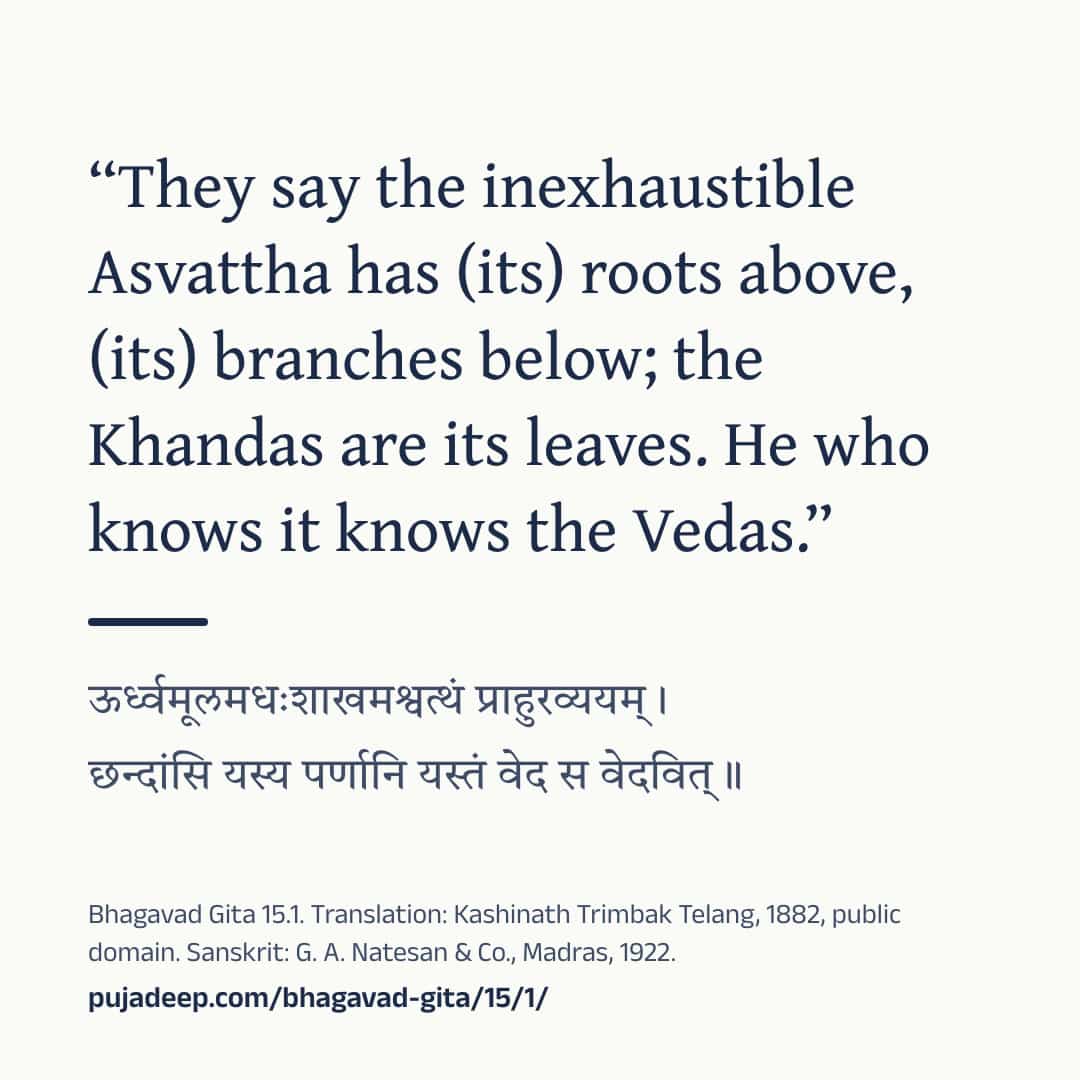
Drawing the picture
See the words
Bhagavad Gita 15.1

ऊर्ध्वमूलमधःशाखमश्वत्थं प्राहुरव्ययम् ।
छन्दांसि यस्य पर्णानि यस्तं वेद स वेदवित् ॥

“They say the inexhaustible Asvattha has (its) roots above, (its) branches below; the Khandas are its leaves. He who knows it knows the Vedas.”
(K. T. Telang, The Bhagavadgîtâ (The Sacred Books of the East, vol. VIII, Oxford: Clarendon Press, 1882), p. 111, public domain)

“With roots above, branches below, the Asvattha is said to be indestructible; the leaves of it are hymns; he who knoweth it is a Veda-knower.”
(Annie Besant, The Bhagavad Gîtâ, or The Lord's Song (London: Theosophical Publishing Society, 1895), p. 135, public domain)

“They speak of an eternal Ashvattha rooted above and branching below, whose leaves are the Vedas; he who knows it, is a Veda-knower.”
(Swami Swarupananda, Srimad-Bhagavad-Gita (Mayavati: Prabuddha Bharata Press, 1909; first printed in Prabuddha Bharata, 1907–1909), p. 283, public domain)

Sanskrit: G. A. Natesan & Co., Madras, 1922.
https://pujadeep.com/bhagavad-gita/15/1/ Nothing is sent from this site. Your own app sends it, to the chat you choose. The picture quotes the translation you chose on this page, with its name and year.
Sanskrit text: The Bhagavad-Gita, or The Lord's Song, with the text in Devanagari and an English translation, 1922. Meanings: written for Pujadeep and checked against the cited edition. Source and changes
Questions families ask
Who speaks Bhagavad Gita 15.1?
Krishna speaks this verse, in chapter 15 (Purushottama Yoga).
Where does the Sanskrit text come from?
Sanskrit text: The Bhagavad-Gita, or The Lord's Song, with the text in Devanagari and an English translation, 1922. Meanings: written for Pujadeep and checked against the cited edition. See the source
Is the meaning on this page a translation?
Explanation written for this site from the sources listed here, and checked against the cited edition. It is not a translation and not the only way to read the text. Free to quote with credit.
Source and licence
- Sanskrit text
- The Bhagavad-Gita, or The Lord's Song, with the text in Devanagari and an English translation (Annie Besant, G. A. Natesan & Co., Madras, 1922). Public domain. The Sanskrit on these pages was read from this printing’s page images.
- Translation
- The Bhagavadgîtâ with the Sanatsugâtîya and the Anugîtâ, translated by Kâshinâth Trimbak Telang (The Sacred Books of the East, vol. VIII, ed. F. Max Müller) (Kashinath Trimbak Telang, F. Max Müller, Clarendon Press, Oxford, 1882). Public domain. Shown verbatim, as printed.
- Translation
- The Bhagavad Gîtâ, or The Lord's Song, translated by Annie Besant (Annie Besant, Theosophical Publishing Society, London, 1895). Public domain. Shown verbatim, as printed.
- Translation
- Srimad-Bhagavad-Gita, with Sanskrit Text; Paraphrase with Word-by-word Literal Translation; English Rendering and Comments, Index, &c., by the Swami Swarupananda (Himalayan Series, No. XX) (Swami Swarupananda, The Editors and Publishers, Advaita Ashrama, Mayavati, Prabuddha Bharata Press, Mayavati, Almora, Himalayas, 1909). Public domain. Shown verbatim, as printed.
- Common wording
- In this text, 32 words follow today's common wording, checked against sanskritdocuments.org; Sanskrit Wikisource; Gita Press, Gorakhpur; GRETIL, Göttingen and Bhaktivedanta Book Trust.
- Our explanation
- Explanation written for this site from the sources listed here, and checked against the cited edition. It is not a translation and not the only way to read the text. Free to quote with credit.
- Checked
- Checked against the cited edition, October 15, 2026.
- Updated
- October 25, 2026