Bhagavad Gita 14.27: meaning and translation
Chapter 14: Gunatraya Vibhaga Yoga. Krishna says
Krishna closes the chapter.
Click or tap a word for its meaning and its dictionary page.
Text and layers
Text and layers
These choices stay in this browser.
Bhagavad Gita 14.27
ब्रह्मणो हि प्रतिष्ठाऽहममृतस्याव्ययस्य च ।शाश्वतस्य च धर्मस्य सुखस्यैकान्तिकस्य च ॥
Brahmano hi pratishthahamamritasyavyayasya chaShashvatasya cha dharmasya sukhasyaikantikasya cha
brahmaṇo hi pratiṣṭhā’hamamṛtasyāvyayasya ca |śāśvatasya ca dharmasya sukhasyaikāntikasya ca ||
Our explanation Krishna closes the chapter. He says he is the foundation (pratiṣṭhā) of Brahman, of the immortal and imperishable, of eternal dharma and of unending happiness. The schools read 'foundation of Brahman' differently (see the views).
हिंदी अर्थ कृष्ण अध्याय पूरा करते हैं। वे कहते हैं कि वे ब्रह्म की प्रतिष्ठा (आधार) हैं, अमृत और अविनाशी की, शाश्वत धर्म की और ऐकांतिक (अखंड) सुख की। “ब्रह्म की प्रतिष्ठा” को परंपराएँ अलग-अलग ढंग से पढ़ती हैं।
Word by word
Every word, with its dictionary page
Word by word
- ब्रह्मणः brahmaṇaḥ · of Brahman (noun (neuter), genitive singular) Dictionary: brahman, Monier-Williams 1899, p. 738, col. 1 “one self-existent impersonal Spirit, the one universal Soul”
- हि hi · for (indeclinable) Dictionary: 2. hi, Monier-Williams 1899, p. 1297, col. 3 “for, because, on account of”
- प्रतिष्ठा pratiṣṭhā · foundation, abode (noun (feminine), nominative singular) Dictionary: 2. prati-ṣṭhā, Monier-Williams 1899, p. 671, col. 2 “a standpoint, resting-place, ground, base, foundation, prop, stay, support”
- अहम् aham · "I" (Krishna) (pronoun, nominative singular) Dictionary: aham, Monier-Williams 1899, p. 124, col. 2 “nom. sg. ‘I,’”
- अमृतस्य amṛtasya · of the immortal (noun (neuter), genitive singular) Dictionary: a-mṛta, Monier-Williams 1899, p. 82, col. 2 “immortality”
- अव्ययस्य avyayasya · of the imperishable (adjective (neuter), genitive singular) Dictionary: 2. a-vyaya, Monier-Williams 1899, p. 111, col. 3 “not liable to change, imperishable, undecaying”
- च ca · and (indeclinable) Dictionary: 2. ca, Monier-Williams 1899, p. 380, col. 1 “and, both, also, moreover, as well as”
- शाश्वतस्य śāśvatasya · of the eternal (adjective (masculine), genitive singular) Dictionary: śāśvata, Monier-Williams 1899, p. 1068, col. 3 “eternal, constant, perpetual”
- च ca · and (indeclinable) Dictionary: 2. ca, Monier-Williams 1899, p. 380, col. 1 “and, both, also, moreover, as well as”
- धर्मस्य dharmasya · of dharma (noun (masculine), genitive singular) Dictionary: 1. dharma, Monier-Williams 1899, p. 510, col. 3 “usage, practice, customary observance or prescribed conduct, duty”
- सुखस्य sukhasya · of happiness (noun (neuter), genitive singular) Dictionary: sukha, Monier-Williams 1899, p. 1221, col. 1 “ease, easiness, comfort, prosperity, pleasure, happiness”
- ऐकान्तिकस्य aikāntikasya · absolute, unending (adjective (neuter), genitive singular) Dictionary: aikāntika, Monier-Williams 1899, p. 233, col. 2 “absolute, necessary, complete, exclusive”
- च ca · and (indeclinable) Dictionary: 2. ca, Monier-Williams 1899, p. 380, col. 1 “and, both, also, moreover, as well as”
1 printing differs
Edition differences. Another printing or text reads this place differently.
- Spelling A digital text reads Same words. The 1922 edition marks the merged vowel with an avagraha (प्रतिष्ठाऽहम्); this e-text does not.
Old translations
Kashinath Trimbak Telang, 1882. Public domain. Page 110.
For I am the embodiment of the Brahman1, of indefeasible immortality, of eternal piety, and of unbroken happiness.
Footnotes (the translator’s own) - Nîlakantha interprets this to mean 'the ultimate object of the Vedas.' I here means Krishna. Srîdhara suggests this parallel, as light embodied is the sun, so is the Brahman embodied identical with Vâsudeva. ↩
Compare 3 translations
Kashinath Trimbak Telang, 1882. Public domain. Page 110.
For I am the embodiment of the Brahman1, of indefeasible immortality, of eternal piety, and of unbroken happiness.
Footnotes (the translator’s own) - Nîlakantha interprets this to mean 'the ultimate object of the Vedas.' I here means Krishna. Srîdhara suggests this parallel, as light embodied is the sun, so is the Brahman embodied identical with Vâsudeva. ↩
You are reading this one
Annie Besant, 1895. Public domain. Page 134.
For I am the Abode of Brahman, of the indestructible nectar of immortality, of immemorial Dharma, and of unmixed bliss.
You are reading this one
Swami Swarupananda, 1909 (first printed 1907). Public domain. Page 282.
For I am the Abode of Brahman, the Immortal and Immutable, of everlasting Dharma and of Absolute Bliss.
You are reading this one
Cite this verse
The translation: K. T. Telang, The Bhagavadgîtâ (The Sacred Books of the East, vol. VIII, Oxford: Clarendon Press, 1882), p. 110. Bhagavad Gita 14.27.
The translation: Annie Besant, The Bhagavad Gîtâ, or The Lord's Song (London: Theosophical Publishing Society, 1895), p. 134. Bhagavad Gita 14.27.
The translation: Swami Swarupananda, Srimad-Bhagavad-Gita (Mayavati: Prabuddha Bharata Press, 1909; first printed in Prabuddha Bharata, 1907–1909), p. 282. Bhagavad Gita 14.27.
Our explanation: “Bhagavad Gita 14.27: meaning and translation.” Pujadeep. Updated October 25, 2026. https://pujadeep.com/bhagavad-gita/14/27/
Pujadeep’s explanations are free to quote with credit: name Pujadeep and link to the page. How to credit
Classical readings, by school
Each reading is named by its school. None is presented as the only meaning.
What Advaita, Vishishtadvaita and Dvaita teach, in short
Shankara Advaita
Shankara says the inner Self (pratyagātman), which Krishna is, is the abode of Brahman, the Supreme Self; so right knowledge sees that the inner Self is the Supreme Self. He also gives other readings, among them: Krishna, as the unconditioned, is the abode of the conditioned Brahman.
Source: The Bhagavad-Gita, with the commentary of Sri Sankaracharya, translated by A. Mahadeva Sastri (2nd ed., Mysore: G. T. A. Printing Works, 1901), commentary on 14.27, pp. 353–354. Summarised in our own words; none of its text is reproduced.
Ramanuja Vishishtadvaita
Ramanuja takes brahma here to be the soul. Worshipped through bhakti, the Lord becomes the support for gaining the immortal soul, for lasting happiness and for the supreme bliss of reaching him. Every such goal depends on loving devotion to him.
Source: Sri Bhagavad-Gita with Sri Ramanujacharya's Visishtadvaita commentary, translated by A. Govindacharya (Madras, 1898), commentary on 14.27, pp. 458–459. Summarised in our own words; none of its text is reproduced.
Share
Show the ways to share
Send one picture or the text to one chat. The picture names its source and the address of this page.
Drawing the picture
See the words
Bhagavad Gita 14.27

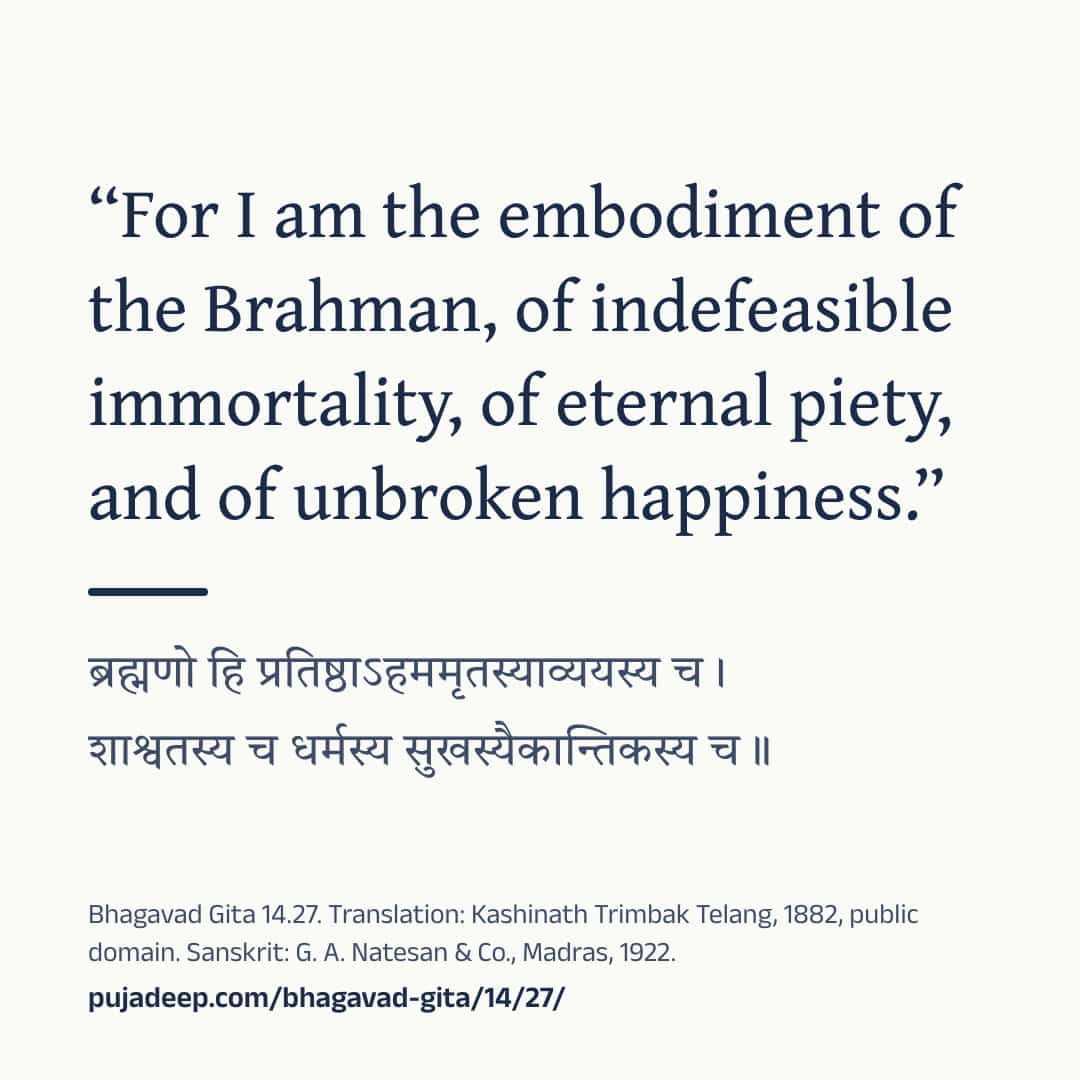
ब्रह्मणो हि प्रतिष्ठाऽहममृतस्याव्ययस्य च ।
शाश्वतस्य च धर्मस्य सुखस्यैकान्तिकस्य च ॥

“For I am the embodiment of the Brahman, of indefeasible immortality, of eternal piety, and of unbroken happiness.”
(K. T. Telang, The Bhagavadgîtâ (The Sacred Books of the East, vol. VIII, Oxford: Clarendon Press, 1882), p. 110, public domain)

“For I am the Abode of Brahman, of the indestructible nectar of immortality, of immemorial Dharma, and of unmixed bliss.”
(Annie Besant, The Bhagavad Gîtâ, or The Lord's Song (London: Theosophical Publishing Society, 1895), p. 134, public domain)

“For I am the Abode of Brahman, the Immortal and Immutable, of everlasting Dharma and of Absolute Bliss.”
(Swami Swarupananda, Srimad-Bhagavad-Gita (Mayavati: Prabuddha Bharata Press, 1909; first printed in Prabuddha Bharata, 1907–1909), p. 282, public domain)

Sanskrit: G. A. Natesan & Co., Madras, 1922.
https://pujadeep.com/bhagavad-gita/14/27/ Nothing is sent from this site. Your own app sends it, to the chat you choose. The picture quotes the translation you chose on this page, with its name and year.
Sanskrit text: The Bhagavad-Gita, or The Lord's Song, with the text in Devanagari and an English translation, 1922. Meanings: written for Pujadeep and checked against the cited edition. Source and changes
Questions families ask
Who speaks Bhagavad Gita 14.27?
Krishna speaks this verse, in chapter 14 (Gunatraya Vibhaga Yoga).
Where does the Sanskrit text come from?
Sanskrit text: The Bhagavad-Gita, or The Lord's Song, with the text in Devanagari and an English translation, 1922. Meanings: written for Pujadeep and checked against the cited edition. See the source
Is the meaning on this page a translation?
Explanation written for this site from the sources listed here, and checked against the cited edition. It is not a translation and not the only way to read the text. Free to quote with credit.
Source and licence
- Sanskrit text
- The Bhagavad-Gita, or The Lord's Song, with the text in Devanagari and an English translation (Annie Besant, G. A. Natesan & Co., Madras, 1922). Public domain. The Sanskrit on these pages was read from this printing’s page images.
- Translation
- The Bhagavadgîtâ with the Sanatsugâtîya and the Anugîtâ, translated by Kâshinâth Trimbak Telang (The Sacred Books of the East, vol. VIII, ed. F. Max Müller) (Kashinath Trimbak Telang, F. Max Müller, Clarendon Press, Oxford, 1882). Public domain. Shown verbatim, as printed.
- Translation
- The Bhagavad Gîtâ, or The Lord's Song, translated by Annie Besant (Annie Besant, Theosophical Publishing Society, London, 1895). Public domain. Shown verbatim, as printed.
- Translation
- Srimad-Bhagavad-Gita, with Sanskrit Text; Paraphrase with Word-by-word Literal Translation; English Rendering and Comments, Index, &c., by the Swami Swarupananda (Himalayan Series, No. XX) (Swami Swarupananda, The Editors and Publishers, Advaita Ashrama, Mayavati, Prabuddha Bharata Press, Mayavati, Almora, Himalayas, 1909). Public domain. Shown verbatim, as printed.
- Commentary
- The Bhagavad-Gita, with the commentary of Sri Sankaracharya, translated by A. Mahadeva Sastri (2nd ed., Mysore: G. T. A. Printing Works, 1901) (Public-domain scan, University of California Libraries). Summarised in our own words; none of its text is reproduced.
- Commentary
- Sri Bhagavad-Gita with Sri Ramanujacharya's Visishtadvaita commentary, translated by A. Govindacharya (Madras, 1898) (Scan uploaded to archive.org (folkscanomy collection)). Summarised in our own words; none of its text is reproduced.
- Common wording
- In this text, 32 words follow today's common wording, checked against sanskritdocuments.org; Sanskrit Wikisource; Gita Press, Gorakhpur; GRETIL, Göttingen and Bhaktivedanta Book Trust.
- Our explanation
- Explanation written for this site from the sources listed here, and checked against the cited edition. It is not a translation and not the only way to read the text. Free to quote with credit.
- Checked
- Checked against the cited edition, October 14, 2026.
- Updated
- October 25, 2026