Bhagavad Gita 14.25: meaning and translation
Chapter 14: Gunatraya Vibhaga Yoga. Krishna says
Such a person, Krishna says, is the same in honour and dishonour, the same towards the side of friends and the side of foes, and has given up every undertaking.
Click or tap a word for its meaning and its dictionary page.
Text and layers
Text and layers
These choices stay in this browser.
Bhagavad Gita 14.25
मानापमानयोस्तुल्यस्तुल्यो मित्रारिपक्षयोः ।सर्वारंभपरित्यागी गुणातीतः स उच्यते ॥
Manapamanayostulyastulyo mitraripakshayohSarvarambhaparityagi gunatitah sa uchyate
mānāpamānayostulyastulyo mitrāripakṣayoḥ |sarvāraṃbhaparityāgī guṇātītaḥ sa ucyate ||
Our explanation Such a person, Krishna says, is the same in honour and dishonour, the same towards the side of friends and the side of foes, and has given up every undertaking. Such a person is said to have gone beyond the guṇas (guṇātīta).
हिंदी अर्थ कृष्ण कहते हैं कि ऐसा व्यक्ति मान और अपमान में समान है, मित्र और शत्रु के पक्ष में समान है, और उसने सब आरंभों (नए कामों की शुरुआत) का त्याग कर दिया है। ऐसा व्यक्ति गुणातीत (गुणों से परे) कहलाता है।
Word by word
Every word, with its dictionary page
Word by word
- मानापमानयोः mānāpamānayoḥ · in honour and dishonour (compound (masculine), locative dual) Dictionary: 1. māna, Monier-Williams 1899, p. 809, col. 1 “consideration, regard, respect, honour”; apa-māna, Monier-Williams 1899, p. 50, col. 2 “disrespect, contempt, disgrace”
- तुल्यः tulyaḥ · the same (adjective (masculine), nominative singular) Dictionary: tulya, Monier-Williams 1899, p. 451, col. 3 “equal to, of the same kind or class or number or value, similar, comparable, like”
- तुल्यः tulyaḥ · the same (adjective (masculine), nominative singular) Dictionary: tulya, Monier-Williams 1899, p. 451, col. 3 “equal to, of the same kind or class or number or value, similar, comparable, like”
- मित्रारिपक्षयोः mitrāripakṣayoḥ · towards the side of friends and of foes (compound (masculine), locative dual) Dictionary: 1. mitra, Monier-Williams 1899, p. 816, col. 1 “a friend, companion, associate”; 2. a-ri, Monier-Williams 1899, p. 87, col. 3 “an enemy”; pakṣa, Monier-Williams 1899, p. 573, col. 3 “a side, party, faction”
- सर्वारंभपरित्यागी sarvāraṃbhaparityāgī · who gives up every undertaking (compound (masculine), nominative singular) Dictionary: sarva, Monier-Williams 1899, p. 1184, col. 3 “whole, entire, all, every”; ā-rambha, Monier-Williams 1899, p. 150, col. 1 “undertaking, beginning”; pari-tyāgin, Monier-Williams 1899, p. 595, col. 2 “leaving, quitting, forsaking, renouncing (mostly ifc.)”
- गुणातीतः guṇātītaḥ · gone beyond the guṇas (compound (masculine), nominative singular) Dictionary: guṇa, Monier-Williams 1899, p. 357, col. 1 “(in Sāṃkhya phil.) an ingredient or constituent of Prakṛiti, chief quality of all existing beings”; atīta, Monier-Williams 1899, p. 16, col. 2 “one who has gone through or got over or beyond”
- सः saḥ · he (pronoun (masculine), nominative singular) Dictionary: tad, Monier-Williams 1899, p. 434, col. 1 “m. he, f. she, n. it, that, this”
- उच्यते ucyate · is called (present passive, 3rd person singular) Dictionary: vac, Monier-Williams 1899, p. 912, col. 1 “to be called or accounted, be regarded as”
1 printing differs
Edition differences. Another printing or text reads this place differently.
- Spelling A digital text reads Same word. The e-text writes the class nasal (सर्वारम्भ); the 1922 edition writes anusvara (सर्वारंभ).
Old translations
Kashinath Trimbak Telang, 1882. Public domain.
Telang translates verses 22–25 as one sentence; see 14.22. Read it at 14.22
Compare 3 translations
Kashinath Trimbak Telang, 1882. Public domain.
Telang translates verses 22–25 as one sentence; see 14.22. Read it at 14.22
You are reading this one
Annie Besant, 1895. Public domain. Page 133.
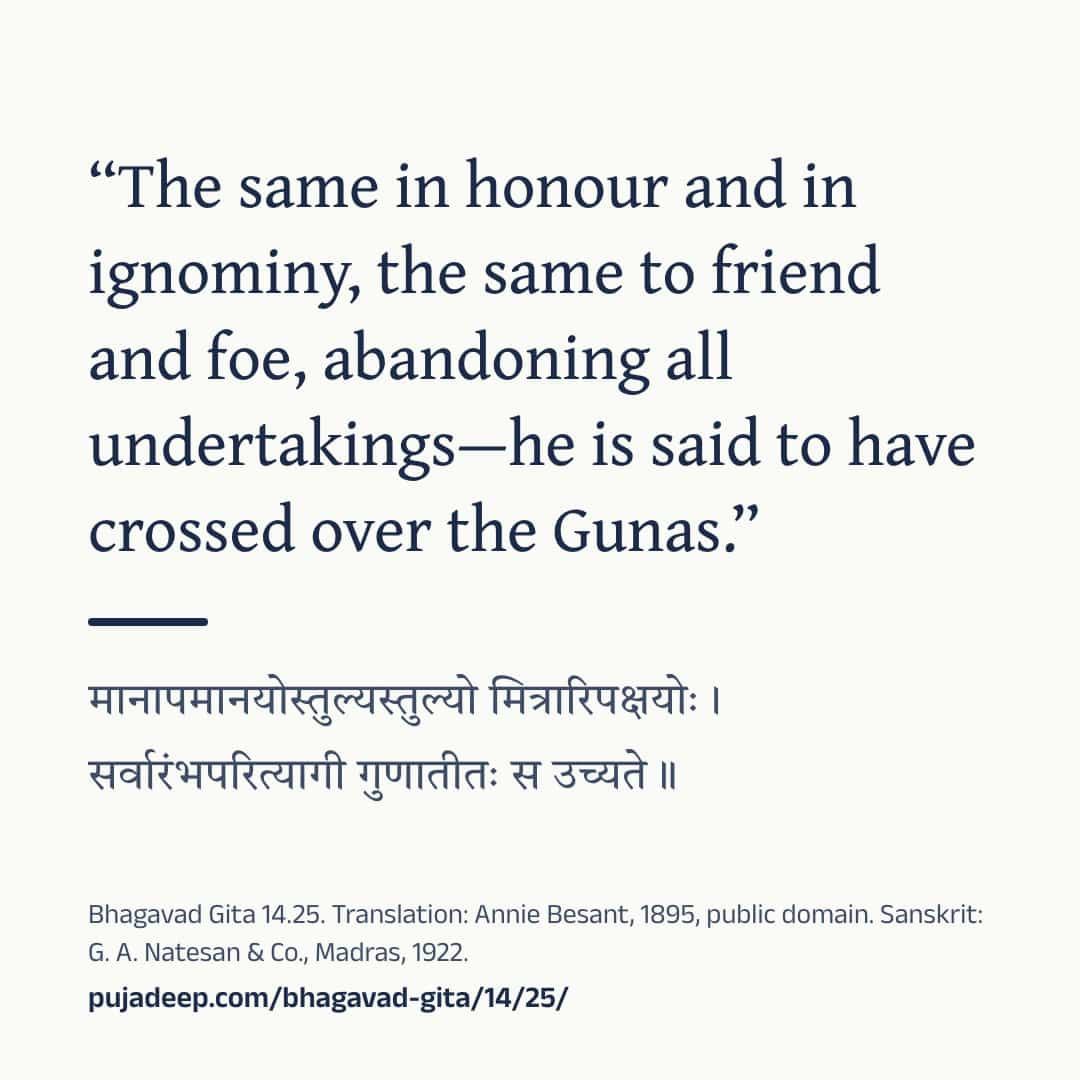
The same in honour and in ignominy, the same to friend and foe, abandoning all undertakings—he is said to have crossed over the Gunas.
This sentence begins in 14.22.
You are reading this one
Swami Swarupananda, 1909 (first printed 1907). Public domain. Page 281.
The same in honour and disgrace, the same to friend and foe, relinquishing all undertakings—he is said to have crossed beyond the Gunas.
This sentence begins in 14.22.
You are reading this one
Cite this verse
The translation: K. T. Telang, The Bhagavadgîtâ (The Sacred Books of the East, vol. VIII, Oxford: Clarendon Press, 1882), p. 110. Bhagavad Gita 14.22–25.
The translation: Annie Besant, The Bhagavad Gîtâ, or The Lord's Song (London: Theosophical Publishing Society, 1895), p. 133. Bhagavad Gita 14.25.
The translation: Swami Swarupananda, Srimad-Bhagavad-Gita (Mayavati: Prabuddha Bharata Press, 1909; first printed in Prabuddha Bharata, 1907–1909), p. 281. Bhagavad Gita 14.25.
Our explanation: “Bhagavad Gita 14.25: meaning and translation.” Pujadeep. Updated October 25, 2026. https://pujadeep.com/bhagavad-gita/14/25/
Pujadeep’s explanations are free to quote with credit: name Pujadeep and link to the page. How to credit
Classical readings, by school
No readings by school on this verse yet.
Share
Show the ways to share
Send one picture or the text to one chat. The picture names its source and the address of this page.
Drawing the picture
See the words
Bhagavad Gita 14.25

मानापमानयोस्तुल्यस्तुल्यो मित्रारिपक्षयोः ।
सर्वारंभपरित्यागी गुणातीतः स उच्यते ॥

“The same in honour and in ignominy, the same to friend and foe, abandoning all undertakings—he is said to have crossed over the Gunas.”
(Annie Besant, The Bhagavad Gîtâ, or The Lord's Song (London: Theosophical Publishing Society, 1895), p. 133, public domain)
This sentence begins in 14.22.

“The same in honour and disgrace, the same to friend and foe, relinquishing all undertakings—he is said to have crossed beyond the Gunas.”
(Swami Swarupananda, Srimad-Bhagavad-Gita (Mayavati: Prabuddha Bharata Press, 1909; first printed in Prabuddha Bharata, 1907–1909), p. 281, public domain)
This sentence begins in 14.22.

Sanskrit: G. A. Natesan & Co., Madras, 1922.
https://pujadeep.com/bhagavad-gita/14/25/ Nothing is sent from this site. Your own app sends it, to the chat you choose. The picture quotes the translation you chose on this page, with its name and year.
Sanskrit text: The Bhagavad-Gita, or The Lord's Song, with the text in Devanagari and an English translation, 1922. Meanings: written for Pujadeep and checked against the cited edition. Source and changes
Questions families ask
Who speaks Bhagavad Gita 14.25?
Krishna speaks this verse, in chapter 14 (Gunatraya Vibhaga Yoga).
Where does the Sanskrit text come from?
Sanskrit text: The Bhagavad-Gita, or The Lord's Song, with the text in Devanagari and an English translation, 1922. Meanings: written for Pujadeep and checked against the cited edition. See the source
Is the meaning on this page a translation?
Explanation written for this site from the sources listed here, and checked against the cited edition. It is not a translation and not the only way to read the text. Free to quote with credit.
Source and licence
- Sanskrit text
- The Bhagavad-Gita, or The Lord's Song, with the text in Devanagari and an English translation (Annie Besant, G. A. Natesan & Co., Madras, 1922). Public domain. The Sanskrit on these pages was read from this printing’s page images.
- Translation
- The Bhagavadgîtâ with the Sanatsugâtîya and the Anugîtâ, translated by Kâshinâth Trimbak Telang (The Sacred Books of the East, vol. VIII, ed. F. Max Müller) (Kashinath Trimbak Telang, F. Max Müller, Clarendon Press, Oxford, 1882). Public domain. Shown verbatim, as printed.
- Translation
- The Bhagavad Gîtâ, or The Lord's Song, translated by Annie Besant (Annie Besant, Theosophical Publishing Society, London, 1895). Public domain. Shown verbatim, as printed.
- Translation
- Srimad-Bhagavad-Gita, with Sanskrit Text; Paraphrase with Word-by-word Literal Translation; English Rendering and Comments, Index, &c., by the Swami Swarupananda (Himalayan Series, No. XX) (Swami Swarupananda, The Editors and Publishers, Advaita Ashrama, Mayavati, Prabuddha Bharata Press, Mayavati, Almora, Himalayas, 1909). Public domain. Shown verbatim, as printed.
- Common wording
- In this text, 32 words follow today's common wording, checked against sanskritdocuments.org; Sanskrit Wikisource; Gita Press, Gorakhpur; GRETIL, Göttingen and Bhaktivedanta Book Trust.
- Our explanation
- Explanation written for this site from the sources listed here, and checked against the cited edition. It is not a translation and not the only way to read the text. Free to quote with credit.
- Checked
- Checked against the cited edition, October 14, 2026.
- Updated
- October 25, 2026