Bhagavad Gita 14.15: meaning and translation
Chapter 14: Gunatraya Vibhaga Yoga. Krishna says
If he dies while rajas prevails, Krishna says, he is born among those attached to action; if he dies while tamas prevails, he is born in the wombs of the unknowing.
Click or tap a word for its meaning and its dictionary page.
Text and layers
Text and layers
These choices stay in this browser.
Bhagavad Gita 14.15
रजसि प्रलयं गत्वा कर्मसङ्गिषु जायते ।तथा प्रलीनस्तमसि मूढयोनिषु जायते ॥
Rajasi pralayam gatva karmasangishu jayateTatha pralinastamasi mudhayonishu jayate
rajasi pralayaṃ gatvā karmasaṅgiṣu jāyate |tathā pralīnastamasi mūḍhayoniṣu jāyate ||
Our explanation If he dies while rajas prevails, Krishna says, he is born among those attached to action; if he dies while tamas prevails, he is born in the wombs of the unknowing.
हिंदी अर्थ कृष्ण कहते हैं कि यदि रज के बढ़े रहते मृत्यु हो, तो वह कर्म में आसक्त लोगों में जन्म लेता है; और यदि तम के बढ़े रहते मृत्यु हो, तो वह मूढ़ योनियों में जन्म लेता है।
Word by word
Every word, with its dictionary page
Word by word
- रजसि rajasi · in rajas (noun (neuter), locative singular) Dictionary: rajas, Monier-Williams 1899, p. 863, col. 2 “the ‘darkening’ quality, passion, emotion, affection”
- प्रलयम् pralayam · death (noun (masculine), accusative singular) Dictionary: pra-laya, Monier-Williams 1899, p. 689, col. 3 “dissolution, reabsorption, destruction, annihilation; death”
- गत्वा gatvā · having met (absolutive (having done)) Dictionary: 1. gam, Monier-Williams 1899, p. 347, col. 1 “to go to any state or condition, undergo”
- कर्मसङ्गिषु karmasaṅgiṣu · among those attached to action (compound (masculine), locative plural) Dictionary: karman, Monier-Williams 1899, p. 258, col. 2 “act, action, performance, business”; saṅgin, Monier-Williams 1899, p. 1133, col. 1 “attached or devoted or addicted to, fond of, intent on”
- जायते jāyate · is born (present, 3rd person singular) Dictionary: jan, Monier-Williams 1899, p. 410, col. 1 “to be born or produced, come into existence”
- तथा tathā · likewise (indeclinable) Dictionary: tathā, Monier-Williams 1899, p. 433, col. 3 “in that manner, so, thus”
- प्रलीनः pralīnaḥ · dying (past participle (masculine), nominative singular) Dictionary: pra-līna, Monier-Williams 1899, p. 690, col. 1 “dissolved, reabsorbed into (loc.), disappeared, lost, died”
- तमसि tamasi · in tamas (noun (neuter), locative singular) Dictionary: tamas, Monier-Williams 1899, p. 438, col. 1 “one of the 3 qualities or constituents of everything in creation”
- मूढयोनिषु mūḍhayoniṣu · in the wombs of the unknowing (compound, locative plural) Dictionary: mūḍha, Monier-Williams 1899, p. 825, col. 2 “stupefied, bewildered, perplexed, confused”; yoni, Monier-Williams 1899, p. 858, col. 2 “the womb, uterus”
- जायते jāyate · is born (present, 3rd person singular) Dictionary: jan, Monier-Williams 1899, p. 410, col. 1 “to be born or produced, come into existence”
Old translations
Kashinath Trimbak Telang, 1882. Public domain. Page 108–109.
Encountering death during (the prevalence of) passion, he is born among those attached to action. Likewise, dying during (the prevalence of) darkness, he is born in the wombs of the ignorant1.
Footnotes (the translator’s own) - Lower creation, such as birds, beasts, &c. ↩
Compare 3 translations
Kashinath Trimbak Telang, 1882. Public domain. Page 108–109.
Encountering death during (the prevalence of) passion, he is born among those attached to action. Likewise, dying during (the prevalence of) darkness, he is born in the wombs of the ignorant1.
Footnotes (the translator’s own) - Lower creation, such as birds, beasts, &c. ↩
You are reading this one
Annie Besant, 1895. Public domain. Page 131.
Having gone to dissolution in Rajas, he is born among those attached to action if dissolved in Tamas, he is born in the wombs of the deluded.
You are reading this one
Swami Swarupananda, 1909 (first printed 1907). Public domain. Page 277.
Meeting death in Rajas, he is born among those attached to action; so dying in Tamas, he is born in the wombs of the irrational.
You are reading this one
Cite this verse
The translation: K. T. Telang, The Bhagavadgîtâ (The Sacred Books of the East, vol. VIII, Oxford: Clarendon Press, 1882), pp. 108–109. Bhagavad Gita 14.15.
The translation: Annie Besant, The Bhagavad Gîtâ, or The Lord's Song (London: Theosophical Publishing Society, 1895), p. 131. Bhagavad Gita 14.15.
The translation: Swami Swarupananda, Srimad-Bhagavad-Gita (Mayavati: Prabuddha Bharata Press, 1909; first printed in Prabuddha Bharata, 1907–1909), p. 277. Bhagavad Gita 14.15.
Our explanation: “Bhagavad Gita 14.15: meaning and translation.” Pujadeep. Updated October 25, 2026. https://pujadeep.com/bhagavad-gita/14/15/
Pujadeep’s explanations are free to quote with credit: name Pujadeep and link to the page. How to credit
Classical readings, by school
No readings by school on this verse yet.
Share
Show the ways to share
Send one picture or the text to one chat. The picture names its source and the address of this page.
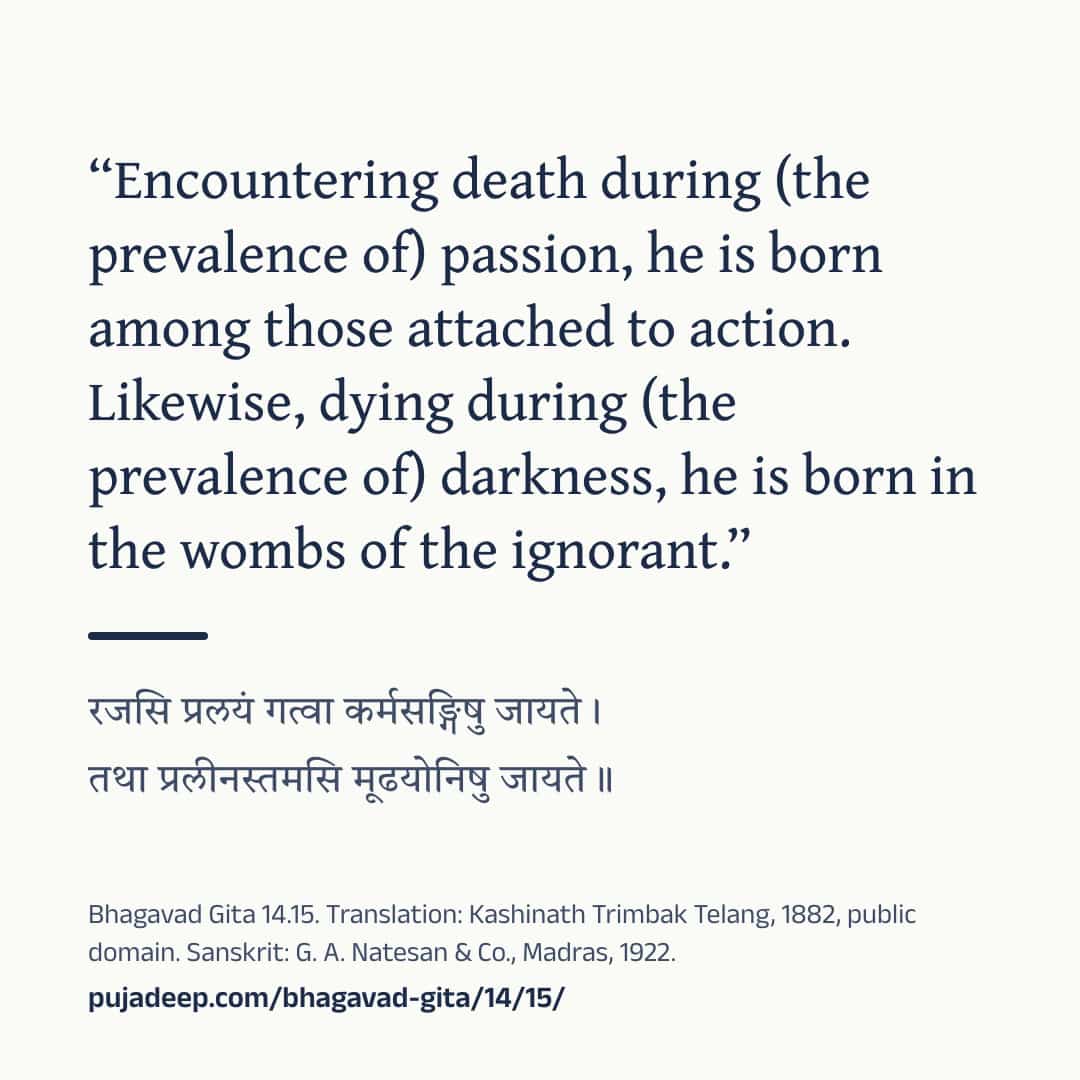
Drawing the picture
See the words
Bhagavad Gita 14.15

रजसि प्रलयं गत्वा कर्मसङ्गिषु जायते ।
तथा प्रलीनस्तमसि मूढयोनिषु जायते ॥

“Encountering death during (the prevalence of) passion, he is born among those attached to action. Likewise, dying during (the prevalence of) darkness, he is born in the wombs of the ignorant.”
(K. T. Telang, The Bhagavadgîtâ (The Sacred Books of the East, vol. VIII, Oxford: Clarendon Press, 1882), pp. 108–109, public domain)

“Having gone to dissolution in Rajas, he is born among those attached to action if dissolved in Tamas, he is born in the wombs of the deluded.”
(Annie Besant, The Bhagavad Gîtâ, or The Lord's Song (London: Theosophical Publishing Society, 1895), p. 131, public domain)

“Meeting death in Rajas, he is born among those attached to action; so dying in Tamas, he is born in the wombs of the irrational.”
(Swami Swarupananda, Srimad-Bhagavad-Gita (Mayavati: Prabuddha Bharata Press, 1909; first printed in Prabuddha Bharata, 1907–1909), p. 277, public domain)

Sanskrit: G. A. Natesan & Co., Madras, 1922.
https://pujadeep.com/bhagavad-gita/14/15/ Nothing is sent from this site. Your own app sends it, to the chat you choose. The picture quotes the translation you chose on this page, with its name and year.
Sanskrit text: The Bhagavad-Gita, or The Lord's Song, with the text in Devanagari and an English translation, 1922. Meanings: written for Pujadeep and checked against the cited edition. Source and changes
Questions families ask
Who speaks Bhagavad Gita 14.15?
Krishna speaks this verse, in chapter 14 (Gunatraya Vibhaga Yoga).
Where does the Sanskrit text come from?
Sanskrit text: The Bhagavad-Gita, or The Lord's Song, with the text in Devanagari and an English translation, 1922. Meanings: written for Pujadeep and checked against the cited edition. See the source
Is the meaning on this page a translation?
Explanation written for this site from the sources listed here, and checked against the cited edition. It is not a translation and not the only way to read the text. Free to quote with credit.
Source and licence
- Sanskrit text
- The Bhagavad-Gita, or The Lord's Song, with the text in Devanagari and an English translation (Annie Besant, G. A. Natesan & Co., Madras, 1922). Public domain. The Sanskrit on these pages was read from this printing’s page images.
- Translation
- The Bhagavadgîtâ with the Sanatsugâtîya and the Anugîtâ, translated by Kâshinâth Trimbak Telang (The Sacred Books of the East, vol. VIII, ed. F. Max Müller) (Kashinath Trimbak Telang, F. Max Müller, Clarendon Press, Oxford, 1882). Public domain. Shown verbatim, as printed.
- Translation
- The Bhagavad Gîtâ, or The Lord's Song, translated by Annie Besant (Annie Besant, Theosophical Publishing Society, London, 1895). Public domain. Shown verbatim, as printed.
- Translation
- Srimad-Bhagavad-Gita, with Sanskrit Text; Paraphrase with Word-by-word Literal Translation; English Rendering and Comments, Index, &c., by the Swami Swarupananda (Himalayan Series, No. XX) (Swami Swarupananda, The Editors and Publishers, Advaita Ashrama, Mayavati, Prabuddha Bharata Press, Mayavati, Almora, Himalayas, 1909). Public domain. Shown verbatim, as printed.
- Common wording
- In this text, 32 words follow today's common wording, checked against sanskritdocuments.org; Sanskrit Wikisource; Gita Press, Gorakhpur; GRETIL, Göttingen and Bhaktivedanta Book Trust.
- Our explanation
- Explanation written for this site from the sources listed here, and checked against the cited edition. It is not a translation and not the only way to read the text. Free to quote with credit.
- Checked
- Checked against the cited edition, October 14, 2026.
- Updated
- October 25, 2026