Bhagavad Gita 14.12: meaning and translation
Chapter 14: Gunatraya Vibhaga Yoga. Krishna says
Greed, busy activity, the starting of undertakings, restlessness and longing arise, Krishna says, when rajas has grown.
Click or tap a word for its meaning and its dictionary page.
Text and layers
Text and layers
These choices stay in this browser.
Bhagavad Gita 14.12
लोभः प्रवृत्तिरारंभः कर्मणामशमः स्पृहा ।रजस्येतानि जायन्ते विवृद्धे भरतर्षभ ॥
Lobhah pravrittirarambhah karmanamashamah sprihaRajasyetani jayante vivriddhe bharatarshabha
lobhaḥ pravṛttirāraṃbhaḥ karmaṇāmaśamaḥ spṛhā |rajasyetāni jāyante vivṛddhe bharatarṣabha ||
Our explanation Greed, busy activity, the starting of undertakings, restlessness and longing arise, Krishna says, when rajas has grown.
हिंदी अर्थ कृष्ण कहते हैं कि जब रज बढ़ता है, तब लोभ, प्रवृत्ति (लगातार सक्रियता), नए कामों का आरंभ, अशांति और लालसा उत्पन्न होते हैं।
Word by word
Every word, with its dictionary page
Word by word
- लोभः lobhaḥ · greed (noun (masculine), nominative singular) Dictionary: lobha, Monier-Williams 1899, p. 905, col. 1 “covetousness, cupidity, avarice”
- प्रवृत्तिः pravṛttiḥ · activity (noun (feminine), nominative singular) Dictionary: pra-vṛtti, Monier-Williams 1899, p. 694, col. 1 “activity, exertion, efficacy, function”
- आरंभः āraṃbhaḥ · undertaking (noun (masculine), nominative singular) Dictionary: ā-rambha, Monier-Williams 1899, p. 150, col. 1 “undertaking, beginning”
- कर्मणाम् karmaṇām · of actions (noun (neuter), genitive plural) Dictionary: karman, Monier-Williams 1899, p. 258, col. 2 “act, action, performance, business”
- अशमः aśamaḥ · restlessness (noun (masculine), nominative singular) Dictionary: a-śama, Monier-Williams 1899, p. 113, col. 1 “disquietude, uneasiness”
- स्पृहा spṛhā · longing (noun (feminine), nominative singular) Dictionary: spṛhā, Monier-Williams 1899, p. 1269, col. 3 “eager desire, desire, covetousness, envy, longing for”
- रजसि rajasi · when rajas (noun (neuter), locative singular) Dictionary: rajas, Monier-Williams 1899, p. 863, col. 2 “the ‘darkening’ quality, passion, emotion, affection”
- एतानि etāni · these (pronoun (neuter), nominative plural) Dictionary: etad, Monier-Williams 1899, p. 231, col. 2 “this, this here, here”
- जायन्ते jāyante · arise (present, 3rd person plural) Dictionary: jan, Monier-Williams 1899, p. 410, col. 1 “to be born or produced, come into existence”
- विवृद्धे vivṛddhe · has grown (past participle (neuter), locative singular) Dictionary: vi-vṛddha, Monier-Williams 1899, p. 989, col. 1 “grown, increased, enhanced”
- भरतर्षभ bharatarṣabha · O best of the Bharatas (compound (masculine), vocative singular) Dictionary: bharata-ṛṣabha, Monier-Williams 1899, p. 747, col. 3 “the best or a prince (lit. ‘bull’) of the Bh°s”
1 printing differs
Edition differences. Another printing or text reads this place differently.
- Spelling A digital text reads Same word. The e-text writes the class nasal (आरम्भः); the 1922 edition writes anusvara (आरंभः).
Old translations
Kashinath Trimbak Telang, 1882. Public domain. Page 108.
Avarice, activity1, performance of actions, want of tranquillity, desire, these are produced, O chief of the descendants of Bharata! when passion is developed.
Footnotes (the translator’s own) - Activity=always doing something or another; performance, &c.=rearing large mansions, &c.; want of tranquillity=perpetual agitation of mind, 'this I will do now, then that, and next the other;' desire=to obtain everything that one comes across. ↩
Compare 3 translations
Kashinath Trimbak Telang, 1882. Public domain. Page 108.
Avarice, activity1, performance of actions, want of tranquillity, desire, these are produced, O chief of the descendants of Bharata! when passion is developed.
Footnotes (the translator’s own) - Activity=always doing something or another; performance, &c.=rearing large mansions, &c.; want of tranquillity=perpetual agitation of mind, 'this I will do now, then that, and next the other;' desire=to obtain everything that one comes across. ↩
You are reading this one
Annie Besant, 1895. Public domain. Page 131.
Greed, outgoing energy, undertaking of actions, restlessness, desire—these are born of the increase of Rajas, O best of the Bhâratas.
You are reading this one
Swami Swarupananda, 1909 (first printed 1907). Public domain. Page 275.
Greed, activity, the undertaking of actions, unrest, longing,—these arise when Rajas is predominant, O bull of the Bháratas.
You are reading this one
Cite this verse
The translation: K. T. Telang, The Bhagavadgîtâ (The Sacred Books of the East, vol. VIII, Oxford: Clarendon Press, 1882), p. 108. Bhagavad Gita 14.12.
The translation: Annie Besant, The Bhagavad Gîtâ, or The Lord's Song (London: Theosophical Publishing Society, 1895), p. 131. Bhagavad Gita 14.12.
The translation: Swami Swarupananda, Srimad-Bhagavad-Gita (Mayavati: Prabuddha Bharata Press, 1909; first printed in Prabuddha Bharata, 1907–1909), p. 275. Bhagavad Gita 14.12.
Our explanation: “Bhagavad Gita 14.12: meaning and translation.” Pujadeep. Updated October 25, 2026. https://pujadeep.com/bhagavad-gita/14/12/
Pujadeep’s explanations are free to quote with credit: name Pujadeep and link to the page. How to credit
Classical readings, by school
No readings by school on this verse yet.
Share
Show the ways to share
Send one picture or the text to one chat. The picture names its source and the address of this page.
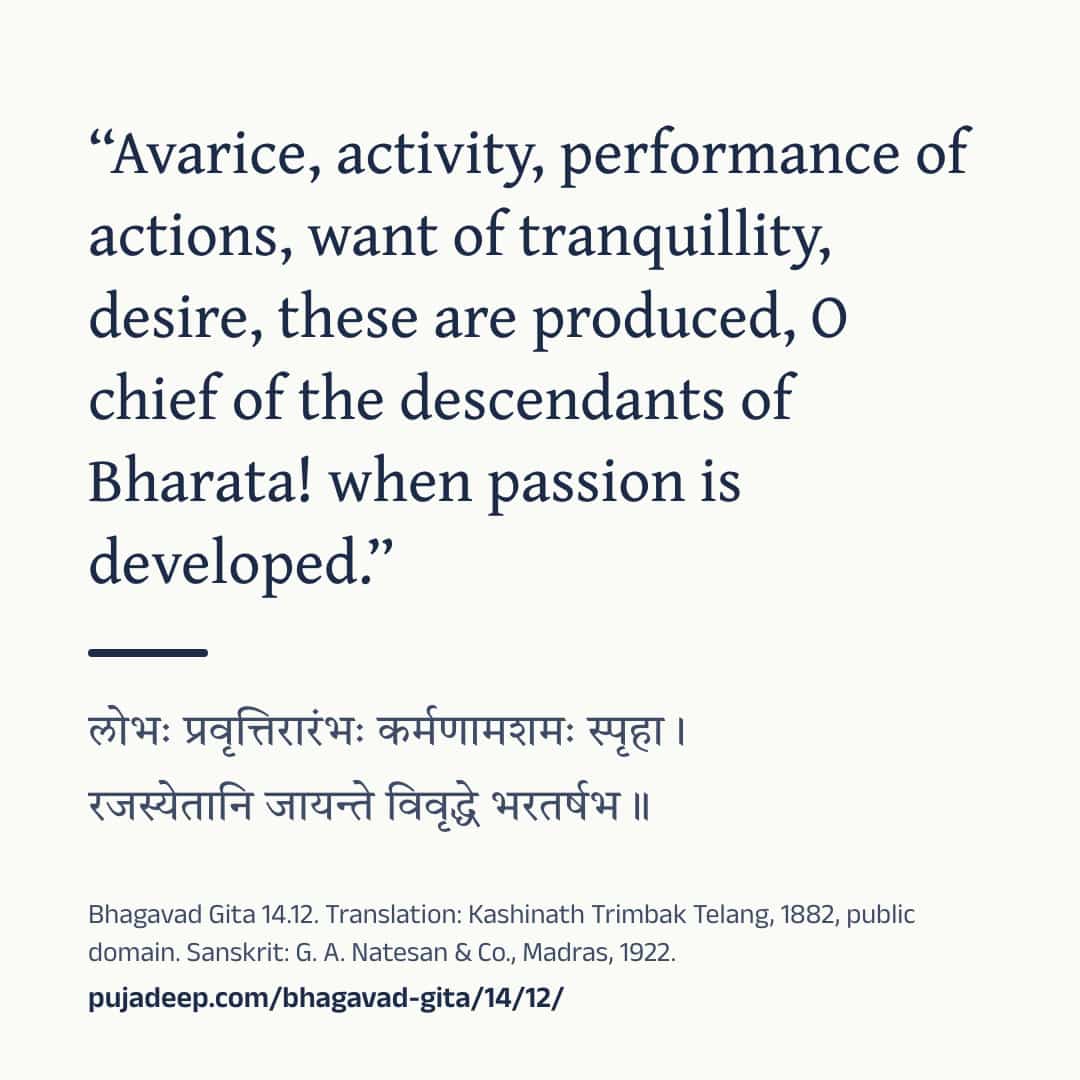
Drawing the picture
See the words
Bhagavad Gita 14.12

लोभः प्रवृत्तिरारंभः कर्मणामशमः स्पृहा ।
रजस्येतानि जायन्ते विवृद्धे भरतर्षभ ॥

“Avarice, activity, performance of actions, want of tranquillity, desire, these are produced, O chief of the descendants of Bharata! when passion is developed.”
(K. T. Telang, The Bhagavadgîtâ (The Sacred Books of the East, vol. VIII, Oxford: Clarendon Press, 1882), p. 108, public domain)

“Greed, outgoing energy, undertaking of actions, restlessness, desire—these are born of the increase of Rajas, O best of the Bhâratas.”
(Annie Besant, The Bhagavad Gîtâ, or The Lord's Song (London: Theosophical Publishing Society, 1895), p. 131, public domain)

“Greed, activity, the undertaking of actions, unrest, longing,—these arise when Rajas is predominant, O bull of the Bháratas.”
(Swami Swarupananda, Srimad-Bhagavad-Gita (Mayavati: Prabuddha Bharata Press, 1909; first printed in Prabuddha Bharata, 1907–1909), p. 275, public domain)

Sanskrit: G. A. Natesan & Co., Madras, 1922.
https://pujadeep.com/bhagavad-gita/14/12/ Nothing is sent from this site. Your own app sends it, to the chat you choose. The picture quotes the translation you chose on this page, with its name and year.
Sanskrit text: The Bhagavad-Gita, or The Lord's Song, with the text in Devanagari and an English translation, 1922. Meanings: written for Pujadeep and checked against the cited edition. Source and changes
Questions families ask
Who speaks Bhagavad Gita 14.12?
Krishna speaks this verse, in chapter 14 (Gunatraya Vibhaga Yoga).
Where does the Sanskrit text come from?
Sanskrit text: The Bhagavad-Gita, or The Lord's Song, with the text in Devanagari and an English translation, 1922. Meanings: written for Pujadeep and checked against the cited edition. See the source
Is the meaning on this page a translation?
Explanation written for this site from the sources listed here, and checked against the cited edition. It is not a translation and not the only way to read the text. Free to quote with credit.
Source and licence
- Sanskrit text
- The Bhagavad-Gita, or The Lord's Song, with the text in Devanagari and an English translation (Annie Besant, G. A. Natesan & Co., Madras, 1922). Public domain. The Sanskrit on these pages was read from this printing’s page images.
- Translation
- The Bhagavadgîtâ with the Sanatsugâtîya and the Anugîtâ, translated by Kâshinâth Trimbak Telang (The Sacred Books of the East, vol. VIII, ed. F. Max Müller) (Kashinath Trimbak Telang, F. Max Müller, Clarendon Press, Oxford, 1882). Public domain. Shown verbatim, as printed.
- Translation
- The Bhagavad Gîtâ, or The Lord's Song, translated by Annie Besant (Annie Besant, Theosophical Publishing Society, London, 1895). Public domain. Shown verbatim, as printed.
- Translation
- Srimad-Bhagavad-Gita, with Sanskrit Text; Paraphrase with Word-by-word Literal Translation; English Rendering and Comments, Index, &c., by the Swami Swarupananda (Himalayan Series, No. XX) (Swami Swarupananda, The Editors and Publishers, Advaita Ashrama, Mayavati, Prabuddha Bharata Press, Mayavati, Almora, Himalayas, 1909). Public domain. Shown verbatim, as printed.
- Common wording
- In this text, 32 words follow today's common wording, checked against sanskritdocuments.org; Sanskrit Wikisource; Gita Press, Gorakhpur; GRETIL, Göttingen and Bhaktivedanta Book Trust.
- Our explanation
- Explanation written for this site from the sources listed here, and checked against the cited edition. It is not a translation and not the only way to read the text. Free to quote with credit.
- Checked
- Checked against the cited edition, October 14, 2026.
- Updated
- October 25, 2026