Bhagavad Gita 14.8: meaning and translation
Chapter 14: Gunatraya Vibhaga Yoga. Krishna says
Tamas, Krishna says, is born of ignorance and deludes all embodied beings; it binds by carelessness (pramāda), laziness and sleep.
Click or tap a word for its meaning and its dictionary page.
Text and layers
Text and layers
These choices stay in this browser.
Bhagavad Gita 14.8
तमस्त्वज्ञानजं विद्धि मोहनं सर्वदेहिनाम् ।प्रमादालस्यनिद्राभिस्तन्निबध्नाति भारत ॥
Tamastvajnanajam viddhi mohanam sarvadehinamPramadalasyanidrabhistannibadhnati bharata
tamastvajñānajaṃ viddhi mohanaṃ sarvadehinām |pramādālasyanidrābhistannibadhnāti bhārata ||
Our explanation Tamas, Krishna says, is born of ignorance and deludes all embodied beings; it binds by carelessness (pramāda), laziness and sleep.
हिंदी अर्थ कृष्ण कहते हैं कि तम अज्ञान से उत्पन्न होता है और सब देहधारियों को मोह में डालता है; वह प्रमाद (लापरवाही), आलस्य और निद्रा से बाँधता है।
Word by word
Every word, with its dictionary page
Word by word
- तमः tamaḥ · tamas (noun (neuter), accusative singular) Dictionary: tamas, Monier-Williams 1899, p. 438, col. 1 “one of the 3 qualities or constituents of everything in creation”
- तु tu · but (indeclinable) Dictionary: 2. tu, Monier-Williams 1899, p. 449, col. 3 “but”
- अज्ञानजम् ajñānajam · born of ignorance (compound (neuter), accusative singular) Dictionary: a-jñāna, Monier-Williams 1899, p. 10, col. 3 “non-cognizance; ignorance”; 2. ja, Monier-Williams 1899, p. 407, col. 3 “ifc. born or descended from, produced or caused by”
- विद्धि viddhi · know (imperative, 2nd person singular) Dictionary: 1. vid, Monier-Williams 1899, p. 963, col. 2 “to know, understand, perceive, learn”
- मोहनम् mohanam · deluding (adjective (neuter), accusative singular) Dictionary: mohana, Monier-Williams 1899, p. 836, col. 1 “depriving of consciousness, bewildering, confusing, perplexing, leading astray, infatuating”
- सर्वदेहिनाम् sarvadehinām · of all embodied beings (compound (masculine), genitive plural) Dictionary: sarva, Monier-Williams 1899, p. 1184, col. 3 “whole, entire, all, every”; dehin, Monier-Williams 1899, p. 497, col. 1 “having a body, corporeal”
- प्रमादालस्यनिद्राभिः pramādālasyanidrābhiḥ · by carelessness, laziness and sleep (compound (feminine), instrumental plural) Dictionary: pra-māda, Monier-Williams 1899, p. 685, col. 2 “negligence, carelessness about (abl. or comp.)”; ālasya, Monier-Williams 1899, p. 153, col. 3 “idleness, sloth, want of energy”; ni-drā, Monier-Williams 1899, p. 548, col. 2 “sleep, slumber, sleepiness, sloth”
- तत् tat · that (pronoun (neuter), nominative singular) Dictionary: tad, Monier-Williams 1899, p. 434, col. 1 “m. he, f. she, n. it, that, this”
- निबध्नाति nibadhnāti · binds (present, 3rd person singular) Dictionary: ni-bandh, Monier-Williams 1899, p. 550, col. 1 “to enchain, fetter (lit. and fig.)”
- भारत bhārata · O Bharata (Arjuna) (noun (masculine), vocative singular) Dictionary: bhārata, Monier-Williams 1899, p. 753, col. 1 “a descendant of Bharata”
Old translations
Kashinath Trimbak Telang, 1882. Public domain. Page 108.
Darkness (you must) know to be born of ignorance, it deludes all embodied (selfs). And that, O descendant of Bharata! binds down (the self) with heedlessness1, indolence, and sleep.
Footnotes (the translator’s own) - Carelessness about duty, owing to being intent on something else. Cf. Sutta Nipâta, pp. 51–91; Dhammapada, stanza 21; Kathopanishad, p. 152. ↩
Compare 3 translations
Kashinath Trimbak Telang, 1882. Public domain. Page 108.
Darkness (you must) know to be born of ignorance, it deludes all embodied (selfs). And that, O descendant of Bharata! binds down (the self) with heedlessness1, indolence, and sleep.
Footnotes (the translator’s own) - Carelessness about duty, owing to being intent on something else. Cf. Sutta Nipâta, pp. 51–91; Dhammapada, stanza 21; Kathopanishad, p. 152. ↩
You are reading this one
Annie Besant, 1895. Public domain. Page 130.
But Tamas, know thou, born of unwisdom, deludeth all Dwellers in the body; that bindeth by negligence, indolence and sloth, O Bhârata.
You are reading this one
Swami Swarupananda, 1909 (first printed 1907). Public domain. Page 273–274.
And know Tamas born of ignorance, delusive to all embodied beings; it binds fast, O descendant of Bharata, by miscomprehension, indolence, and sleep.
You are reading this one
Cite this verse
The translation: K. T. Telang, The Bhagavadgîtâ (The Sacred Books of the East, vol. VIII, Oxford: Clarendon Press, 1882), p. 108. Bhagavad Gita 14.8.
The translation: Annie Besant, The Bhagavad Gîtâ, or The Lord's Song (London: Theosophical Publishing Society, 1895), p. 130. Bhagavad Gita 14.8.
The translation: Swami Swarupananda, Srimad-Bhagavad-Gita (Mayavati: Prabuddha Bharata Press, 1909; first printed in Prabuddha Bharata, 1907–1909), pp. 273–274. Bhagavad Gita 14.8.
Our explanation: “Bhagavad Gita 14.8: meaning and translation.” Pujadeep. Updated October 25, 2026. https://pujadeep.com/bhagavad-gita/14/8/
Pujadeep’s explanations are free to quote with credit: name Pujadeep and link to the page. How to credit
Classical readings, by school
No readings by school on this verse yet.
Share
Show the ways to share
Send one picture or the text to one chat. The picture names its source and the address of this page.
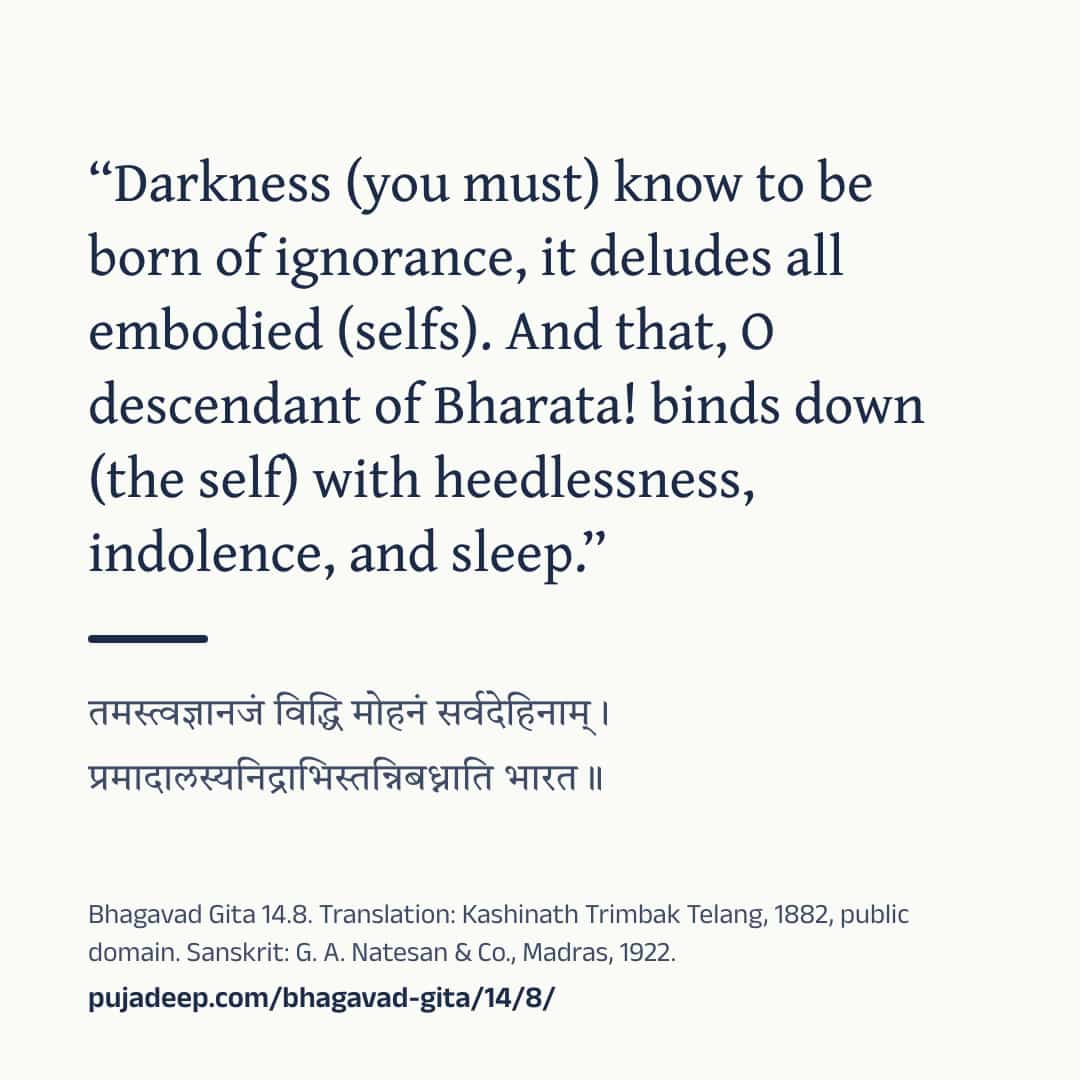
Drawing the picture
See the words
Bhagavad Gita 14.8

तमस्त्वज्ञानजं विद्धि मोहनं सर्वदेहिनाम् ।
प्रमादालस्यनिद्राभिस्तन्निबध्नाति भारत ॥

“Darkness (you must) know to be born of ignorance, it deludes all embodied (selfs). And that, O descendant of Bharata! binds down (the self) with heedlessness, indolence, and sleep.”
(K. T. Telang, The Bhagavadgîtâ (The Sacred Books of the East, vol. VIII, Oxford: Clarendon Press, 1882), p. 108, public domain)

“But Tamas, know thou, born of unwisdom, deludeth all Dwellers in the body; that bindeth by negligence, indolence and sloth, O Bhârata.”
(Annie Besant, The Bhagavad Gîtâ, or The Lord's Song (London: Theosophical Publishing Society, 1895), p. 130, public domain)

“And know Tamas born of ignorance, delusive to all embodied beings; it binds fast, O descendant of Bharata, by miscomprehension, indolence, and sleep.”
(Swami Swarupananda, Srimad-Bhagavad-Gita (Mayavati: Prabuddha Bharata Press, 1909; first printed in Prabuddha Bharata, 1907–1909), pp. 273–274, public domain)

Sanskrit: G. A. Natesan & Co., Madras, 1922.
https://pujadeep.com/bhagavad-gita/14/8/ Nothing is sent from this site. Your own app sends it, to the chat you choose. The picture quotes the translation you chose on this page, with its name and year.
Sanskrit text: The Bhagavad-Gita, or The Lord's Song, with the text in Devanagari and an English translation, 1922. Meanings: written for Pujadeep and checked against the cited edition. Source and changes
Questions families ask
Who speaks Bhagavad Gita 14.8?
Krishna speaks this verse, in chapter 14 (Gunatraya Vibhaga Yoga).
Where does the Sanskrit text come from?
Sanskrit text: The Bhagavad-Gita, or The Lord's Song, with the text in Devanagari and an English translation, 1922. Meanings: written for Pujadeep and checked against the cited edition. See the source
Is the meaning on this page a translation?
Explanation written for this site from the sources listed here, and checked against the cited edition. It is not a translation and not the only way to read the text. Free to quote with credit.
Source and licence
- Sanskrit text
- The Bhagavad-Gita, or The Lord's Song, with the text in Devanagari and an English translation (Annie Besant, G. A. Natesan & Co., Madras, 1922). Public domain. The Sanskrit on these pages was read from this printing’s page images.
- Translation
- The Bhagavadgîtâ with the Sanatsugâtîya and the Anugîtâ, translated by Kâshinâth Trimbak Telang (The Sacred Books of the East, vol. VIII, ed. F. Max Müller) (Kashinath Trimbak Telang, F. Max Müller, Clarendon Press, Oxford, 1882). Public domain. Shown verbatim, as printed.
- Translation
- The Bhagavad Gîtâ, or The Lord's Song, translated by Annie Besant (Annie Besant, Theosophical Publishing Society, London, 1895). Public domain. Shown verbatim, as printed.
- Translation
- Srimad-Bhagavad-Gita, with Sanskrit Text; Paraphrase with Word-by-word Literal Translation; English Rendering and Comments, Index, &c., by the Swami Swarupananda (Himalayan Series, No. XX) (Swami Swarupananda, The Editors and Publishers, Advaita Ashrama, Mayavati, Prabuddha Bharata Press, Mayavati, Almora, Himalayas, 1909). Public domain. Shown verbatim, as printed.
- Common wording
- In this text, 32 words follow today's common wording, checked against sanskritdocuments.org; Sanskrit Wikisource; Gita Press, Gorakhpur; GRETIL, Göttingen and Bhaktivedanta Book Trust.
- Our explanation
- Explanation written for this site from the sources listed here, and checked against the cited edition. It is not a translation and not the only way to read the text. Free to quote with credit.
- Checked
- Checked against the cited edition, October 14, 2026.
- Updated
- October 25, 2026