Bhagavad Gita 14.6: meaning and translation
Chapter 14: Gunatraya Vibhaga Yoga. Krishna says
Of these, Krishna says, sattva, being pure, is bright and free from affliction; it binds by attachment to happiness and attachment to knowledge.
Click or tap a word for its meaning and its dictionary page.
Text and layers
Text and layers
These choices stay in this browser.
Bhagavad Gita 14.6
तत्र सत्त्वं निर्मलत्वात्प्रकाशकमनामयम् ।सुखसङ्गेन बध्नाति ज्ञानसङ्गेन चानघ ॥
Tatra sattvam nirmalatvatprakashakamanamayamSukhasangena badhnati jnanasangena chanagha
tatra sattvaṃ nirmalatvātprakāśakamanāmayam |sukhasaṅgena badhnāti jñānasaṅgena cānagha ||
Our explanation Of these, Krishna says, sattva, being pure, is bright and free from affliction; it binds by attachment to happiness and attachment to knowledge. He calls Arjuna sinless (anagha). Telang's note gives Shankara's and Ramanuja's explanations of this bond.
हिंदी अर्थ कृष्ण कहते हैं कि इनमें सत्त्व निर्मल होने के कारण प्रकाश देने वाला और विकार से रहित है; वह सुख की आसक्ति और ज्ञान की आसक्ति से बाँधता है। वे अर्जुन को अनघ (निष्पाप) कहकर पुकारते हैं। तेलंग की टिप्पणी इस बंधन की शंकराचार्य और रामानुजाचार्य की व्याख्याएँ देती है।
Word by word
Every word, with its dictionary page
Word by word
- तत्र tatra · of these (indeclinable) Dictionary: tatra, Monier-Williams 1899, p. 433, col. 2 “in that, therein, in that case”
- सत्त्वम् sattvam · sattva (noun (neuter), nominative singular) Dictionary: sat-tva, Monier-Williams 1899, p. 1135, col. 2 “the quality of purity or goodness”
- निर्मलत्वात् nirmalatvāt · because it is pure (noun (neuter), ablative singular) Dictionary: nir-mala-tva, Monier-Williams 1899, p. 541, col. 3 “stainlessness, cleanness, purity”
- प्रकाशकम् prakāśakam · bright, giving light (adjective (neuter), nominative singular) Dictionary: pra-kāśaka, Monier-Williams 1899, p. 653, col. 2 “irradiating, illuminating, giving light”
- अनामयम् anāmayam · free from affliction (adjective (neuter), nominative singular) Dictionary: an-āmaya, Monier-Williams 1899, p. 28, col. 2 “free from disease, healthy, salubrious”
- सुखसङ्गेन sukhasaṅgena · by attachment to happiness (compound (masculine), instrumental singular) Dictionary: sukha, Monier-Williams 1899, p. 1221, col. 1 “ease, easiness, comfort, prosperity, pleasure, happiness”; saṅga, Monier-Williams 1899, p. 1132, col. 3 “(esp.) worldly or selfish attachment or affection, desire”
- बध्नाति badhnāti · binds (present, 3rd person singular) Dictionary: bandh, Monier-Williams 1899, p. 720, col. 1 “to bind, tie, fix, fasten, chain, fetter”
- ज्ञानसङ्गेन jñānasaṅgena · by attachment to knowledge (compound (masculine), instrumental singular) Dictionary: jñāna, Monier-Williams 1899, p. 426, col. 1 “knowing, becoming acquainted with, knowledge”; saṅga, Monier-Williams 1899, p. 1132, col. 3 “(esp.) worldly or selfish attachment or affection, desire”
- च ca · and (indeclinable) Dictionary: 2. ca, Monier-Williams 1899, p. 380, col. 1 “and, both, also, moreover, as well as”
- अनघ anagha · O sinless one (noun (masculine), vocative singular) Dictionary: an-agha, Monier-Williams 1899, p. 24, col. 2 “sinless; faultless”
Old translations
Kashinath Trimbak Telang, 1882. Public domain. Page 107.
Of these, goodness, which, in consequence of being untainted, is enlightening and free from (all) misery, binds the soul, O sinless one! with the bond of pleasure and the bond of knowledge1.
Footnotes (the translator’s own) - Pleasure and knowledge appertain to the mind, not the self, hence they are described as constituting bonds, when erroneously connected with the self, Saṅkara and Srîdhara. They constitute 'bonds,' because the self when brought into contact with them, strives to obtain them, Râmânuga. ↩
Compare 3 translations
Kashinath Trimbak Telang, 1882. Public domain. Page 107.
Of these, goodness, which, in consequence of being untainted, is enlightening and free from (all) misery, binds the soul, O sinless one! with the bond of pleasure and the bond of knowledge1.
Footnotes (the translator’s own) - Pleasure and knowledge appertain to the mind, not the self, hence they are described as constituting bonds, when erroneously connected with the self, Saṅkara and Srîdhara. They constitute 'bonds,' because the self when brought into contact with them, strives to obtain them, Râmânuga. ↩
You are reading this one
Annie Besant, 1895. Public domain. Page 130.
Of these Sattva, from its stainlessness luminous and healthy, bindeth by the attachment to bliss and the attachment to wisdom, O sinless one.
You are reading this one
Swami Swarupananda, 1909 (first printed 1907). Public domain. Page 272.
Of these, Satva, luminous and free from evil, from its stainlessness, binds, O sinless one, by attachment to happiness, and by attachment to knowledge.
You are reading this one
Cite this verse
The translation: K. T. Telang, The Bhagavadgîtâ (The Sacred Books of the East, vol. VIII, Oxford: Clarendon Press, 1882), p. 107. Bhagavad Gita 14.6.
The translation: Annie Besant, The Bhagavad Gîtâ, or The Lord's Song (London: Theosophical Publishing Society, 1895), p. 130. Bhagavad Gita 14.6.
The translation: Swami Swarupananda, Srimad-Bhagavad-Gita (Mayavati: Prabuddha Bharata Press, 1909; first printed in Prabuddha Bharata, 1907–1909), p. 272. Bhagavad Gita 14.6.
Our explanation: “Bhagavad Gita 14.6: meaning and translation.” Pujadeep. Updated October 25, 2026. https://pujadeep.com/bhagavad-gita/14/6/
Pujadeep’s explanations are free to quote with credit: name Pujadeep and link to the page. How to credit
Classical readings, by school
No readings by school on this verse yet.
Share
Show the ways to share
Send one picture or the text to one chat. The picture names its source and the address of this page.
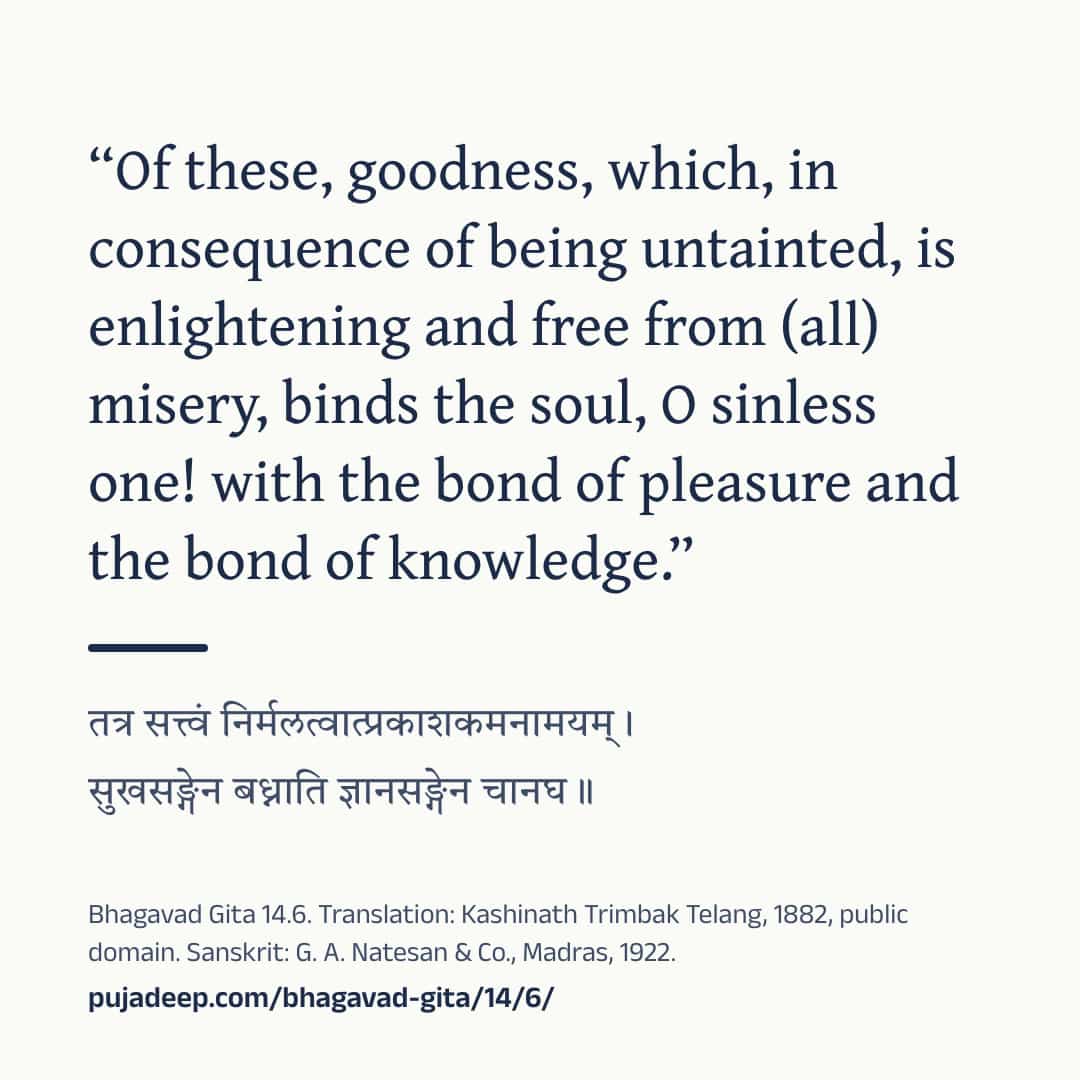
Drawing the picture
See the words
Bhagavad Gita 14.6

तत्र सत्त्वं निर्मलत्वात्प्रकाशकमनामयम् ।
सुखसङ्गेन बध्नाति ज्ञानसङ्गेन चानघ ॥

“Of these, goodness, which, in consequence of being untainted, is enlightening and free from (all) misery, binds the soul, O sinless one! with the bond of pleasure and the bond of knowledge.”
(K. T. Telang, The Bhagavadgîtâ (The Sacred Books of the East, vol. VIII, Oxford: Clarendon Press, 1882), p. 107, public domain)

“Of these Sattva, from its stainlessness luminous and healthy, bindeth by the attachment to bliss and the attachment to wisdom, O sinless one.”
(Annie Besant, The Bhagavad Gîtâ, or The Lord's Song (London: Theosophical Publishing Society, 1895), p. 130, public domain)

“Of these, Satva, luminous and free from evil, from its stainlessness, binds, O sinless one, by attachment to happiness, and by attachment to knowledge.”
(Swami Swarupananda, Srimad-Bhagavad-Gita (Mayavati: Prabuddha Bharata Press, 1909; first printed in Prabuddha Bharata, 1907–1909), p. 272, public domain)

Sanskrit: G. A. Natesan & Co., Madras, 1922.
https://pujadeep.com/bhagavad-gita/14/6/ Nothing is sent from this site. Your own app sends it, to the chat you choose. The picture quotes the translation you chose on this page, with its name and year.
Sanskrit text: The Bhagavad-Gita, or The Lord's Song, with the text in Devanagari and an English translation, 1922. Meanings: written for Pujadeep and checked against the cited edition. Source and changes
Questions families ask
Who speaks Bhagavad Gita 14.6?
Krishna speaks this verse, in chapter 14 (Gunatraya Vibhaga Yoga).
Where does the Sanskrit text come from?
Sanskrit text: The Bhagavad-Gita, or The Lord's Song, with the text in Devanagari and an English translation, 1922. Meanings: written for Pujadeep and checked against the cited edition. See the source
Is the meaning on this page a translation?
Explanation written for this site from the sources listed here, and checked against the cited edition. It is not a translation and not the only way to read the text. Free to quote with credit.
Source and licence
- Sanskrit text
- The Bhagavad-Gita, or The Lord's Song, with the text in Devanagari and an English translation (Annie Besant, G. A. Natesan & Co., Madras, 1922). Public domain. The Sanskrit on these pages was read from this printing’s page images.
- Translation
- The Bhagavadgîtâ with the Sanatsugâtîya and the Anugîtâ, translated by Kâshinâth Trimbak Telang (The Sacred Books of the East, vol. VIII, ed. F. Max Müller) (Kashinath Trimbak Telang, F. Max Müller, Clarendon Press, Oxford, 1882). Public domain. Shown verbatim, as printed.
- Translation
- The Bhagavad Gîtâ, or The Lord's Song, translated by Annie Besant (Annie Besant, Theosophical Publishing Society, London, 1895). Public domain. Shown verbatim, as printed.
- Translation
- Srimad-Bhagavad-Gita, with Sanskrit Text; Paraphrase with Word-by-word Literal Translation; English Rendering and Comments, Index, &c., by the Swami Swarupananda (Himalayan Series, No. XX) (Swami Swarupananda, The Editors and Publishers, Advaita Ashrama, Mayavati, Prabuddha Bharata Press, Mayavati, Almora, Himalayas, 1909). Public domain. Shown verbatim, as printed.
- Common wording
- In this text, 32 words follow today's common wording, checked against sanskritdocuments.org; Sanskrit Wikisource; Gita Press, Gorakhpur; GRETIL, Göttingen and Bhaktivedanta Book Trust.
- Our explanation
- Explanation written for this site from the sources listed here, and checked against the cited edition. It is not a translation and not the only way to read the text. Free to quote with credit.
- Checked
- Checked against the cited edition, October 14, 2026.
- Updated
- October 25, 2026