Bhagavad Gita 14.3: meaning and translation
Chapter 14: Gunatraya Vibhaga Yoga. Krishna says
Krishna says that the great brahma is his womb, and in it he places the seed; from that comes the birth of all beings, Bharata.
Click or tap a word for its meaning and its dictionary page.
Text and layers
Text and layers
These choices stay in this browser.
Bhagavad Gita 14.3
मम योनिर्महद्ब्रह्म तस्मिन् गर्भं दधाम्यहम् ।सम्भवः सर्वभूतानां ततो भवति भारत ॥
Mama yonirmahadbrahma tasmin garbham dadhamyahamSambhavah sarvabhutanam tato bhavati bharata
mama yonirmahadbrahma tasmin garbhaṃ dadhāmyaham |sambhavaḥ sarvabhūtānāṃ tato bhavati bhārata ||
Our explanation Krishna says that the great brahma is his womb, and in it he places the seed; from that comes the birth of all beings, Bharata. Both translators keep the word 'Brahman', and Telang's note explains it as the 'nature' (prakṛti) spoken of in chapter 13. The commentators explain 'womb' and 'seed' (see the views).
हिंदी अर्थ कृष्ण कहते हैं कि महद् ब्रह्म उनकी योनि (गर्भ) है, और उसमें वे बीज रखते हैं; हे भारत, उसी से सब प्राणियों का जन्म होता है। दोनों अनुवादक “ब्रह्म” शब्द रखते हैं, और तेलंग की टिप्पणी इसे अध्याय 13 में बताई गई प्रकृति बताती है। टीकाकार “योनि” और “बीज” को समझाते हैं।
Word by word
Every word, with its dictionary page
Word by word
- मम mama · "my" (Krishna's) (pronoun, genitive singular) Dictionary: 1. mad, Monier-Williams 1899, p. 777, col. 2 “base of the first pers. pron. in the sg. number (esp. in comp.)”
- योनिः yoniḥ · womb, source (noun, nominative singular) Dictionary: yoni, Monier-Williams 1899, p. 858, col. 2 “the womb, uterus”
- महत् mahat · great (adjective (neuter), nominative singular) Dictionary: mahat, Monier-Williams 1899, p. 794, col. 2 “great (in space, time, quantity or degree)”
- ब्रह्म brahma · brahma, here the great source (noun (neuter), nominative singular) Dictionary: brahman, Monier-Williams 1899, p. 738, col. 1
- तस्मिन् tasmin · in that (pronoun (neuter), locative singular) Dictionary: tad, Monier-Williams 1899, p. 434, col. 1 “m. he, f. she, n. it, that, this”
- गर्भम् garbham · the seed, the germ (noun (masculine), accusative singular) Dictionary: garbha, Monier-Williams 1899, p. 349, col. 3 “a fœtus or embryo, child, brood or offspring”
- दधामि dadhāmi · place (present, 1st person singular) Dictionary: 1. dhā, Monier-Williams 1899, p. 513, col. 3 “to put, place, set, lay in or on”
- अहम् aham · "I" (Krishna) (pronoun, nominative singular) Dictionary: aham, Monier-Williams 1899, p. 124, col. 2 “nom. sg. ‘I,’”
- सम्भवः sambhavaḥ · birth, origin (noun (masculine), nominative singular) Dictionary: sam-bhava, Monier-Williams 1899, p. 1179, col. 1 “birth, production, origin, source”
- सर्वभूतानाम् sarvabhūtānām · of all beings (compound (neuter), genitive plural) Dictionary: sarva, Monier-Williams 1899, p. 1184, col. 3 “whole, entire, all, every”; bhūta, Monier-Williams 1899, p. 761, col. 3 “that which is or exists, any living being”
- ततः tataḥ · from that (indeclinable) Dictionary: tatas, Monier-Williams 1899, p. 432, col. 3 “from that, in consequence of that, for that reason, consequently”
- भवति bhavati · comes about (present, 3rd person singular) Dictionary: 1. bhū, Monier-Williams 1899, p. 760, col. 2 “arise, come into being, exist”
- भारत bhārata · O Bharata (Arjuna) (noun (masculine), vocative singular) Dictionary: bhārata, Monier-Williams 1899, p. 753, col. 1 “a descendant of Bharata”
1 printing differs
Edition differences. Another printing or text reads this place differently.
- Spelling A digital text reads Same letters. The e-text prints महद् ब्रह्म as two words and joins तस्मिन्गर्भं; the 1922 edition joins महद्ब्रह्म and prints तस्मिन् गर्भं as two words.
Old translations
Kashinath Trimbak Telang, 1882. Public domain. Page 107.
The great Brahman1 is a womb for me, in which I cast the seed. From that, O descendant of Bharata! is the birth of all things.
Footnotes (the translator’s own) - I. e. the 'nature' spoken of before. ↩
Compare 3 translations
Kashinath Trimbak Telang, 1882. Public domain. Page 107.
The great Brahman1 is a womb for me, in which I cast the seed. From that, O descendant of Bharata! is the birth of all things.
Footnotes (the translator’s own) - I. e. the 'nature' spoken of before. ↩
You are reading this one
Annie Besant, 1895. Public domain. Page 129.
My womb is the mighty Brahman; in that I place the germ; thence cometh the production of all beings, O Bhârata.
You are reading this one
Swami Swarupananda, 1909 (first printed 1907). Public domain. Page 271.
My womb is the Great Prakriti, in that I place the germ; from thence, O descendant of Bharata, is the birth of all beings.
You are reading this one
Cite this verse
The translation: K. T. Telang, The Bhagavadgîtâ (The Sacred Books of the East, vol. VIII, Oxford: Clarendon Press, 1882), p. 107. Bhagavad Gita 14.3.
The translation: Annie Besant, The Bhagavad Gîtâ, or The Lord's Song (London: Theosophical Publishing Society, 1895), p. 129. Bhagavad Gita 14.3.
The translation: Swami Swarupananda, Srimad-Bhagavad-Gita (Mayavati: Prabuddha Bharata Press, 1909; first printed in Prabuddha Bharata, 1907–1909), p. 271. Bhagavad Gita 14.3.
Our explanation: “Bhagavad Gita 14.3: meaning and translation.” Pujadeep. Updated October 25, 2026. https://pujadeep.com/bhagavad-gita/14/3/
Pujadeep’s explanations are free to quote with credit: name Pujadeep and link to the page. How to credit
Classical readings, by school
Each reading is named by its school. None is presented as the only meaning.
What Advaita, Vishishtadvaita and Dvaita teach, in short
Shankara Advaita
Shankara says the womb is the Lord's own prakṛti, the māyā made of the three guṇas. It is called great because it is greater than all its effects, and brahma because it is the source that feeds all its changes. The seed is the birth of Hiraṇyagarbha, from which all beings come: the Lord joins the knower of the field to the field.
Source: The Bhagavad-Gita, with the commentary of Sri Sankaracharya, translated by A. Mahadeva Sastri (2nd ed., Mysore: G. T. A. Printing Works, 1901), commentary on 14.3, p. 341. Summarised in our own words; none of its text is reproduced.
Ramanuja Vishishtadvaita
Ramanuja says brahma here is unconscious matter, called vast because all its changes come from it, and the seed is the whole mass of conscious souls. The Lord unites souls, the enjoyers, with matter, the field of enjoyment, and so all beings are born by his will.
Source: Sri Bhagavad-Gita with Sri Ramanujacharya's Visishtadvaita commentary, translated by A. Govindacharya (Madras, 1898), commentary on 14.3, p. 445. Summarised in our own words; none of its text is reproduced.
Share
Show the ways to share
Send one picture or the text to one chat. The picture names its source and the address of this page.
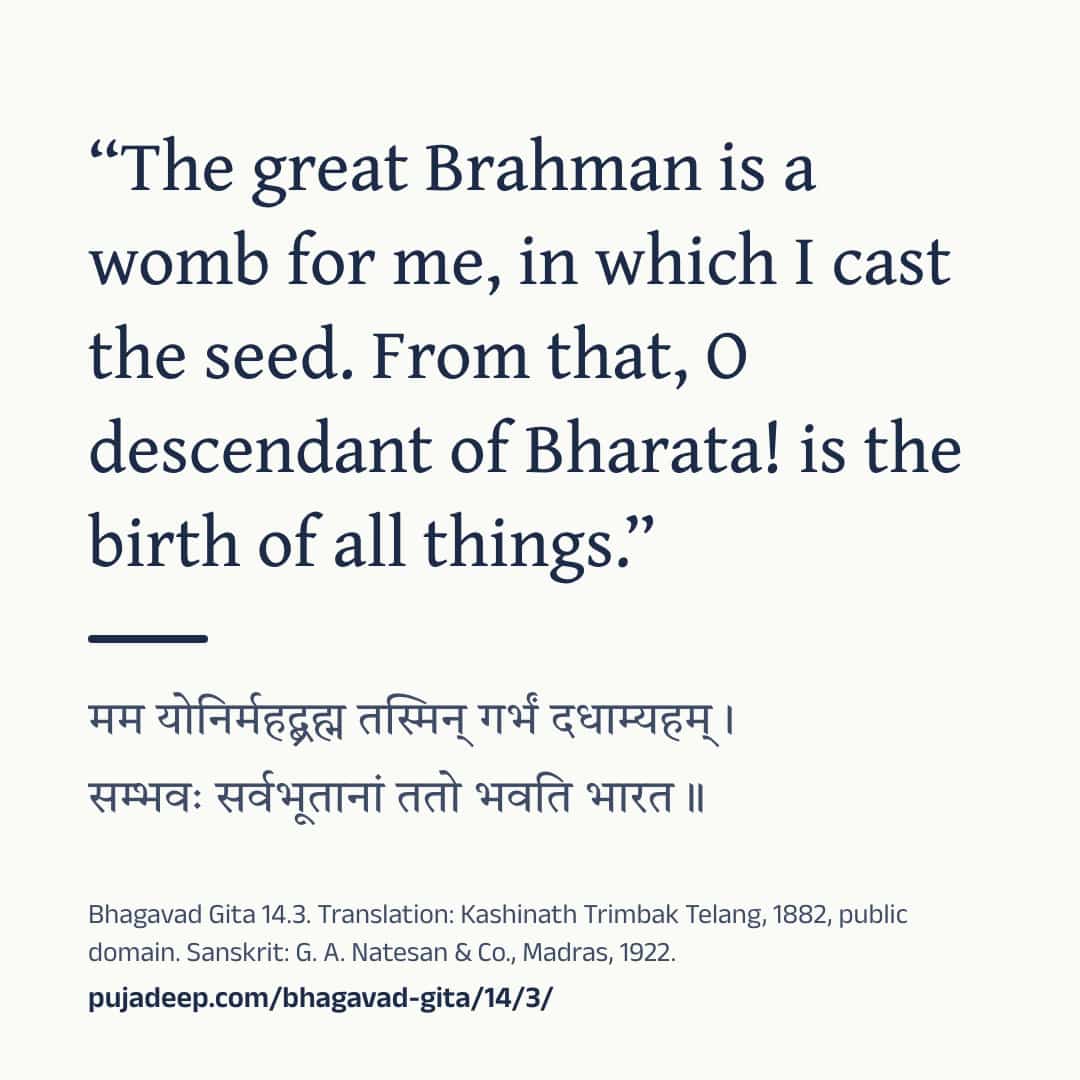
Drawing the picture
See the words
Bhagavad Gita 14.3

मम योनिर्महद्ब्रह्म तस्मिन् गर्भं दधाम्यहम् ।
सम्भवः सर्वभूतानां ततो भवति भारत ॥

“The great Brahman is a womb for me, in which I cast the seed. From that, O descendant of Bharata! is the birth of all things.”
(K. T. Telang, The Bhagavadgîtâ (The Sacred Books of the East, vol. VIII, Oxford: Clarendon Press, 1882), p. 107, public domain)

“My womb is the mighty Brahman; in that I place the germ; thence cometh the production of all beings, O Bhârata.”
(Annie Besant, The Bhagavad Gîtâ, or The Lord's Song (London: Theosophical Publishing Society, 1895), p. 129, public domain)

“My womb is the Great Prakriti, in that I place the germ; from thence, O descendant of Bharata, is the birth of all beings.”
(Swami Swarupananda, Srimad-Bhagavad-Gita (Mayavati: Prabuddha Bharata Press, 1909; first printed in Prabuddha Bharata, 1907–1909), p. 271, public domain)

Sanskrit: G. A. Natesan & Co., Madras, 1922.
https://pujadeep.com/bhagavad-gita/14/3/ Nothing is sent from this site. Your own app sends it, to the chat you choose. The picture quotes the translation you chose on this page, with its name and year.
Sanskrit text: The Bhagavad-Gita, or The Lord's Song, with the text in Devanagari and an English translation, 1922. Meanings: written for Pujadeep and checked against the cited edition. Source and changes
Questions families ask
Who speaks Bhagavad Gita 14.3?
Krishna speaks this verse, in chapter 14 (Gunatraya Vibhaga Yoga).
Where does the Sanskrit text come from?
Sanskrit text: The Bhagavad-Gita, or The Lord's Song, with the text in Devanagari and an English translation, 1922. Meanings: written for Pujadeep and checked against the cited edition. See the source
Is the meaning on this page a translation?
Explanation written for this site from the sources listed here, and checked against the cited edition. It is not a translation and not the only way to read the text. Free to quote with credit.
Source and licence
- Sanskrit text
- The Bhagavad-Gita, or The Lord's Song, with the text in Devanagari and an English translation (Annie Besant, G. A. Natesan & Co., Madras, 1922). Public domain. The Sanskrit on these pages was read from this printing’s page images.
- Translation
- The Bhagavadgîtâ with the Sanatsugâtîya and the Anugîtâ, translated by Kâshinâth Trimbak Telang (The Sacred Books of the East, vol. VIII, ed. F. Max Müller) (Kashinath Trimbak Telang, F. Max Müller, Clarendon Press, Oxford, 1882). Public domain. Shown verbatim, as printed.
- Translation
- The Bhagavad Gîtâ, or The Lord's Song, translated by Annie Besant (Annie Besant, Theosophical Publishing Society, London, 1895). Public domain. Shown verbatim, as printed.
- Translation
- Srimad-Bhagavad-Gita, with Sanskrit Text; Paraphrase with Word-by-word Literal Translation; English Rendering and Comments, Index, &c., by the Swami Swarupananda (Himalayan Series, No. XX) (Swami Swarupananda, The Editors and Publishers, Advaita Ashrama, Mayavati, Prabuddha Bharata Press, Mayavati, Almora, Himalayas, 1909). Public domain. Shown verbatim, as printed.
- Commentary
- The Bhagavad-Gita, with the commentary of Sri Sankaracharya, translated by A. Mahadeva Sastri (2nd ed., Mysore: G. T. A. Printing Works, 1901) (Public-domain scan, University of California Libraries). Summarised in our own words; none of its text is reproduced.
- Commentary
- Sri Bhagavad-Gita with Sri Ramanujacharya's Visishtadvaita commentary, translated by A. Govindacharya (Madras, 1898) (Scan uploaded to archive.org (folkscanomy collection)). Summarised in our own words; none of its text is reproduced.
- Common wording
- In this text, 32 words follow today's common wording, checked against sanskritdocuments.org; Sanskrit Wikisource; Gita Press, Gorakhpur; GRETIL, Göttingen and Bhaktivedanta Book Trust.
- Our explanation
- Explanation written for this site from the sources listed here, and checked against the cited edition. It is not a translation and not the only way to read the text. Free to quote with credit.
- Checked
- Checked against the cited edition, October 14, 2026.
- Updated
- October 25, 2026