Bhagavad Gita 14.5: meaning and translation
Chapter 14: Gunatraya Vibhaga Yoga. Krishna says
Krishna names the three guṇas that arise from nature: sattva (clarity, goodness), rajas (passion, restless activity) and tamas (darkness, inertia).
Click or tap a word for its meaning and its dictionary page.
Text and layers
Text and layers
These choices stay in this browser.
Bhagavad Gita 14.5
सत्त्वं रजस्तम इति गुणाः प्रकृतिसंभवाः ।निबध्नन्ति महाबाहो देहे देहिनमव्ययम् ॥
Sattvam rajastama iti gunah prakritisambhavahNibadhnanti mahabaho dehe dehinamavyayam
sattvaṃ rajastama iti guṇāḥ prakṛtisaṃbhavāḥ |nibadhnanti mahābāho dehe dehinamavyayam ||
Our explanation Krishna names the three guṇas that arise from nature: sattva (clarity, goodness), rajas (passion, restless activity) and tamas (darkness, inertia). He says they bind the unchanging embodied self in the body. Besant keeps the Sanskrit names; Telang translates them as goodness, passion and darkness. The schools explain how the guṇas bind (see the views).
हिंदी अर्थ कृष्ण प्रकृति से उत्पन्न तीन गुणों के नाम बताते हैं: सत्त्व (निर्मलता, अच्छाई), रज (राग, बेचैन सक्रियता) और तम (अंधकार, जड़ता)। वे कहते हैं कि ये अविनाशी देही (शरीर में रहने वाले) को शरीर में बाँधते हैं। बेसेंट संस्कृत नाम रखती हैं; तेलंग इनका अनुवाद goodness, passion और darkness करते हैं। गुण कैसे बाँधते हैं, इसे परंपराएँ अलग ढंग से समझाती हैं।
Word by word
Every word, with its dictionary page
Word by word
- सत्त्वम् sattvam · sattva (clarity, goodness) (noun (neuter), nominative singular) Dictionary: sat-tva, Monier-Williams 1899, p. 1135, col. 2 “the quality of purity or goodness”
- रजः rajaḥ · rajas (passion, activity) (noun (neuter), nominative singular) Dictionary: rajas, Monier-Williams 1899, p. 863, col. 2 “the ‘darkening’ quality, passion, emotion, affection”
- तमः tamaḥ · tamas (darkness, inertia) (noun (neuter), nominative singular) Dictionary: tamas, Monier-Williams 1899, p. 438, col. 1 “one of the 3 qualities or constituents of everything in creation”
- इति iti · thus, these (indeclinable) Dictionary: 2. iti, Monier-Williams 1899, p. 165, col. 1 “in this manner, thus”
- गुणाः guṇāḥ · the guṇas (qualities) (noun (masculine), nominative plural) Dictionary: guṇa, Monier-Williams 1899, p. 357, col. 1 “(in Sāṃkhya phil.) an ingredient or constituent of Prakṛiti, chief quality of all existing beings”
- प्रकृतिसंभवाः prakṛtisaṃbhavāḥ · born of nature (prakṛti) (compound (masculine), nominative plural) Dictionary: pra-kṛti, Monier-Williams 1899, p. 654, col. 1 “nature, character, constitution, temper, disposition”; sam-bhava, Monier-Williams 1899, p. 1179, col. 1 “birth, production, origin, source”
- निबध्नन्ति nibadhnanti · bind (present, 3rd person plural) Dictionary: ni-bandh, Monier-Williams 1899, p. 550, col. 1 “to enchain, fetter (lit. and fig.)”
- महाबाहो mahābāho · O mighty-armed one (compound (masculine), vocative singular) Dictionary: mahā-bāhu, Monier-Williams 1899, p. 798, col. 1 “long-armed”
- देहे dehe · in the body (noun (masculine), locative singular) Dictionary: deha, Monier-Williams 1899, p. 496, col. 3 “the body”
- देहिनम् dehinam · the embodied self (noun (masculine), accusative singular) Dictionary: dehin, Monier-Williams 1899, p. 497, col. 1 “having a body, corporeal”
- अव्ययम् avyayam · unchanging, imperishable (adjective (masculine), accusative singular) Dictionary: 2. a-vyaya, Monier-Williams 1899, p. 111, col. 3 “not liable to change, imperishable, undecaying”
1 printing differs
Edition differences. Another printing or text reads this place differently.
- Spelling A digital text reads Same word. The e-text writes the class nasal (प्रकृतिसम्भवाः); the 1922 edition writes anusvara (प्रकृतिसंभवाः).
Old translations
Kashinath Trimbak Telang, 1882. Public domain. Page 107.
Goodness, passion, darkness, these qualities1 born from nature, O you of mighty arms! bind down the inexhaustible soul in the body.
Footnotes (the translator’s own) - These constitute nature. We must understand nature, with Professor Bhândârkar, as the hypothetical cause of the soul's feeling itself limited and conditioned. If nature is understood, as it usually is, to mean matter, its being made up of the qualities is inexplicable. Interpreted idealistically, as suggested by Professor Bhândârkar, the destruction of it spoken of at the close of the last chapter also becomes intelligible. By means of knowledge of the soul, the unreality of these manifestations is understood and nature is destroyed. ↩
Compare 3 translations
Kashinath Trimbak Telang, 1882. Public domain. Page 107.
Goodness, passion, darkness, these qualities1 born from nature, O you of mighty arms! bind down the inexhaustible soul in the body.
Footnotes (the translator’s own) - These constitute nature. We must understand nature, with Professor Bhândârkar, as the hypothetical cause of the soul's feeling itself limited and conditioned. If nature is understood, as it usually is, to mean matter, its being made up of the qualities is inexplicable. Interpreted idealistically, as suggested by Professor Bhândârkar, the destruction of it spoken of at the close of the last chapter also becomes intelligible. By means of knowledge of the soul, the unreality of these manifestations is understood and nature is destroyed. ↩
You are reading this one
Annie Besant, 1895. Public domain. Page 130.
Sattva, Rajas, Tamas, such are the Gunas; Prakriti-born they bind fast in the body, O great-armed one, the indestructible Dweller in the body.
You are reading this one
Swami Swarupananda, 1909 (first printed 1907). Public domain. Page 272.
Satva, Rajas, Tamas,—these Gunas, O mighty-armed, born of Prakriti, bind fast the indestructible embodied in the body.
You are reading this one
Cite this verse
The translation: K. T. Telang, The Bhagavadgîtâ (The Sacred Books of the East, vol. VIII, Oxford: Clarendon Press, 1882), p. 107. Bhagavad Gita 14.5.
The translation: Annie Besant, The Bhagavad Gîtâ, or The Lord's Song (London: Theosophical Publishing Society, 1895), p. 130. Bhagavad Gita 14.5.
The translation: Swami Swarupananda, Srimad-Bhagavad-Gita (Mayavati: Prabuddha Bharata Press, 1909; first printed in Prabuddha Bharata, 1907–1909), p. 272. Bhagavad Gita 14.5.
Our explanation: “Bhagavad Gita 14.5: meaning and translation.” Pujadeep. Updated October 25, 2026. https://pujadeep.com/bhagavad-gita/14/5/
Pujadeep’s explanations are free to quote with credit: name Pujadeep and link to the page. How to credit
Classical readings, by school
Each reading is named by its school. None is presented as the only meaning.
What Advaita, Vishishtadvaita and Dvaita teach, in short
Shankara Advaita
Shankara says guṇa here is a technical term, not a quality inside a substance. The guṇas are forms of ignorance (avidyā) that depend on the knower of the field, and they bind the Self only 'as it were', since 13.31 says the Self is never tainted.
Source: The Bhagavad-Gita, with the commentary of Sri Sankaracharya, translated by A. Mahadeva Sastri (2nd ed., Mysore: G. T. A. Printing Works, 1901), commentary on 14.5, pp. 342–343. Summarised in our own words; none of its text is reproduced.
Ramanuja Vishishtadvaita
Ramanuja says the guṇas are real qualities of matter, latent in unevolved matter and manifest in what evolves from it. They confine the soul, which is free by nature, in bodies such as those of gods and humans.
Source: Sri Bhagavad-Gita with Sri Ramanujacharya's Visishtadvaita commentary, translated by A. Govindacharya (Madras, 1898), commentary on 14.5, p. 446. Summarised in our own words; none of its text is reproduced.
Share
Show the ways to share
Send one picture or the text to one chat. The picture names its source and the address of this page.
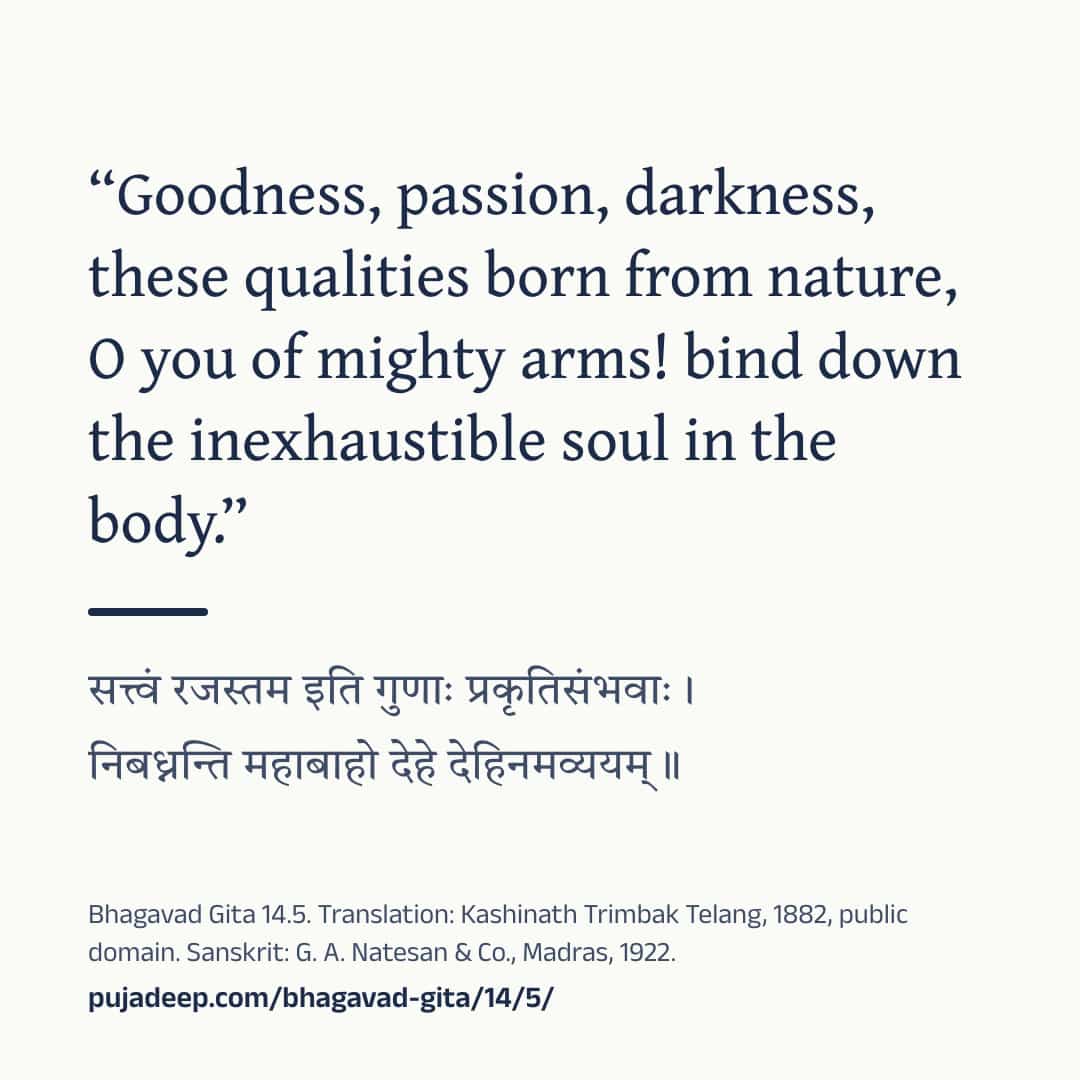
Drawing the picture
See the words
Bhagavad Gita 14.5

सत्त्वं रजस्तम इति गुणाः प्रकृतिसंभवाः ।
निबध्नन्ति महाबाहो देहे देहिनमव्ययम् ॥

“Goodness, passion, darkness, these qualities born from nature, O you of mighty arms! bind down the inexhaustible soul in the body.”
(K. T. Telang, The Bhagavadgîtâ (The Sacred Books of the East, vol. VIII, Oxford: Clarendon Press, 1882), p. 107, public domain)

“Sattva, Rajas, Tamas, such are the Gunas; Prakriti-born they bind fast in the body, O great-armed one, the indestructible Dweller in the body.”
(Annie Besant, The Bhagavad Gîtâ, or The Lord's Song (London: Theosophical Publishing Society, 1895), p. 130, public domain)

“Satva, Rajas, Tamas,—these Gunas, O mighty-armed, born of Prakriti, bind fast the indestructible embodied in the body.”
(Swami Swarupananda, Srimad-Bhagavad-Gita (Mayavati: Prabuddha Bharata Press, 1909; first printed in Prabuddha Bharata, 1907–1909), p. 272, public domain)

Sanskrit: G. A. Natesan & Co., Madras, 1922.
https://pujadeep.com/bhagavad-gita/14/5/ Nothing is sent from this site. Your own app sends it, to the chat you choose. The picture quotes the translation you chose on this page, with its name and year.
Sanskrit text: The Bhagavad-Gita, or The Lord's Song, with the text in Devanagari and an English translation, 1922. Meanings: written for Pujadeep and checked against the cited edition. Source and changes
Questions families ask
Who speaks Bhagavad Gita 14.5?
Krishna speaks this verse, in chapter 14 (Gunatraya Vibhaga Yoga).
Where does the Sanskrit text come from?
Sanskrit text: The Bhagavad-Gita, or The Lord's Song, with the text in Devanagari and an English translation, 1922. Meanings: written for Pujadeep and checked against the cited edition. See the source
Is the meaning on this page a translation?
Explanation written for this site from the sources listed here, and checked against the cited edition. It is not a translation and not the only way to read the text. Free to quote with credit.
Source and licence
- Sanskrit text
- The Bhagavad-Gita, or The Lord's Song, with the text in Devanagari and an English translation (Annie Besant, G. A. Natesan & Co., Madras, 1922). Public domain. The Sanskrit on these pages was read from this printing’s page images.
- Translation
- The Bhagavadgîtâ with the Sanatsugâtîya and the Anugîtâ, translated by Kâshinâth Trimbak Telang (The Sacred Books of the East, vol. VIII, ed. F. Max Müller) (Kashinath Trimbak Telang, F. Max Müller, Clarendon Press, Oxford, 1882). Public domain. Shown verbatim, as printed.
- Translation
- The Bhagavad Gîtâ, or The Lord's Song, translated by Annie Besant (Annie Besant, Theosophical Publishing Society, London, 1895). Public domain. Shown verbatim, as printed.
- Translation
- Srimad-Bhagavad-Gita, with Sanskrit Text; Paraphrase with Word-by-word Literal Translation; English Rendering and Comments, Index, &c., by the Swami Swarupananda (Himalayan Series, No. XX) (Swami Swarupananda, The Editors and Publishers, Advaita Ashrama, Mayavati, Prabuddha Bharata Press, Mayavati, Almora, Himalayas, 1909). Public domain. Shown verbatim, as printed.
- Commentary
- The Bhagavad-Gita, with the commentary of Sri Sankaracharya, translated by A. Mahadeva Sastri (2nd ed., Mysore: G. T. A. Printing Works, 1901) (Public-domain scan, University of California Libraries). Summarised in our own words; none of its text is reproduced.
- Commentary
- Sri Bhagavad-Gita with Sri Ramanujacharya's Visishtadvaita commentary, translated by A. Govindacharya (Madras, 1898) (Scan uploaded to archive.org (folkscanomy collection)). Summarised in our own words; none of its text is reproduced.
- Common wording
- In this text, 32 words follow today's common wording, checked against sanskritdocuments.org; Sanskrit Wikisource; Gita Press, Gorakhpur; GRETIL, Göttingen and Bhaktivedanta Book Trust.
- Our explanation
- Explanation written for this site from the sources listed here, and checked against the cited edition. It is not a translation and not the only way to read the text. Free to quote with credit.
- Checked
- Checked against the cited edition, October 14, 2026.
- Updated
- October 25, 2026