Bhagavad Gita 14.2: meaning and translation
Chapter 14: Gunatraya Vibhaga Yoga. Krishna says
Krishna says that those who take refuge in this knowledge and come to share his nature (sādharmya) are not born at the creation of the world and are not troubled at its dissolution.
Click or tap a word for its meaning and its dictionary page.
Text and layers
Text and layers
These choices stay in this browser.
Bhagavad Gita 14.2
इदं ज्ञानमुपाश्रित्य मम साधर्म्यमागताः ।सर्गेऽपि नोपजायन्ते प्रलये न व्यथन्ति च ॥
Idam jnanamupashritya mama sadharmyamagatahSargepi nopajayante pralaye na vyathanti cha
idaṃ jñānamupāśritya mama sādharmyamāgatāḥ |sarge’pi nopajāyante pralaye na vyathanti ca ||
Our explanation Krishna says that those who take refuge in this knowledge and come to share his nature (sādharmya) are not born at the creation of the world and are not troubled at its dissolution. The schools read sādharmya differently (see the views).
हिंदी अर्थ कृष्ण कहते हैं कि जो इस ज्ञान का आश्रय लेकर उनके साधर्म्य (उनके समान स्वभाव) को प्राप्त होते हैं, वे सृष्टि के समय जन्म नहीं लेते और प्रलय के समय व्यथित नहीं होते। “साधर्म्य” को परंपराएँ अलग-अलग ढंग से समझती हैं।
Word by word
Every word, with its dictionary page
Word by word
- इदम् idam · this (pronoun (neuter), accusative singular) Dictionary: 1. idam, Monier-Williams 1899, p. 165, col. 2 “this, this here, referring to something near the speaker”
- ज्ञानम् jñānam · knowledge (noun (neuter), accusative singular) Dictionary: jñāna, Monier-Williams 1899, p. 426, col. 1 “knowing, becoming acquainted with, knowledge”
- उपाश्रित्य upāśritya · taking refuge in (absolutive (having done)) Dictionary: upā-śri, Monier-Williams 1899, p. 214, col. 3 “to take refuge or have recourse to”
- मम mama · "my" (Krishna's) (pronoun, genitive singular) Dictionary: 1. mad, Monier-Williams 1899, p. 777, col. 2 “base of the first pers. pron. in the sg. number (esp. in comp.)”
- साधर्म्यम् sādharmyam · sameness of nature (noun (neuter), accusative singular) Dictionary: sādharmya, Monier-Williams 1899, p. 1202, col. 2 “sameness or identity of nature, likeness or homogeneousness”
- आगताः āgatāḥ · having come to (past participle (masculine), nominative plural) Dictionary: ā-gata, Monier-Williams 1899, p. 129, col. 2 “come, arrived”
- सर्गे sarge · at the creation (noun (masculine), locative singular) Dictionary: sarga, Monier-Williams 1899, p. 1184, col. 1 “emission or creation of matter, primary creation”
- अपि api · even (indeclinable) Dictionary: api, Monier-Williams 1899, p. 55, col. 1 “in the sense of even, also, very”
- न na · not (indeclinable) Dictionary: 2. na, Monier-Williams 1899, p. 523, col. 1 “not, no, nor, neither”
- उपजायन्ते upajāyante · are born (present, 3rd person plural) Dictionary: upa-jan, Monier-Williams 1899, p. 198, col. 1 “to be born, originate, come forth, appear, become visible”
- प्रलये pralaye · at the dissolution (noun (masculine), locative singular) Dictionary: pra-laya, Monier-Williams 1899, p. 689, col. 3 “dissolution, reabsorption, destruction, annihilation; death”
- न na · not (indeclinable) Dictionary: 2. na, Monier-Williams 1899, p. 523, col. 1 “not, no, nor, neither”
- व्यथन्ति vyathanti · are troubled (present, 3rd person plural) Dictionary: vyath, Monier-Williams 1899, p. 1031, col. 1 “to tremble, waver, go astray, come to naught, fail”
- च ca · and (indeclinable) Dictionary: 2. ca, Monier-Williams 1899, p. 380, col. 1 “and, both, also, moreover, as well as”
Old translations
Kashinath Trimbak Telang, 1882. Public domain. Page 107.
Those who, resorting to this knowledge, reach assimilation with my essence, are not born at the creation, and are not afflicted1 at the destruction (of the universe).
Footnotes (the translator’s own) - I. e. 'are not destroyed,' Madhusûdana; 'do not fall,' Saṅkara; 'are not born,' Srîdhara, and apparently Râmânuga. ↩
Compare 3 translations
Kashinath Trimbak Telang, 1882. Public domain. Page 107.
Those who, resorting to this knowledge, reach assimilation with my essence, are not born at the creation, and are not afflicted1 at the destruction (of the universe).
Footnotes (the translator’s own) - I. e. 'are not destroyed,' Madhusûdana; 'do not fall,' Saṅkara; 'are not born,' Srîdhara, and apparently Râmânuga. ↩
You are reading this one
Annie Besant, 1895. Public domain. Page 129.
Having taken refuge in this wisdom and having entered into My Nature, they are not re-born even in the emanation of a universe, nor are disquieted in the dissolution.
You are reading this one
Swami Swarupananda, 1909 (first printed 1907). Public domain. Page 271.
Abiding by this knowledge, having attained to My Being, neither do they come forth in evolution, nor are they troubled in involution.
You are reading this one
Cite this verse
The translation: K. T. Telang, The Bhagavadgîtâ (The Sacred Books of the East, vol. VIII, Oxford: Clarendon Press, 1882), p. 107. Bhagavad Gita 14.2.
The translation: Annie Besant, The Bhagavad Gîtâ, or The Lord's Song (London: Theosophical Publishing Society, 1895), p. 129. Bhagavad Gita 14.2.
The translation: Swami Swarupananda, Srimad-Bhagavad-Gita (Mayavati: Prabuddha Bharata Press, 1909; first printed in Prabuddha Bharata, 1907–1909), p. 271. Bhagavad Gita 14.2.
Our explanation: “Bhagavad Gita 14.2: meaning and translation.” Pujadeep. Updated October 25, 2026. https://pujadeep.com/bhagavad-gita/14/2/
Pujadeep’s explanations are free to quote with credit: name Pujadeep and link to the page. How to credit
Classical readings, by school
Each reading is named by its school. None is presented as the only meaning.
What Advaita, Vishishtadvaita and Dvaita teach, in short
Shankara Advaita
Shankara takes sādharmya to mean identity with the Lord, not likeness in qualities, because the Gita does not set the Lord and the knower of the field apart. Such people are not affected even at Brahmā's own dissolution.
Source: The Bhagavad-Gita, with the commentary of Sri Sankaracharya, translated by A. Mahadeva Sastri (2nd ed., Mysore: G. T. A. Printing Works, 1901), commentary on 14.2, pp. 340–341. Summarised in our own words; none of its text is reproduced.
Ramanuja Vishishtadvaita
Ramanuja takes sādharmya to mean a state like the Lord's own. Those who gain this knowledge are no longer subject to the processes of creation or to the pains of dissolution.
Source: Sri Bhagavad-Gita with Sri Ramanujacharya's Visishtadvaita commentary, translated by A. Govindacharya (Madras, 1898), commentary on 14.2, p. 444. Summarised in our own words; none of its text is reproduced.
Share
Show the ways to share
Send one picture or the text to one chat. The picture names its source and the address of this page.
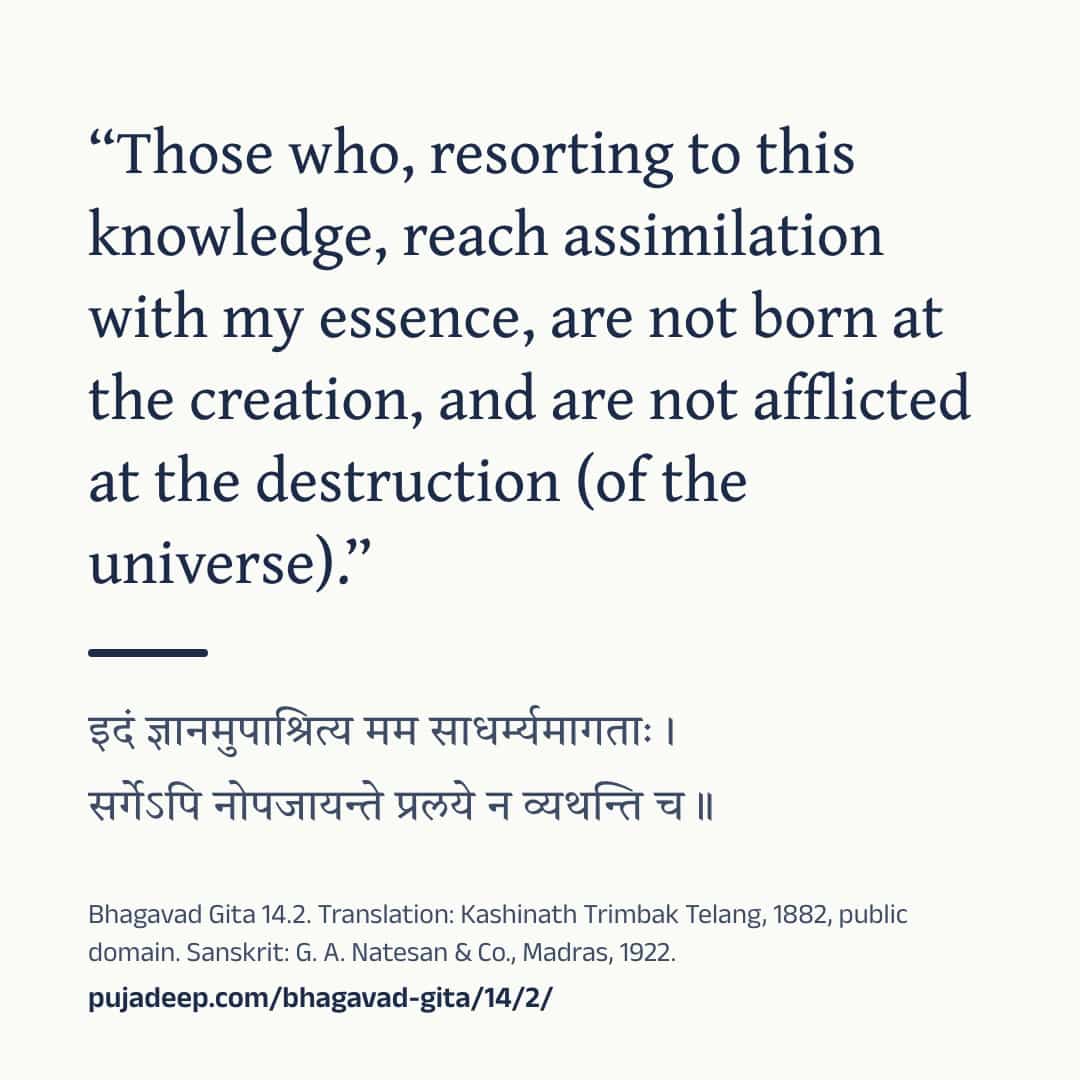
Drawing the picture
See the words
Bhagavad Gita 14.2

इदं ज्ञानमुपाश्रित्य मम साधर्म्यमागताः ।
सर्गेऽपि नोपजायन्ते प्रलये न व्यथन्ति च ॥

“Those who, resorting to this knowledge, reach assimilation with my essence, are not born at the creation, and are not afflicted at the destruction (of the universe).”
(K. T. Telang, The Bhagavadgîtâ (The Sacred Books of the East, vol. VIII, Oxford: Clarendon Press, 1882), p. 107, public domain)

“Having taken refuge in this wisdom and having entered into My Nature, they are not re-born even in the emanation of a universe, nor are disquieted in the dissolution.”
(Annie Besant, The Bhagavad Gîtâ, or The Lord's Song (London: Theosophical Publishing Society, 1895), p. 129, public domain)

“Abiding by this knowledge, having attained to My Being, neither do they come forth in evolution, nor are they troubled in involution.”
(Swami Swarupananda, Srimad-Bhagavad-Gita (Mayavati: Prabuddha Bharata Press, 1909; first printed in Prabuddha Bharata, 1907–1909), p. 271, public domain)

Sanskrit: G. A. Natesan & Co., Madras, 1922.
https://pujadeep.com/bhagavad-gita/14/2/ Nothing is sent from this site. Your own app sends it, to the chat you choose. The picture quotes the translation you chose on this page, with its name and year.
Sanskrit text: The Bhagavad-Gita, or The Lord's Song, with the text in Devanagari and an English translation, 1922. Meanings: written for Pujadeep and checked against the cited edition. Source and changes
Questions families ask
Who speaks Bhagavad Gita 14.2?
Krishna speaks this verse, in chapter 14 (Gunatraya Vibhaga Yoga).
Where does the Sanskrit text come from?
Sanskrit text: The Bhagavad-Gita, or The Lord's Song, with the text in Devanagari and an English translation, 1922. Meanings: written for Pujadeep and checked against the cited edition. See the source
Is the meaning on this page a translation?
Explanation written for this site from the sources listed here, and checked against the cited edition. It is not a translation and not the only way to read the text. Free to quote with credit.
Source and licence
- Sanskrit text
- The Bhagavad-Gita, or The Lord's Song, with the text in Devanagari and an English translation (Annie Besant, G. A. Natesan & Co., Madras, 1922). Public domain. The Sanskrit on these pages was read from this printing’s page images.
- Translation
- The Bhagavadgîtâ with the Sanatsugâtîya and the Anugîtâ, translated by Kâshinâth Trimbak Telang (The Sacred Books of the East, vol. VIII, ed. F. Max Müller) (Kashinath Trimbak Telang, F. Max Müller, Clarendon Press, Oxford, 1882). Public domain. Shown verbatim, as printed.
- Translation
- The Bhagavad Gîtâ, or The Lord's Song, translated by Annie Besant (Annie Besant, Theosophical Publishing Society, London, 1895). Public domain. Shown verbatim, as printed.
- Translation
- Srimad-Bhagavad-Gita, with Sanskrit Text; Paraphrase with Word-by-word Literal Translation; English Rendering and Comments, Index, &c., by the Swami Swarupananda (Himalayan Series, No. XX) (Swami Swarupananda, The Editors and Publishers, Advaita Ashrama, Mayavati, Prabuddha Bharata Press, Mayavati, Almora, Himalayas, 1909). Public domain. Shown verbatim, as printed.
- Commentary
- The Bhagavad-Gita, with the commentary of Sri Sankaracharya, translated by A. Mahadeva Sastri (2nd ed., Mysore: G. T. A. Printing Works, 1901) (Public-domain scan, University of California Libraries). Summarised in our own words; none of its text is reproduced.
- Commentary
- Sri Bhagavad-Gita with Sri Ramanujacharya's Visishtadvaita commentary, translated by A. Govindacharya (Madras, 1898) (Scan uploaded to archive.org (folkscanomy collection)). Summarised in our own words; none of its text is reproduced.
- Common wording
- In this text, 32 words follow today's common wording, checked against sanskritdocuments.org; Sanskrit Wikisource; Gita Press, Gorakhpur; GRETIL, Göttingen and Bhaktivedanta Book Trust.
- Our explanation
- Explanation written for this site from the sources listed here, and checked against the cited edition. It is not a translation and not the only way to read the text. Free to quote with credit.
- Checked
- Checked against the cited edition, October 14, 2026.
- Updated
- October 25, 2026