Bhagavad Gita 14.4: meaning and translation
Chapter 14: Gunatraya Vibhaga Yoga. Krishna says
Whatever forms come to be in any womb, Krishna tells Arjuna, son of Kunti, the great brahma is their womb, and he is the father who gives the seed.
Click or tap a word for its meaning and its dictionary page.
Text and layers
Text and layers
These choices stay in this browser.
Bhagavad Gita 14.4
सर्वयोनिषु कौन्तेय मूर्तयः संभवन्ति याः ।तासां ब्रह्म महद्योनिरहं बीजप्रदः पिता ॥
Sarvayonishu kaunteya murtayah sambhavanti yahTasam brahma mahadyoniraham bijapradah pita
sarvayoniṣu kaunteya mūrtayaḥ saṃbhavanti yāḥ |tāsāṃ brahma mahadyonirahaṃ bījapradaḥ pitā ||
Our explanation Whatever forms come to be in any womb, Krishna tells Arjuna, son of Kunti, the great brahma is their womb, and he is the father who gives the seed.
हिंदी अर्थ कृष्ण अर्जुन (कौन्तेय) से कहते हैं कि किसी भी योनि में जो भी शरीर उत्पन्न होते हैं, उन सबकी योनि महद् ब्रह्म है, और वे स्वयं बीज देने वाले पिता हैं।
Word by word
Every word, with its dictionary page
Word by word
- सर्वयोनिषु sarvayoniṣu · in all wombs (compound, locative plural) Dictionary: sarva, Monier-Williams 1899, p. 1184, col. 3 “whole, entire, all, every”; yoni, Monier-Williams 1899, p. 858, col. 2 “the womb, uterus”
- कौन्तेय kaunteya · O son of Kunti (noun (masculine), vocative singular) Dictionary: kaunteya, Monier-Williams 1899, p. 316, col. 2 “metron. fr. Kuntī”
- मूर्तयः mūrtayaḥ · forms, bodies (noun (feminine), nominative plural) Dictionary: mūrti, Monier-Williams 1899, p. 824, col. 1 “any solid body or material form”
- संभवन्ति saṃbhavanti · come into being (present, 3rd person plural) Dictionary: sam-bhū, Monier-Williams 1899, p. 1178, col. 3 “to be born or produced from (abl.), arise, spring up, develop”
- याः yāḥ · which (pronoun (feminine), nominative plural) Dictionary: yad, Monier-Williams 1899, p. 844, col. 2 “who, which, what, whichever, whatever, that”
- तासाम् tāsām · of them (pronoun (feminine), genitive plural) Dictionary: tad, Monier-Williams 1899, p. 434, col. 1 “m. he, f. she, n. it, that, this”
- ब्रह्म brahma · brahma, the great source (noun (neuter), nominative singular) Dictionary: brahman, Monier-Williams 1899, p. 738, col. 1
- महत् mahat · great (adjective (neuter), nominative singular) Dictionary: mahat, Monier-Williams 1899, p. 794, col. 2 “great (in space, time, quantity or degree)”
- योनिः yoniḥ · womb (noun, nominative singular) Dictionary: yoni, Monier-Williams 1899, p. 858, col. 2 “the womb, uterus”
- अहम् aham · "I" (Krishna) (pronoun, nominative singular) Dictionary: aham, Monier-Williams 1899, p. 124, col. 2 “nom. sg. ‘I,’”
- बीजप्रदः bījapradaḥ · who gives the seed (compound (masculine), nominative singular) Dictionary: bīja, Monier-Williams 1899, p. 732, col. 2 “seed (of plants), semen (of men and animals), seed-corn, grain”; pra-da, Monier-Williams 1899, p. 679, col. 3 “giving, yielding, offering, granting, bestowing”
- पिता pitā · father (noun (masculine), nominative singular) Dictionary: pitṛ, Monier-Williams 1899, p. 626, col. 2 “a father”
1 printing differs
Edition differences. Another printing or text reads this place differently.
- Spelling A digital text reads Same word. The e-text writes the class nasal (सम्भवन्ति); the 1922 edition writes anusvara (संभवन्ति).
Old translations
Kashinath Trimbak Telang, 1882. Public domain. Page 107.
Of the bodies, O son of Kuntî! which are born from all wombs, the (main) womb is the great Brahman, and I (am) the father, the giver of the seed.
Compare 3 translations
Kashinath Trimbak Telang, 1882. Public domain. Page 107.
Of the bodies, O son of Kuntî! which are born from all wombs, the (main) womb is the great Brahman, and I (am) the father, the giver of the seed.
You are reading this one
Annie Besant, 1895. Public domain. Page 129.
In whatsoever wombs mortals are produced, O Kaunteya, the mighty Brahman is their womb, I their generating Father.
You are reading this one
Swami Swarupananda, 1909 (first printed 1907). Public domain. Page 272.
Whatever forms are produced, O son of Kunti, in all the wombs, the Great Prakriti is their womb, I the seed-giving Father.
You are reading this one
Cite this verse
The translation: K. T. Telang, The Bhagavadgîtâ (The Sacred Books of the East, vol. VIII, Oxford: Clarendon Press, 1882), p. 107. Bhagavad Gita 14.4.
The translation: Annie Besant, The Bhagavad Gîtâ, or The Lord's Song (London: Theosophical Publishing Society, 1895), p. 129. Bhagavad Gita 14.4.
The translation: Swami Swarupananda, Srimad-Bhagavad-Gita (Mayavati: Prabuddha Bharata Press, 1909; first printed in Prabuddha Bharata, 1907–1909), p. 272. Bhagavad Gita 14.4.
Our explanation: “Bhagavad Gita 14.4: meaning and translation.” Pujadeep. Updated October 25, 2026. https://pujadeep.com/bhagavad-gita/14/4/
Pujadeep’s explanations are free to quote with credit: name Pujadeep and link to the page. How to credit
Classical readings, by school
No readings by school on this verse yet.
Share
Show the ways to share
Send one picture or the text to one chat. The picture names its source and the address of this page.
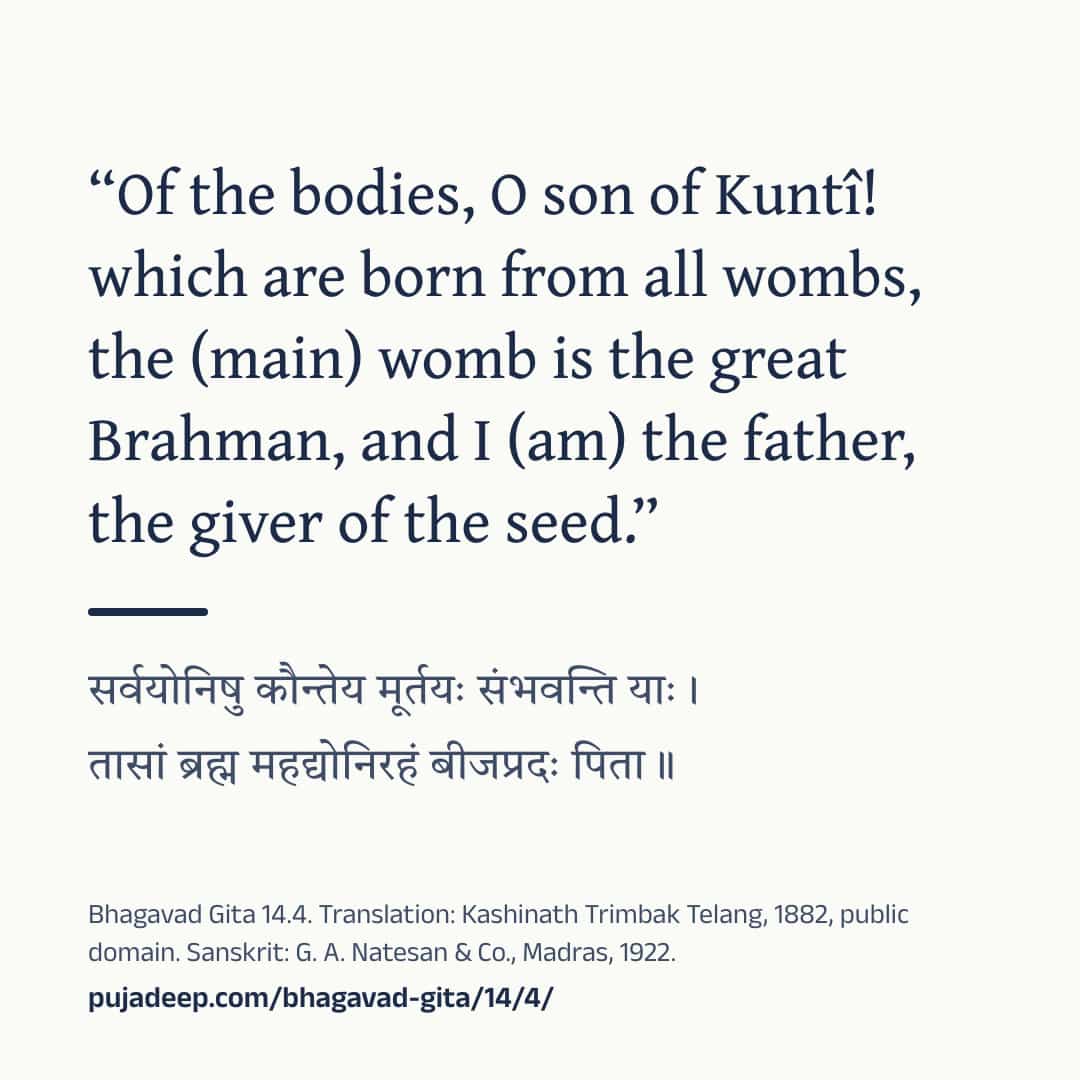
Drawing the picture
See the words
Bhagavad Gita 14.4

सर्वयोनिषु कौन्तेय मूर्तयः संभवन्ति याः ।
तासां ब्रह्म महद्योनिरहं बीजप्रदः पिता ॥

“Of the bodies, O son of Kuntî! which are born from all wombs, the (main) womb is the great Brahman, and I (am) the father, the giver of the seed.”
(K. T. Telang, The Bhagavadgîtâ (The Sacred Books of the East, vol. VIII, Oxford: Clarendon Press, 1882), p. 107, public domain)

“In whatsoever wombs mortals are produced, O Kaunteya, the mighty Brahman is their womb, I their generating Father.”
(Annie Besant, The Bhagavad Gîtâ, or The Lord's Song (London: Theosophical Publishing Society, 1895), p. 129, public domain)

“Whatever forms are produced, O son of Kunti, in all the wombs, the Great Prakriti is their womb, I the seed-giving Father.”
(Swami Swarupananda, Srimad-Bhagavad-Gita (Mayavati: Prabuddha Bharata Press, 1909; first printed in Prabuddha Bharata, 1907–1909), p. 272, public domain)

Sanskrit: G. A. Natesan & Co., Madras, 1922.
https://pujadeep.com/bhagavad-gita/14/4/ Nothing is sent from this site. Your own app sends it, to the chat you choose. The picture quotes the translation you chose on this page, with its name and year.
Sanskrit text: The Bhagavad-Gita, or The Lord's Song, with the text in Devanagari and an English translation, 1922. Meanings: written for Pujadeep and checked against the cited edition. Source and changes
Questions families ask
Who speaks Bhagavad Gita 14.4?
Krishna speaks this verse, in chapter 14 (Gunatraya Vibhaga Yoga).
Where does the Sanskrit text come from?
Sanskrit text: The Bhagavad-Gita, or The Lord's Song, with the text in Devanagari and an English translation, 1922. Meanings: written for Pujadeep and checked against the cited edition. See the source
Is the meaning on this page a translation?
Explanation written for this site from the sources listed here, and checked against the cited edition. It is not a translation and not the only way to read the text. Free to quote with credit.
Source and licence
- Sanskrit text
- The Bhagavad-Gita, or The Lord's Song, with the text in Devanagari and an English translation (Annie Besant, G. A. Natesan & Co., Madras, 1922). Public domain. The Sanskrit on these pages was read from this printing’s page images.
- Translation
- The Bhagavadgîtâ with the Sanatsugâtîya and the Anugîtâ, translated by Kâshinâth Trimbak Telang (The Sacred Books of the East, vol. VIII, ed. F. Max Müller) (Kashinath Trimbak Telang, F. Max Müller, Clarendon Press, Oxford, 1882). Public domain. Shown verbatim, as printed.
- Translation
- The Bhagavad Gîtâ, or The Lord's Song, translated by Annie Besant (Annie Besant, Theosophical Publishing Society, London, 1895). Public domain. Shown verbatim, as printed.
- Translation
- Srimad-Bhagavad-Gita, with Sanskrit Text; Paraphrase with Word-by-word Literal Translation; English Rendering and Comments, Index, &c., by the Swami Swarupananda (Himalayan Series, No. XX) (Swami Swarupananda, The Editors and Publishers, Advaita Ashrama, Mayavati, Prabuddha Bharata Press, Mayavati, Almora, Himalayas, 1909). Public domain. Shown verbatim, as printed.
- Common wording
- In this text, 32 words follow today's common wording, checked against sanskritdocuments.org; Sanskrit Wikisource; Gita Press, Gorakhpur; GRETIL, Göttingen and Bhaktivedanta Book Trust.
- Our explanation
- Explanation written for this site from the sources listed here, and checked against the cited edition. It is not a translation and not the only way to read the text. Free to quote with credit.
- Checked
- Checked against the cited edition, October 14, 2026.
- Updated
- October 25, 2026