Bhagavad Gita 14.18: meaning and translation
Chapter 14: Gunatraya Vibhaga Yoga. Krishna says
Those settled in sattva go upward, Krishna says; those of rajas stay in the middle; and those of tamas, following the lowest guṇa, go downward.
Click or tap a word for its meaning and its dictionary page.
Text and layers
Text and layers
These choices stay in this browser.
Bhagavad Gita 14.18
ऊर्ध्वं गच्छन्ति सत्त्वस्था मध्ये तिष्ठन्ति राजसाः ।जघन्यगुणवृत्तिस्था अधो गच्छन्ति तामसाः ॥
Urdhvam gachchhanti sattvastha madhye tishthanti rajasahJaghanyagunavrittistha adho gachchhanti tamasah
ūrdhvaṃ gacchanti sattvasthā madhye tiṣṭhanti rājasāḥ |jaghanyaguṇavṛttisthā adho gacchanti tāmasāḥ ||
Our explanation Those settled in sattva go upward, Krishna says; those of rajas stay in the middle; and those of tamas, following the lowest guṇa, go downward. Telang's note, following the commentators, reads upward, middle and downward as birth among gods, humans and animals.
हिंदी अर्थ कृष्ण कहते हैं कि सत्त्व में स्थित लोग ऊपर जाते हैं, राजस लोग बीच में रहते हैं, और तामस लोग, सबसे नीचे के गुण का अनुसरण करते हुए, नीचे जाते हैं। तेलंग की टिप्पणी, टीकाकारों के अनुसार, ऊपर, बीच और नीचे का अर्थ देवताओं, मनुष्यों और पशुओं में जन्म लेती है।
Word by word
Every word, with its dictionary page
Word by word
- ऊर्ध्वम् ūrdhvam · upward (adverb) Dictionary: ūrdhva, Monier-Williams 1899, p. 222, col. 1 “upwards, towards the upper part, aloft, above”
- गच्छन्ति gacchanti · go (present, 3rd person plural) Dictionary: 1. gam, Monier-Williams 1899, p. 347, col. 1 “to go, move, go away, set out, come”
- सत्त्वस्थाः sattvasthāḥ · those settled in sattva (compound (masculine), nominative plural) Dictionary: sat-tva, Monier-Williams 1899, p. 1135, col. 2 “the quality of purity or goodness”; stha, Monier-Williams 1899, p. 1262, col. 3 “standing, staying, abiding, being situated in”
- मध्ये madhye · in the middle (noun (neuter), locative singular) Dictionary: madhya, Monier-Williams 1899, p. 781, col. 3 “the middle, midst, centre, inside, interior”
- तिष्ठन्ति tiṣṭhanti · stay (present, 3rd person plural) Dictionary: sthā, Monier-Williams 1899, p. 1262, col. 2 “to stay, remain, continue in any condition or action”
- राजसाः rājasāḥ · those of rajas (adjective (masculine), nominative plural) Dictionary: rājasa, Monier-Williams 1899, p. 875, col. 2 “belonging or relating to the quality rajas”
- जघन्यगुणवृत्तिस्थाः jaghanyaguṇavṛttisthāḥ · living in the ways of the lowest guṇa (compound (masculine), nominative plural) Dictionary: jaghanya-guṇa, Monier-Williams 1899, p. 408, col. 3 “the lowest of the 3 Guṇas”; vṛtti, Monier-Williams 1899, p. 1010, col. 1 “mode of life or conduct, course of action, behaviour”; stha, Monier-Williams 1899, p. 1262, col. 3 “standing, staying, abiding, being situated in”
- अधः adhaḥ · downward (indeclinable) Dictionary: adhas, Monier-Williams 1899, p. 20, col. 1 “below, down; in the lower region; beneath, under”
- गच्छन्ति gacchanti · go (present, 3rd person plural) Dictionary: 1. gam, Monier-Williams 1899, p. 347, col. 1 “to go, move, go away, set out, come”
- तामसाः tāmasāḥ · those of tamas (adjective (masculine), nominative plural) Dictionary: tāmasa, Monier-Williams 1899, p. 442, col. 3 “appertaining to or affected by the quality tamas”
Old translations
Kashinath Trimbak Telang, 1882. Public domain. Page 109.
Those who adhere to (the ways of) goodness go up1; the passionate remain in the middle; while those of the qualities of darkness, adhering to the ways of the lowest quality, go down.
Footnotes (the translator’s own) - I. e. are born as gods, &c.; 'middle,' as men, &c.; 'down,' as brutes, &c. ↩
Compare 3 translations
Kashinath Trimbak Telang, 1882. Public domain. Page 109.
Those who adhere to (the ways of) goodness go up1; the passionate remain in the middle; while those of the qualities of darkness, adhering to the ways of the lowest quality, go down.
Footnotes (the translator’s own) - I. e. are born as gods, &c.; 'middle,' as men, &c.; 'down,' as brutes, &c. ↩
You are reading this one
Annie Besant, 1895. Public domain. Page 132.
They rise upwards who are settled in Sattva; the Râjasic dwell in the midmost place; the Tâmasic go downwards, enveloped in the vilest qualities.
You are reading this one
Swami Swarupananda, 1909 (first printed 1907). Public domain. Page 278.
The Satva-abiding go upwards; the Rájasic dwell in the middle; and the Támasic, abiding in the function of the lowest Guna, go downwards.
You are reading this one
Cite this verse
The translation: K. T. Telang, The Bhagavadgîtâ (The Sacred Books of the East, vol. VIII, Oxford: Clarendon Press, 1882), p. 109. Bhagavad Gita 14.18.
The translation: Annie Besant, The Bhagavad Gîtâ, or The Lord's Song (London: Theosophical Publishing Society, 1895), p. 132. Bhagavad Gita 14.18.
The translation: Swami Swarupananda, Srimad-Bhagavad-Gita (Mayavati: Prabuddha Bharata Press, 1909; first printed in Prabuddha Bharata, 1907–1909), p. 278. Bhagavad Gita 14.18.
Our explanation: “Bhagavad Gita 14.18: meaning and translation.” Pujadeep. Updated October 25, 2026. https://pujadeep.com/bhagavad-gita/14/18/
Pujadeep’s explanations are free to quote with credit: name Pujadeep and link to the page. How to credit
Classical readings, by school
No readings by school on this verse yet.
Share
Show the ways to share
Send one picture or the text to one chat. The picture names its source and the address of this page.
Drawing the picture
See the words
Bhagavad Gita 14.18

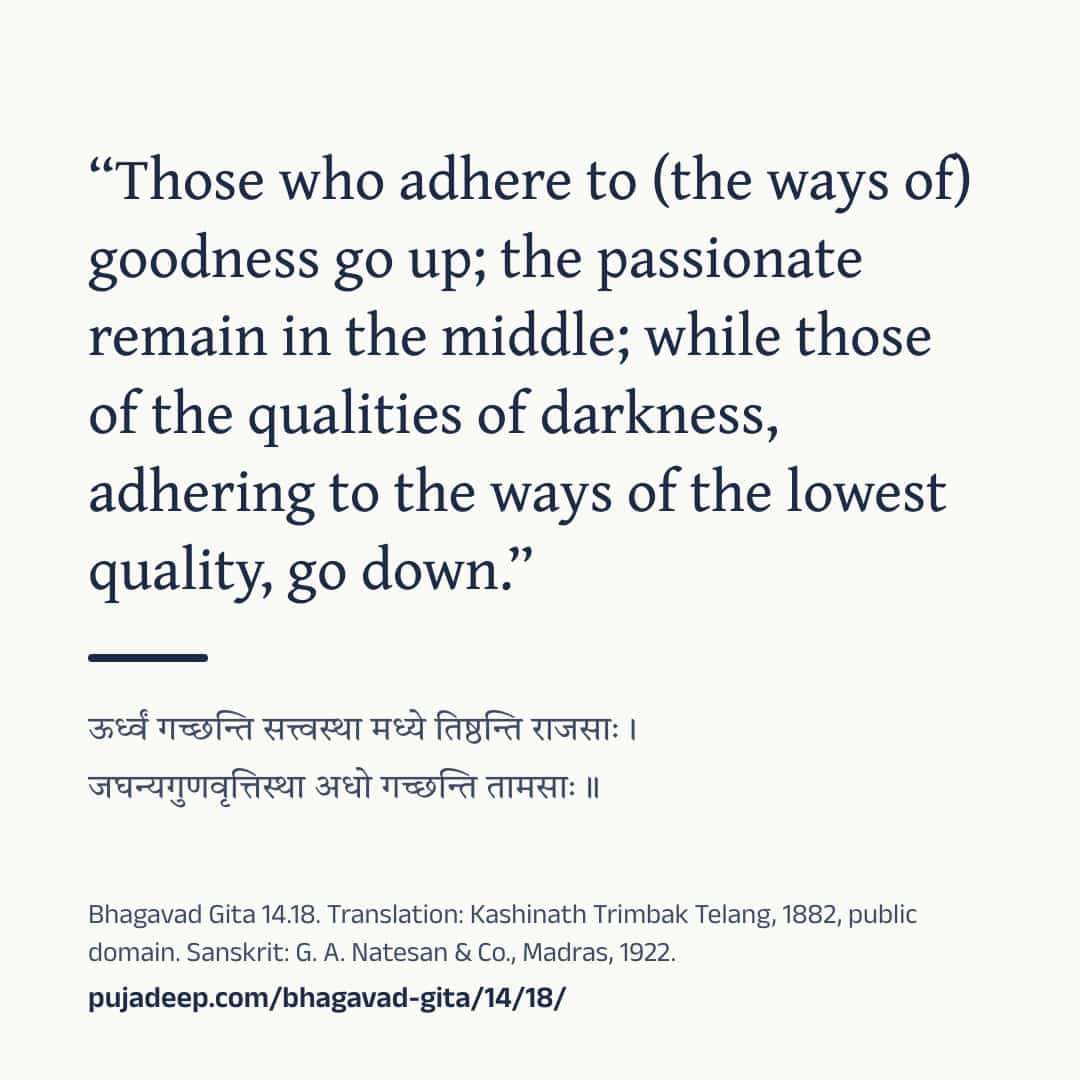
ऊर्ध्वं गच्छन्ति सत्त्वस्था मध्ये तिष्ठन्ति राजसाः ।
जघन्यगुणवृत्तिस्था अधो गच्छन्ति तामसाः ॥

“Those who adhere to (the ways of) goodness go up; the passionate remain in the middle; while those of the qualities of darkness, adhering to the ways of the lowest quality, go down.”
(K. T. Telang, The Bhagavadgîtâ (The Sacred Books of the East, vol. VIII, Oxford: Clarendon Press, 1882), p. 109, public domain)

“They rise upwards who are settled in Sattva; the Râjasic dwell in the midmost place; the Tâmasic go downwards, enveloped in the vilest qualities.”
(Annie Besant, The Bhagavad Gîtâ, or The Lord's Song (London: Theosophical Publishing Society, 1895), p. 132, public domain)

“The Satva-abiding go upwards; the Rájasic dwell in the middle; and the Támasic, abiding in the function of the lowest Guna, go downwards.”
(Swami Swarupananda, Srimad-Bhagavad-Gita (Mayavati: Prabuddha Bharata Press, 1909; first printed in Prabuddha Bharata, 1907–1909), p. 278, public domain)

Sanskrit: G. A. Natesan & Co., Madras, 1922.
https://pujadeep.com/bhagavad-gita/14/18/ Nothing is sent from this site. Your own app sends it, to the chat you choose. The picture quotes the translation you chose on this page, with its name and year.
Sanskrit text: The Bhagavad-Gita, or The Lord's Song, with the text in Devanagari and an English translation, 1922. Meanings: written for Pujadeep and checked against the cited edition. Source and changes
Questions families ask
Who speaks Bhagavad Gita 14.18?
Krishna speaks this verse, in chapter 14 (Gunatraya Vibhaga Yoga).
Where does the Sanskrit text come from?
Sanskrit text: The Bhagavad-Gita, or The Lord's Song, with the text in Devanagari and an English translation, 1922. Meanings: written for Pujadeep and checked against the cited edition. See the source
Is the meaning on this page a translation?
Explanation written for this site from the sources listed here, and checked against the cited edition. It is not a translation and not the only way to read the text. Free to quote with credit.
Source and licence
- Sanskrit text
- The Bhagavad-Gita, or The Lord's Song, with the text in Devanagari and an English translation (Annie Besant, G. A. Natesan & Co., Madras, 1922). Public domain. The Sanskrit on these pages was read from this printing’s page images.
- Translation
- The Bhagavadgîtâ with the Sanatsugâtîya and the Anugîtâ, translated by Kâshinâth Trimbak Telang (The Sacred Books of the East, vol. VIII, ed. F. Max Müller) (Kashinath Trimbak Telang, F. Max Müller, Clarendon Press, Oxford, 1882). Public domain. Shown verbatim, as printed.
- Translation
- The Bhagavad Gîtâ, or The Lord's Song, translated by Annie Besant (Annie Besant, Theosophical Publishing Society, London, 1895). Public domain. Shown verbatim, as printed.
- Translation
- Srimad-Bhagavad-Gita, with Sanskrit Text; Paraphrase with Word-by-word Literal Translation; English Rendering and Comments, Index, &c., by the Swami Swarupananda (Himalayan Series, No. XX) (Swami Swarupananda, The Editors and Publishers, Advaita Ashrama, Mayavati, Prabuddha Bharata Press, Mayavati, Almora, Himalayas, 1909). Public domain. Shown verbatim, as printed.
- Common wording
- In this text, 32 words follow today's common wording, checked against sanskritdocuments.org; Sanskrit Wikisource; Gita Press, Gorakhpur; GRETIL, Göttingen and Bhaktivedanta Book Trust.
- Our explanation
- Explanation written for this site from the sources listed here, and checked against the cited edition. It is not a translation and not the only way to read the text. Free to quote with credit.
- Checked
- Checked against the cited edition, October 14, 2026.
- Updated
- October 25, 2026