Bhagavad Gita 14.26: meaning and translation
Chapter 14: Gunatraya Vibhaga Yoga. Krishna says
Krishna answers the last question, how one goes beyond the guṇas.
Click or tap a word for its meaning and its dictionary page.
Text and layers
Text and layers
These choices stay in this browser.
Bhagavad Gita 14.26
मां च योऽव्यभिचारेण भक्तियोगेन सेवते ।स गुणान्समतीत्यैतान् ब्रह्मभूयाय कल्पते ॥
Mam cha yovyabhicharena bhaktiyogena sevateSa gunansamatityaitan brahmabhuyaya kalpate
māṃ ca yo’vyabhicāreṇa bhaktiyogena sevate |sa guṇānsamatītyaitān brahmabhūyāya kalpate ||
Our explanation Krishna answers the last question, how one goes beyond the guṇas. Whoever serves him with unwavering devotion (bhakti-yoga), he says, crosses beyond these guṇas and becomes fit for brahma-bhūya, becoming Brahman. The schools read this in different ways (see the views).
हिंदी अर्थ कृष्ण अंतिम प्रश्न का उत्तर देते हैं कि गुणों से परे कैसे जाया जाए। वे कहते हैं कि जो अव्यभिचारी (अविचल) भक्तियोग से उनकी सेवा करता है, वह इन गुणों को पार करके ब्रह्मभूय (ब्रह्म होने) के योग्य होता है। परंपराएँ इसे अलग-अलग ढंग से पढ़ती हैं।
Word by word
Every word, with its dictionary page
Word by word
- माम् mām · "me" (Krishna) (pronoun, accusative singular) Dictionary: 1. mad, Monier-Williams 1899, p. 777, col. 2 “base of the first pers. pron. in the sg. number (esp. in comp.)”
- च ca · and (indeclinable) Dictionary: 2. ca, Monier-Williams 1899, p. 380, col. 1 “and, both, also, moreover, as well as”
- यः yaḥ · who (pronoun (masculine), nominative singular) Dictionary: yad, Monier-Williams 1899, p. 844, col. 2 “who, which, what, whichever, whatever, that”
- अव्यभिचारेण avyabhicāreṇa · unwavering (adjective (masculine), instrumental singular) Dictionary: a-vyabhicāra, Monier-Williams 1899, p. 111, col. 3 “constant”
- भक्तियोगेन bhaktiyogena · by the path of devotion (compound (masculine), instrumental singular) Dictionary: bhakti-yoga, Monier-Williams 1899, p. 743, col. 2 “devoted attachment, loving devotion”
- सेवते sevate · serves, worships (present, 3rd person singular) Dictionary: sev, Monier-Williams 1899, p. 1247, col. 1 “to serve, wait or attend upon, honour, obey, worship”
- सः saḥ · he (pronoun (masculine), nominative singular) Dictionary: tad, Monier-Williams 1899, p. 434, col. 1 “m. he, f. she, n. it, that, this”
- गुणान् guṇān · the guṇas (noun (masculine), accusative plural) Dictionary: guṇa, Monier-Williams 1899, p. 357, col. 1 “(in Sāṃkhya phil.) an ingredient or constituent of Prakṛiti, chief quality of all existing beings”
- समतीत्य samatītya · going fully beyond (absolutive (having done)) Dictionary: sam-atī, Monier-Williams 1899, p. 1154, col. 1 “to go or pass by entirely, go through or beyond, cross over”
- एतान् etān · these (pronoun (masculine), accusative plural) Dictionary: etad, Monier-Williams 1899, p. 231, col. 2 “this, this here, here”
- ब्रह्मभूयाय brahmabhūyāya · for becoming Brahman (compound (neuter), dative singular) Dictionary: brahma-bhūya, Monier-Williams 1899, p. 739, col. 2 “identification with or absorption into Brahmă”
- कल्पते kalpate · becomes fit (present, 3rd person singular) Dictionary: kḷp, Monier-Williams 1899, p. 308, col. 2 “to be fit for”
2 printings differ
Edition differences. Another printing or text reads this place differently.
- The printed edition reads: मां च योऽव्यभिचारेण भक्तियोगेन सेवते ।
स गुणान्समतीत्यैतान् ब्रह्मभूंयाय कल्पते ॥ The print shows an anusvara over भू (ब्रह्मभूंयाय); read as a stray sort and not shown, because brahma-bhūyāya ('for becoming Brahman') has no nasal and both proofreading references read ब्रह्मभूयाय. - Spelling A digital text reads Same letters. The 1922 edition prints समतीत्यैतान् ब्रह्मभूयाय as two words.
Old translations
Kashinath Trimbak Telang, 1882. Public domain. Page 110.
And he who worships me with an unswerving devotion, transcends these qualities, and becomes fit for (entrance into) the essence of the Brahman.
Compare 3 translations
Kashinath Trimbak Telang, 1882. Public domain. Page 110.
And he who worships me with an unswerving devotion, transcends these qualities, and becomes fit for (entrance into) the essence of the Brahman.
You are reading this one
Annie Besant, 1895. Public domain. Page 133–134.
And he who serveth Me exclusively by the Yoga of devotion, he, crossing beyond the Gunas alike, he is fit for the Abode of Brahman.
You are reading this one
Swami Swarupananda, 1909 (first printed 1907). Public domain. Page 282.
And he who serves Me with an unswerving devotion, crossing beyond the Gunas, is fitted for becoming Brahman.
You are reading this one
Cite this verse
The translation: K. T. Telang, The Bhagavadgîtâ (The Sacred Books of the East, vol. VIII, Oxford: Clarendon Press, 1882), p. 110. Bhagavad Gita 14.26.
The translation: Annie Besant, The Bhagavad Gîtâ, or The Lord's Song (London: Theosophical Publishing Society, 1895), pp. 133–134. Bhagavad Gita 14.26.
The translation: Swami Swarupananda, Srimad-Bhagavad-Gita (Mayavati: Prabuddha Bharata Press, 1909; first printed in Prabuddha Bharata, 1907–1909), p. 282. Bhagavad Gita 14.26.
Our explanation: “Bhagavad Gita 14.26: meaning and translation.” Pujadeep. Updated October 25, 2026. https://pujadeep.com/bhagavad-gita/14/26/
Pujadeep’s explanations are free to quote with credit: name Pujadeep and link to the page. How to credit
Classical readings, by school
Each reading is named by its school. None is presented as the only meaning.
What Advaita, Vishishtadvaita and Dvaita teach, in short
Shankara Advaita
Shankara says that a renunciant, or even a person of works, who serves the Lord dwelling in all hearts with unfailing devotion devoted to discriminating knowledge, crosses the guṇas and becomes fit for liberation (mokṣa), that is, for becoming Brahman. He adds that this devotion is itself the result of the Lord's grace.
Source: The Bhagavad-Gita, with the commentary of Sri Sankaracharya, translated by A. Mahadeva Sastri (2nd ed., Mysore: G. T. A. Printing Works, 1901), commentary on 14.26, p. 353. Summarised in our own words; none of its text is reproduced.
Ramanuja Vishishtadvaita
Ramanuja says reflection on the difference between soul and matter is not enough, because old habits overpower it; the guṇas are crossed through single-minded, loving bhakti to the Lord. Brahma-bhūya is the soul's realisation of its own immortal nature, a state like Brahman's.
Source: Sri Bhagavad-Gita with Sri Ramanujacharya's Visishtadvaita commentary, translated by A. Govindacharya (Madras, 1898), commentary on 14.26, p. 458. Summarised in our own words; none of its text is reproduced.
Share
Show the ways to share
Send one picture or the text to one chat. The picture names its source and the address of this page.
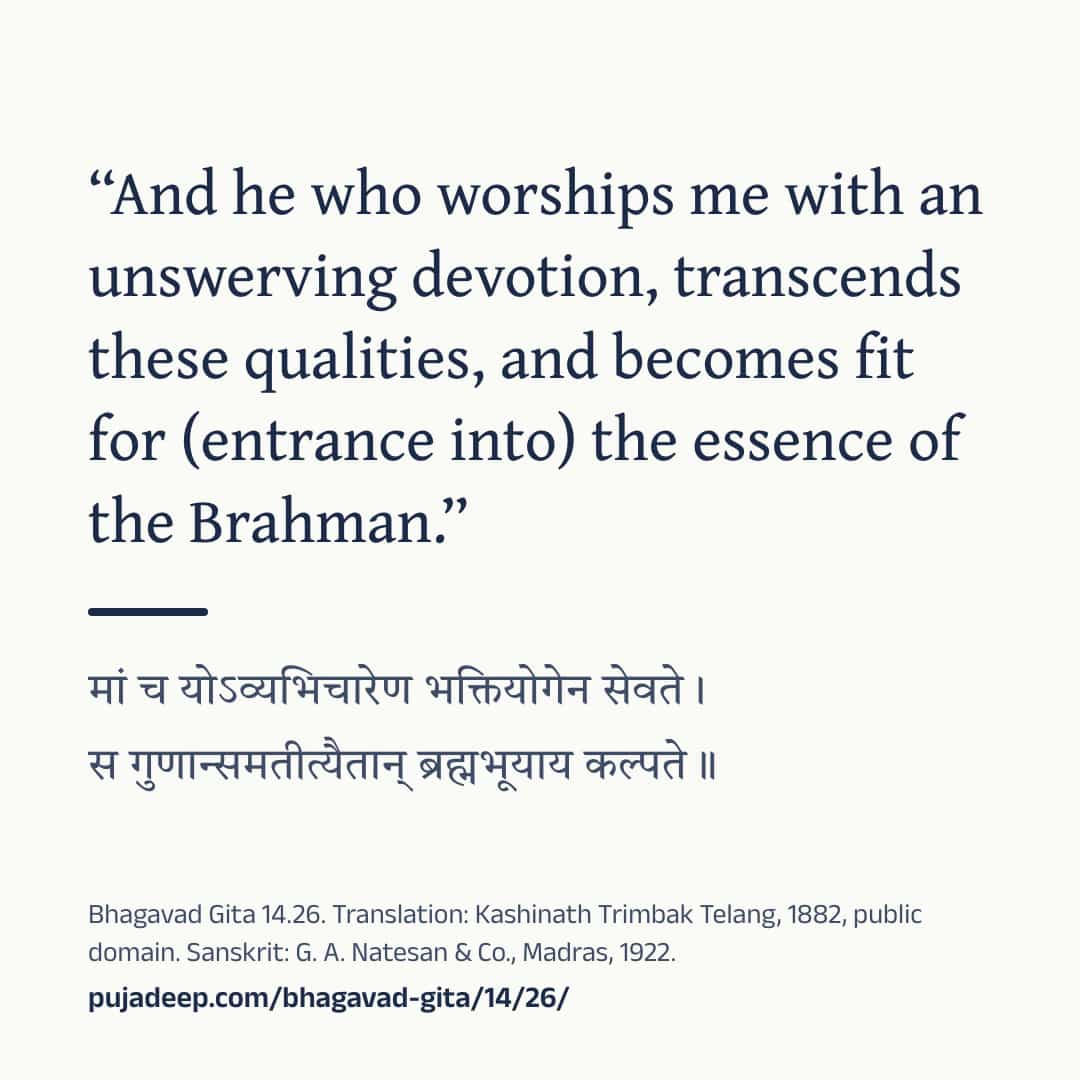
Drawing the picture
See the words
Bhagavad Gita 14.26

मां च योऽव्यभिचारेण भक्तियोगेन सेवते ।
स गुणान्समतीत्यैतान् ब्रह्मभूयाय कल्पते ॥

“And he who worships me with an unswerving devotion, transcends these qualities, and becomes fit for (entrance into) the essence of the Brahman.”
(K. T. Telang, The Bhagavadgîtâ (The Sacred Books of the East, vol. VIII, Oxford: Clarendon Press, 1882), p. 110, public domain)

“And he who serveth Me exclusively by the Yoga of devotion, he, crossing beyond the Gunas alike, he is fit for the Abode of Brahman.”
(Annie Besant, The Bhagavad Gîtâ, or The Lord's Song (London: Theosophical Publishing Society, 1895), pp. 133–134, public domain)

“And he who serves Me with an unswerving devotion, crossing beyond the Gunas, is fitted for becoming Brahman.”
(Swami Swarupananda, Srimad-Bhagavad-Gita (Mayavati: Prabuddha Bharata Press, 1909; first printed in Prabuddha Bharata, 1907–1909), p. 282, public domain)

Sanskrit: G. A. Natesan & Co., Madras, 1922.
https://pujadeep.com/bhagavad-gita/14/26/ Nothing is sent from this site. Your own app sends it, to the chat you choose. The picture quotes the translation you chose on this page, with its name and year.
Sanskrit text: The Bhagavad-Gita, or The Lord's Song, with the text in Devanagari and an English translation, 1922. Meanings: written for Pujadeep and checked against the cited edition. Source and changes
Questions families ask
Who speaks Bhagavad Gita 14.26?
Krishna speaks this verse, in chapter 14 (Gunatraya Vibhaga Yoga).
Where does the Sanskrit text come from?
Sanskrit text: The Bhagavad-Gita, or The Lord's Song, with the text in Devanagari and an English translation, 1922. Meanings: written for Pujadeep and checked against the cited edition. See the source
Is the meaning on this page a translation?
Explanation written for this site from the sources listed here, and checked against the cited edition. It is not a translation and not the only way to read the text. Free to quote with credit.
Source and licence
- Sanskrit text
- The Bhagavad-Gita, or The Lord's Song, with the text in Devanagari and an English translation (Annie Besant, G. A. Natesan & Co., Madras, 1922). Public domain. The Sanskrit on these pages was read from this printing’s page images.
- Translation
- The Bhagavadgîtâ with the Sanatsugâtîya and the Anugîtâ, translated by Kâshinâth Trimbak Telang (The Sacred Books of the East, vol. VIII, ed. F. Max Müller) (Kashinath Trimbak Telang, F. Max Müller, Clarendon Press, Oxford, 1882). Public domain. Shown verbatim, as printed.
- Translation
- The Bhagavad Gîtâ, or The Lord's Song, translated by Annie Besant (Annie Besant, Theosophical Publishing Society, London, 1895). Public domain. Shown verbatim, as printed.
- Translation
- Srimad-Bhagavad-Gita, with Sanskrit Text; Paraphrase with Word-by-word Literal Translation; English Rendering and Comments, Index, &c., by the Swami Swarupananda (Himalayan Series, No. XX) (Swami Swarupananda, The Editors and Publishers, Advaita Ashrama, Mayavati, Prabuddha Bharata Press, Mayavati, Almora, Himalayas, 1909). Public domain. Shown verbatim, as printed.
- Commentary
- The Bhagavad-Gita, with the commentary of Sri Sankaracharya, translated by A. Mahadeva Sastri (2nd ed., Mysore: G. T. A. Printing Works, 1901) (Public-domain scan, University of California Libraries). Summarised in our own words; none of its text is reproduced.
- Commentary
- Sri Bhagavad-Gita with Sri Ramanujacharya's Visishtadvaita commentary, translated by A. Govindacharya (Madras, 1898) (Scan uploaded to archive.org (folkscanomy collection)). Summarised in our own words; none of its text is reproduced.
- Common wording
- In this text, 32 words follow today's common wording, checked against sanskritdocuments.org; Sanskrit Wikisource; Gita Press, Gorakhpur; GRETIL, Göttingen and Bhaktivedanta Book Trust.
- Our explanation
- Explanation written for this site from the sources listed here, and checked against the cited edition. It is not a translation and not the only way to read the text. Free to quote with credit.
- Checked
- Checked against the cited edition, October 14, 2026.
- Updated
- October 25, 2026