Bhagavad Gita 14.19: meaning and translation
Chapter 14: Gunatraya Vibhaga Yoga. Krishna says
When the seer sees no doer other than the guṇas, and knows what is beyond the guṇas, Krishna says, he comes to his state (madbhāva).
Click or tap a word for its meaning and its dictionary page.
Text and layers
Text and layers
These choices stay in this browser.
Bhagavad Gita 14.19
नान्यं गुणेभ्यः कर्तारं यदा द्रष्टाऽनुपश्यति ।गुणेभ्यश्च परं वेत्ति मद्भावं सोऽधिगच्छति ॥
Nanyam gunebhyah kartaram yada drashtanupashyatiGunebhyashcha param vetti madbhavam sodhigachchhati
nānyaṃ guṇebhyaḥ kartāraṃ yadā draṣṭā’nupaśyati |guṇebhyaśca paraṃ vetti madbhāvaṃ so’dhigacchati ||
Our explanation When the seer sees no doer other than the guṇas, and knows what is beyond the guṇas, Krishna says, he comes to his state (madbhāva). The schools explain what lies beyond the guṇas and what this state is (see the views).
हिंदी अर्थ कृष्ण कहते हैं कि जब द्रष्टा गुणों के सिवा किसी और को कर्ता नहीं देखता, और गुणों से परे जो है उसे जानता है, तब वह उनके भाव (मद्भाव) को प्राप्त होता है। गुणों से परे क्या है और यह भाव क्या है, इसे परंपराएँ अलग ढंग से समझाती हैं।
Word by word
Every word, with its dictionary page
Word by word
- न na · no (indeclinable) Dictionary: 2. na, Monier-Williams 1899, p. 523, col. 1 “not, no, nor, neither”
- अन्यम् anyam · other (pronoun (masculine), accusative singular) Dictionary: 2. anya, Monier-Williams 1899, p. 45, col. 2 “other, different”
- गुणेभ्यः guṇebhyaḥ · than the guṇas (noun (masculine), ablative plural) Dictionary: guṇa, Monier-Williams 1899, p. 357, col. 1 “(in Sāṃkhya phil.) an ingredient or constituent of Prakṛiti, chief quality of all existing beings”
- कर्तारम् kartāram · doer (noun (masculine), accusative singular) Dictionary: kartṛ, Monier-Williams 1899, p. 257, col. 3 “one who makes or does or acts or effects, a doer, maker, agent, author”
- यदा yadā · when (indeclinable) Dictionary: yadā, Monier-Williams 1899, p. 844, col. 1 “when, at what time, whenever”
- द्रष्टा draṣṭā · the seer (noun (masculine), nominative singular) Dictionary: draṣṭṛ, Monier-Williams 1899, p. 501, col. 2 “one who sees”
- अनुपश्यति anupaśyati · sees (present, 3rd person singular) Dictionary: anu-paś, Monier-Williams 1899, p. 35, col. 1 “to look at, perceive, notice, discover”
- गुणेभ्यः guṇebhyaḥ · than the guṇas (noun (masculine), ablative plural) Dictionary: guṇa, Monier-Williams 1899, p. 357, col. 1 “(in Sāṃkhya phil.) an ingredient or constituent of Prakṛiti, chief quality of all existing beings”
- च ca · and (indeclinable) Dictionary: 2. ca, Monier-Williams 1899, p. 380, col. 1 “and, both, also, moreover, as well as”
- परम् param · what is beyond (adjective (neuter), accusative singular) Dictionary: 1. para, Monier-Williams 1899, p. 586, col. 1 “best or worst, highest, supreme, chief”
- वेत्ति vetti · knows (present, 3rd person singular) Dictionary: 1. vid, Monier-Williams 1899, p. 963, col. 2 “to know, understand, perceive, learn”
- मद्भावम् madbhāvam · "my" (Krishna's) state (compound (masculine), accusative singular) Dictionary: mad-bhāva, Monier-Williams 1899, p. 777, col. 2 “my essence”
- सः saḥ · he (pronoun (masculine), nominative singular) Dictionary: tad, Monier-Williams 1899, p. 434, col. 1 “m. he, f. she, n. it, that, this”
- अधिगच्छति adhigacchati · attains (present, 3rd person singular) Dictionary: adhi-gam, Monier-Williams 1899, p. 20, col. 3 “to meet, find, discover, obtain”
1 printing differs
Edition differences. Another printing or text reads this place differently.
- Spelling A digital text reads Same words. The 1922 edition marks the merged vowel with an avagraha (द्रष्टाऽनुपश्यति); this e-text does not.
Old translations
Kashinath Trimbak Telang, 1882. Public domain. Page 109.
When a right-seeing person sees none but the qualities (to be) the doers (of all action), and knows what is above the qualities1, he enters into my essence.
Footnotes (the translator’s own) - I. e. what has been called Kshetragña before, the supervising principle within one. ↩
Compare 3 translations
Kashinath Trimbak Telang, 1882. Public domain. Page 109.
When a right-seeing person sees none but the qualities (to be) the doers (of all action), and knows what is above the qualities1, he enters into my essence.
Footnotes (the translator’s own) - I. e. what has been called Kshetragña before, the supervising principle within one. ↩
You are reading this one
Annie Besant, 1895. Public domain. Page 132.
When the Seer perceiveth no agent other than the Gunas, and knoweth THAT which is higher than the Gunas, he entereth into My Nature.
You are reading this one
Swami Swarupananda, 1909 (first printed 1907). Public domain. Page 278.
When the seer beholds no agent other than the Gunas and knows That which is higher than the Gunas, he attains to My being.
You are reading this one
Cite this verse
The translation: K. T. Telang, The Bhagavadgîtâ (The Sacred Books of the East, vol. VIII, Oxford: Clarendon Press, 1882), p. 109. Bhagavad Gita 14.19.
The translation: Annie Besant, The Bhagavad Gîtâ, or The Lord's Song (London: Theosophical Publishing Society, 1895), p. 132. Bhagavad Gita 14.19.
The translation: Swami Swarupananda, Srimad-Bhagavad-Gita (Mayavati: Prabuddha Bharata Press, 1909; first printed in Prabuddha Bharata, 1907–1909), p. 278. Bhagavad Gita 14.19.
Our explanation: “Bhagavad Gita 14.19: meaning and translation.” Pujadeep. Updated October 25, 2026. https://pujadeep.com/bhagavad-gita/14/19/
Pujadeep’s explanations are free to quote with credit: name Pujadeep and link to the page. How to credit
Classical readings, by school
Each reading is named by its school. None is presented as the only meaning.
What Advaita, Vishishtadvaita and Dvaita teach, in short
Shankara Advaita
Shankara says the seer realises that the guṇas, turning into body, senses and objects, are the only doers, and sees the Witness who is distinct from them. Seeing that all is Vāsudeva, he becomes Vāsudeva.
Source: The Bhagavad-Gita, with the commentary of Sri Sankaracharya, translated by A. Mahadeva Sastri (2nd ed., Mysore: G. T. A. Printing Works, 1901), commentary on 14.19, p. 349. Summarised in our own words; none of its text is reproduced.
Ramanuja Vishishtadvaita
Ramanuja says the seer, having suppressed rajas and tamas by pure food and by works offered to the Lord, sees the guṇas as the doers and the self as actionless and made of consciousness. Realising this, he reaches a state like the Lord's own.
Source: Sri Bhagavad-Gita with Sri Ramanujacharya's Visishtadvaita commentary, translated by A. Govindacharya (Madras, 1898), commentary on 14.19, pp. 454–455. Summarised in our own words; none of its text is reproduced.
Share
Show the ways to share
Send one picture or the text to one chat. The picture names its source and the address of this page.
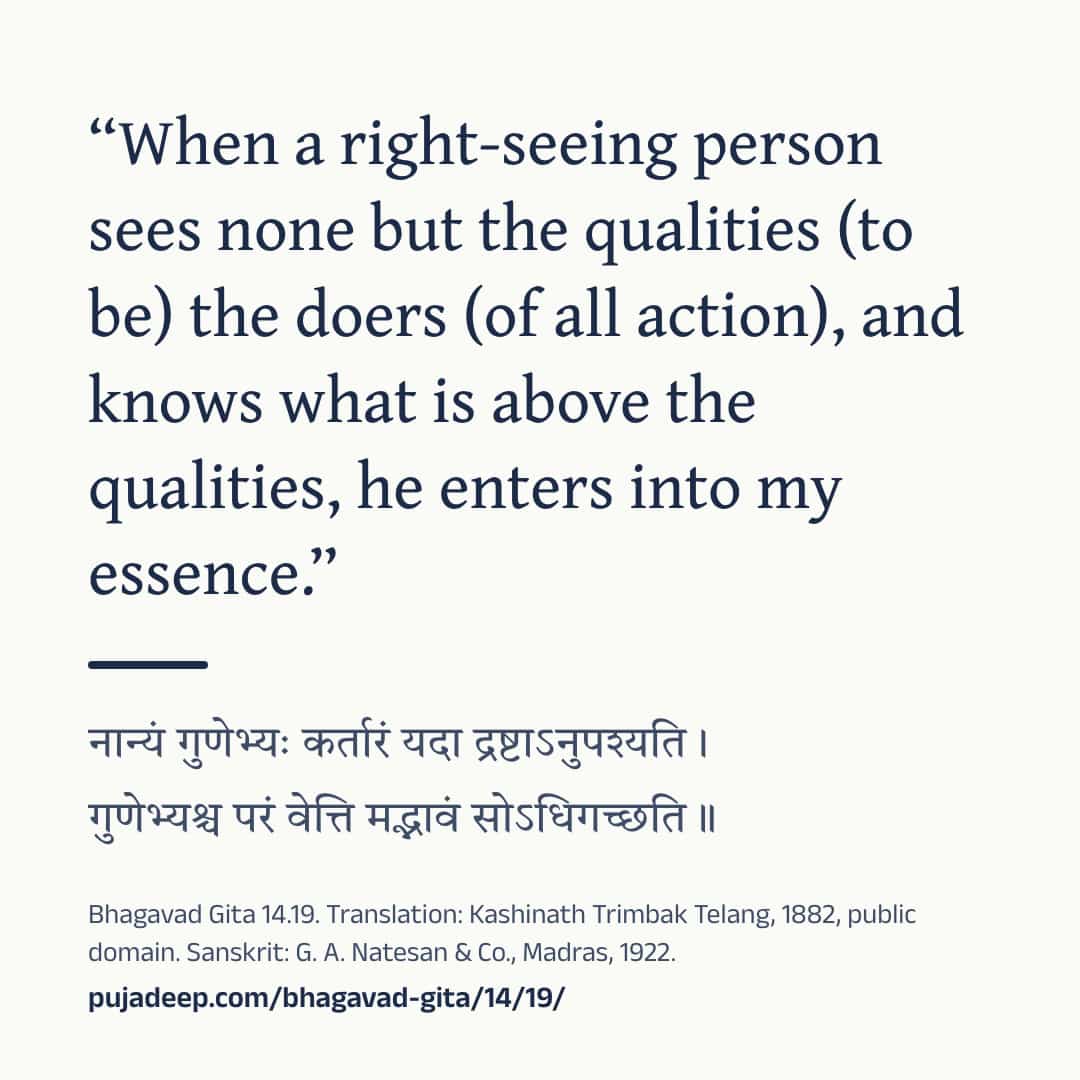
Drawing the picture
See the words
Bhagavad Gita 14.19

नान्यं गुणेभ्यः कर्तारं यदा द्रष्टाऽनुपश्यति ।
गुणेभ्यश्च परं वेत्ति मद्भावं सोऽधिगच्छति ॥

“When a right-seeing person sees none but the qualities (to be) the doers (of all action), and knows what is above the qualities, he enters into my essence.”
(K. T. Telang, The Bhagavadgîtâ (The Sacred Books of the East, vol. VIII, Oxford: Clarendon Press, 1882), p. 109, public domain)

“When the Seer perceiveth no agent other than the Gunas, and knoweth THAT which is higher than the Gunas, he entereth into My Nature.”
(Annie Besant, The Bhagavad Gîtâ, or The Lord's Song (London: Theosophical Publishing Society, 1895), p. 132, public domain)

“When the seer beholds no agent other than the Gunas and knows That which is higher than the Gunas, he attains to My being.”
(Swami Swarupananda, Srimad-Bhagavad-Gita (Mayavati: Prabuddha Bharata Press, 1909; first printed in Prabuddha Bharata, 1907–1909), p. 278, public domain)

Sanskrit: G. A. Natesan & Co., Madras, 1922.
https://pujadeep.com/bhagavad-gita/14/19/ Nothing is sent from this site. Your own app sends it, to the chat you choose. The picture quotes the translation you chose on this page, with its name and year.
Sanskrit text: The Bhagavad-Gita, or The Lord's Song, with the text in Devanagari and an English translation, 1922. Meanings: written for Pujadeep and checked against the cited edition. Source and changes
Questions families ask
Who speaks Bhagavad Gita 14.19?
Krishna speaks this verse, in chapter 14 (Gunatraya Vibhaga Yoga).
Where does the Sanskrit text come from?
Sanskrit text: The Bhagavad-Gita, or The Lord's Song, with the text in Devanagari and an English translation, 1922. Meanings: written for Pujadeep and checked against the cited edition. See the source
Is the meaning on this page a translation?
Explanation written for this site from the sources listed here, and checked against the cited edition. It is not a translation and not the only way to read the text. Free to quote with credit.
Source and licence
- Sanskrit text
- The Bhagavad-Gita, or The Lord's Song, with the text in Devanagari and an English translation (Annie Besant, G. A. Natesan & Co., Madras, 1922). Public domain. The Sanskrit on these pages was read from this printing’s page images.
- Translation
- The Bhagavadgîtâ with the Sanatsugâtîya and the Anugîtâ, translated by Kâshinâth Trimbak Telang (The Sacred Books of the East, vol. VIII, ed. F. Max Müller) (Kashinath Trimbak Telang, F. Max Müller, Clarendon Press, Oxford, 1882). Public domain. Shown verbatim, as printed.
- Translation
- The Bhagavad Gîtâ, or The Lord's Song, translated by Annie Besant (Annie Besant, Theosophical Publishing Society, London, 1895). Public domain. Shown verbatim, as printed.
- Translation
- Srimad-Bhagavad-Gita, with Sanskrit Text; Paraphrase with Word-by-word Literal Translation; English Rendering and Comments, Index, &c., by the Swami Swarupananda (Himalayan Series, No. XX) (Swami Swarupananda, The Editors and Publishers, Advaita Ashrama, Mayavati, Prabuddha Bharata Press, Mayavati, Almora, Himalayas, 1909). Public domain. Shown verbatim, as printed.
- Commentary
- The Bhagavad-Gita, with the commentary of Sri Sankaracharya, translated by A. Mahadeva Sastri (2nd ed., Mysore: G. T. A. Printing Works, 1901) (Public-domain scan, University of California Libraries). Summarised in our own words; none of its text is reproduced.
- Commentary
- Sri Bhagavad-Gita with Sri Ramanujacharya's Visishtadvaita commentary, translated by A. Govindacharya (Madras, 1898) (Scan uploaded to archive.org (folkscanomy collection)). Summarised in our own words; none of its text is reproduced.
- Common wording
- In this text, 32 words follow today's common wording, checked against sanskritdocuments.org; Sanskrit Wikisource; Gita Press, Gorakhpur; GRETIL, Göttingen and Bhaktivedanta Book Trust.
- Our explanation
- Explanation written for this site from the sources listed here, and checked against the cited edition. It is not a translation and not the only way to read the text. Free to quote with credit.
- Checked
- Checked against the cited edition, October 14, 2026.
- Updated
- October 25, 2026