Bhagavad Gita 14.20: meaning and translation
Chapter 14: Gunatraya Vibhaga Yoga. Krishna says
Going beyond these three guṇas, from which the body arises, Krishna says, the embodied one is freed from birth, death, old age and sorrow and tastes the deathless (amṛta).
Click or tap a word for its meaning and its dictionary page.
Text and layers
Text and layers
These choices stay in this browser.
Bhagavad Gita 14.20
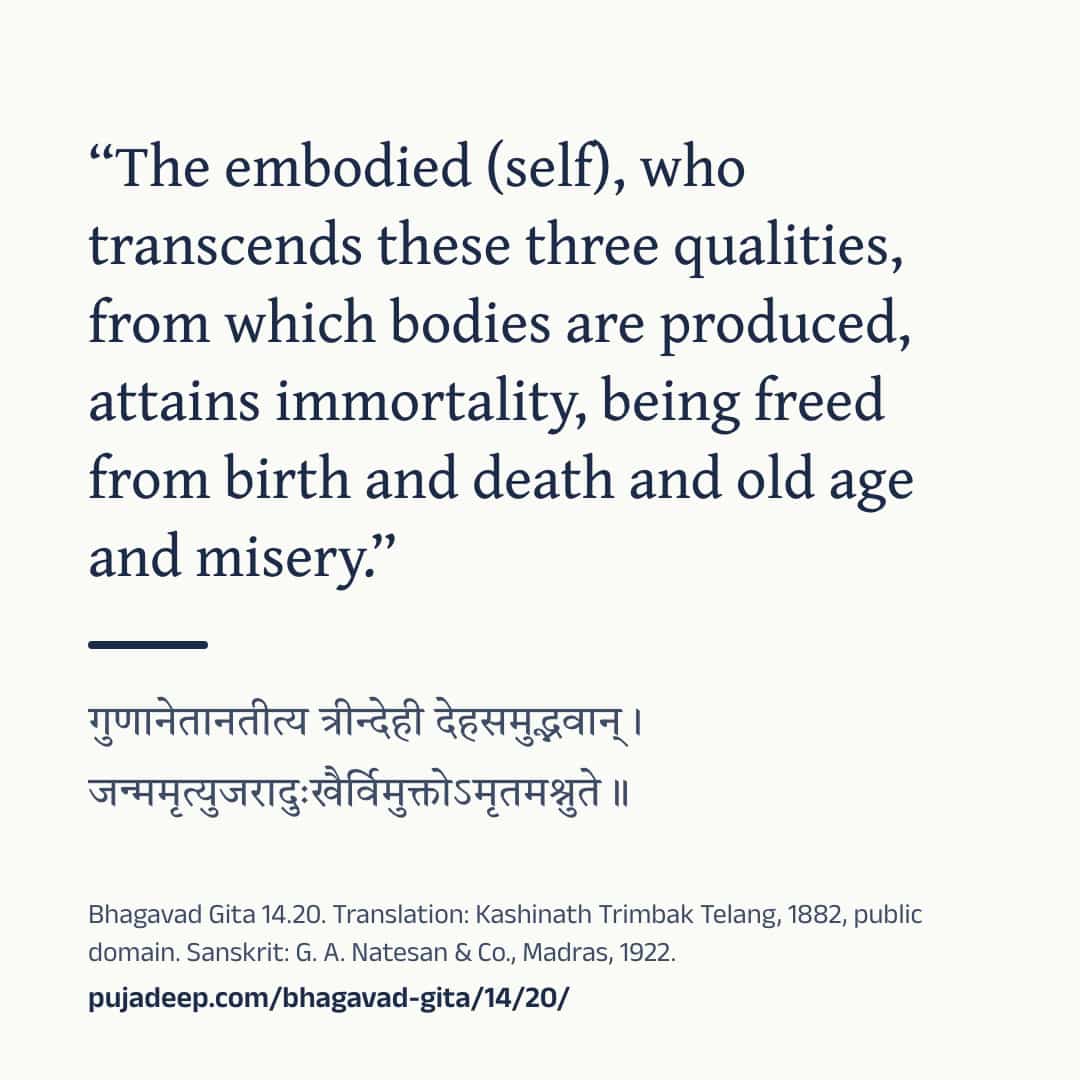
गुणानेतानतीत्य त्रीन्देही देहसमुद्भवान् ।जन्ममृत्युजरादुःखैर्विमुक्तोऽमृतमश्नुते ॥
Gunanetanatitya trindehi dehasamudbhavanJanmamrityujaraduhkhairvimuktomritamashnute
guṇānetānatītya trīndehī dehasamudbhavān |janmamṛtyujarāduḥkhairvimukto’mṛtamaśnute ||
Our explanation Going beyond these three guṇas, from which the body arises, Krishna says, the embodied one is freed from birth, death, old age and sorrow and tastes the deathless (amṛta).
हिंदी अर्थ कृष्ण कहते हैं कि शरीर को उत्पन्न करने वाले इन तीनों गुणों से परे जाकर देही जन्म, मृत्यु, बुढ़ापे और दुःखों से छूट जाता है और अमृत का अनुभव करता है।
Word by word
Every word, with its dictionary page
Word by word
- गुणान् guṇān · the guṇas (noun (masculine), accusative plural) Dictionary: guṇa, Monier-Williams 1899, p. 357, col. 1 “(in Sāṃkhya phil.) an ingredient or constituent of Prakṛiti, chief quality of all existing beings”
- एतान् etān · these (pronoun (masculine), accusative plural) Dictionary: etad, Monier-Williams 1899, p. 231, col. 2 “this, this here, here”
- अतीत्य atītya · going beyond (absolutive (having done)) Dictionary: atī, Monier-Williams 1899, p. 16, col. 2 “to overcome, overtake, outdo”
- त्रीन् trīn · three (numeral (masculine), accusative plural) Dictionary: tri, Monier-Williams 1899, p. 457, col. 3
- देही dehī · the embodied one (noun (masculine), nominative singular) Dictionary: dehin, Monier-Williams 1899, p. 497, col. 1 “having a body, corporeal”
- देहसमुद्भवान् dehasamudbhavān · from which the body arises (compound (masculine), accusative plural) Dictionary: deha, Monier-Williams 1899, p. 496, col. 3 “the body”; sam-udbhava, Monier-Williams 1899, p. 1168, col. 2 “existence, production, origin (ifc. either ‘arisen or produced from’ or ‘being the source of’)”
- जन्ममृत्युजरादुःखैः janmamṛtyujarāduḥkhaiḥ · from birth, death, old age and sorrow (compound (neuter), instrumental plural) Dictionary: janman, Monier-Williams 1899, p. 411, col. 3 “birth, production”; mṛtyu, Monier-Williams 1899, p. 827, col. 3 “death, dying”; jarā, Monier-Williams 1899, p. 413, col. 3 “the act of becoming old, old age”; 1. duḥkha, Monier-Williams 1899, p. 483, col. 2 “uneasiness, pain, sorrow, trouble, difficulty”
- विमुक्तः vimuktaḥ · freed (past participle (masculine), nominative singular) Dictionary: vi-mukta, Monier-Williams 1899, p. 980, col. 2 “set free, liberated (esp. from mundane existence), freed or delivered or escaped from”
- अमृतम् amṛtam · the deathless (noun (neuter), accusative singular) Dictionary: a-mṛta, Monier-Williams 1899, p. 82, col. 2 “immortality”
- अश्नुते aśnute · attains, tastes (present, 3rd person singular) Dictionary: 1. aś, Monier-Williams 1899, p. 112, col. 2 “to reach, come to, arrive at, get, gain, obtain”
Old translations
Kashinath Trimbak Telang, 1882. Public domain. Page 109.
The embodied (self), who transcends these three qualities, from which bodies are produced1, attains immortality, being freed from birth and death and old age and misery.
Footnotes (the translator’s own) - Bodies are developments of the qualities, say the commentators, which is not incompatible with the explanation of qualities given above. As to transcending qualities, cf. p. 48 supra. ↩
Compare 3 translations
Kashinath Trimbak Telang, 1882. Public domain. Page 109.
The embodied (self), who transcends these three qualities, from which bodies are produced1, attains immortality, being freed from birth and death and old age and misery.
Footnotes (the translator’s own) - Bodies are developments of the qualities, say the commentators, which is not incompatible with the explanation of qualities given above. As to transcending qualities, cf. p. 48 supra. ↩
You are reading this one
Annie Besant, 1895. Public domain. Page 132.
When the Dweller in the body hath crossed over the three Gunas, whence all bodies have been produced, liberated from birth, death, old age and sorrow, he drinketh the nectar of immortality.1
Footnotes (the translator’s own) - The Amrita. ↩
You are reading this one
Swami Swarupananda, 1909 (first printed 1907). Public domain. Page 279.
The embodied, having crossed beyond these three Gunas out of which the body is evolved, is freed from birth, decay and pain, and attains to immortality.
You are reading this one
Cite this verse
The translation: K. T. Telang, The Bhagavadgîtâ (The Sacred Books of the East, vol. VIII, Oxford: Clarendon Press, 1882), p. 109. Bhagavad Gita 14.20.
The translation: Annie Besant, The Bhagavad Gîtâ, or The Lord's Song (London: Theosophical Publishing Society, 1895), p. 132. Bhagavad Gita 14.20.
The translation: Swami Swarupananda, Srimad-Bhagavad-Gita (Mayavati: Prabuddha Bharata Press, 1909; first printed in Prabuddha Bharata, 1907–1909), p. 279. Bhagavad Gita 14.20.
Our explanation: “Bhagavad Gita 14.20: meaning and translation.” Pujadeep. Updated October 25, 2026. https://pujadeep.com/bhagavad-gita/14/20/
Pujadeep’s explanations are free to quote with credit: name Pujadeep and link to the page. How to credit
Classical readings, by school
No readings by school on this verse yet.
Share
Show the ways to share
Send one picture or the text to one chat. The picture names its source and the address of this page.
Drawing the picture
See the words
Bhagavad Gita 14.20

गुणानेतानतीत्य त्रीन्देही देहसमुद्भवान् ।
जन्ममृत्युजरादुःखैर्विमुक्तोऽमृतमश्नुते ॥

“The embodied (self), who transcends these three qualities, from which bodies are produced, attains immortality, being freed from birth and death and old age and misery.”
(K. T. Telang, The Bhagavadgîtâ (The Sacred Books of the East, vol. VIII, Oxford: Clarendon Press, 1882), p. 109, public domain)

“When the Dweller in the body hath crossed over the three Gunas, whence all bodies have been produced, liberated from birth, death, old age and sorrow, he drinketh the nectar of immortality.”
(Annie Besant, The Bhagavad Gîtâ, or The Lord's Song (London: Theosophical Publishing Society, 1895), p. 132, public domain)

“The embodied, having crossed beyond these three Gunas out of which the body is evolved, is freed from birth, decay and pain, and attains to immortality.”
(Swami Swarupananda, Srimad-Bhagavad-Gita (Mayavati: Prabuddha Bharata Press, 1909; first printed in Prabuddha Bharata, 1907–1909), p. 279, public domain)

Sanskrit: G. A. Natesan & Co., Madras, 1922.
https://pujadeep.com/bhagavad-gita/14/20/ Nothing is sent from this site. Your own app sends it, to the chat you choose. The picture quotes the translation you chose on this page, with its name and year.
Sanskrit text: The Bhagavad-Gita, or The Lord's Song, with the text in Devanagari and an English translation, 1922. Meanings: written for Pujadeep and checked against the cited edition. Source and changes
Questions families ask
Who speaks Bhagavad Gita 14.20?
Krishna speaks this verse, in chapter 14 (Gunatraya Vibhaga Yoga).
Where does the Sanskrit text come from?
Sanskrit text: The Bhagavad-Gita, or The Lord's Song, with the text in Devanagari and an English translation, 1922. Meanings: written for Pujadeep and checked against the cited edition. See the source
Is the meaning on this page a translation?
Explanation written for this site from the sources listed here, and checked against the cited edition. It is not a translation and not the only way to read the text. Free to quote with credit.
Source and licence
- Sanskrit text
- The Bhagavad-Gita, or The Lord's Song, with the text in Devanagari and an English translation (Annie Besant, G. A. Natesan & Co., Madras, 1922). Public domain. The Sanskrit on these pages was read from this printing’s page images.
- Translation
- The Bhagavadgîtâ with the Sanatsugâtîya and the Anugîtâ, translated by Kâshinâth Trimbak Telang (The Sacred Books of the East, vol. VIII, ed. F. Max Müller) (Kashinath Trimbak Telang, F. Max Müller, Clarendon Press, Oxford, 1882). Public domain. Shown verbatim, as printed.
- Translation
- The Bhagavad Gîtâ, or The Lord's Song, translated by Annie Besant (Annie Besant, Theosophical Publishing Society, London, 1895). Public domain. Shown verbatim, as printed.
- Translation
- Srimad-Bhagavad-Gita, with Sanskrit Text; Paraphrase with Word-by-word Literal Translation; English Rendering and Comments, Index, &c., by the Swami Swarupananda (Himalayan Series, No. XX) (Swami Swarupananda, The Editors and Publishers, Advaita Ashrama, Mayavati, Prabuddha Bharata Press, Mayavati, Almora, Himalayas, 1909). Public domain. Shown verbatim, as printed.
- Common wording
- In this text, 32 words follow today's common wording, checked against sanskritdocuments.org; Sanskrit Wikisource; Gita Press, Gorakhpur; GRETIL, Göttingen and Bhaktivedanta Book Trust.
- Our explanation
- Explanation written for this site from the sources listed here, and checked against the cited edition. It is not a translation and not the only way to read the text. Free to quote with credit.
- Checked
- Checked against the cited edition, October 14, 2026.
- Updated
- October 25, 2026