Bhagavad Gita 14.22: meaning and translation
Chapter 14: Gunatraya Vibhaga Yoga. Krishna says
Krishna answers.
Click or tap a word for its meaning and its dictionary page.
Text and layers
Text and layers
These choices stay in this browser.
Bhagavad Gita 14.22
श्रीभगवानुवाच ।
प्रकाशं च प्रवृत्तिं च मोहमेव च पाण्डव ।न द्वेष्टि संप्रवृत्तानि न निवृत्तानि काङ्क्षति ॥
Prakasham cha pravrittim cha mohameva cha pandavaNa dveshti sampravrittani na nivrittani kankshati
prakāśaṃ ca pravṛttiṃ ca mohameva ca pāṇḍava |na dveṣṭi saṃpravṛttāni na nivṛttāni kāṅkṣati ||
Our explanation Krishna answers. Such a person, Pandava, does not hate light, activity or delusion (the marks of sattva, rajas and tamas) when they arise, nor long for them when they cease. The description continues to verse 25.
हिंदी अर्थ कृष्ण उत्तर देते हैं। हे पांडव, ऐसा व्यक्ति प्रकाश, प्रवृत्ति और मोह (सत्त्व, रज और तम के चिह्न) के आने पर उनसे द्वेष नहीं करता, और उनके चले जाने पर उनकी कामना नहीं करता। यह वर्णन श्लोक 25 तक चलता है।
Word by word
Every word, with its dictionary page
Word by word
- प्रकाशम् prakāśam · light (noun (masculine), accusative singular) Dictionary: pra-kāśa, Monier-Williams 1899, p. 653, col. 1 “clearness, brightness, splendour, lustre, light”
- च ca · and (indeclinable) Dictionary: 2. ca, Monier-Williams 1899, p. 380, col. 1 “and, both, also, moreover, as well as”
- प्रवृत्तिम् pravṛttim · activity (noun (feminine), accusative singular) Dictionary: pra-vṛtti, Monier-Williams 1899, p. 694, col. 1 “activity, exertion, efficacy, function”
- च ca · and (indeclinable) Dictionary: 2. ca, Monier-Williams 1899, p. 380, col. 1 “and, both, also, moreover, as well as”
- मोहम् moham · delusion (noun (masculine), accusative singular) Dictionary: moha, Monier-Williams 1899, p. 836, col. 1 “loss of consciousness, bewilderment, perplexity, distraction, infatuation, delusion, error, folly”
- एव eva · also (indeclinable) Dictionary: 1. eva, Monier-Williams 1899, p. 232, col. 2 “just, exactly, very, same, only, even, alone, merely”
- च ca · and (indeclinable) Dictionary: 2. ca, Monier-Williams 1899, p. 380, col. 1 “and, both, also, moreover, as well as”
- पाण्डव pāṇḍava · O son of Pandu (noun (masculine), vocative singular) Dictionary: pāṇḍava, Monier-Williams 1899, p. 616, col. 2 “a son or descendant of Pāṇḍu”
- न na · not (indeclinable) Dictionary: 2. na, Monier-Williams 1899, p. 523, col. 1 “not, no, nor, neither”
- द्वेष्टि dveṣṭi · hates (present, 3rd person singular) Dictionary: 2. dviṣ, Monier-Williams 1899, p. 506, col. 3 “to hate, show hatred against”
- संप्रवृत्तानि saṃpravṛttāni · when they arise (past participle (neuter), accusative plural) Dictionary: sam-pravṛtta, Monier-Williams 1899, p. 1176, col. 2 “arisen, existent, present”
- न na · not (indeclinable) Dictionary: 2. na, Monier-Williams 1899, p. 523, col. 1 “not, no, nor, neither”
- निवृत्तानि nivṛttāni · when they cease (past participle (neuter), accusative plural) Dictionary: ni-vṛtta, Monier-Williams 1899, p. 560, col. 1 “passed away, gone, ceased, disappeared, vanished”
- काङ्क्षति kāṅkṣati · longs for (present, 3rd person singular) Dictionary: kāṅkṣ, Monier-Williams 1899, p. 268, col. 1 “to wish, desire, long for, hope for”
1 printing differs
Edition differences. Another printing or text reads this place differently.
- Spelling A digital text reads Same word. The e-text writes the class nasal (सम्प्रवृत्तानि); the 1922 edition writes anusvara (संप्रवृत्तानि).
Old translations
Kashinath Trimbak Telang, 1882. Public domain. Page 110.
The Deity said:
He is said to have transcended the qualities, O son of Pându! who is not averse to light and activity and delusion (when they) prevail, and who does not desire (them when they) cease1; who sitting like one unconcerned is never perturbed by the qualities2; who remains steady and moves3 not, (thinking) merely that the qualities4 exist; who is self-contained5; to whom pain and pleasure are alike; to whom a sod and a stone and gold are alike; to whom what is agreeable and what is disagreeable are alike; who has discernment; to whom censure and praise of himself are alike; who is alike in honour and dishonour; who is alike towards the sides of friends and foes; and who abandons all action6.
This sentence covers verses 14.22 to 14.25.
Footnotes (the translator’s own) - I. e. who does not feel troubled, for instance, thinking now I am actuated by a motive of passion or darkness, and so forth. ↩
- So as to lose all discrimination. ↩
- I. e. from his determination to pursue truth, by worldly pleasures or pains. ↩
- Cf. p. 55 supra. ↩
- Intent on the self only. ↩
- For the whole passage, cf. p. 101 supra. ↩
Compare 3 translations
Kashinath Trimbak Telang, 1882. Public domain. Page 110.
The Deity said:
He is said to have transcended the qualities, O son of Pându! who is not averse to light and activity and delusion (when they) prevail, and who does not desire (them when they) cease1; who sitting like one unconcerned is never perturbed by the qualities2; who remains steady and moves3 not, (thinking) merely that the qualities4 exist; who is self-contained5; to whom pain and pleasure are alike; to whom a sod and a stone and gold are alike; to whom what is agreeable and what is disagreeable are alike; who has discernment; to whom censure and praise of himself are alike; who is alike in honour and dishonour; who is alike towards the sides of friends and foes; and who abandons all action6.
This sentence covers verses 14.22 to 14.25.
Footnotes (the translator’s own) - I. e. who does not feel troubled, for instance, thinking now I am actuated by a motive of passion or darkness, and so forth. ↩
- So as to lose all discrimination. ↩
- I. e. from his determination to pursue truth, by worldly pleasures or pains. ↩
- Cf. p. 55 supra. ↩
- Intent on the self only. ↩
- For the whole passage, cf. p. 101 supra. ↩
You are reading this one
Annie Besant, 1895. Public domain. Page 133.
The Blessed Lord said:
He who hateth not radiance, nor outgoing energy, nor even delusion, O Pândava, when present, nor longeth after them absent;
This sentence goes on in 14.23.
You are reading this one
Swami Swarupananda, 1909 (first printed 1907). Public domain. Page 280.
The Blessed Lord said:
He who hates not the appearance of light, (the effect of Satva), activity (the effect of Rajas), and delusion (the effect of Tamas), (in his own mind), O Pándava, nor longs for them when absent;
This sentence goes on in 14.23.
You are reading this one
Cite this verse
The translation: K. T. Telang, The Bhagavadgîtâ (The Sacred Books of the East, vol. VIII, Oxford: Clarendon Press, 1882), p. 110. Bhagavad Gita 14.22–25.
The translation: Annie Besant, The Bhagavad Gîtâ, or The Lord's Song (London: Theosophical Publishing Society, 1895), p. 133. Bhagavad Gita 14.22.
The translation: Swami Swarupananda, Srimad-Bhagavad-Gita (Mayavati: Prabuddha Bharata Press, 1909; first printed in Prabuddha Bharata, 1907–1909), p. 280. Bhagavad Gita 14.22.
Our explanation: “Bhagavad Gita 14.22: meaning and translation.” Pujadeep. Updated October 25, 2026. https://pujadeep.com/bhagavad-gita/14/22/
Pujadeep’s explanations are free to quote with credit: name Pujadeep and link to the page. How to credit
Classical readings, by school
Each reading is named by its school. None is presented as the only meaning.
What Advaita, Vishishtadvaita and Dvaita teach, in short
Shankara Advaita
Shankara says this is a mark that only the person himself can see, since no one can perceive another's hatred or longing.
Source: The Bhagavad-Gita, with the commentary of Sri Sankaracharya, translated by A. Mahadeva Sastri (2nd ed., Mysore: G. T. A. Printing Works, 1901), commentary on 14.22, pp. 350–351. Summarised in our own words; none of its text is reproduced.
Ramanuja Vishishtadvaita
Ramanuja says the sign is that he feels no hatred when light and the rest prevail in things he does not want, and no longing when they are absent from things he wants.
Source: Sri Bhagavad-Gita with Sri Ramanujacharya's Visishtadvaita commentary, translated by A. Govindacharya (Madras, 1898), commentary on 14.22, pp. 455–456. Summarised in our own words; none of its text is reproduced.
Share
Show the ways to share
Send one picture or the text to one chat. The picture names its source and the address of this page.
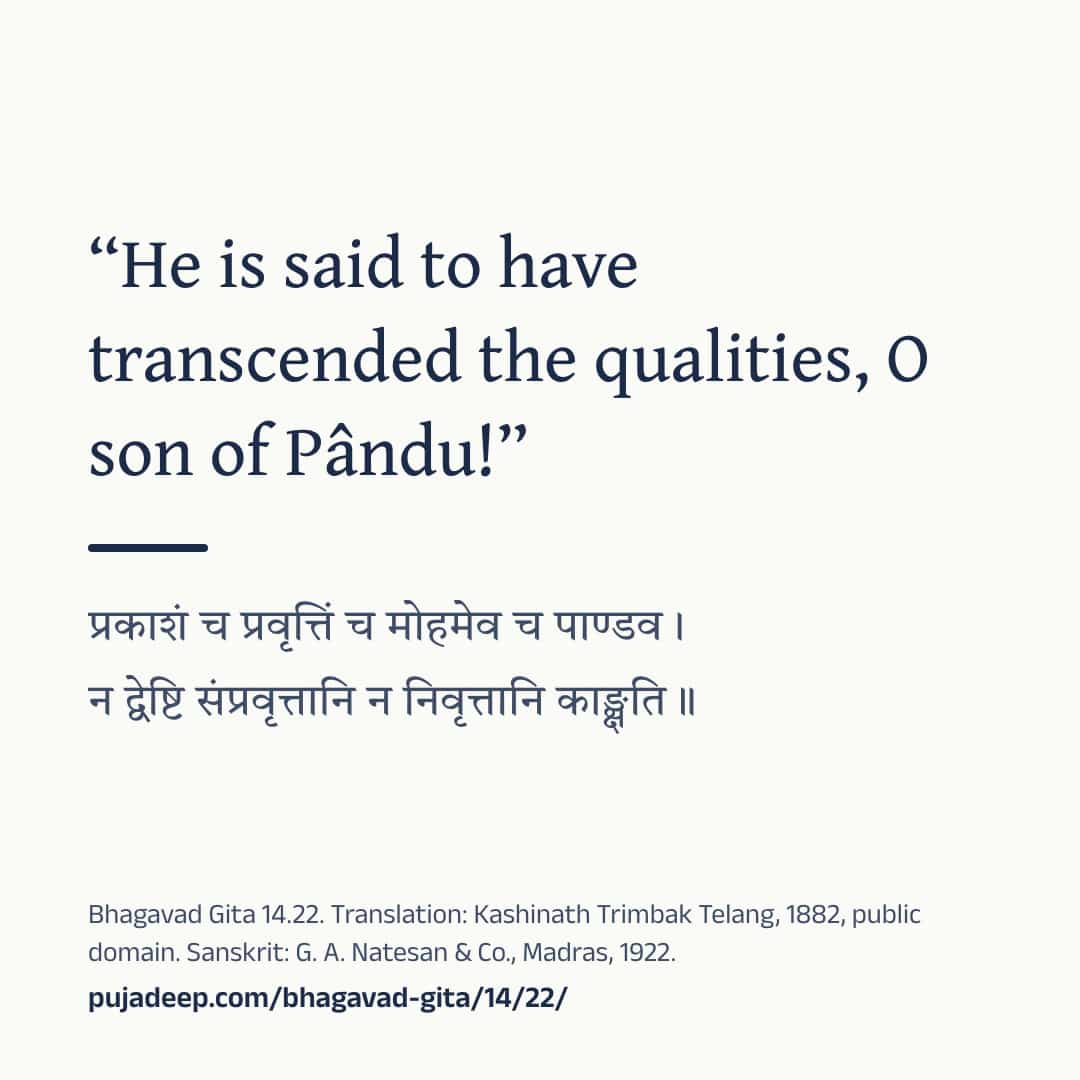
Drawing the picture
See the words
Bhagavad Gita 14.22

प्रकाशं च प्रवृत्तिं च मोहमेव च पाण्डव ।
न द्वेष्टि संप्रवृत्तानि न निवृत्तानि काङ्क्षति ॥

“He is said to have transcended the qualities, O son of Pându! who is not averse to light and activity and delusion (when they) prevail, and who does not desire (them when they) cease; who sitting like one unconcerned is never perturbed by the qualities; who remains steady and moves not, (thinking) merely that the qualities exist; who is self-contained; to whom pain and pleasure are alike; to whom a sod and a stone and gold are alike; to whom what is agreeable and what is disagreeable are alike; who has discernment; to whom censure and praise of himself are alike; who is alike in honour and dishonour; who is alike towards the sides of friends and foes; and who abandons all action.”
(K. T. Telang, The Bhagavadgîtâ (The Sacred Books of the East, vol. VIII, Oxford: Clarendon Press, 1882), p. 110, public domain)
This sentence covers verses 14.22 to 14.25.

“He who hateth not radiance, nor outgoing energy, nor even delusion, O Pândava, when present, nor longeth after them absent;”
(Annie Besant, The Bhagavad Gîtâ, or The Lord's Song (London: Theosophical Publishing Society, 1895), p. 133, public domain)
This sentence goes on in 14.23.

“He who hates not the appearance of light, (the effect of Satva), activity (the effect of Rajas), and delusion (the effect of Tamas), (in his own mind), O Pándava, nor longs for them when absent;”
(Swami Swarupananda, Srimad-Bhagavad-Gita (Mayavati: Prabuddha Bharata Press, 1909; first printed in Prabuddha Bharata, 1907–1909), p. 280, public domain)
This sentence goes on in 14.23.

Sanskrit: G. A. Natesan & Co., Madras, 1922.
https://pujadeep.com/bhagavad-gita/14/22/ Nothing is sent from this site. Your own app sends it, to the chat you choose. The picture quotes the translation you chose on this page, with its name and year.
Sanskrit text: The Bhagavad-Gita, or The Lord's Song, with the text in Devanagari and an English translation, 1922. Meanings: written for Pujadeep and checked against the cited edition. Source and changes
Questions families ask
Who speaks Bhagavad Gita 14.22?
Krishna speaks this verse, in chapter 14 (Gunatraya Vibhaga Yoga).
Where does the Sanskrit text come from?
Sanskrit text: The Bhagavad-Gita, or The Lord's Song, with the text in Devanagari and an English translation, 1922. Meanings: written for Pujadeep and checked against the cited edition. See the source
Is the meaning on this page a translation?
Explanation written for this site from the sources listed here, and checked against the cited edition. It is not a translation and not the only way to read the text. Free to quote with credit.
Source and licence
- Sanskrit text
- The Bhagavad-Gita, or The Lord's Song, with the text in Devanagari and an English translation (Annie Besant, G. A. Natesan & Co., Madras, 1922). Public domain. The Sanskrit on these pages was read from this printing’s page images.
- Translation
- The Bhagavadgîtâ with the Sanatsugâtîya and the Anugîtâ, translated by Kâshinâth Trimbak Telang (The Sacred Books of the East, vol. VIII, ed. F. Max Müller) (Kashinath Trimbak Telang, F. Max Müller, Clarendon Press, Oxford, 1882). Public domain. Shown verbatim, as printed.
- Translation
- The Bhagavad Gîtâ, or The Lord's Song, translated by Annie Besant (Annie Besant, Theosophical Publishing Society, London, 1895). Public domain. Shown verbatim, as printed.
- Translation
- Srimad-Bhagavad-Gita, with Sanskrit Text; Paraphrase with Word-by-word Literal Translation; English Rendering and Comments, Index, &c., by the Swami Swarupananda (Himalayan Series, No. XX) (Swami Swarupananda, The Editors and Publishers, Advaita Ashrama, Mayavati, Prabuddha Bharata Press, Mayavati, Almora, Himalayas, 1909). Public domain. Shown verbatim, as printed.
- Commentary
- The Bhagavad-Gita, with the commentary of Sri Sankaracharya, translated by A. Mahadeva Sastri (2nd ed., Mysore: G. T. A. Printing Works, 1901) (Public-domain scan, University of California Libraries). Summarised in our own words; none of its text is reproduced.
- Commentary
- Sri Bhagavad-Gita with Sri Ramanujacharya's Visishtadvaita commentary, translated by A. Govindacharya (Madras, 1898) (Scan uploaded to archive.org (folkscanomy collection)). Summarised in our own words; none of its text is reproduced.
- Common wording
- In this text, 32 words follow today's common wording, checked against sanskritdocuments.org; Sanskrit Wikisource; Gita Press, Gorakhpur; GRETIL, Göttingen and Bhaktivedanta Book Trust.
- Our explanation
- Explanation written for this site from the sources listed here, and checked against the cited edition. It is not a translation and not the only way to read the text. Free to quote with credit.
- Checked
- Checked against the cited edition, October 14, 2026.
- Updated
- October 25, 2026