Bhagavad Gita 14.24: meaning and translation
Chapter 14: Gunatraya Vibhaga Yoga. Krishna says
Krishna says such a person is the same in pain and pleasure and rests in himself; a lump of earth, a stone and gold are alike to him; he is the same towards the pleasant and the unpleasant; he is steady, and the same in blame and praise of himself.
Click or tap a word for its meaning and its dictionary page.
Text and layers
Text and layers
These choices stay in this browser.
Bhagavad Gita 14.24
समदुःखसुखः स्वस्थः समलोष्टाश्मकाञ्चनः ।तुल्यप्रियाप्रियो धीरस्तुल्यनिन्दात्मसंस्तुतिः ॥
Samaduhkhasukhah svasthah samaloshtashmakanchanahTulyapriyapriyo dhirastulyanindatmasanstutih
samaduḥkhasukhaḥ svasthaḥ samaloṣṭāśmakāñcanaḥ |tulyapriyāpriyo dhīrastulyanindātmasaṃstutiḥ ||
Our explanation Krishna says such a person is the same in pain and pleasure and rests in himself; a lump of earth, a stone and gold are alike to him; he is the same towards the pleasant and the unpleasant; he is steady, and the same in blame and praise of himself.
हिंदी अर्थ कृष्ण कहते हैं कि ऐसा व्यक्ति दुःख और सुख में समान रहता है और अपने में स्थित है; मिट्टी का ढेला, पत्थर और सोना उसके लिए एक समान हैं; प्रिय और अप्रिय में वह समान रहता है; वह धीर है, और अपनी निंदा और स्तुति में समान रहता है।
Word by word
Every word, with its dictionary page
Word by word
- समदुःखसुखः samaduḥkhasukhaḥ · the same in pain and pleasure (compound (masculine), nominative singular) Dictionary: 2. sama, Monier-Williams 1899, p. 1152, col. 1 “same, equal, similar, like, equivalent”; 1. duḥkha, Monier-Williams 1899, p. 483, col. 2 “uneasiness, pain, sorrow, trouble, difficulty”; sukha, Monier-Williams 1899, p. 1221, col. 1 “ease, easiness, comfort, prosperity, pleasure, happiness”
- स्वस्थः svasthaḥ · resting in himself (compound (masculine), nominative singular) Dictionary: sva-stha, Monier-Williams 1899, p. 1277, col. 1 “self-abiding”
- समलोष्टाश्मकाञ्चनः samaloṣṭāśmakāñcanaḥ · alike to clod, stone and gold (compound (masculine), nominative singular) Dictionary: 2. sama, Monier-Williams 1899, p. 1152, col. 1 “same, equal, similar, like, equivalent”; loṣṭa, Monier-Williams 1899, p. 908, col. 2 “a lump of earth or clay, clod”; 2. aśman, Monier-Williams 1899, p. 114, col. 1 “a stone, rock”; kāñcana, Monier-Williams 1899, p. 268, col. 2 “gold”
- तुल्यप्रियाप्रियः tulyapriyāpriyaḥ · the same to the pleasant and the unpleasant (compound (masculine), nominative singular) Dictionary: tulya, Monier-Williams 1899, p. 451, col. 3 “equal to, of the same kind or class or number or value, similar, comparable, like”; priya, Monier-Williams 1899, p. 710, col. 1 “beloved, dear to (gen., loc., dat. or comp.), liked, favourite”; a-priya, Monier-Williams 1899, p. 59, col. 2 “disagreeable, disliked”
- धीरः dhīraḥ · steady, wise (adjective (masculine), nominative singular) Dictionary: 1. dhīra, Monier-Williams 1899, p. 517, col. 1 “intelligent, wise, skilful, clever”; 2. dhīra, Monier-Williams 1899, p. 517, col. 1 “steady, constant, firm”
- तुल्यनिन्दात्मसंस्तुतिः tulyanindātmasaṃstutiḥ · the same in blame and praise of himself (compound (masculine), nominative singular) Dictionary: tulya, Monier-Williams 1899, p. 451, col. 3 “equal to, of the same kind or class or number or value, similar, comparable, like”; nindā, Monier-Williams 1899, p. 549, col. 2 “blame, censure, reproach, reviling”; ātman, Monier-Williams 1899, p. 135, col. 1 “the individual soul, self”; saṃ-stuti, Monier-Williams 1899, p. 1121, col. 1 “praise, eulogy”
Old translations
Kashinath Trimbak Telang, 1882. Public domain.
Telang translates verses 22–25 as one sentence; see 14.22. Read it at 14.22
Compare 3 translations
Kashinath Trimbak Telang, 1882. Public domain.
Telang translates verses 22–25 as one sentence; see 14.22. Read it at 14.22
You are reading this one
Annie Besant, 1895. Public domain. Page 133.
Balanced in pleasure and pain, self-reliant, to whom a lump of earth, a rock and gold are alike; the same to loved and unloved, firm, the same in censure and in praise,
This sentence begins in 14.22. This sentence goes on in 14.25.
You are reading this one
Swami Swarupananda, 1909 (first printed 1907). Public domain. Page 281.
Alike in pleasure and pain, Self-abiding, regarding a clod of earth, a stone or gold alike; the same to loved and unloved, firm, the same to censure and praise;
This sentence begins in 14.22. This sentence goes on in 14.25.
You are reading this one
Cite this verse
The translation: K. T. Telang, The Bhagavadgîtâ (The Sacred Books of the East, vol. VIII, Oxford: Clarendon Press, 1882), p. 110. Bhagavad Gita 14.22–25.
The translation: Annie Besant, The Bhagavad Gîtâ, or The Lord's Song (London: Theosophical Publishing Society, 1895), p. 133. Bhagavad Gita 14.24.
The translation: Swami Swarupananda, Srimad-Bhagavad-Gita (Mayavati: Prabuddha Bharata Press, 1909; first printed in Prabuddha Bharata, 1907–1909), p. 281. Bhagavad Gita 14.24.
Our explanation: “Bhagavad Gita 14.24: meaning and translation.” Pujadeep. Updated October 25, 2026. https://pujadeep.com/bhagavad-gita/14/24/
Pujadeep’s explanations are free to quote with credit: name Pujadeep and link to the page. How to credit
Classical readings, by school
No readings by school on this verse yet.
Share
Show the ways to share
Send one picture or the text to one chat. The picture names its source and the address of this page.
Drawing the picture
See the words
Bhagavad Gita 14.24

समदुःखसुखः स्वस्थः समलोष्टाश्मकाञ्चनः ।
तुल्यप्रियाप्रियो धीरस्तुल्यनिन्दात्मसंस्तुतिः ॥

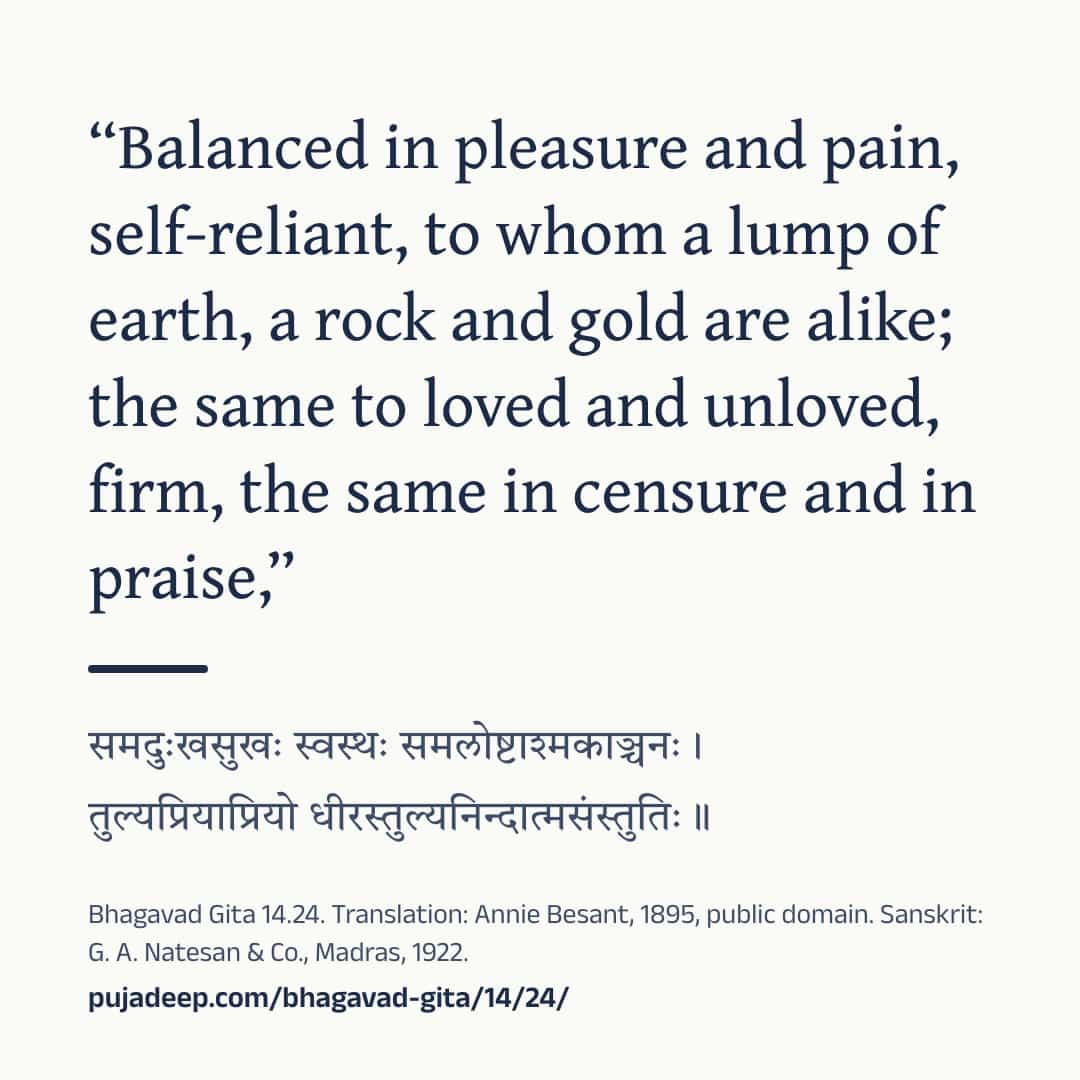
“Balanced in pleasure and pain, self-reliant, to whom a lump of earth, a rock and gold are alike; the same to loved and unloved, firm, the same in censure and in praise,”
(Annie Besant, The Bhagavad Gîtâ, or The Lord's Song (London: Theosophical Publishing Society, 1895), p. 133, public domain)
This sentence begins in 14.22. This sentence goes on in 14.25.

“Alike in pleasure and pain, Self-abiding, regarding a clod of earth, a stone or gold alike; the same to loved and unloved, firm, the same to censure and praise;”
(Swami Swarupananda, Srimad-Bhagavad-Gita (Mayavati: Prabuddha Bharata Press, 1909; first printed in Prabuddha Bharata, 1907–1909), p. 281, public domain)
This sentence begins in 14.22. This sentence goes on in 14.25.

Sanskrit: G. A. Natesan & Co., Madras, 1922.
https://pujadeep.com/bhagavad-gita/14/24/ Nothing is sent from this site. Your own app sends it, to the chat you choose. The picture quotes the translation you chose on this page, with its name and year.
Sanskrit text: The Bhagavad-Gita, or The Lord's Song, with the text in Devanagari and an English translation, 1922. Meanings: written for Pujadeep and checked against the cited edition. Source and changes
Questions families ask
Who speaks Bhagavad Gita 14.24?
Krishna speaks this verse, in chapter 14 (Gunatraya Vibhaga Yoga).
Where does the Sanskrit text come from?
Sanskrit text: The Bhagavad-Gita, or The Lord's Song, with the text in Devanagari and an English translation, 1922. Meanings: written for Pujadeep and checked against the cited edition. See the source
Is the meaning on this page a translation?
Explanation written for this site from the sources listed here, and checked against the cited edition. It is not a translation and not the only way to read the text. Free to quote with credit.
Source and licence
- Sanskrit text
- The Bhagavad-Gita, or The Lord's Song, with the text in Devanagari and an English translation (Annie Besant, G. A. Natesan & Co., Madras, 1922). Public domain. The Sanskrit on these pages was read from this printing’s page images.
- Translation
- The Bhagavadgîtâ with the Sanatsugâtîya and the Anugîtâ, translated by Kâshinâth Trimbak Telang (The Sacred Books of the East, vol. VIII, ed. F. Max Müller) (Kashinath Trimbak Telang, F. Max Müller, Clarendon Press, Oxford, 1882). Public domain. Shown verbatim, as printed.
- Translation
- The Bhagavad Gîtâ, or The Lord's Song, translated by Annie Besant (Annie Besant, Theosophical Publishing Society, London, 1895). Public domain. Shown verbatim, as printed.
- Translation
- Srimad-Bhagavad-Gita, with Sanskrit Text; Paraphrase with Word-by-word Literal Translation; English Rendering and Comments, Index, &c., by the Swami Swarupananda (Himalayan Series, No. XX) (Swami Swarupananda, The Editors and Publishers, Advaita Ashrama, Mayavati, Prabuddha Bharata Press, Mayavati, Almora, Himalayas, 1909). Public domain. Shown verbatim, as printed.
- Common wording
- In this text, 32 words follow today's common wording, checked against sanskritdocuments.org; Sanskrit Wikisource; Gita Press, Gorakhpur; GRETIL, Göttingen and Bhaktivedanta Book Trust.
- Our explanation
- Explanation written for this site from the sources listed here, and checked against the cited edition. It is not a translation and not the only way to read the text. Free to quote with credit.
- Checked
- Checked against the cited edition, October 14, 2026.
- Updated
- October 25, 2026