Bhagavad Gita 14.21: meaning and translation
Chapter 14: Gunatraya Vibhaga Yoga. Arjuna says
Arjuna asks three questions: by what signs is the one who has gone beyond the three guṇas known, how does such a person behave, and how does one go beyond them?
Click or tap a word for its meaning and its dictionary page.
Text and layers
Text and layers
These choices stay in this browser.
Bhagavad Gita 14.21
अर्जुन उवाच ।
कैर्लिङ्गैस्त्रीन्गुणानेतानतीतो भवति प्रभो ।किमाचारः कथं चैतांस्त्रीन्गुणानतिवर्तते ॥
Kairlingaistringunanetanatito bhavati prabhoKimacharah katham chaitanstringunanativartate
kairliṅgaistrīnguṇānetānatīto bhavati prabho |kimācāraḥ kathaṃ caitāṃstrīnguṇānativartate ||
Our explanation Arjuna asks three questions: by what signs is the one who has gone beyond the three guṇas known, how does such a person behave, and how does one go beyond them? Telang's note compares the answer with the person of steady wisdom in chapter 2.
हिंदी अर्थ अर्जुन तीन प्रश्न पूछते हैं: तीनों गुणों से परे गए व्यक्ति के क्या लक्षण हैं, उसका आचरण कैसा होता है, और वह इन गुणों से परे कैसे जाता है? तेलंग की टिप्पणी इसके उत्तर की तुलना अध्याय 2 के स्थितप्रज्ञ से करती है।
Word by word
Every word, with its dictionary page
Word by word
- कैः kaiḥ · by what (pronoun (neuter), instrumental plural) Dictionary: kim, Monier-Williams 1899, p. 282, col. 2 “what? how? whence? wherefore? why?”
- लिङ्गैः liṅgaiḥ · marks, signs (noun (neuter), instrumental plural) Dictionary: liṅga, Monier-Williams 1899, p. 901, col. 3 “a mark, spot, sign, token, badge, emblem, characteristic”
- त्रीन् trīn · three (numeral (masculine), accusative plural) Dictionary: tri, Monier-Williams 1899, p. 457, col. 3
- गुणान् guṇān · guṇas (noun (masculine), accusative plural) Dictionary: guṇa, Monier-Williams 1899, p. 357, col. 1 “(in Sāṃkhya phil.) an ingredient or constituent of Prakṛiti, chief quality of all existing beings”
- एतान् etān · these (pronoun (masculine), accusative plural) Dictionary: etad, Monier-Williams 1899, p. 231, col. 2 “this, this here, here”
- अतीतः atītaḥ · gone beyond (past participle (masculine), nominative singular) Dictionary: atīta, Monier-Williams 1899, p. 16, col. 2 “one who has gone through or got over or beyond”
- भवति bhavati · is (present, 3rd person singular) Dictionary: 1. bhū, Monier-Williams 1899, p. 760, col. 2 “arise, come into being, exist”
- प्रभो prabho · O Lord (noun (masculine), vocative singular) Dictionary: pra-bhu, Monier-Williams 1899, p. 684, col. 3 “a master, lord, king”
- किमाचारः kimācāraḥ · of what conduct (compound (masculine), nominative singular) Dictionary: kim, Monier-Williams 1899, p. 282, col. 2 “what? how? whence? wherefore? why?”; ā-cāra, Monier-Williams 1899, p. 131, col. 3 “conduct, manner of action, behaviour, good behaviour, good conduct”
- कथम् katham · how (indeclinable) Dictionary: katham, Monier-Williams 1899, p. 247, col. 2 “how? in what manner?”
- च ca · and (indeclinable) Dictionary: 2. ca, Monier-Williams 1899, p. 380, col. 1 “and, both, also, moreover, as well as”
- एतान् etān · these (pronoun (masculine), accusative plural) Dictionary: etad, Monier-Williams 1899, p. 231, col. 2 “this, this here, here”
- त्रीन् trīn · three (numeral (masculine), accusative plural) Dictionary: tri, Monier-Williams 1899, p. 457, col. 3
- गुणान् guṇān · guṇas (noun (masculine), accusative plural) Dictionary: guṇa, Monier-Williams 1899, p. 357, col. 1 “(in Sāṃkhya phil.) an ingredient or constituent of Prakṛiti, chief quality of all existing beings”
- अतिवर्तते ativartate · goes beyond (present, 3rd person singular) Dictionary: ati-vṛt, Monier-Williams 1899, p. 15, col. 3 “to pass beyond, surpass, cross; to get over, overcome”
Old translations
Kashinath Trimbak Telang, 1882. Public domain. Page 109.
Arguna said:
What are the characteristics, O lord! of one who has transcended these three qualities? What is his conduct, and how does he transcend these three qualities1?
Footnotes (the translator’s own) - Cf. as to what follows what is said in chapter II about 'one whose mind is steady.' ↩
Compare 3 translations
Kashinath Trimbak Telang, 1882. Public domain. Page 109.
Arguna said:
What are the characteristics, O lord! of one who has transcended these three qualities? What is his conduct, and how does he transcend these three qualities1?
Footnotes (the translator’s own) - Cf. as to what follows what is said in chapter II about 'one whose mind is steady.' ↩
You are reading this one
Annie Besant, 1895. Public domain. Page 132–133.
Arjuna said:
What are the marks of him who hath crossed over the three Gunas, O Lord? How acteth he, and how doth he go beyond these three Gunas?
You are reading this one
Swami Swarupananda, 1909 (first printed 1907). Public domain. Page 279.
Arjuna said:
By what marks, O Lord, is he (known) who has crossed beyond these three Gunas? What is his conduct, and how does he pass beyond these three Gunas?
You are reading this one
Cite this verse
The translation: K. T. Telang, The Bhagavadgîtâ (The Sacred Books of the East, vol. VIII, Oxford: Clarendon Press, 1882), p. 109. Bhagavad Gita 14.21.
The translation: Annie Besant, The Bhagavad Gîtâ, or The Lord's Song (London: Theosophical Publishing Society, 1895), pp. 132–133. Bhagavad Gita 14.21.
The translation: Swami Swarupananda, Srimad-Bhagavad-Gita (Mayavati: Prabuddha Bharata Press, 1909; first printed in Prabuddha Bharata, 1907–1909), p. 279. Bhagavad Gita 14.21.
Our explanation: “Bhagavad Gita 14.21: meaning and translation.” Pujadeep. Updated October 25, 2026. https://pujadeep.com/bhagavad-gita/14/21/
Pujadeep’s explanations are free to quote with credit: name Pujadeep and link to the page. How to credit
Classical readings, by school
No readings by school on this verse yet.
Share
Show the ways to share
Send one picture or the text to one chat. The picture names its source and the address of this page.
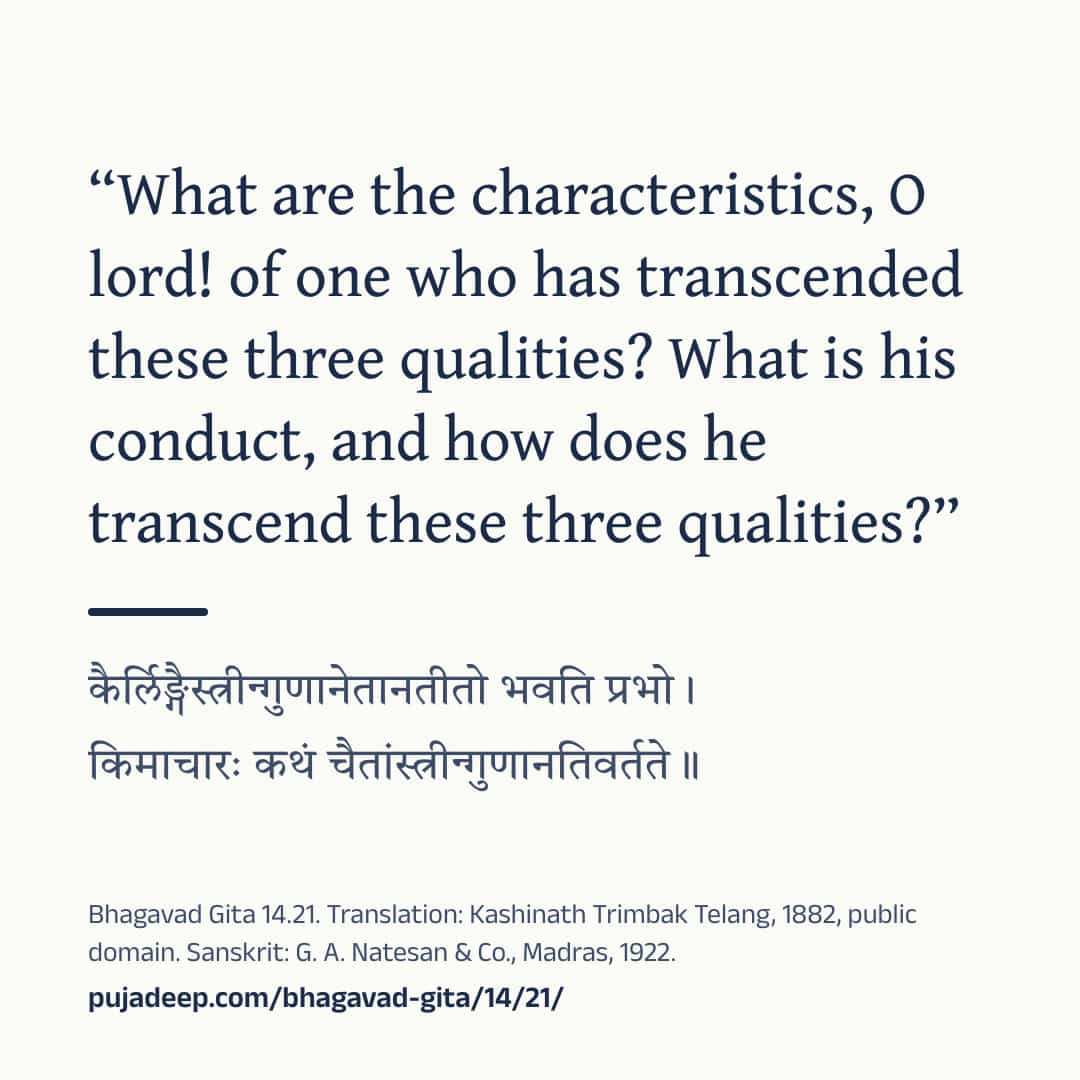
Drawing the picture
See the words
Bhagavad Gita 14.21

कैर्लिङ्गैस्त्रीन्गुणानेतानतीतो भवति प्रभो ।
किमाचारः कथं चैतांस्त्रीन्गुणानतिवर्तते ॥

“What are the characteristics, O lord! of one who has transcended these three qualities? What is his conduct, and how does he transcend these three qualities?”
(K. T. Telang, The Bhagavadgîtâ (The Sacred Books of the East, vol. VIII, Oxford: Clarendon Press, 1882), p. 109, public domain)

“What are the marks of him who hath crossed over the three Gunas, O Lord? How acteth he, and how doth he go beyond these three Gunas?”
(Annie Besant, The Bhagavad Gîtâ, or The Lord's Song (London: Theosophical Publishing Society, 1895), pp. 132–133, public domain)

“By what marks, O Lord, is he (known) who has crossed beyond these three Gunas? What is his conduct, and how does he pass beyond these three Gunas?”
(Swami Swarupananda, Srimad-Bhagavad-Gita (Mayavati: Prabuddha Bharata Press, 1909; first printed in Prabuddha Bharata, 1907–1909), p. 279, public domain)

Sanskrit: G. A. Natesan & Co., Madras, 1922.
https://pujadeep.com/bhagavad-gita/14/21/ Nothing is sent from this site. Your own app sends it, to the chat you choose. The picture quotes the translation you chose on this page, with its name and year.
Sanskrit text: The Bhagavad-Gita, or The Lord's Song, with the text in Devanagari and an English translation, 1922. Meanings: written for Pujadeep and checked against the cited edition. Source and changes
Questions families ask
Who speaks Bhagavad Gita 14.21?
Arjuna speaks this verse, in chapter 14 (Gunatraya Vibhaga Yoga).
Where does the Sanskrit text come from?
Sanskrit text: The Bhagavad-Gita, or The Lord's Song, with the text in Devanagari and an English translation, 1922. Meanings: written for Pujadeep and checked against the cited edition. See the source
Is the meaning on this page a translation?
Explanation written for this site from the sources listed here, and checked against the cited edition. It is not a translation and not the only way to read the text. Free to quote with credit.
Source and licence
- Sanskrit text
- The Bhagavad-Gita, or The Lord's Song, with the text in Devanagari and an English translation (Annie Besant, G. A. Natesan & Co., Madras, 1922). Public domain. The Sanskrit on these pages was read from this printing’s page images.
- Translation
- The Bhagavadgîtâ with the Sanatsugâtîya and the Anugîtâ, translated by Kâshinâth Trimbak Telang (The Sacred Books of the East, vol. VIII, ed. F. Max Müller) (Kashinath Trimbak Telang, F. Max Müller, Clarendon Press, Oxford, 1882). Public domain. Shown verbatim, as printed.
- Translation
- The Bhagavad Gîtâ, or The Lord's Song, translated by Annie Besant (Annie Besant, Theosophical Publishing Society, London, 1895). Public domain. Shown verbatim, as printed.
- Translation
- Srimad-Bhagavad-Gita, with Sanskrit Text; Paraphrase with Word-by-word Literal Translation; English Rendering and Comments, Index, &c., by the Swami Swarupananda (Himalayan Series, No. XX) (Swami Swarupananda, The Editors and Publishers, Advaita Ashrama, Mayavati, Prabuddha Bharata Press, Mayavati, Almora, Himalayas, 1909). Public domain. Shown verbatim, as printed.
- Common wording
- In this text, 32 words follow today's common wording, checked against sanskritdocuments.org; Sanskrit Wikisource; Gita Press, Gorakhpur; GRETIL, Göttingen and Bhaktivedanta Book Trust.
- Our explanation
- Explanation written for this site from the sources listed here, and checked against the cited edition. It is not a translation and not the only way to read the text. Free to quote with credit.
- Checked
- Checked against the cited edition, October 14, 2026.
- Updated
- October 25, 2026