भगवद्गीता 14.5: अर्थ और अनुवाद
अध्याय 14: गुणत्रयविभागयोग। कृष्ण कहते हैं
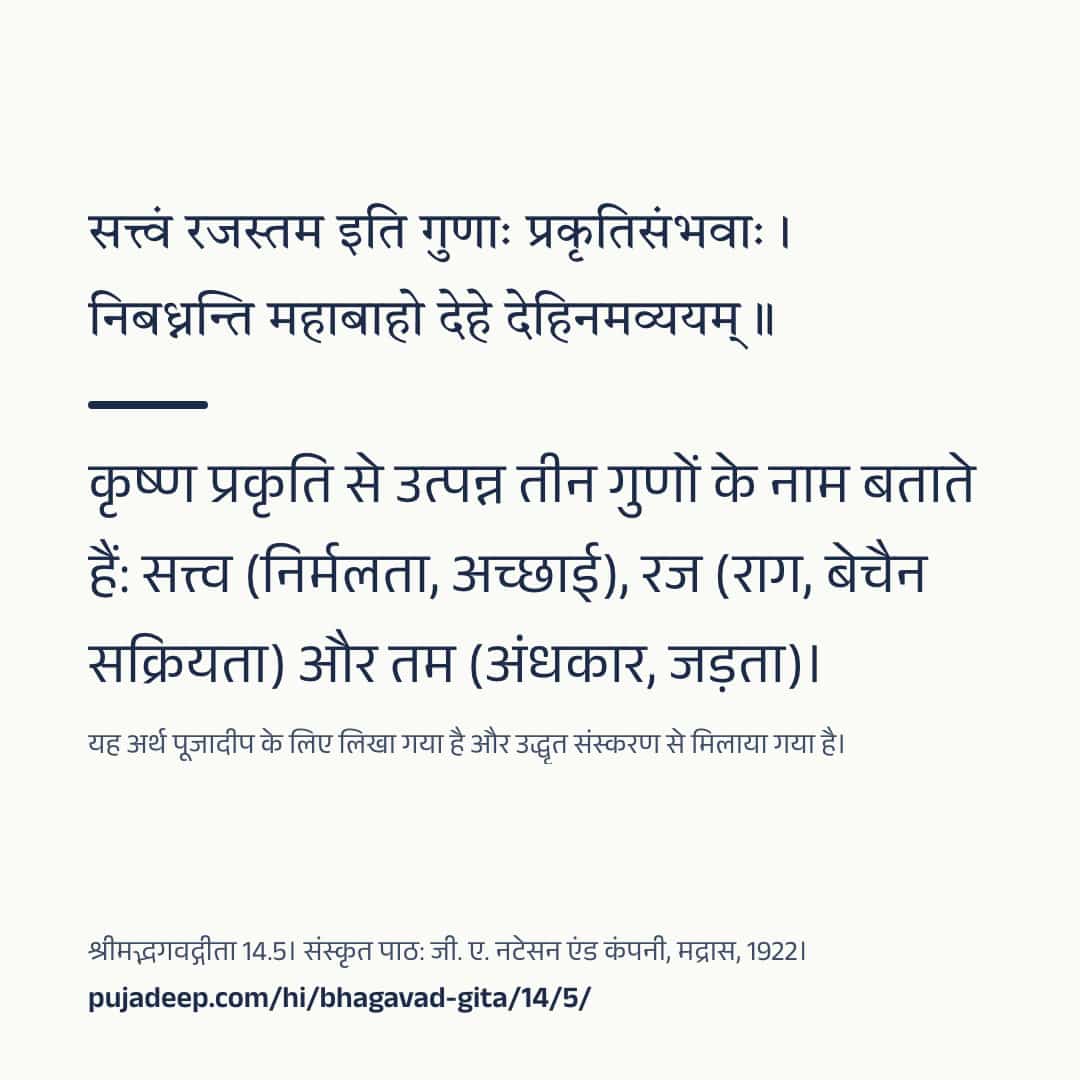
श्रीमद्भगवद्गीता (Bhagavad Gita) 14.5: कृष्ण प्रकृति से उत्पन्न तीन गुणों के नाम बताते हैं: सत्त्व (निर्मलता, अच्छाई), रज (राग, बेचैन सक्रियता) और तम (अंधकार, जड़ता)।
किसी शब्द पर क्लिक करें या उसे छुएँ, उसका अर्थ और कोश का पृष्ठ देखें।
दिखावट
दिखावट
ये चुनाव इसी ब्राउज़र में रहते हैं।
श्रीमद्भगवद्गीता 14.5
सत्त्वं रजस्तम इति गुणाः प्रकृतिसंभवाः ।निबध्नन्ति महाबाहो देहे देहिनमव्ययम् ॥
Sattvam rajastama iti gunah prakritisambhavahNibadhnanti mahabaho dehe dehinamavyayam
sattvaṃ rajastama iti guṇāḥ prakṛtisaṃbhavāḥ |nibadhnanti mahābāho dehe dehinamavyayam ||
भावार्थ कृष्ण प्रकृति से उत्पन्न तीन गुणों के नाम बताते हैं: सत्त्व (निर्मलता, अच्छाई), रज (राग, बेचैन सक्रियता) और तम (अंधकार, जड़ता)। वे कहते हैं कि ये अविनाशी देही (शरीर में रहने वाले) को शरीर में बाँधते हैं। बेसेंट संस्कृत नाम रखती हैं; तेलंग इनका अनुवाद goodness, passion और darkness करते हैं। गुण कैसे बाँधते हैं, इसे परंपराएँ अलग ढंग से समझाती हैं।
English meaning Krishna names the three guṇas that arise from nature: sattva (clarity, goodness), rajas (passion, restless activity) and tamas (darkness, inertia). He says they bind the unchanging embodied self in the body. Besant keeps the Sanskrit names; Telang translates them as goodness, passion and darkness. The schools explain how the guṇas bind (see the views).
शब्दार्थ
हर शब्द, शब्दकोश के पृष्ठ के साथ
शब्दार्थ
- सत्त्वम् sattvam · सत्त्व (सत्त्वगुण) (संज्ञा (नपुंसकलिंग), प्रथमा एकवचन) शब्दकोश: sat-tva, मोनियर-विलियम्स 1899, पृ. 1135, स्तंभ 2
the quality of purity or goodness
- रजः rajaḥ · रजस् (रजोगुण) (संज्ञा (नपुंसकलिंग), प्रथमा एकवचन) शब्दकोश: rajas, मोनियर-विलियम्स 1899, पृ. 863, स्तंभ 2
the ‘darkening’ quality, passion, emotion, affection
- तमः tamaḥ · तमस् (तमोगुण) (संज्ञा (नपुंसकलिंग), प्रथमा एकवचन) शब्दकोश: tamas, मोनियर-विलियम्स 1899, पृ. 438, स्तंभ 1
one of the 3 qualities or constituents of everything in creation
- इति iti · ये, इस प्रकार (अव्यय) शब्दकोश: 2. iti, मोनियर-विलियम्स 1899, पृ. 165, स्तंभ 1
in this manner, thus
- गुणाः guṇāḥ · गुण (संज्ञा (पुंलिंग), प्रथमा बहुवचन) शब्दकोश: guṇa, मोनियर-विलियम्स 1899, पृ. 357, स्तंभ 1
(in Sāṃkhya phil.) an ingredient or constituent of Prakṛiti, chief quality of all existing beings
- प्रकृतिसंभवाः prakṛtisaṃbhavāḥ · प्रकृति से उत्पन्न (समास (पुंलिंग), प्रथमा बहुवचन) शब्दकोश: pra-kṛti, मोनियर-विलियम्स 1899, पृ. 654, स्तंभ 1
nature, character, constitution, temper, disposition
; sam-bhava, मोनियर-विलियम्स 1899, पृ. 1179, स्तंभ 1birth, production, origin, source
- निबध्नन्ति nibadhnanti · बाँधते हैं (वर्तमान काल (लट्), प्रथम पुरुष बहुवचन) शब्दकोश: ni-bandh, मोनियर-विलियम्स 1899, पृ. 550, स्तंभ 1
to enchain, fetter (lit. and fig.)
- महाबाहो mahābāho · हे महाबाहु (समास (पुंलिंग), संबोधन एकवचन) शब्दकोश: mahā-bāhu, मोनियर-विलियम्स 1899, पृ. 798, स्तंभ 1
long-armed
- देहे dehe · शरीर में (संज्ञा (पुंलिंग), सप्तमी एकवचन) शब्दकोश: deha, मोनियर-विलियम्स 1899, पृ. 496, स्तंभ 3
the body
- देहिनम् dehinam · देही (शरीरधारी आत्मा) को (संज्ञा (पुंलिंग), द्वितीया एकवचन) शब्दकोश: dehin, मोनियर-विलियम्स 1899, पृ. 497, स्तंभ 1
having a body, corporeal
- अव्ययम् avyayam · अविनाशी (विशेषण (पुंलिंग), द्वितीया एकवचन) शब्दकोश: 2. a-vyaya, मोनियर-विलियम्स 1899, पृ. 111, स्तंभ 3
not liable to change, imperishable, undecaying
1 छपाई में पाठभेद
संस्करणों के अंतर। कोई दूसरा मुद्रण या पाठ इस स्थान को अलग ढंग से पढ़ता है।
- वर्तनी एक डिजिटल प्रति में पाठ है शब्द वही है। यह डिजिटल प्रति वर्ग का पंचमाक्षर लिखती है (प्रकृतिसम्भवाः); 1922 का संस्करण अनुस्वार लिखता है (प्रकृतिसंभवाः)।
पुराने अंग्रेज़ी अनुवाद
Kashinath Trimbak Telang, 1882। सार्वजनिक डोमेन (कॉपीराइट-मुक्त)। पृष्ठ 107।
Goodness, passion, darkness, these qualities1 born from nature, O you of mighty arms! bind down the inexhaustible soul in the body.
पाद-टिप्पणियाँ (अनुवादक की अपनी) - These constitute nature. We must understand nature, with Professor Bhândârkar, as the hypothetical cause of the soul's feeling itself limited and conditioned. If nature is understood, as it usually is, to mean matter, its being made up of the qualities is inexplicable. Interpreted idealistically, as suggested by Professor Bhândârkar, the destruction of it spoken of at the close of the last chapter also becomes intelligible. By means of knowledge of the soul, the unreality of these manifestations is understood and nature is destroyed. ↩
3 अनुवादों की तुलना करें
Kashinath Trimbak Telang, 1882। सार्वजनिक डोमेन (कॉपीराइट-मुक्त)। पृष्ठ 107।
Goodness, passion, darkness, these qualities1 born from nature, O you of mighty arms! bind down the inexhaustible soul in the body.
पाद-टिप्पणियाँ (अनुवादक की अपनी) - These constitute nature. We must understand nature, with Professor Bhândârkar, as the hypothetical cause of the soul's feeling itself limited and conditioned. If nature is understood, as it usually is, to mean matter, its being made up of the qualities is inexplicable. Interpreted idealistically, as suggested by Professor Bhândârkar, the destruction of it spoken of at the close of the last chapter also becomes intelligible. By means of knowledge of the soul, the unreality of these manifestations is understood and nature is destroyed. ↩
आप यही पढ़ रहे हैं
Annie Besant, 1895। सार्वजनिक डोमेन (कॉपीराइट-मुक्त)। पृष्ठ 130।
Sattva, Rajas, Tamas, such are the Gunas; Prakriti-born they bind fast in the body, O great-armed one, the indestructible Dweller in the body.
आप यही पढ़ रहे हैं
Swami Swarupananda, 1909 (पहली बार 1907 में छपा)। सार्वजनिक डोमेन (कॉपीराइट-मुक्त)। पृष्ठ 272।
Satva, Rajas, Tamas,—these Gunas, O mighty-armed, born of Prakriti, bind fast the indestructible embodied in the body.
आप यही पढ़ रहे हैं
इस श्लोक का हवाला दें
अनुवाद: K. T. Telang, The Bhagavadgîtâ (The Sacred Books of the East, vol. VIII, Oxford: Clarendon Press, 1882), पृष्ठ 107। भगवद्गीता 14.5।
अनुवाद: Annie Besant, The Bhagavad Gîtâ, or The Lord's Song (London: Theosophical Publishing Society, 1895), पृष्ठ 130। भगवद्गीता 14.5।
अनुवाद: Swami Swarupananda, Srimad-Bhagavad-Gita (Mayavati: Prabuddha Bharata Press, 1909; first printed in Prabuddha Bharata, 1907–1909), पृष्ठ 272। भगवद्गीता 14.5।
हमारी व्याख्या: “भगवद्गीता 14.5: अर्थ और अनुवाद”। पूजादीप। अद्यतन 25 अक्टूबर 2026। https://pujadeep.com/hi/bhagavad-gita/14/5/
पूजादीप की व्याख्याएँ श्रेय देकर उद्धृत की जा सकती हैं: पूजादीप का नाम और पृष्ठ का लिंक दें। श्रेय कैसे दें
शास्त्रीय व्याख्याएँ, संप्रदाय के अनुसार
हर व्याख्या अपने संप्रदाय के नाम से दी गई है। कोई भी एकमात्र अर्थ के रूप में प्रस्तुत नहीं है।
अद्वैत, विशिष्टाद्वैत और द्वैत क्या सिखाते हैं, संक्षेप में
शंकराचार्य अद्वैत
शंकराचार्य कहते हैं कि यहाँ “गुण” एक पारिभाषिक शब्द है, किसी वस्तु में रहने वाला धर्म नहीं। गुण अविद्या के रूप हैं जो क्षेत्रज्ञ पर आश्रित हैं, और वे आत्मा को केवल “मानो” बाँधते हैं, क्योंकि 13.31 कहता है कि आत्मा कभी लिप्त नहीं होता।
स्रोत: The Bhagavad-Gita, with the commentary of Sri Sankaracharya, translated by A. Mahadeva Sastri (2nd ed., Mysore: G. T. A. Printing Works, 1901), commentary on 14.5, pp. 342–343. हमारे अपने शब्दों में सार; इसका कोई पाठ उद्धृत नहीं किया गया।
रामानुजाचार्य विशिष्टाद्वैत
रामानुजाचार्य कहते हैं कि गुण प्रकृति के वास्तविक गुण हैं, जो अव्यक्त प्रकृति में छिपे रहते हैं और उससे विकसित वस्तुओं में प्रकट होते हैं। वे स्वभाव से मुक्त जीवात्मा को देवता, मनुष्य आदि के शरीरों में बाँध देते हैं।
स्रोत: Sri Bhagavad-Gita with Sri Ramanujacharya's Visishtadvaita commentary, translated by A. Govindacharya (Madras, 1898), commentary on 14.5, p. 446. हमारे अपने शब्दों में सार; इसका कोई पाठ उद्धृत नहीं किया गया।
भेजें
साझा करने के तरीके दिखाएँ
एक तस्वीर या पाठ एक चैट में भेजें। तस्वीर पर उसका स्रोत और इस पृष्ठ का पता लिखा है।
तस्वीर बन रही है
शब्द देखें
श्रीमद्भगवद्गीता 14.5

सत्त्वं रजस्तम इति गुणाः प्रकृतिसंभवाः ।
निबध्नन्ति महाबाहो देहे देहिनमव्ययम् ॥

“Goodness, passion, darkness, these qualities born from nature, O you of mighty arms! bind down the inexhaustible soul in the body.”
(K. T. Telang, The Bhagavadgîtâ (The Sacred Books of the East, vol. VIII, Oxford: Clarendon Press, 1882), p. 107, public domain)

“Sattva, Rajas, Tamas, such are the Gunas; Prakriti-born they bind fast in the body, O great-armed one, the indestructible Dweller in the body.”
(Annie Besant, The Bhagavad Gîtâ, or The Lord's Song (London: Theosophical Publishing Society, 1895), p. 130, public domain)

“Satva, Rajas, Tamas,—these Gunas, O mighty-armed, born of Prakriti, bind fast the indestructible embodied in the body.”
(Swami Swarupananda, Srimad-Bhagavad-Gita (Mayavati: Prabuddha Bharata Press, 1909; first printed in Prabuddha Bharata, 1907–1909), p. 272, public domain)

संस्कृत पाठ: जी. ए. नटेसन एंड कंपनी, मद्रास, 1922।
https://pujadeep.com/hi/bhagavad-gita/14/5/
इस साइट से कुछ नहीं भेजा जाता। आपका अपना ऐप उसे आपकी चुनी हुई चैट में भेजता है। तस्वीर में वही अनुवाद है जो आपने इस पृष्ठ पर चुना है, उसके नाम और वर्ष के साथ।
संस्कृत पाठ: 1922 का मद्रास मुद्रण। अर्थ: पूजादीप के लिए लिखे और जाँचे गए। स्रोत और बदलाव
परिवारों के प्रश्न
गीता 14.5 कौन कहता है?
यह श्लोक कृष्ण कहते हैं, अध्याय 14 (गुणत्रयविभागयोग) में।
संस्कृत पाठ कहाँ से लिया गया है?
संस्कृत पाठ: 1922 का मद्रास मुद्रण। अर्थ: पूजादीप के लिए लिखे और जाँचे गए। स्रोत देखें
क्या इस पृष्ठ का अर्थ अनुवाद है?
इस साइट के लिए यहाँ दिए स्रोतों के आधार पर लिखी और उद्धृत संस्करण से मिलाई गई व्याख्या। यह अनुवाद नहीं है, और पाठ को पढ़ने का एकमात्र तरीका भी नहीं है। श्रेय देकर आप इसे उद्धृत कर सकते हैं।
स्रोत और लाइसेंस
- संस्कृत पाठ
- The Bhagavad-Gita, or The Lord's Song, with the text in Devanagari and an English translation (Annie Besant, G. A. Natesan & Co., Madras, 1922). सार्वजनिक डोमेन (कॉपीराइट-मुक्त)। इन पृष्ठों का संस्कृत पाठ इसी मुद्रण के पृष्ठ-चित्रों से पढ़ा गया है।
- अनुवाद
- The Bhagavadgîtâ with the Sanatsugâtîya and the Anugîtâ, translated by Kâshinâth Trimbak Telang (The Sacred Books of the East, vol. VIII, ed. F. Max Müller) (Kashinath Trimbak Telang, F. Max Müller, Clarendon Press, Oxford, 1882). सार्वजनिक डोमेन (कॉपीराइट-मुक्त)। जैसा छपा है, वैसा ही दिखाया गया।
- अनुवाद
- The Bhagavad Gîtâ, or The Lord's Song, translated by Annie Besant (Annie Besant, Theosophical Publishing Society, London, 1895). सार्वजनिक डोमेन (कॉपीराइट-मुक्त)। जैसा छपा है, वैसा ही दिखाया गया।
- अनुवाद
- Srimad-Bhagavad-Gita, with Sanskrit Text; Paraphrase with Word-by-word Literal Translation; English Rendering and Comments, Index, &c., by the Swami Swarupananda (Himalayan Series, No. XX) (Swami Swarupananda, The Editors and Publishers, Advaita Ashrama, Mayavati, Prabuddha Bharata Press, Mayavati, Almora, Himalayas, 1909). सार्वजनिक डोमेन (कॉपीराइट-मुक्त)। जैसा छपा है, वैसा ही दिखाया गया।
- भाष्य
- The Bhagavad-Gita, with the commentary of Sri Sankaracharya, translated by A. Mahadeva Sastri (2nd ed., Mysore: G. T. A. Printing Works, 1901) (Public-domain scan, University of California Libraries). हमारे अपने शब्दों में सार; इसका कोई पाठ उद्धृत नहीं किया गया।
- भाष्य
- Sri Bhagavad-Gita with Sri Ramanujacharya's Visishtadvaita commentary, translated by A. Govindacharya (Madras, 1898) (Scan uploaded to archive.org (folkscanomy collection)). हमारे अपने शब्दों में सार; इसका कोई पाठ उद्धृत नहीं किया गया।
- प्रचलित पाठ
- इस पाठ में 32 शब्द आज के प्रचलित रूप में हैं; इन्हें sanskritdocuments.org; संस्कृत विकिस्रोत; गीता प्रेस, गोरखपुर; ग्रेटिल, गॉटिंगेन और भक्तिवेदांत बुक ट्रस्ट के पाठ से मिलाकर जाँचा गया।
- हमारी व्याख्या
- इस साइट के लिए यहाँ दिए स्रोतों के आधार पर लिखी और उद्धृत संस्करण से मिलाई गई व्याख्या। यह अनुवाद नहीं है, और पाठ को पढ़ने का एकमात्र तरीका भी नहीं है। श्रेय देकर आप इसे उद्धृत कर सकते हैं।
- जाँच
- उद्धृत संस्करण से मिलाया गया, 14 अक्टूबर 2026।
- अद्यतन
- 25 अक्टूबर 2026