Bhagavad Gita 15.2: meaning and translation
Chapter 15: Purushottama Yoga. Krishna says
Its branches spread below and above, Krishna says, fed by the guṇas, with the objects of the senses as their young shoots.
Click or tap a word for its meaning and its dictionary page.
Text and layers
Text and layers
These choices stay in this browser.
Bhagavad Gita 15.2
अधश्चोर्ध्वं प्रसृतास्तस्य शाखाः गुणप्रवृद्धा विषयप्रवालाः ।अधश्च मूलान्यनुसन्ततानि कर्मानुबन्धीनि मनुष्यलोके ॥
Adhashchordhvam prasritastasya shakhah gunapravriddha vishayapravalahAdhashcha mulanyanusantatani karmanubandhini manushyaloke
adhaścordhvaṃ prasṛtāstasya śākhāḥ guṇapravṛddhā viṣayapravālāḥ |adhaśca mūlānyanusantatāni karmānubandhīni manuṣyaloke ||
Our explanation Its branches spread below and above, Krishna says, fed by the guṇas, with the objects of the senses as their young shoots. Below, in the human world, its roots stretch out and bind people to action.
हिंदी अर्थ कृष्ण कहते हैं कि इसकी शाखाएँ नीचे और ऊपर फैली हैं, गुणों से पोषित हैं, और इंद्रियों के विषय इसकी कोंपलें हैं। नीचे, मनुष्य-लोक में, इसकी जड़ें फैली हैं, जो मनुष्य को कर्म से बाँधती हैं।
Word by word
Every word, with its dictionary page
Word by word
- अधः adhaḥ · below (indeclinable) Dictionary: adhas, Monier-Williams 1899, p. 20, col. 1 “below, down; in the lower region; beneath, under”
- च ca · and (indeclinable) Dictionary: 2. ca, Monier-Williams 1899, p. 380, col. 1 “and, both, also, moreover, as well as”
- ऊर्ध्वम् ūrdhvam · above (adverb) Dictionary: ūrdhva, Monier-Williams 1899, p. 222, col. 1 “rising or tending upwards, raised, elevated, erected, erect, upright, high, above”
- प्रसृताः prasṛtāḥ · spread out (past participle, nominative plural) Dictionary: pra-sṛta, Monier-Williams 1899, p. 698, col. 2 “wide-spreading”
- तस्य tasya · its (pronoun, genitive singular) Dictionary: tad, Monier-Williams 1899, p. 434, col. 1 “m. he, f. she, n. it, that, this”
- शाखाः śākhāḥ · branches (nominative plural) Dictionary: śākhā, Monier-Williams 1899, p. 1062, col. 3 “a branch (lit. and fig.)”
- गुणप्रवृद्धाः guṇapravṛddhāḥ · grown by the guṇas (compound, nominative plural) Dictionary: guṇa, Monier-Williams 1899, p. 357, col. 1 “a quality, peculiarity, attribute or property”; pra-vṛddha, Monier-Williams 1899, p. 694, col. 1 “grown up, fully developed, increased, augmented”
- विषयप्रवालाः viṣayapravālāḥ · with sense objects as shoots (compound, nominative plural) Dictionary: viṣaya, Monier-Williams 1899, p. 997, col. 1 “an object of sense”; pra-vāla, Monier-Williams 1899, p. 691, col. 3 “a young shoot, sprout, new leaf or branch”
- अधः adhaḥ · below (indeclinable) Dictionary: adhas, Monier-Williams 1899, p. 20, col. 1 “below, down; in the lower region; beneath, under”
- च ca · and (indeclinable) Dictionary: 2. ca, Monier-Williams 1899, p. 380, col. 1 “and, both, also, moreover, as well as”
- मूलानि mūlāni · roots (nominative plural) Dictionary: mūla, Monier-Williams 1899, p. 826, col. 2 “a root (of any plant or tree)”
- अनुसन्ततानि anusantatāni · stretched out, spread along (past participle, nominative plural) Dictionary: anu-saṃ-tan, Monier-Williams 1899, p. 40, col. 3 “to overspread, diffuse, extend everywhere; to join on, continue”
- कर्मानुबन्धीनि karmānubandhīni · binding to action (compound, nominative plural) Dictionary: karman, Monier-Williams 1899, p. 258, col. 2 “act, action, performance, business”; anu-bandhin, Monier-Williams 1899, p. 36, col. 2 “connected with, attached; having in its train or as a consequence, resulting”
- मनुष्यलोके manuṣyaloke · in the world of humans (compound, locative singular) Dictionary: manuṣya-loka, Monier-Williams 1899, p. 785, col. 1 “the world of men”
1 printing differs
Edition differences. Another printing or text reads this place differently.
- Spelling A digital text reads Same words. The 1922 edition prints the visarga at the end of the first quarter (शाखाः, at the end of the printed line); the e-text, and another digital text, write शाखा in sandhi with गुण….
Old translations
Kashinath Trimbak Telang, 1882. Public domain. Page 111.
Upwards and downwards extend its branches, which are enlarged by the qualities, and the sprouts of which are sensuous objects. And downwards to this human world are continued its roots which lead on to action.
Compare 3 translations
Kashinath Trimbak Telang, 1882. Public domain. Page 111.
Upwards and downwards extend its branches, which are enlarged by the qualities, and the sprouts of which are sensuous objects. And downwards to this human world are continued its roots which lead on to action.
You are reading this one
Annie Besant, 1895. Public domain. Page 135.
Downwards and upwards spread the branches of it, nourished by the Gunas, the objects of the senses its buds; and its roots grow downwards, the bonds of action in the world of men.
You are reading this one
Swami Swarupananda, 1909 (first printed 1907). Public domain. Page 284.
Below and above spread its branches, nourished by the Gunas; sense-objects are its buds; and below in the world of man stretch forth the roots, orginating action.
You are reading this one
Cite this verse
The translation: K. T. Telang, The Bhagavadgîtâ (The Sacred Books of the East, vol. VIII, Oxford: Clarendon Press, 1882), p. 111. Bhagavad Gita 15.2.
The translation: Annie Besant, The Bhagavad Gîtâ, or The Lord's Song (London: Theosophical Publishing Society, 1895), p. 135. Bhagavad Gita 15.2.
The translation: Swami Swarupananda, Srimad-Bhagavad-Gita (Mayavati: Prabuddha Bharata Press, 1909; first printed in Prabuddha Bharata, 1907–1909), p. 284. Bhagavad Gita 15.2.
Our explanation: “Bhagavad Gita 15.2: meaning and translation.” Pujadeep. Updated October 25, 2026. https://pujadeep.com/bhagavad-gita/15/2/
Pujadeep’s explanations are free to quote with credit: name Pujadeep and link to the page. How to credit
Classical readings, by school
No readings by school on this verse yet.
Share
Show the ways to share
Send one picture or the text to one chat. The picture names its source and the address of this page.
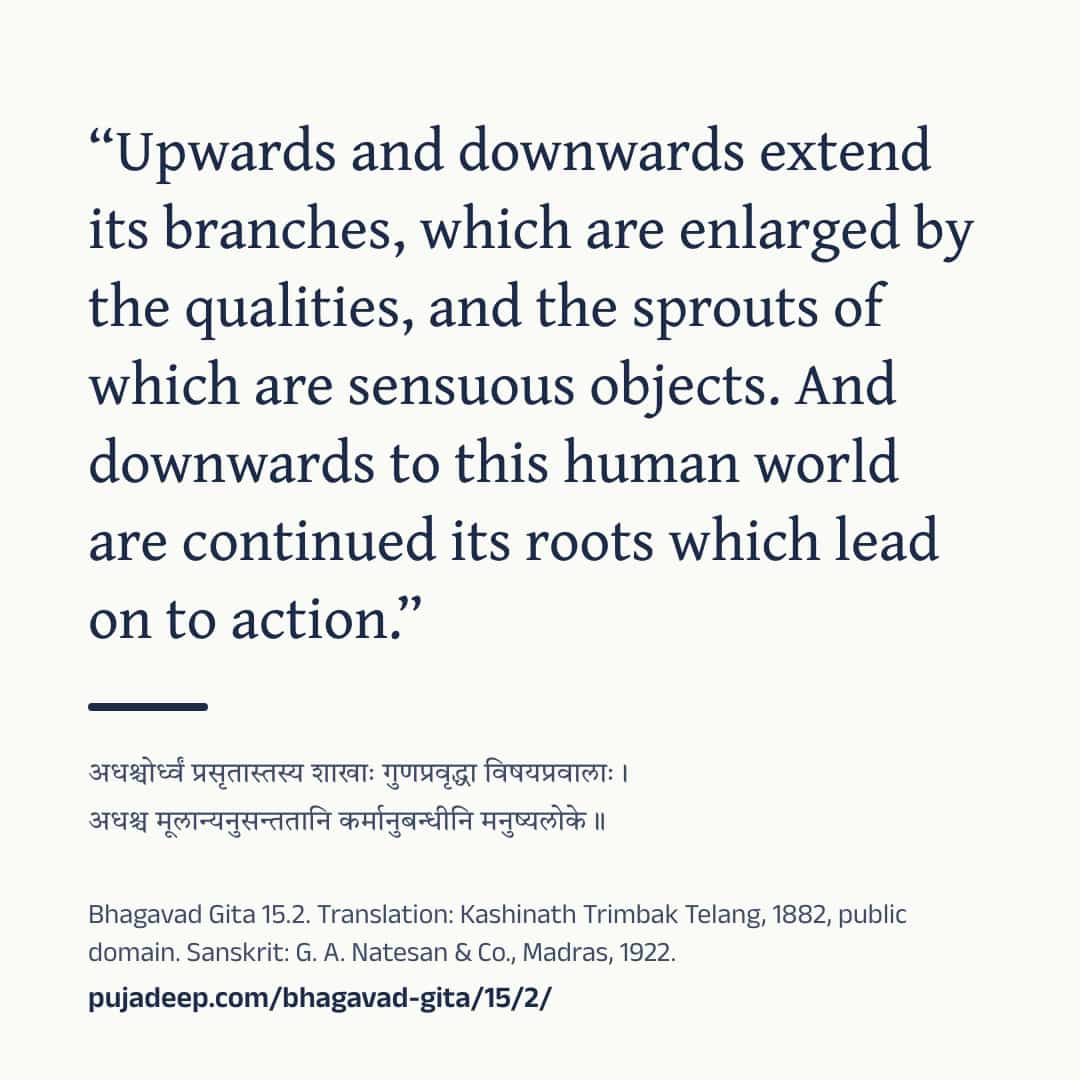
Drawing the picture
See the words
Bhagavad Gita 15.2

अधश्चोर्ध्वं प्रसृतास्तस्य शाखाः गुणप्रवृद्धा विषयप्रवालाः ।
अधश्च मूलान्यनुसन्ततानि कर्मानुबन्धीनि मनुष्यलोके ॥

“Upwards and downwards extend its branches, which are enlarged by the qualities, and the sprouts of which are sensuous objects. And downwards to this human world are continued its roots which lead on to action.”
(K. T. Telang, The Bhagavadgîtâ (The Sacred Books of the East, vol. VIII, Oxford: Clarendon Press, 1882), p. 111, public domain)

“Downwards and upwards spread the branches of it, nourished by the Gunas, the objects of the senses its buds; and its roots grow downwards, the bonds of action in the world of men.”
(Annie Besant, The Bhagavad Gîtâ, or The Lord's Song (London: Theosophical Publishing Society, 1895), p. 135, public domain)

“Below and above spread its branches, nourished by the Gunas; sense-objects are its buds; and below in the world of man stretch forth the roots, orginating action.”
(Swami Swarupananda, Srimad-Bhagavad-Gita (Mayavati: Prabuddha Bharata Press, 1909; first printed in Prabuddha Bharata, 1907–1909), p. 284, public domain)

Sanskrit: G. A. Natesan & Co., Madras, 1922.
https://pujadeep.com/bhagavad-gita/15/2/ Nothing is sent from this site. Your own app sends it, to the chat you choose. The picture quotes the translation you chose on this page, with its name and year.
Sanskrit text: The Bhagavad-Gita, or The Lord's Song, with the text in Devanagari and an English translation, 1922. Meanings: written for Pujadeep and checked against the cited edition. Source and changes
Questions families ask
Who speaks Bhagavad Gita 15.2?
Krishna speaks this verse, in chapter 15 (Purushottama Yoga).
Where does the Sanskrit text come from?
Sanskrit text: The Bhagavad-Gita, or The Lord's Song, with the text in Devanagari and an English translation, 1922. Meanings: written for Pujadeep and checked against the cited edition. See the source
Is the meaning on this page a translation?
Explanation written for this site from the sources listed here, and checked against the cited edition. It is not a translation and not the only way to read the text. Free to quote with credit.
Source and licence
- Sanskrit text
- The Bhagavad-Gita, or The Lord's Song, with the text in Devanagari and an English translation (Annie Besant, G. A. Natesan & Co., Madras, 1922). Public domain. The Sanskrit on these pages was read from this printing’s page images.
- Translation
- The Bhagavadgîtâ with the Sanatsugâtîya and the Anugîtâ, translated by Kâshinâth Trimbak Telang (The Sacred Books of the East, vol. VIII, ed. F. Max Müller) (Kashinath Trimbak Telang, F. Max Müller, Clarendon Press, Oxford, 1882). Public domain. Shown verbatim, as printed.
- Translation
- The Bhagavad Gîtâ, or The Lord's Song, translated by Annie Besant (Annie Besant, Theosophical Publishing Society, London, 1895). Public domain. Shown verbatim, as printed.
- Translation
- Srimad-Bhagavad-Gita, with Sanskrit Text; Paraphrase with Word-by-word Literal Translation; English Rendering and Comments, Index, &c., by the Swami Swarupananda (Himalayan Series, No. XX) (Swami Swarupananda, The Editors and Publishers, Advaita Ashrama, Mayavati, Prabuddha Bharata Press, Mayavati, Almora, Himalayas, 1909). Public domain. Shown verbatim, as printed.
- Common wording
- In this text, 32 words follow today's common wording, checked against sanskritdocuments.org; Sanskrit Wikisource; Gita Press, Gorakhpur; GRETIL, Göttingen and Bhaktivedanta Book Trust.
- Our explanation
- Explanation written for this site from the sources listed here, and checked against the cited edition. It is not a translation and not the only way to read the text. Free to quote with credit.
- Checked
- Checked against the cited edition, October 15, 2026.
- Updated
- October 25, 2026