Bhagavad Gita 12.19: meaning and translation
Chapter 12: Bhakti Yoga. Krishna says
Krishna: Such a person takes blame and praise alike, speaks little (maunī), is content with whatever comes, has no fixed home or is not tied to one (aniketa), and has a steady mind.
Click or tap a word for its meaning and its dictionary page.
Text and layers
Text and layers
These choices stay in this browser.
Bhagavad Gita 12.19
तुल्यनिन्दास्तुतिर्मौनी सन्तुष्टो येनकेनचित् ।अनिकेतः स्थिरमतिर्भक्तिमान्मे प्रियो नरः ॥
Tulyanindastutirmauni santushto yenakenachitAniketah sthiramatirbhaktimanme priyo narah
tulyanindāstutirmaunī santuṣṭo yenakenacit |aniketaḥ sthiramatirbhaktimānme priyo naraḥ ||
Our explanation Such a person takes blame and praise alike, speaks little (maunī), is content with whatever comes, has no fixed home or is not tied to one (aniketa), and has a steady mind. Krishna says that such a person, full of devotion, is dear to him.
हिंदी अर्थ ऐसा व्यक्ति निंदा और स्तुति को समान मानता है, मौनी (कम बोलने वाला) है, जो कुछ मिल जाए उसी में संतुष्ट रहता है, अनिकेत (जिसका कोई निश्चित घर न हो, या जो घर से बँधा न हो) है, और स्थिर बुद्धि वाला है। कृष्ण कहते हैं कि ऐसा भक्तिमान मनुष्य उन्हें प्रिय है।
Word by word
Every word, with its dictionary page
Word by word
- तुल्यनिन्दास्तुतिः tulyanindāstutiḥ · the same in blame and praise (compound, nominative singular) Dictionary: tulya, Monier-Williams 1899, p. 451, col. 3 “equal to, of the same kind or class or number or value, similar, comparable, like”; nindā, Monier-Williams 1899, p. 549, col. 2 “blame, censure, reproach, reviling”; stuti, Monier-Williams 1899, p. 1259, col. 1 “praise, eulogy, panegyric, commendation”
- मौनी maunī · silent, restrained in speech (nominative singular) Dictionary: maunin, Monier-Williams 1899, p. 837, col. 1 “observing silence, silent, taciturn”
- सन्तुष्टः santuṣṭaḥ · content (past participle, nominative singular) Dictionary: saṃ-tuṣṭa, Monier-Williams 1899, p. 1142, col. 2 “quite satisfied or contented, well pleased or delighted with”
- येनकेनचित् yenakenacit · with whatever comes (pronoun, instrumental singular) Dictionary: yad, Monier-Williams 1899, p. 844, col. 2 “who, which, what, whichever, whatever, that”; kim, Monier-Williams 1899, p. 282, col. 2 “what? how? whence? wherefore? why?”; 2. cid, Monier-Williams 1899, p. 398, col. 1 “even, indeed, also”
- अनिकेतः aniketaḥ · without a fixed home (nominative singular) Dictionary: a-niketa, Monier-Williams 1899, p. 29, col. 2 “houseless”
- स्थिरमतिः sthiramatiḥ · steady-minded (compound, nominative singular) Dictionary: sthira-mati, Monier-Williams 1899, p. 1265, col. 1 “firm-minded, steady”
- भक्तिमान् bhaktimān · full of devotion (nominative singular) Dictionary: bhakti-mat, Monier-Williams 1899, p. 743, col. 2 “accompanied by devotion or loyalty”
- मे me · to "me" (pronoun, genitive singular) Dictionary: 1. mad, Monier-Williams 1899, p. 777, col. 2 “base of the first pers. pron. in the sg. number (esp. in comp.)”
- प्रियः priyaḥ · dear (nominative singular) Dictionary: priya, Monier-Williams 1899, p. 710, col. 1 “beloved, dear to (gen., loc., dat. or comp.), liked, favourite”
- नरः naraḥ · person, man (nominative singular) Dictionary: nara, Monier-Williams 1899, p. 528, col. 3 “a man, a male, a person”
1 printing differs
Edition differences. Another printing or text reads this place differently.
- Spelling A digital text reads Same letters. The e-text prints येन केनचित् as two words; the 1922 edition prints येनकेनचित् as one.
Old translations
Kashinath Trimbak Telang, 1882. Public domain.
Telang translates verses 18–19 as one sentence; see 12.18. Read it at 12.18
Compare 3 translations
Kashinath Trimbak Telang, 1882. Public domain.
Telang translates verses 18–19 as one sentence; see 12.18. Read it at 12.18
You are reading this one
Annie Besant, 1895. Public domain. Page 121.
Unshaken by praise or reproach, silent, wholly content with what cometh, homeless, firm in mind, My devotee, that man is dear to Me.
This sentence begins in 12.18.
You are reading this one
Swami Swarupananda, 1909 (first printed 1907). Public domain.
Swarupananda renders verses 18–19 together; see 12.18. Read it at 12.18
You are reading this one
Cite this verse
The translation: K. T. Telang, The Bhagavadgîtâ (The Sacred Books of the East, vol. VIII, Oxford: Clarendon Press, 1882), pp. 101–102. Bhagavad Gita 12.18–19.
The translation: Annie Besant, The Bhagavad Gîtâ, or The Lord's Song (London: Theosophical Publishing Society, 1895), p. 121. Bhagavad Gita 12.19.
The translation: Swami Swarupananda, Srimad-Bhagavad-Gita (Mayavati: Prabuddha Bharata Press, 1909; first printed in Prabuddha Bharata, 1907–1909), p. 251. Bhagavad Gita 12.18–19.
Our explanation: “Bhagavad Gita 12.19: meaning and translation.” Pujadeep. Updated October 27, 2026. https://pujadeep.com/bhagavad-gita/12/19/
Pujadeep’s explanations are free to quote with credit: name Pujadeep and link to the page. How to credit
Classical readings, by school
Each reading is named by its school. None is presented as the only meaning.
What Advaita, Vishishtadvaita and Dvaita teach, in short
Madhva Dvaita
Madhva gives aniketa ('with no fixed home') a second sense, 'dwelling in the glorious Lord', taking a as a name of Vishnu. Steady-minded means one whose conclusions are not shaken by false reasoning. The repeated 'my devotee' in these verses, he says, shows that devotion should weigh more than all the other virtues named, and the evenness named so often means freedom from elation and the like.
Source: The Bhagavad-Gita: translation and commentaries in English according to Sri Madhwacharya's Bhashyas, by S. Subba Rau (Madras, 1906), commentary on 12.18–12.19, p. 242 (leaf n240). Summarised in our own words; none of its text is reproduced.
Share
Show the ways to share
Send one picture or the text to one chat. The picture names its source and the address of this page.
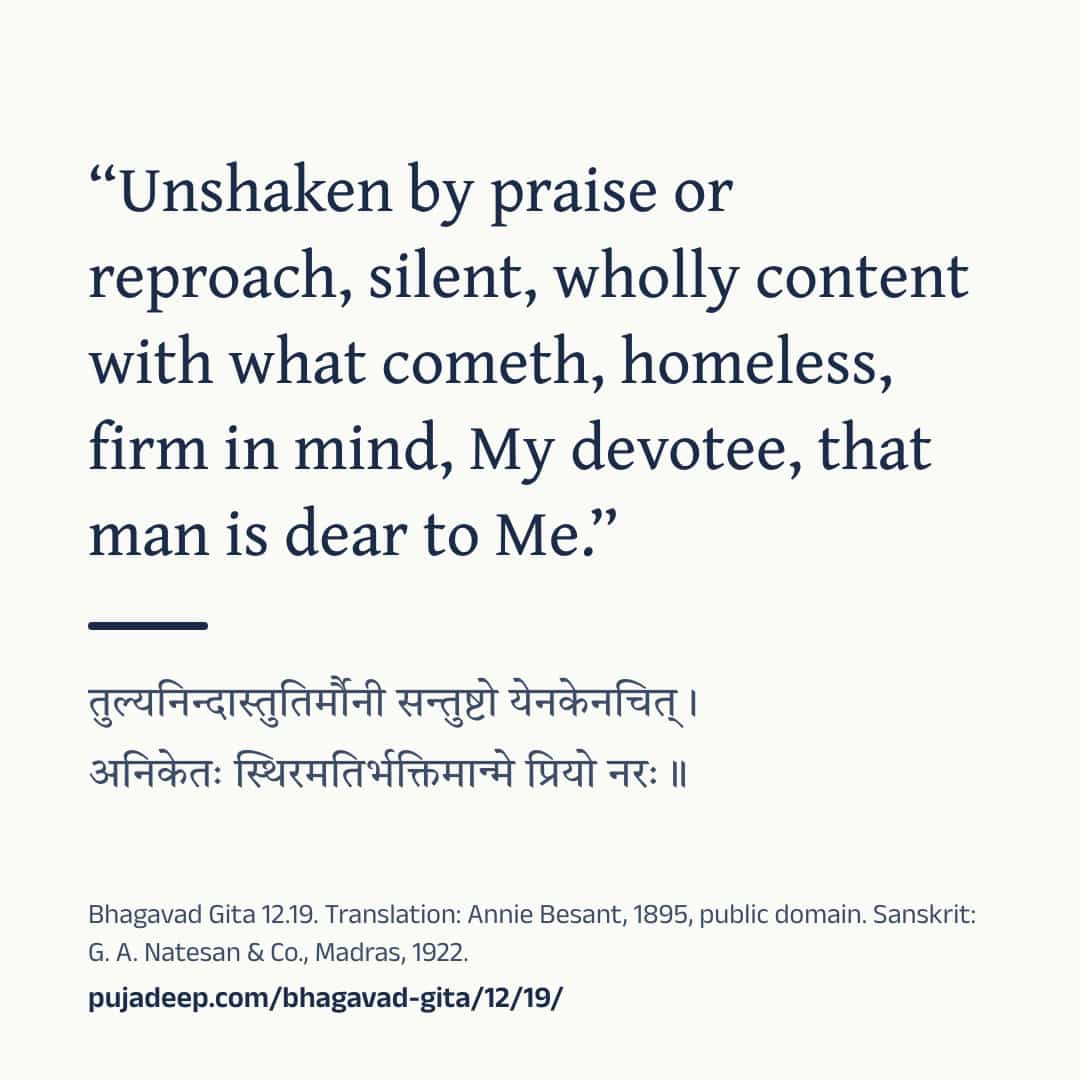
Drawing the picture
See the words
Bhagavad Gita 12.19

तुल्यनिन्दास्तुतिर्मौनी सन्तुष्टो येनकेनचित् ।
अनिकेतः स्थिरमतिर्भक्तिमान्मे प्रियो नरः ॥

“Unshaken by praise or reproach, silent, wholly content with what cometh, homeless, firm in mind, My devotee, that man is dear to Me.”
(Annie Besant, The Bhagavad Gîtâ, or The Lord's Song (London: Theosophical Publishing Society, 1895), p. 121, public domain)
This sentence begins in 12.18.

Sanskrit: G. A. Natesan & Co., Madras, 1922.
https://pujadeep.com/bhagavad-gita/12/19/ Nothing is sent from this site. Your own app sends it, to the chat you choose. The picture quotes the translation you chose on this page, with its name and year.
Sanskrit text: The Bhagavad-Gita, or The Lord's Song, with the text in Devanagari and an English translation, 1922. Meanings: written for Pujadeep and checked against the cited edition. Source and changes
Questions families ask
Who speaks Bhagavad Gita 12.19?
Krishna speaks this verse, in chapter 12 (Bhakti Yoga).
Where does the Sanskrit text come from?
Sanskrit text: The Bhagavad-Gita, or The Lord's Song, with the text in Devanagari and an English translation, 1922. Meanings: written for Pujadeep and checked against the cited edition. See the source
Is the meaning on this page a translation?
Explanation written for this site from the sources listed here, and checked against the cited edition. It is not a translation and not the only way to read the text. Free to quote with credit.
Source and licence
- Sanskrit text
- The Bhagavad-Gita, or The Lord's Song, with the text in Devanagari and an English translation (Annie Besant, G. A. Natesan & Co., Madras, 1922). Public domain. The Sanskrit on these pages was read from this printing’s page images.
- Translation
- The Bhagavadgîtâ with the Sanatsugâtîya and the Anugîtâ, translated by Kâshinâth Trimbak Telang (The Sacred Books of the East, vol. VIII, ed. F. Max Müller) (Kashinath Trimbak Telang, F. Max Müller, Clarendon Press, Oxford, 1882). Public domain. Shown verbatim, as printed.
- Translation
- The Bhagavad Gîtâ, or The Lord's Song, translated by Annie Besant (Annie Besant, Theosophical Publishing Society, London, 1895). Public domain. Shown verbatim, as printed.
- Translation
- Srimad-Bhagavad-Gita, with Sanskrit Text; Paraphrase with Word-by-word Literal Translation; English Rendering and Comments, Index, &c., by the Swami Swarupananda (Himalayan Series, No. XX) (Swami Swarupananda, The Editors and Publishers, Advaita Ashrama, Mayavati, Prabuddha Bharata Press, Mayavati, Almora, Himalayas, 1909). Public domain. Shown verbatim, as printed.
- Commentary
- The Bhagavad-Gita: translation and commentaries in English according to Sri Madhwacharya's Bhashyas, by S. Subba Rau (Madras, 1906) (Scan uploaded to archive.org (folkscanomy collection)). Summarised in our own words; none of its text is reproduced.
- Common wording
- In this text, 32 words follow today's common wording, checked against sanskritdocuments.org; Sanskrit Wikisource; Gita Press, Gorakhpur; GRETIL, Göttingen and Bhaktivedanta Book Trust.
- Our explanation
- Explanation written for this site from the sources listed here, and checked against the cited edition. It is not a translation and not the only way to read the text. Free to quote with credit.
- Checked
- Checked against the cited edition, October 27, 2026.