Bhagavad Gita 12.11: meaning and translation
Chapter 12: Bhakti Yoga. Krishna says
If he cannot do even this, Krishna says, he should take refuge in union with Krishna (mad-yoga), keep himself under control, and give up the fruit of all his actions.
Click or tap a word for its meaning and its dictionary page.
Text and layers
Text and layers
These choices stay in this browser.
Bhagavad Gita 12.11
अथैतदप्यशक्तोऽसि कर्तुं मद्योगमाश्रितः ।सर्वकर्मफलत्यागं ततः कुरु यतात्मवान् ॥
Athaitadapyashaktosi kartum madyogamashritahSarvakarmaphalatyagam tatah kuru yatatmavan
athaitadapyaśakto’si kartuṃ madyogamāśritaḥ |sarvakarmaphalatyāgaṃ tataḥ kuru yatātmavān ||
Our explanation If he cannot do even this, Krishna says, he should take refuge in union with Krishna (mad-yoga), keep himself under control, and give up the fruit of all his actions.
हिंदी अर्थ कृष्ण कहते हैं कि यदि अर्जुन यह भी नहीं कर सकते, तो कृष्ण के योग (उनसे जुड़ने) का आश्रय लेकर, अपने मन को वश में रखकर, सब कर्मों के फल का त्याग करें।
Word by word
Every word, with its dictionary page
Word by word
- अथ atha · now, if (indeclinable) Dictionary: atha, Monier-Williams 1899, p. 17, col. 3 “now; then; moreover”
- एतत् etat · this (pronoun, accusative singular) Dictionary: etad, Monier-Williams 1899, p. 231, col. 2 “this, this here, here”
- अपि api · even (indeclinable) Dictionary: api, Monier-Williams 1899, p. 55, col. 1 “and, also, moreover, besides”
- अशक्तः aśaktaḥ · unable (nominative singular) Dictionary: a-śakta, Monier-Williams 1899, p. 112, col. 3 “unable, incompetent”
- असि asi · you are (present, 2nd person singular) Dictionary: 1. as, Monier-Williams 1899, p. 117, col. 2 “to be, live, exist, be present”
- कर्तुम् kartum · to do (infinitive ('to do')) Dictionary: 1. kṛ, Monier-Williams 1899, p. 301, col. 1 “to do, make, perform, accomplish, cause, effect”
- मद्योगम् madyogam · union with "me", "my" yoga (compound, accusative singular) Dictionary: 1. mad, Monier-Williams 1899, p. 777, col. 2 “base of the first pers. pron. in the sg. number (esp. in comp.)”; yoga, Monier-Williams 1899, p. 856, col. 2 “any junction, union, combination”
- आश्रितः āśritaḥ · taking refuge in (past participle, nominative singular) Dictionary: ā-śrita, Monier-Williams 1899, p. 158, col. 3 “having recourse to, resorting to as a retreat or asylum”
- सर्वकर्मफलत्यागम् sarvakarmaphalatyāgam · giving up the fruit of all actions (compound, accusative singular) Dictionary: sarva, Monier-Williams 1899, p. 1184, col. 3 “whole, entire, all, every”; karma-phala, Monier-Williams 1899, p. 259, col. 1 “the fruit or recompense of actions”; tyāga, Monier-Williams 1899, p. 456, col. 3 “leaving, abandoning, forsaking”
- ततः tataḥ · then (indeclinable) Dictionary: tatas, Monier-Williams 1899, p. 432, col. 2 “thereupon, then, after that, afterwards”
- कुरु kuru · do (imperative, 2nd person singular) Dictionary: 1. kṛ, Monier-Williams 1899, p. 301, col. 1 “to do, make, perform, accomplish, cause, effect”
- यतात्मवान् yatātmavān · with the self controlled (nominative singular) Dictionary: yatātman, Monier-Williams 1899, p. 845, col. 3 “self-restrained”
Old translations
Kashinath Trimbak Telang, 1882. Public domain. Page 100.
If you are unable to do even this, then resort to devotion1 to me, and, with self-restraint, abandon all fruit of action.
Footnotes (the translator’s own) - Performing actions, but dedicating them to me. ↩
Compare 3 translations
Kashinath Trimbak Telang, 1882. Public domain. Page 100.
If you are unable to do even this, then resort to devotion1 to me, and, with self-restraint, abandon all fruit of action.
Footnotes (the translator’s own) - Performing actions, but dedicating them to me. ↩
You are reading this one
Annie Besant, 1895. Public domain. Page 119–120.
If to do this even thou hast not strength, take refuge in union with Me; thus renouncing all fruit of action, act thou with the self controlled.
You are reading this one
Swami Swarupananda, 1909 (first printed 1907). Public domain. Page 247.
If thou art unable to do even this, then taking refuge in Me, and self-controlled, abandon the fruit of all action.
You are reading this one
Cite this verse
The translation: K. T. Telang, The Bhagavadgîtâ (The Sacred Books of the East, vol. VIII, Oxford: Clarendon Press, 1882), p. 100. Bhagavad Gita 12.11.
The translation: Annie Besant, The Bhagavad Gîtâ, or The Lord's Song (London: Theosophical Publishing Society, 1895), pp. 119–120. Bhagavad Gita 12.11.
The translation: Swami Swarupananda, Srimad-Bhagavad-Gita (Mayavati: Prabuddha Bharata Press, 1909; first printed in Prabuddha Bharata, 1907–1909), p. 247. Bhagavad Gita 12.11.
Our explanation: “Bhagavad Gita 12.11: meaning and translation.” Pujadeep. Updated October 27, 2026. https://pujadeep.com/bhagavad-gita/12/11/
Pujadeep’s explanations are free to quote with credit: name Pujadeep and link to the page. How to credit
Classical readings, by school
No readings by school on this verse yet.
Share
Show the ways to share
Send one picture or the text to one chat. The picture names its source and the address of this page.
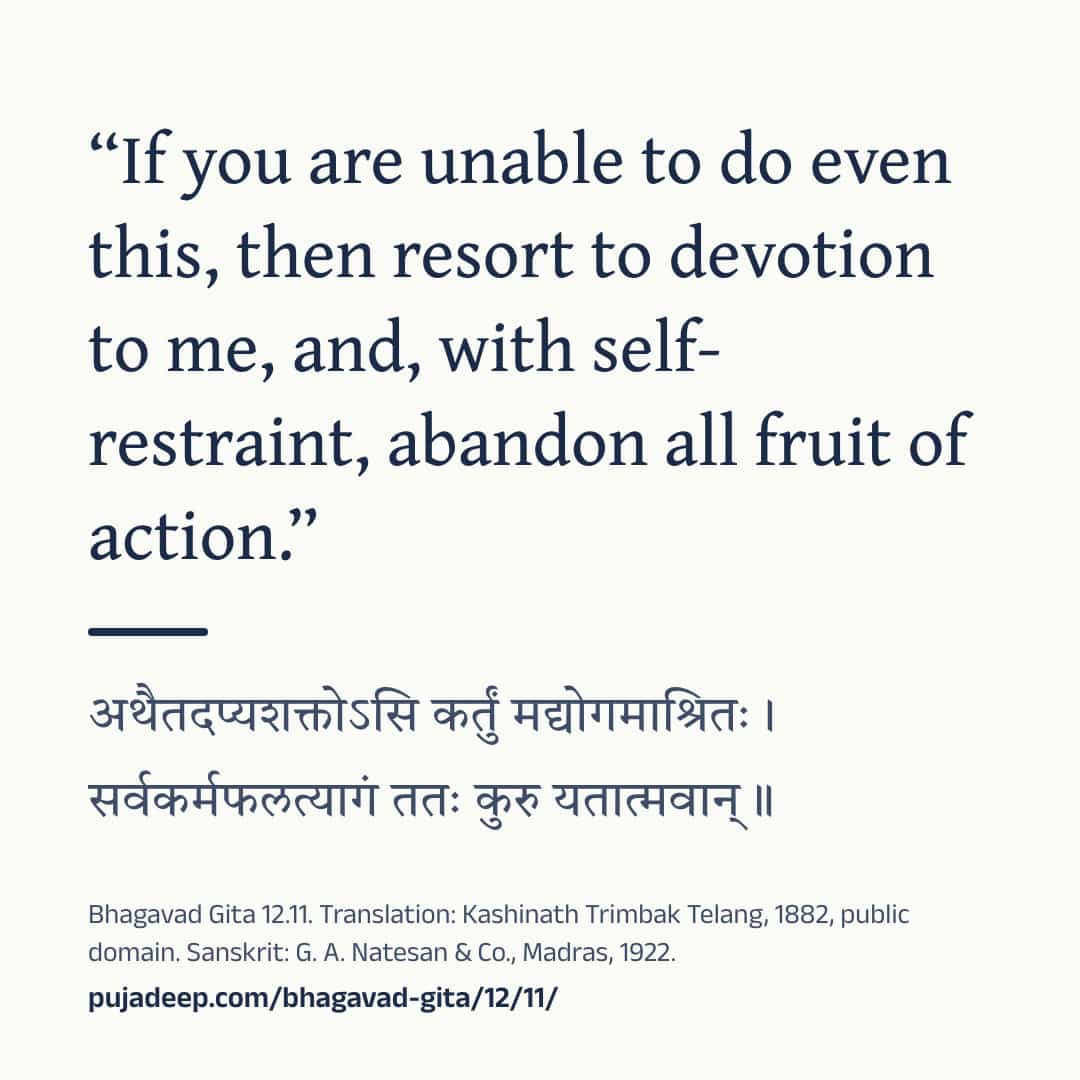
Drawing the picture
See the words
Bhagavad Gita 12.11

अथैतदप्यशक्तोऽसि कर्तुं मद्योगमाश्रितः ।
सर्वकर्मफलत्यागं ततः कुरु यतात्मवान् ॥

“If you are unable to do even this, then resort to devotion to me, and, with self-restraint, abandon all fruit of action.”
(K. T. Telang, The Bhagavadgîtâ (The Sacred Books of the East, vol. VIII, Oxford: Clarendon Press, 1882), p. 100, public domain)

“If to do this even thou hast not strength, take refuge in union with Me; thus renouncing all fruit of action, act thou with the self controlled.”
(Annie Besant, The Bhagavad Gîtâ, or The Lord's Song (London: Theosophical Publishing Society, 1895), pp. 119–120, public domain)

“If thou art unable to do even this, then taking refuge in Me, and self-controlled, abandon the fruit of all action.”
(Swami Swarupananda, Srimad-Bhagavad-Gita (Mayavati: Prabuddha Bharata Press, 1909; first printed in Prabuddha Bharata, 1907–1909), p. 247, public domain)

Sanskrit: G. A. Natesan & Co., Madras, 1922.
https://pujadeep.com/bhagavad-gita/12/11/ Nothing is sent from this site. Your own app sends it, to the chat you choose. The picture quotes the translation you chose on this page, with its name and year.
Sanskrit text: The Bhagavad-Gita, or The Lord's Song, with the text in Devanagari and an English translation, 1922. Meanings: written for Pujadeep and checked against the cited edition. Source and changes
Questions families ask
Who speaks Bhagavad Gita 12.11?
Krishna speaks this verse, in chapter 12 (Bhakti Yoga).
Where does the Sanskrit text come from?
Sanskrit text: The Bhagavad-Gita, or The Lord's Song, with the text in Devanagari and an English translation, 1922. Meanings: written for Pujadeep and checked against the cited edition. See the source
Is the meaning on this page a translation?
Explanation written for this site from the sources listed here, and checked against the cited edition. It is not a translation and not the only way to read the text. Free to quote with credit.
Source and licence
- Sanskrit text
- The Bhagavad-Gita, or The Lord's Song, with the text in Devanagari and an English translation (Annie Besant, G. A. Natesan & Co., Madras, 1922). Public domain. The Sanskrit on these pages was read from this printing’s page images.
- Translation
- The Bhagavadgîtâ with the Sanatsugâtîya and the Anugîtâ, translated by Kâshinâth Trimbak Telang (The Sacred Books of the East, vol. VIII, ed. F. Max Müller) (Kashinath Trimbak Telang, F. Max Müller, Clarendon Press, Oxford, 1882). Public domain. Shown verbatim, as printed.
- Translation
- The Bhagavad Gîtâ, or The Lord's Song, translated by Annie Besant (Annie Besant, Theosophical Publishing Society, London, 1895). Public domain. Shown verbatim, as printed.
- Translation
- Srimad-Bhagavad-Gita, with Sanskrit Text; Paraphrase with Word-by-word Literal Translation; English Rendering and Comments, Index, &c., by the Swami Swarupananda (Himalayan Series, No. XX) (Swami Swarupananda, The Editors and Publishers, Advaita Ashrama, Mayavati, Prabuddha Bharata Press, Mayavati, Almora, Himalayas, 1909). Public domain. Shown verbatim, as printed.
- Common wording
- In this text, 32 words follow today's common wording, checked against sanskritdocuments.org; Sanskrit Wikisource; Gita Press, Gorakhpur; GRETIL, Göttingen and Bhaktivedanta Book Trust.
- Our explanation
- Explanation written for this site from the sources listed here, and checked against the cited edition. It is not a translation and not the only way to read the text. Free to quote with credit.
- Checked
- Checked against the cited edition, October 27, 2026.