Bhagavad Gita 12.4: meaning and translation
Chapter 12: Bhakti Yoga. Krishna says
Krishna: Such people hold all their senses in check, keep an even mind towards everything, and delight in the good of all beings.
Click or tap a word for its meaning and its dictionary page.
Text and layers
Text and layers
These choices stay in this browser.
Bhagavad Gita 12.4
संनियम्येन्द्रियग्रामं सर्वत्र समबुद्धयः ।ते प्राप्नुवन्ति मामेव सर्वभूतहिते रताः ॥
Sanniyamyendriyagramam sarvatra samabuddhayahTe prapnuvanti mameva sarvabhutahite ratah
saṃniyamyendriyagrāmaṃ sarvatra samabuddhayaḥ |te prāpnuvanti māmeva sarvabhūtahite ratāḥ ||
Our explanation Such people hold all their senses in check, keep an even mind towards everything, and delight in the good of all beings. Krishna says that they, too, reach him. The schools explain “reach him” in different ways (see the views).
हिंदी अर्थ ऐसे लोग सब इंद्रियों को वश में रखते हैं, सब जगह समान बुद्धि रखते हैं और सब प्राणियों के हित में लगे रहते हैं। कृष्ण कहते हैं कि वे भी उन्हीं को पाते हैं। अलग-अलग परंपराएँ इस “पाने” को अलग ढंग से समझाती हैं।
Word by word
Every word, with its dictionary page
Word by word
- संनियम्य saṃniyamya · having fully restrained (absolutive ('having done')) Dictionary: saṃ-ni-yam, Monier-Williams 1899, p. 1147, col. 1 “to hold together, keep back, restrain, subdue, suppress”
- इन्द्रियग्रामम् indriyagrāmam · the group of senses (compound, accusative singular) Dictionary: indriya-grāma, Monier-Williams 1899, p. 167, col. 2 “the assemblage of the organs, the senses or organs of sense collectively”
- सर्वत्र sarvatra · everywhere, in all things (indeclinable) Dictionary: sarvatra, Monier-Williams 1899, p. 1189, col. 2 “everywhere, in every case, always, at all times”
- समबुद्धयः samabuddhayaḥ · even-minded (compound, nominative plural) Dictionary: sama-buddhi, Monier-Williams 1899, p. 1152, col. 3 “esteeming all things alike, indifferent”
- ते te · they (pronoun, nominative plural) Dictionary: tad, Monier-Williams 1899, p. 434, col. 1 “m. he, f. she, n. it, that, this”
- प्राप्नुवन्ति prāpnuvanti · reach (present, 3rd person plural) Dictionary: prāp, Monier-Williams 1899, p. 707, col. 2 “to attain to, reach, arrive at, meet with, find”
- माम् mām · "me" (Krishna) (pronoun, accusative singular) Dictionary: 1. mad, Monier-Williams 1899, p. 777, col. 2 “base of the first pers. pron. in the sg. number (esp. in comp.)”
- एव eva · indeed, only (indeclinable) Dictionary: 1. eva, Monier-Williams 1899, p. 232, col. 2 “indeed, truly, really”
- सर्वभूतहिते sarvabhūtahite · in the good of all beings (compound, locative singular) Dictionary: sarva, Monier-Williams 1899, p. 1184, col. 3 “whole, entire, all, every”; bhūta, Monier-Williams 1899, p. 761, col. 3 “that which is or exists, any living being (divine, human, animal, and even vegetable)”; 2. hita, Monier-Williams 1899, p. 1298, col. 2 “anything useful or salutary or suitable or proper, benefit, advantage, profit, service, good, welfare”
- रताः ratāḥ · delighting, devoted (past participle, nominative plural) Dictionary: rata, Monier-Williams 1899, p. 867, col. 2 “delighting in, intent upon, fond or enamoured of, devoted or attached”
1 printing differs
Edition differences. Another printing or text reads this place differently.
- Spelling A digital text reads Same word. The e-text writes the class nasal (सन्नियम्य); the 1922 edition writes anusvara (संनियम्य).
Old translations
Kashinath Trimbak Telang, 1882. Public domain.
Telang translates verses 3–4 as one sentence; see 12.3. Read it at 12.3
Compare 3 translations
Kashinath Trimbak Telang, 1882. Public domain.
Telang translates verses 3–4 as one sentence; see 12.3. Read it at 12.3
You are reading this one
Annie Besant, 1895. Public domain. Page 118.
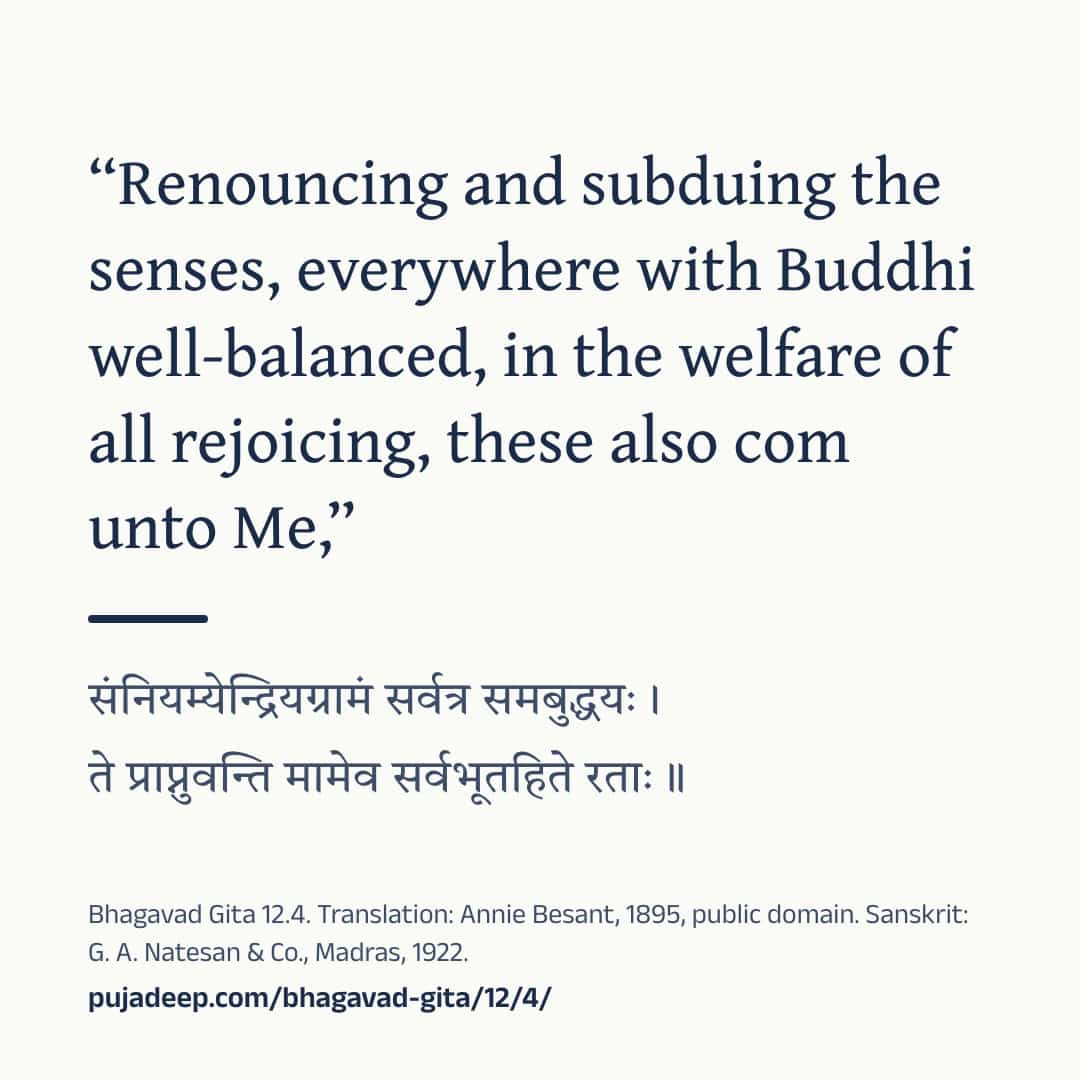
Renouncing and subduing the senses, everywhere with Buddhi well-balanced, in the welfare of all rejoicing, these also com unto Me,
This sentence begins in 12.3.
You are reading this one
Swami Swarupananda, 1909 (first printed 1907). Public domain.
Swarupananda renders verses 3–4 together; see 12.3. Read it at 12.3
You are reading this one
Cite this verse
The translation: K. T. Telang, The Bhagavadgîtâ (The Sacred Books of the East, vol. VIII, Oxford: Clarendon Press, 1882), pp. 99–100. Bhagavad Gita 12.3–4.
The translation: Annie Besant, The Bhagavad Gîtâ, or The Lord's Song (London: Theosophical Publishing Society, 1895), p. 118. Bhagavad Gita 12.4.
The translation: Swami Swarupananda, Srimad-Bhagavad-Gita (Mayavati: Prabuddha Bharata Press, 1909; first printed in Prabuddha Bharata, 1907–1909), pp. 243–244. Bhagavad Gita 12.3–4.
Our explanation: “Bhagavad Gita 12.4: meaning and translation.” Pujadeep. Updated October 27, 2026. https://pujadeep.com/bhagavad-gita/12/4/
Pujadeep’s explanations are free to quote with credit: name Pujadeep and link to the page. How to credit
Classical readings, by school
Each reading is named by its school. None is presented as the only meaning.
What Advaita, Vishishtadvaita and Dvaita teach, in short
Shankara Advaita
Shankara says it hardly needs saying that these seekers reach the Lord, since 7.18 calls the wise person the Lord's very Self. For the same reason there is no need to call them the best yogins, because they are one with the Lord.
Source: The Bhagavad-Gita, with the commentary of Sri Sankaracharya, translated by A. Mahadeva Sastri (2nd ed., Mysore: G. T. A. Printing Works, 1901), commentary on 12.3–4, p. 268. Summarised in our own words; none of its text is reproduced.
Ramanuja Vishishtadvaita
Ramanuja reads “they reach Me” as their coming to know the self, freed from saṃsāra, whose nature is like the Lord's own; he cites 14.2 for this likeness.
Source: Sri Bhagavad-Gita with Sri Ramanujacharya's Visishtadvaita commentary, translated by A. Govindacharya (Madras, 1898), commentary on 12.3–5, p. 383. Summarised in our own words; none of its text is reproduced.
Madhva Dvaita
Madhva says those who worship Śrī as the Unmanifest also reach the Lord and liberation, but only with very great difficulty, and their worship must go together with devotion to the Lord, knowledge that he is supreme, and meditation on him. Worship of the Lord himself is not hard in that way, so his worshippers rank higher. 'Even-minded everywhere' means, for him, having rightly understood all things, as chapter 6 teaches.
Source: The Bhagavad-Gita: translation and commentaries in English according to Sri Madhwacharya's Bhashyas, by S. Subba Rau (Madras, 1906), commentary on 12.3–12.4, p. 237 (leaf n235). Summarised in our own words; none of its text is reproduced.
Share
Show the ways to share
Send one picture or the text to one chat. The picture names its source and the address of this page.
Drawing the picture
See the words
Bhagavad Gita 12.4

संनियम्येन्द्रियग्रामं सर्वत्र समबुद्धयः ।
ते प्राप्नुवन्ति मामेव सर्वभूतहिते रताः ॥

“Renouncing and subduing the senses, everywhere with Buddhi well-balanced, in the welfare of all rejoicing, these also com unto Me,”
(Annie Besant, The Bhagavad Gîtâ, or The Lord's Song (London: Theosophical Publishing Society, 1895), p. 118, public domain)
This sentence begins in 12.3.

Sanskrit: G. A. Natesan & Co., Madras, 1922.
https://pujadeep.com/bhagavad-gita/12/4/ Nothing is sent from this site. Your own app sends it, to the chat you choose. The picture quotes the translation you chose on this page, with its name and year.
Sanskrit text: The Bhagavad-Gita, or The Lord's Song, with the text in Devanagari and an English translation, 1922. Meanings: written for Pujadeep and checked against the cited edition. Source and changes
Questions families ask
Who speaks Bhagavad Gita 12.4?
Krishna speaks this verse, in chapter 12 (Bhakti Yoga).
Where does the Sanskrit text come from?
Sanskrit text: The Bhagavad-Gita, or The Lord's Song, with the text in Devanagari and an English translation, 1922. Meanings: written for Pujadeep and checked against the cited edition. See the source
Is the meaning on this page a translation?
Explanation written for this site from the sources listed here, and checked against the cited edition. It is not a translation and not the only way to read the text. Free to quote with credit.
Source and licence
- Sanskrit text
- The Bhagavad-Gita, or The Lord's Song, with the text in Devanagari and an English translation (Annie Besant, G. A. Natesan & Co., Madras, 1922). Public domain. The Sanskrit on these pages was read from this printing’s page images.
- Translation
- The Bhagavadgîtâ with the Sanatsugâtîya and the Anugîtâ, translated by Kâshinâth Trimbak Telang (The Sacred Books of the East, vol. VIII, ed. F. Max Müller) (Kashinath Trimbak Telang, F. Max Müller, Clarendon Press, Oxford, 1882). Public domain. Shown verbatim, as printed.
- Translation
- The Bhagavad Gîtâ, or The Lord's Song, translated by Annie Besant (Annie Besant, Theosophical Publishing Society, London, 1895). Public domain. Shown verbatim, as printed.
- Translation
- Srimad-Bhagavad-Gita, with Sanskrit Text; Paraphrase with Word-by-word Literal Translation; English Rendering and Comments, Index, &c., by the Swami Swarupananda (Himalayan Series, No. XX) (Swami Swarupananda, The Editors and Publishers, Advaita Ashrama, Mayavati, Prabuddha Bharata Press, Mayavati, Almora, Himalayas, 1909). Public domain. Shown verbatim, as printed.
- Commentary
- The Bhagavad-Gita, with the commentary of Sri Sankaracharya, translated by A. Mahadeva Sastri (2nd ed., Mysore: G. T. A. Printing Works, 1901) (Public-domain scan, University of California Libraries). Summarised in our own words; none of its text is reproduced.
- Commentary
- Sri Bhagavad-Gita with Sri Ramanujacharya's Visishtadvaita commentary, translated by A. Govindacharya (Madras, 1898) (Scan uploaded to archive.org (folkscanomy collection)). Summarised in our own words; none of its text is reproduced.
- Commentary
- The Bhagavad-Gita: translation and commentaries in English according to Sri Madhwacharya's Bhashyas, by S. Subba Rau (Madras, 1906) (Scan uploaded to archive.org (folkscanomy collection)). Summarised in our own words; none of its text is reproduced.
- Common wording
- In this text, 32 words follow today's common wording, checked against sanskritdocuments.org; Sanskrit Wikisource; Gita Press, Gorakhpur; GRETIL, Göttingen and Bhaktivedanta Book Trust.
- Our explanation
- Explanation written for this site from the sources listed here, and checked against the cited edition. It is not a translation and not the only way to read the text. Free to quote with credit.
- Checked
- Checked against the cited edition, October 27, 2026.