Bhagavad Gita 12.8: meaning and translation
Chapter 12: Bhakti Yoga. Krishna says
Krishna tells Arjuna to place his mind (manas) on him alone and to let his understanding (buddhi) enter into him.
Click or tap a word for its meaning and its dictionary page.
Text and layers
Text and layers
These choices stay in this browser.
Bhagavad Gita 12.8
मय्येव मन आधत्स्व मयि बुद्धिं निवेशय ।निवसिष्यसि मय्येव अत ऊर्ध्वं न संशयः ॥
Mayyeva mana adhatsva mayi buddhim niveshayaNivasishyasi mayyeva ata urdhvam na sanshayah
mayyeva mana ādhatsva mayi buddhiṃ niveśaya |nivasiṣyasi mayyeva ata ūrdhvaṃ na saṃśayaḥ ||
Our explanation Krishna tells Arjuna to place his mind (manas) on him alone and to let his understanding (buddhi) enter into him. Then, Krishna says, Arjuna will dwell in him from that time on, without doubt.
हिंदी अर्थ कृष्ण अर्जुन से कहते हैं कि वे अपना मन (मनस्) केवल उन्हीं में लगाएँ और अपनी बुद्धि उन्हीं में स्थिर करें। कृष्ण कहते हैं कि तब अर्जुन इसके बाद उन्हीं में निवास करेंगे, इसमें संशय नहीं।
Word by word
Every word, with its dictionary page
Word by word
- मयि mayi · on "me" (Krishna) (pronoun, locative singular) Dictionary: 1. mad, Monier-Williams 1899, p. 777, col. 2 “base of the first pers. pron. in the sg. number (esp. in comp.)”
- एव eva · only (indeclinable) Dictionary: 1. eva, Monier-Williams 1899, p. 232, col. 2 “indeed, truly, really”
- मनः manaḥ · the mind (accusative singular) Dictionary: manas, Monier-Williams 1899, p. 783, col. 3 “mind (in its widest sense as applied to all the mental powers)”
- आधत्स्व ādhatsva · place, fix (imperative, 2nd person singular) Dictionary: ā-dhā, Monier-Williams 1899, p. 138, col. 2 “to place on, put down, deposit, put”
- मयि mayi · in "me" (Krishna) (pronoun, locative singular) Dictionary: 1. mad, Monier-Williams 1899, p. 777, col. 2 “base of the first pers. pron. in the sg. number (esp. in comp.)”
- बुद्धिम् buddhim · the understanding, intellect (accusative singular) Dictionary: buddhi, Monier-Williams 1899, p. 733, col. 3 “intelligence, reason, intellect, mind”
- निवेशय niveśaya · set, let enter (causative imperative, 2nd person singular) Dictionary: ni-viś, Monier-Williams 1899, p. 559, col. 2 “Caus. -veśayati, to bring to rest; to cause to enter, introduce”
- निवसिष्यसि nivasiṣyasi · you will dwell (future, 2nd person singular) Dictionary: ni-vas, Monier-Williams 1899, p. 559, col. 1 “to sojourn, pass or spend time, dwell or live or be in”
- मयि mayi · in "me" (Krishna) (pronoun, locative singular) Dictionary: 1. mad, Monier-Williams 1899, p. 777, col. 2 “base of the first pers. pron. in the sg. number (esp. in comp.)”
- एव eva · only (indeclinable) Dictionary: 1. eva, Monier-Williams 1899, p. 232, col. 2 “indeed, truly, really”
- अतः ataḥ · from this, hence (indeclinable) Dictionary: atas, Monier-Williams 1899, p. 12, col. 1 “from this, than this; hence; henceforth”
- ऊर्ध्वम् ūrdhvam · after, onward (adverb) Dictionary: ata-ūrdhvam, Monier-Williams 1899, p. 12, col. 1 “henceforth, afterwards”; ūrdhva, Monier-Williams 1899, p. 222, col. 1 “rising or tending upwards, raised, elevated, erected, erect, upright, high, above”
- न na · not, no (indeclinable) Dictionary: 2. na, Monier-Williams 1899, p. 523, col. 1 “not, no, nor, neither”
- संशयः saṃśayaḥ · doubt (nominative singular) Dictionary: saṃ-śaya, Monier-Williams 1899, p. 1117, col. 3 “uncertainty, irresolution, hesitation, doubt”
Old translations
Kashinath Trimbak Telang, 1882. Public domain. Page 100.
Place your mind on me only; fix your understanding on me. In me you will dwell1 hereafter, (there is) no doubt.
Footnotes (the translator’s own) - I. e. assimilated with me, as expressed before. ↩
Compare 3 translations
Kashinath Trimbak Telang, 1882. Public domain. Page 100.
Place your mind on me only; fix your understanding on me. In me you will dwell1 hereafter, (there is) no doubt.
Footnotes (the translator’s own) - I. e. assimilated with me, as expressed before. ↩
You are reading this one
Annie Besant, 1895. Public domain. Page 119.
Place thy Manas in Me, into Me let thy Buddhi enter; then doubtless thou shalt abide in Me on high hereafter.
You are reading this one
Swami Swarupananda, 1909 (first printed 1907). Public domain. Page 246.
Fix thy mind on Me only, place thy intellect in Me: thou shalt no doubt live in Me hereafter.
You are reading this one
Cite this verse
The translation: K. T. Telang, The Bhagavadgîtâ (The Sacred Books of the East, vol. VIII, Oxford: Clarendon Press, 1882), p. 100. Bhagavad Gita 12.8.
The translation: Annie Besant, The Bhagavad Gîtâ, or The Lord's Song (London: Theosophical Publishing Society, 1895), p. 119. Bhagavad Gita 12.8.
The translation: Swami Swarupananda, Srimad-Bhagavad-Gita (Mayavati: Prabuddha Bharata Press, 1909; first printed in Prabuddha Bharata, 1907–1909), p. 246. Bhagavad Gita 12.8.
Our explanation: “Bhagavad Gita 12.8: meaning and translation.” Pujadeep. Updated October 27, 2026. https://pujadeep.com/bhagavad-gita/12/8/
Pujadeep’s explanations are free to quote with credit: name Pujadeep and link to the page. How to credit
Classical readings, by school
Each reading is named by its school. None is presented as the only meaning.
What Advaita, Vishishtadvaita and Dvaita teach, in short
Madhva Dvaita
Madhva takes 'place your understanding in me' as growing in the knowledge of the Lord, and 'you will dwell in me' as reaching a state of full bliss that no sorrow can touch.
Source: The Bhagavad-Gita: translation and commentaries in English according to Sri Madhwacharya's Bhashyas, by S. Subba Rau (Madras, 1906), commentary on 12.8, pp. 239–240 (leaves n237–n238). Summarised in our own words; none of its text is reproduced.
Share
Show the ways to share
Send one picture or the text to one chat. The picture names its source and the address of this page.
Drawing the picture
See the words
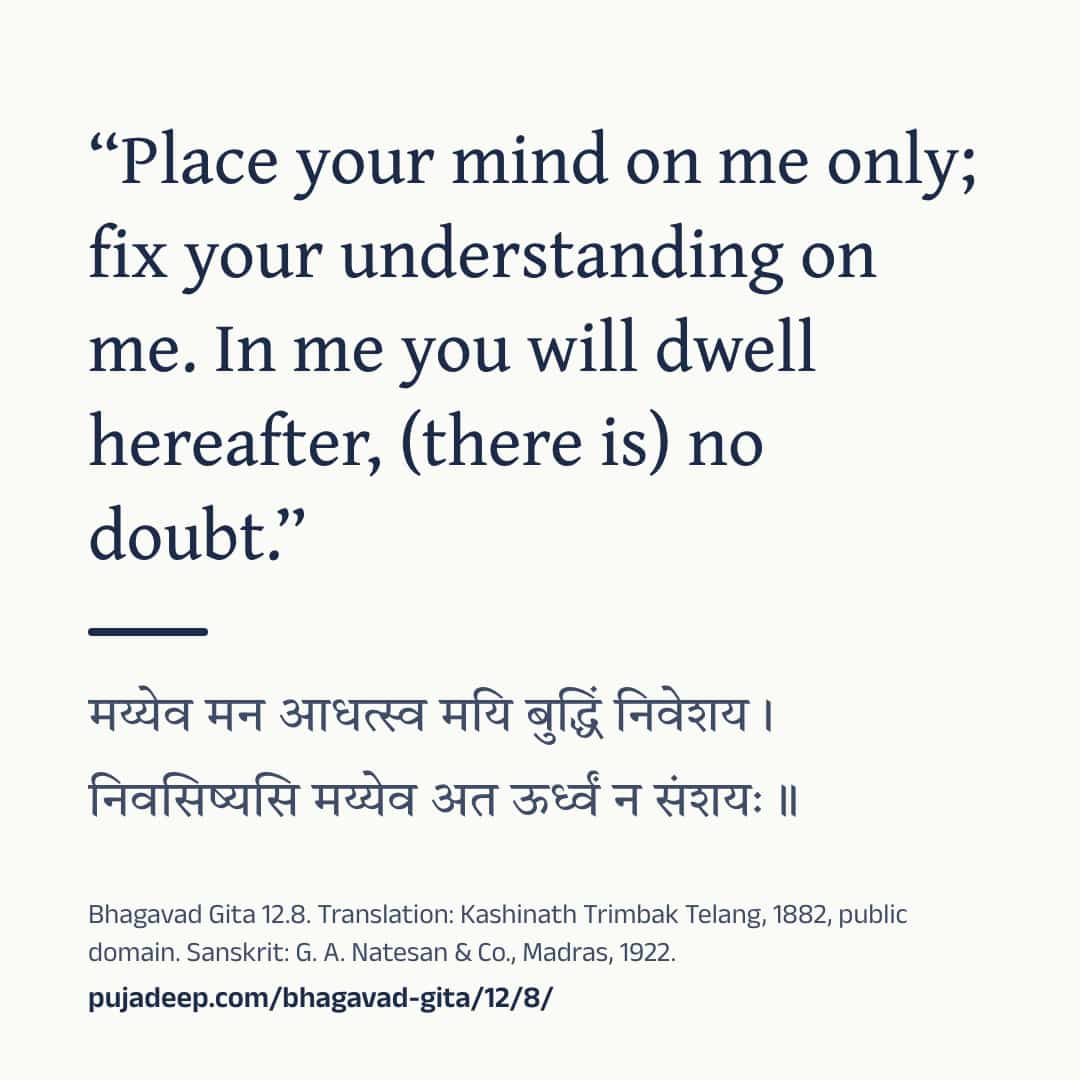
Bhagavad Gita 12.8

मय्येव मन आधत्स्व मयि बुद्धिं निवेशय ।
निवसिष्यसि मय्येव अत ऊर्ध्वं न संशयः ॥

“Place your mind on me only; fix your understanding on me. In me you will dwell hereafter, (there is) no doubt.”
(K. T. Telang, The Bhagavadgîtâ (The Sacred Books of the East, vol. VIII, Oxford: Clarendon Press, 1882), p. 100, public domain)

“Place thy Manas in Me, into Me let thy Buddhi enter; then doubtless thou shalt abide in Me on high hereafter.”
(Annie Besant, The Bhagavad Gîtâ, or The Lord's Song (London: Theosophical Publishing Society, 1895), p. 119, public domain)

“Fix thy mind on Me only, place thy intellect in Me: thou shalt no doubt live in Me hereafter.”
(Swami Swarupananda, Srimad-Bhagavad-Gita (Mayavati: Prabuddha Bharata Press, 1909; first printed in Prabuddha Bharata, 1907–1909), p. 246, public domain)

Sanskrit: G. A. Natesan & Co., Madras, 1922.
https://pujadeep.com/bhagavad-gita/12/8/ Nothing is sent from this site. Your own app sends it, to the chat you choose. The picture quotes the translation you chose on this page, with its name and year.
Sanskrit text: The Bhagavad-Gita, or The Lord's Song, with the text in Devanagari and an English translation, 1922. Meanings: written for Pujadeep and checked against the cited edition. Source and changes
Questions families ask
Who speaks Bhagavad Gita 12.8?
Krishna speaks this verse, in chapter 12 (Bhakti Yoga).
Where does the Sanskrit text come from?
Sanskrit text: The Bhagavad-Gita, or The Lord's Song, with the text in Devanagari and an English translation, 1922. Meanings: written for Pujadeep and checked against the cited edition. See the source
Is the meaning on this page a translation?
Explanation written for this site from the sources listed here, and checked against the cited edition. It is not a translation and not the only way to read the text. Free to quote with credit.
Source and licence
- Sanskrit text
- The Bhagavad-Gita, or The Lord's Song, with the text in Devanagari and an English translation (Annie Besant, G. A. Natesan & Co., Madras, 1922). Public domain. The Sanskrit on these pages was read from this printing’s page images.
- Translation
- The Bhagavadgîtâ with the Sanatsugâtîya and the Anugîtâ, translated by Kâshinâth Trimbak Telang (The Sacred Books of the East, vol. VIII, ed. F. Max Müller) (Kashinath Trimbak Telang, F. Max Müller, Clarendon Press, Oxford, 1882). Public domain. Shown verbatim, as printed.
- Translation
- The Bhagavad Gîtâ, or The Lord's Song, translated by Annie Besant (Annie Besant, Theosophical Publishing Society, London, 1895). Public domain. Shown verbatim, as printed.
- Translation
- Srimad-Bhagavad-Gita, with Sanskrit Text; Paraphrase with Word-by-word Literal Translation; English Rendering and Comments, Index, &c., by the Swami Swarupananda (Himalayan Series, No. XX) (Swami Swarupananda, The Editors and Publishers, Advaita Ashrama, Mayavati, Prabuddha Bharata Press, Mayavati, Almora, Himalayas, 1909). Public domain. Shown verbatim, as printed.
- Commentary
- The Bhagavad-Gita: translation and commentaries in English according to Sri Madhwacharya's Bhashyas, by S. Subba Rau (Madras, 1906) (Scan uploaded to archive.org (folkscanomy collection)). Summarised in our own words; none of its text is reproduced.
- Common wording
- In this text, 32 words follow today's common wording, checked against sanskritdocuments.org; Sanskrit Wikisource; Gita Press, Gorakhpur; GRETIL, Göttingen and Bhaktivedanta Book Trust.
- Our explanation
- Explanation written for this site from the sources listed here, and checked against the cited edition. It is not a translation and not the only way to read the text. Free to quote with credit.
- Checked
- Checked against the cited edition, October 27, 2026.