Bhagavad Gita 12.3: meaning and translation
Chapter 12: Bhakti Yoga. Krishna says
Krishna now speaks of the other group, those who worship the Imperishable (akṣara).
Click or tap a word for its meaning and its dictionary page.
Text and layers
Text and layers
These choices stay in this browser.
Bhagavad Gita 12.3
ये त्वक्षरमनिर्देश्यमव्यक्तं पर्युपासते ।सर्वत्रगमचिन्त्यं च कूटस्थमचलं ध्रुवम् ॥
Ye tvaksharamanirdeshyamavyaktam paryupasateSarvatragamachintyam cha kutasthamachalam dhruvam
ye tvakṣaramanirdeśyamavyaktaṃ paryupāsate |sarvatragamacintyaṃ ca kūṭasthamacalaṃ dhruvam ||
Our explanation Krishna now speaks of the other group, those who worship the Imperishable (akṣara). He describes it as beyond words, unmanifest, present everywhere, beyond thought, unchanging (kūṭastha), unmoving and constant. The sentence continues in the next verse.
हिंदी अर्थ अब कृष्ण दूसरे समूह की बात करते हैं, जो अक्षर (अविनाशी) की उपासना करते हैं। वे उसे ऐसा बताते हैं जिसे शब्दों में न बताया जा सके, जो अव्यक्त है, सब जगह व्याप्त है, सोच से परे है, कूटस्थ (कभी न बदलने वाला), अचल और ध्रुव (नित्य) है। यह वाक्य अगले श्लोक में पूरा होता है।
Word by word
Every word, with its dictionary page
Word by word
- ये ye · those who (relative pronoun, nominative plural) Dictionary: yad, Monier-Williams 1899, p. 844, col. 2 “who, which, what, whichever, whatever, that”
- तु tu · but (indeclinable) Dictionary: 2. tu, Monier-Williams 1899, p. 449, col. 3 “but; and; or”
- अक्षरम् akṣaram · the Imperishable (accusative singular) Dictionary: a-kṣara, Monier-Williams 1899, p. 3, col. 2 “imperishable; unalterable”
- अनिर्देश्यम् anirdeśyam · that cannot be defined (accusative singular) Dictionary: a-nirdeśya, Monier-Williams 1899, p. 30, col. 1 “undefinable, inexplicable, incomparable”
- अव्यक्तम् avyaktam · the Unmanifest (accusative singular) Dictionary: a-vyakta, Monier-Williams 1899, p. 111, col. 2 “not manifest, unapparent, indistinct, invisible, imperceptible”
- पर्युपासते paryupāsate · worship, attend on (present, 3rd person plural) Dictionary: pary-upās, Monier-Williams 1899, p. 608, col. 3 “to approach respectfully, attend upon, worship”
- सर्वत्रगम् sarvatragam · present everywhere (accusative singular) Dictionary: sarvatra-ga, Monier-Williams 1899, p. 1189, col. 2 “all-pervading, omnipresent”
- अचिन्त्यम् acintyam · beyond thought (accusative singular) Dictionary: a-cintya, Monier-Williams 1899, p. 9, col. 1 “inconceivable, surpassing thought”
- च ca · and (indeclinable) Dictionary: 2. ca, Monier-Williams 1899, p. 380, col. 1 “and, both, also, moreover, as well as”
- कूटस्थम् kūṭastham · unchanging, standing firm (accusative singular) Dictionary: kūṭa-stha, Monier-Williams 1899, p. 299, col. 3 “(in phil.) immovable, uniform, unchangeable”
- अचलम् acalam · unmoving (accusative singular) Dictionary: a-cala, Monier-Williams 1899, p. 8, col. 3 “not moving, immovable”
- ध्रुवम् dhruvam · constant, eternal (accusative singular) Dictionary: dhruva, Monier-Williams 1899, p. 521, col. 2 “fixed, firm, immovable, unchangeable, constant, lasting, permanent, eternal”
1 printing differs
Edition differences. Another printing or text reads this place differently.
- Spelling A digital text reads Same words. The e-text writes the class nasal and joins the words (चिन्त्यञ्च, अचलन्ध्रुवम्); the 1922 edition writes anusvara (चिन्त्यं च, अचलं ध्रुवम्).
Old translations
Kashinath Trimbak Telang, 1882. Public domain. Page 99–100.
But those, who, restraining the (whole) group of the senses, and with a mind at all times equable, meditate on the indescribable, indestructible, unperceived (principle) which is all-pervading, unthinkable, indifferent1, immovable, and constant, they, intent on the good of all beings, necessarily attain to me.
This sentence covers verses 12.3 to 12.4.
Footnotes (the translator’s own) - Passively looking on what occurs on earth; immovable=changeless; constant=eternal. ↩
Compare 3 translations
Kashinath Trimbak Telang, 1882. Public domain. Page 99–100.
But those, who, restraining the (whole) group of the senses, and with a mind at all times equable, meditate on the indescribable, indestructible, unperceived (principle) which is all-pervading, unthinkable, indifferent1, immovable, and constant, they, intent on the good of all beings, necessarily attain to me.
This sentence covers verses 12.3 to 12.4.
Footnotes (the translator’s own) - Passively looking on what occurs on earth; immovable=changeless; constant=eternal. ↩
You are reading this one
Annie Besant, 1895. Public domain. Page 118.
They who worship the Indestructible, the Invisible, the Unmanifested, Omnipresent and Unthinkable, the Unchanging, Immutable, Eternal,
This sentence goes on in 12.4.
You are reading this one
Swami Swarupananda, 1909 (first printed 1907). Public domain. Page 243–244.
But those also, who worship the Imperishable, the Indefinable, the Unmanifested, the Omnipresent, the Unthinkable, the Unchangeable, the Immovable, the Eternal,—having subdued all the senses, even-minded everywhere, engaged in the welfare of all beings,—verily, they reach only Myself.
This sentence covers verses 12.3 to 12.4.
You are reading this one
Cite this verse
The translation: K. T. Telang, The Bhagavadgîtâ (The Sacred Books of the East, vol. VIII, Oxford: Clarendon Press, 1882), pp. 99–100. Bhagavad Gita 12.3–4.
The translation: Annie Besant, The Bhagavad Gîtâ, or The Lord's Song (London: Theosophical Publishing Society, 1895), p. 118. Bhagavad Gita 12.3.
The translation: Swami Swarupananda, Srimad-Bhagavad-Gita (Mayavati: Prabuddha Bharata Press, 1909; first printed in Prabuddha Bharata, 1907–1909), pp. 243–244. Bhagavad Gita 12.3–4.
Our explanation: “Bhagavad Gita 12.3: meaning and translation.” Pujadeep. Updated October 27, 2026. https://pujadeep.com/bhagavad-gita/12/3/
Pujadeep’s explanations are free to quote with credit: name Pujadeep and link to the page. How to credit
Classical readings, by school
Each reading is named by its school. None is presented as the only meaning.
What Advaita, Vishishtadvaita and Dvaita teach, in short
Shankara Advaita
Shankara takes the Imperishable to be Brahman free of all limiting conditions. Words cannot define it and the senses cannot perceive it, so the mind cannot think of it. He explains kūṭastha as the one who is seated in māyā as its witness and its Lord.
Source: The Bhagavad-Gita, with the commentary of Sri Sankaracharya, translated by A. Mahadeva Sastri (2nd ed., Mysore: G. T. A. Printing Works, 1901), commentary on 12.3–4, pp. 267–268. Summarised in our own words; none of its text is reproduced.
Ramanuja Vishishtadvaita
Ramanuja takes the Imperishable here to be the individual self. It cannot be defined as a god, a human and so on, because it is distinct from the body. It is present in every body, yet cannot be thought of as any bodily form, and it stays the same whatever body it takes. He adds that 15.16–17 shows the Supreme Person to be different from this imperishable self.
Source: Sri Bhagavad-Gita with Sri Ramanujacharya's Visishtadvaita commentary, translated by A. Govindacharya (Madras, 1898), commentary on 12.3–5, pp. 382–383. Summarised in our own words; none of its text is reproduced.
Madhva Dvaita
Madhva again takes the Unmanifest to be Śrī, the conscious Prakṛti, who rules over subtle matter, the non-conscious Prakṛti, in its causal state. She is beyond thought because her good qualities are countless. She is unchanging (acala) because her place never changes: the Lord on one side, all limited beings on the other. Kūṭa he takes as the unmanifest space over which she presides. These many epithets, he says, show that liberation through her worship is possible.
Source: The Bhagavad-Gita: translation and commentaries in English according to Sri Madhwacharya's Bhashyas, by S. Subba Rau (Madras, 1906), commentary on 12.3–12.4, pp. 236–237 (leaves n234–n235). Summarised in our own words; none of its text is reproduced.
Share
Show the ways to share
Send one picture or the text to one chat. The picture names its source and the address of this page.
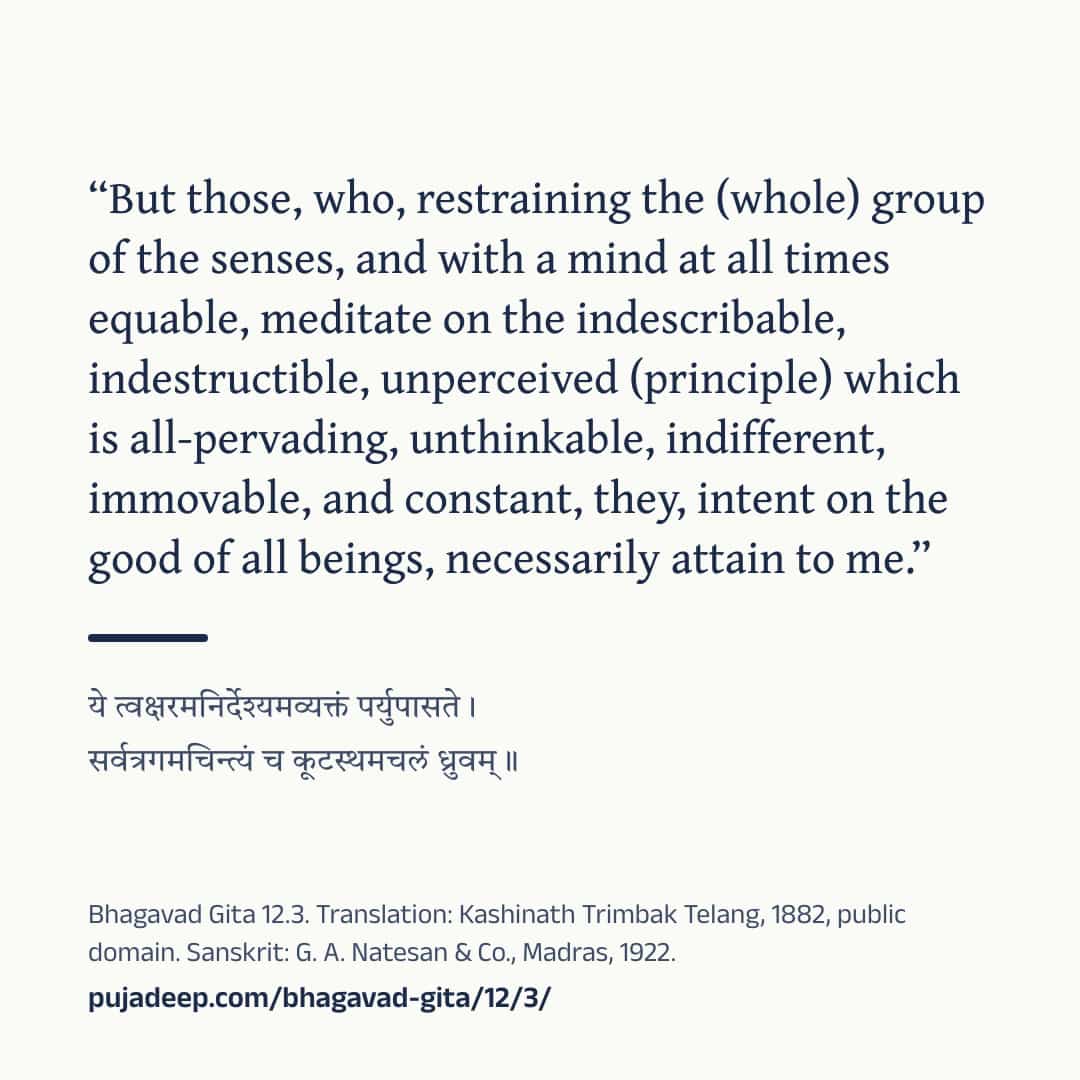
Drawing the picture
See the words
Bhagavad Gita 12.3

ये त्वक्षरमनिर्देश्यमव्यक्तं पर्युपासते ।
सर्वत्रगमचिन्त्यं च कूटस्थमचलं ध्रुवम् ॥

“But those, who, restraining the (whole) group of the senses, and with a mind at all times equable, meditate on the indescribable, indestructible, unperceived (principle) which is all-pervading, unthinkable, indifferent, immovable, and constant, they, intent on the good of all beings, necessarily attain to me.”
(K. T. Telang, The Bhagavadgîtâ (The Sacred Books of the East, vol. VIII, Oxford: Clarendon Press, 1882), pp. 99–100, public domain)
This sentence covers verses 12.3 to 12.4.

“They who worship the Indestructible, the Invisible, the Unmanifested, Omnipresent and Unthinkable, the Unchanging, Immutable, Eternal,”
(Annie Besant, The Bhagavad Gîtâ, or The Lord's Song (London: Theosophical Publishing Society, 1895), p. 118, public domain)
This sentence goes on in 12.4.

“But those also, who worship the Imperishable, the Indefinable, the Unmanifested, the Omnipresent, the Unthinkable, the Unchangeable, the Immovable, the Eternal,—having subdued all the senses, even-minded everywhere, engaged in the welfare of all beings,—verily, they reach only Myself.”
(Swami Swarupananda, Srimad-Bhagavad-Gita (Mayavati: Prabuddha Bharata Press, 1909; first printed in Prabuddha Bharata, 1907–1909), pp. 243–244, public domain)
This sentence covers verses 12.3 to 12.4.

Sanskrit: G. A. Natesan & Co., Madras, 1922.
https://pujadeep.com/bhagavad-gita/12/3/ Nothing is sent from this site. Your own app sends it, to the chat you choose. The picture quotes the translation you chose on this page, with its name and year.
Sanskrit text: The Bhagavad-Gita, or The Lord's Song, with the text in Devanagari and an English translation, 1922. Meanings: written for Pujadeep and checked against the cited edition. Source and changes
Questions families ask
Who speaks Bhagavad Gita 12.3?
Krishna speaks this verse, in chapter 12 (Bhakti Yoga).
Where does the Sanskrit text come from?
Sanskrit text: The Bhagavad-Gita, or The Lord's Song, with the text in Devanagari and an English translation, 1922. Meanings: written for Pujadeep and checked against the cited edition. See the source
Is the meaning on this page a translation?
Explanation written for this site from the sources listed here, and checked against the cited edition. It is not a translation and not the only way to read the text. Free to quote with credit.
Source and licence
- Sanskrit text
- The Bhagavad-Gita, or The Lord's Song, with the text in Devanagari and an English translation (Annie Besant, G. A. Natesan & Co., Madras, 1922). Public domain. The Sanskrit on these pages was read from this printing’s page images.
- Translation
- The Bhagavadgîtâ with the Sanatsugâtîya and the Anugîtâ, translated by Kâshinâth Trimbak Telang (The Sacred Books of the East, vol. VIII, ed. F. Max Müller) (Kashinath Trimbak Telang, F. Max Müller, Clarendon Press, Oxford, 1882). Public domain. Shown verbatim, as printed.
- Translation
- The Bhagavad Gîtâ, or The Lord's Song, translated by Annie Besant (Annie Besant, Theosophical Publishing Society, London, 1895). Public domain. Shown verbatim, as printed.
- Translation
- Srimad-Bhagavad-Gita, with Sanskrit Text; Paraphrase with Word-by-word Literal Translation; English Rendering and Comments, Index, &c., by the Swami Swarupananda (Himalayan Series, No. XX) (Swami Swarupananda, The Editors and Publishers, Advaita Ashrama, Mayavati, Prabuddha Bharata Press, Mayavati, Almora, Himalayas, 1909). Public domain. Shown verbatim, as printed.
- Commentary
- The Bhagavad-Gita, with the commentary of Sri Sankaracharya, translated by A. Mahadeva Sastri (2nd ed., Mysore: G. T. A. Printing Works, 1901) (Public-domain scan, University of California Libraries). Summarised in our own words; none of its text is reproduced.
- Commentary
- Sri Bhagavad-Gita with Sri Ramanujacharya's Visishtadvaita commentary, translated by A. Govindacharya (Madras, 1898) (Scan uploaded to archive.org (folkscanomy collection)). Summarised in our own words; none of its text is reproduced.
- Commentary
- The Bhagavad-Gita: translation and commentaries in English according to Sri Madhwacharya's Bhashyas, by S. Subba Rau (Madras, 1906) (Scan uploaded to archive.org (folkscanomy collection)). Summarised in our own words; none of its text is reproduced.
- Common wording
- In this text, 32 words follow today's common wording, checked against sanskritdocuments.org; Sanskrit Wikisource; Gita Press, Gorakhpur; GRETIL, Göttingen and Bhaktivedanta Book Trust.
- Our explanation
- Explanation written for this site from the sources listed here, and checked against the cited edition. It is not a translation and not the only way to read the text. Free to quote with credit.
- Checked
- Checked against the cited edition, October 27, 2026.