Bhagavad Gita 12.14: meaning and translation
Chapter 12: Bhakti Yoga. Krishna says
Such a person is always content, steady in yoga, self-controlled and firm in resolve, with mind and understanding offered to Krishna.
Click or tap a word for its meaning and its dictionary page.
Text and layers
Text and layers
These choices stay in this browser.
Bhagavad Gita 12.14
सन्तुष्टः सततं योगी यतात्मा दृढनिश्चयः ।मय्यर्पितमनोबुद्धिर्यो मद्भक्तः स मे प्रियः ॥
Santushtah satatam yogi yatatma dridhanishchayahMayyarpitamanobuddhiryo madbhaktah sa me priyah
santuṣṭaḥ satataṃ yogī yatātmā dṛḍhaniścayaḥ |mayyarpitamanobuddhiryo madbhaktaḥ sa me priyaḥ ||
Our explanation Such a person is always content, steady in yoga, self-controlled and firm in resolve, with mind and understanding offered to Krishna. Krishna says that such a devotee is dear to him.
हिंदी अर्थ ऐसा व्यक्ति सदा संतुष्ट रहता है, योग में स्थिर रहता है, अपने मन को वश में रखता है, दृढ़ निश्चय वाला है, और उसने अपना मन और बुद्धि कृष्ण को अर्पित कर दी है। कृष्ण कहते हैं कि ऐसा भक्त उन्हें प्रिय है।
Word by word
Every word, with its dictionary page
Word by word
- सन्तुष्टः santuṣṭaḥ · content (past participle, nominative singular) Dictionary: saṃ-tuṣṭa, Monier-Williams 1899, p. 1142, col. 2 “quite satisfied or contented, well pleased or delighted with”
- सततम् satatam · always (adverb) Dictionary: sa-tata, Monier-Williams 1899, p. 1138, col. 1 “constant, perpetual, continual, uninterrupted”
- योगी yogī · the yogi (nominative singular) Dictionary: yogin, Monier-Williams 1899, p. 857, col. 3 “a follower of the Yoga system, a Yogin (usually called Yogī) or contemplative saint”
- यतात्मा yatātmā · self-controlled (compound, nominative singular) Dictionary: yatātman, Monier-Williams 1899, p. 845, col. 3 “self-restrained”
- दृढनिश्चयः dṛḍhaniścayaḥ · firm in resolve (compound, nominative singular) Dictionary: dṛḍha-niścaya, Monier-Williams 1899, p. 490, col. 2 “‘having fixed certainty,’ certain, undoubted”
- मय्यर्पितमनोबुद्धिः mayyarpitamanobuddhiḥ · mind and intellect given to "me" (compound, nominative singular) Dictionary: 1. mad, Monier-Williams 1899, p. 777, col. 2 “base of the first pers. pron. in the sg. number (esp. in comp.)”; arpita, Monier-Williams 1899, p. 92, col. 3 “offered, delivered, entrusted”; manas, Monier-Williams 1899, p. 783, col. 3 “mind (in its widest sense as applied to all the mental powers)”; buddhi, Monier-Williams 1899, p. 733, col. 3 “intelligence, reason, intellect, mind”
- यः yaḥ · who (relative pronoun, nominative singular) Dictionary: yad, Monier-Williams 1899, p. 844, col. 2 “who, which, what, whichever, whatever, that”
- मद्भक्तः madbhaktaḥ · devotee of "me" (Krishna) (compound, nominative singular) Dictionary: mad-bhakta, Monier-Williams 1899, p. 777, col. 2 “devoted to me”
- सः saḥ · he (pronoun, nominative singular) Dictionary: tad, Monier-Williams 1899, p. 434, col. 1 “m. he, f. she, n. it, that, this”
- मे me · to "me", for "me" (pronoun, genitive singular) Dictionary: 1. mad, Monier-Williams 1899, p. 777, col. 2 “base of the first pers. pron. in the sg. number (esp. in comp.)”
- प्रियः priyaḥ · dear (nominative singular) Dictionary: priya, Monier-Williams 1899, p. 710, col. 1 “beloved, dear to (gen., loc., dat. or comp.), liked, favourite”
2 printings differ
Edition differences. Another printing or text reads this place differently.
- The printed edition reads: सन्तुष्टः सततं योगी यतात्मा दृढनिश्चयः ।
मय्यर्पितमनोबुद्धिर्यो मे भक्तः स मे प्रियः ॥ - Word The 1922 Madras printing reads: मय्यर्पितमनोबुद्धिर्यो मे भक्तः स मे प्रियः The 1922 base printing (leaf n191) reads मे भक्तः ('devoted to me', two words). Under decision 14 the display follows the common wording मद्भक्तः ('my devotee', one compound), printed by Gita Press (p. 145) and read in sanskritdocuments.org, GRETIL and Sanskrit Wikisource. The sense is the same.
Old translations
Kashinath Trimbak Telang, 1882. Public domain.
Telang translates verses 13–14 as one sentence; see 12.13. Read it at 12.13
Compare 3 translations
Kashinath Trimbak Telang, 1882. Public domain.
Telang translates verses 13–14 as one sentence; see 12.13. Read it at 12.13
You are reading this one
Annie Besant, 1895. Public domain. Page 120.
Content with all, ever harmonious, with the self controlled, resolute, with Manas and Buddhi fixed in Me, My devotee, he is dear to Me.
This sentence begins in 12.13.
You are reading this one
Swami Swarupananda, 1909 (first printed 1907). Public domain.
Swarupananda renders verses 13–14 together; see 12.13. Read it at 12.13
You are reading this one
Cite this verse
The translation: K. T. Telang, The Bhagavadgîtâ (The Sacred Books of the East, vol. VIII, Oxford: Clarendon Press, 1882), p. 101. Bhagavad Gita 12.13–14.
The translation: Annie Besant, The Bhagavad Gîtâ, or The Lord's Song (London: Theosophical Publishing Society, 1895), p. 120. Bhagavad Gita 12.14.
The translation: Swami Swarupananda, Srimad-Bhagavad-Gita (Mayavati: Prabuddha Bharata Press, 1909; first printed in Prabuddha Bharata, 1907–1909), p. 249. Bhagavad Gita 12.13–14.
Our explanation: “Bhagavad Gita 12.14: meaning and translation.” Pujadeep. Updated October 27, 2026. https://pujadeep.com/bhagavad-gita/12/14/
Pujadeep’s explanations are free to quote with credit: name Pujadeep and link to the page. How to credit
Classical readings, by school
Each reading is named by its school. None is presented as the only meaning.
What Advaita, Vishishtadvaita and Dvaita teach, in short
Madhva Dvaita
Madhva explains 'firm in resolve' (dṛḍha-niścaya) as one whose settled understanding of the truth is not shaken by doubts about whether it is right.
Source: The Bhagavad-Gita: translation and commentaries in English according to Sri Madhwacharya's Bhashyas, by S. Subba Rau (Madras, 1906), commentary on 12.13–12.14, p. 241 (leaf n239). Summarised in our own words; none of its text is reproduced.
Share
Show the ways to share
Send one picture or the text to one chat. The picture names its source and the address of this page.
Drawing the picture
See the words
Bhagavad Gita 12.14

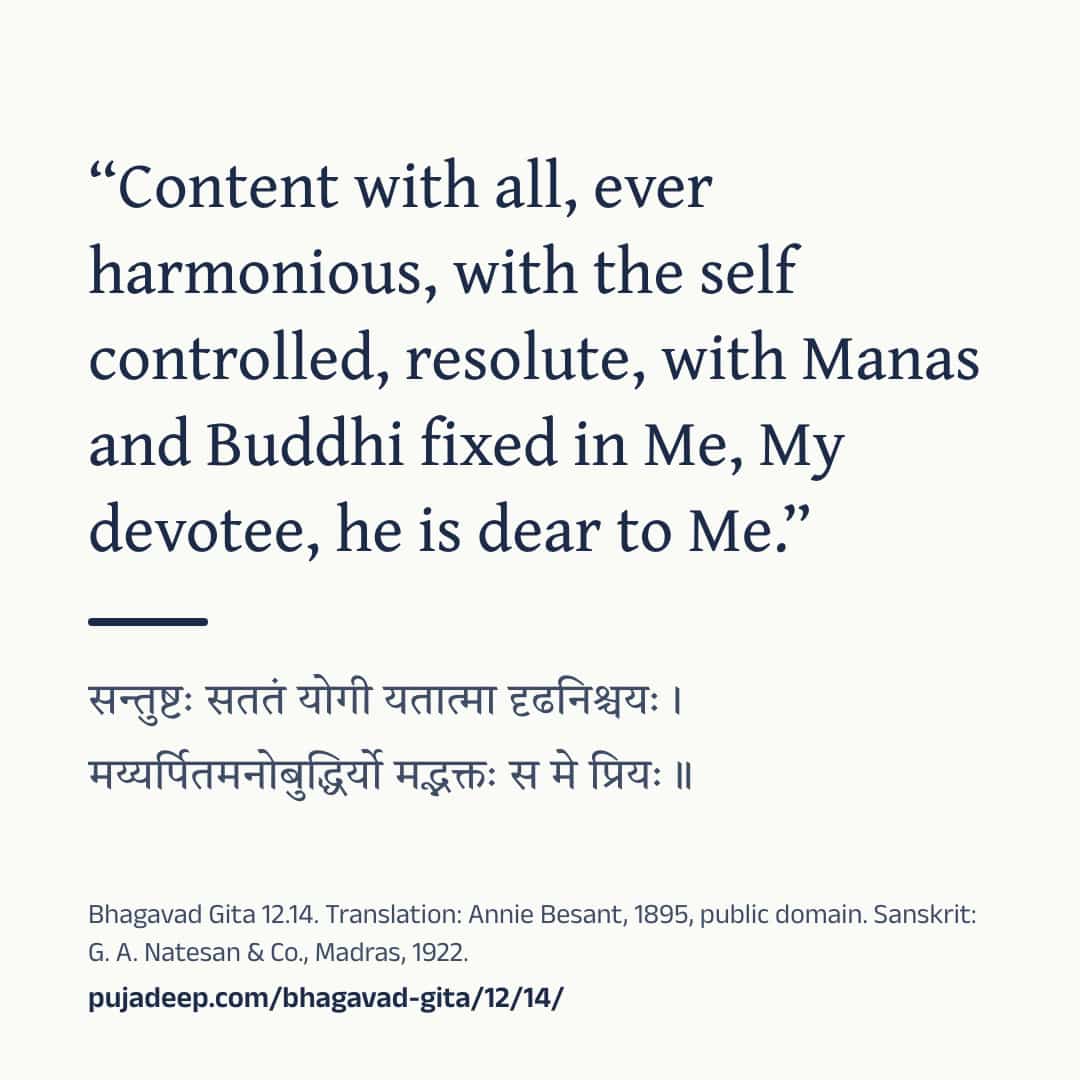
सन्तुष्टः सततं योगी यतात्मा दृढनिश्चयः ।
मय्यर्पितमनोबुद्धिर्यो मद्भक्तः स मे प्रियः ॥

“Content with all, ever harmonious, with the self controlled, resolute, with Manas and Buddhi fixed in Me, My devotee, he is dear to Me.”
(Annie Besant, The Bhagavad Gîtâ, or The Lord's Song (London: Theosophical Publishing Society, 1895), p. 120, public domain)
This sentence begins in 12.13.

Sanskrit: G. A. Natesan & Co., Madras, 1922.
https://pujadeep.com/bhagavad-gita/12/14/ Nothing is sent from this site. Your own app sends it, to the chat you choose. The picture quotes the translation you chose on this page, with its name and year.
Sanskrit text: The Bhagavad-Gita, or The Lord's Song, with the text in Devanagari and an English translation, 1922. Meanings: written for Pujadeep and checked against the cited edition. Source and changes
Questions families ask
Who speaks Bhagavad Gita 12.14?
Krishna speaks this verse, in chapter 12 (Bhakti Yoga).
Where does the Sanskrit text come from?
Sanskrit text: The Bhagavad-Gita, or The Lord's Song, with the text in Devanagari and an English translation, 1922. Meanings: written for Pujadeep and checked against the cited edition. See the source
Is the meaning on this page a translation?
Explanation written for this site from the sources listed here, and checked against the cited edition. It is not a translation and not the only way to read the text. Free to quote with credit.
Source and licence
- Sanskrit text
- The Bhagavad-Gita, or The Lord's Song, with the text in Devanagari and an English translation (Annie Besant, G. A. Natesan & Co., Madras, 1922). Public domain. The Sanskrit on these pages was read from this printing’s page images.
- Translation
- The Bhagavadgîtâ with the Sanatsugâtîya and the Anugîtâ, translated by Kâshinâth Trimbak Telang (The Sacred Books of the East, vol. VIII, ed. F. Max Müller) (Kashinath Trimbak Telang, F. Max Müller, Clarendon Press, Oxford, 1882). Public domain. Shown verbatim, as printed.
- Translation
- The Bhagavad Gîtâ, or The Lord's Song, translated by Annie Besant (Annie Besant, Theosophical Publishing Society, London, 1895). Public domain. Shown verbatim, as printed.
- Translation
- Srimad-Bhagavad-Gita, with Sanskrit Text; Paraphrase with Word-by-word Literal Translation; English Rendering and Comments, Index, &c., by the Swami Swarupananda (Himalayan Series, No. XX) (Swami Swarupananda, The Editors and Publishers, Advaita Ashrama, Mayavati, Prabuddha Bharata Press, Mayavati, Almora, Himalayas, 1909). Public domain. Shown verbatim, as printed.
- Commentary
- The Bhagavad-Gita: translation and commentaries in English according to Sri Madhwacharya's Bhashyas, by S. Subba Rau (Madras, 1906) (Scan uploaded to archive.org (folkscanomy collection)). Summarised in our own words; none of its text is reproduced.
- Common wording
- In this text, 32 words follow today's common wording, checked against sanskritdocuments.org; Sanskrit Wikisource; Gita Press, Gorakhpur; GRETIL, Göttingen and Bhaktivedanta Book Trust.
- Our explanation
- Explanation written for this site from the sources listed here, and checked against the cited edition. It is not a translation and not the only way to read the text. Free to quote with credit.
- Checked
- Checked against the cited edition, October 27, 2026.