Bhagavad Gita 12.9: meaning and translation
Chapter 12: Bhakti Yoga. Krishna says
If Arjuna cannot keep his mind (citta) steadily on him, Krishna says, he should seek to reach him through the yoga of practice (abhyāsa-yoga), that is, by steady and repeated effort.
Click or tap a word for its meaning and its dictionary page.
Text and layers
Text and layers
These choices stay in this browser.
Bhagavad Gita 12.9
अथ चित्तं समाधातुं न शक्नोषि मयि स्थिरम् ।अभ्यासयोगेन ततो मामिच्छाप्तुं धनञ्जय ॥
Atha chittam samadhatum na shaknoshi mayi sthiramAbhyasayogena tato mamichchhaptum dhananjaya
atha cittaṃ samādhātuṃ na śaknoṣi mayi sthiram |abhyāsayogena tato māmicchāptuṃ dhanañjaya ||
Our explanation If Arjuna cannot keep his mind (citta) steadily on him, Krishna says, he should seek to reach him through the yoga of practice (abhyāsa-yoga), that is, by steady and repeated effort. Krishna calls Arjuna Dhananjaya, winner of wealth.
हिंदी अर्थ कृष्ण कहते हैं कि यदि अर्जुन अपना चित्त उनमें स्थिर नहीं रख पाते, तो अभ्यास-योग से, यानी बार-बार लगातार प्रयास करके, उन्हें पाने की इच्छा करें। यहाँ कृष्ण अर्जुन को धनंजय (धन को जीतने वाले) कहकर पुकारते हैं।
Word by word
Every word, with its dictionary page
Word by word
- अथ atha · now, if (indeclinable) Dictionary: atha, Monier-Williams 1899, p. 17, col. 3 “now; then; moreover”
- चित्तम् cittam · the mind (accusative singular) Dictionary: citta, Monier-Williams 1899, p. 395, col. 3 “the heart, mind”
- समाधातुम् samādhātum · to fix steadily (infinitive ('to do')) Dictionary: sam-ā-dhā, Monier-Williams 1899, p. 1159, col. 3 “to direct or fix the eyes or mind upon”
- न na · not (indeclinable) Dictionary: 2. na, Monier-Williams 1899, p. 523, col. 1 “not, no, nor, neither”
- शक्नोषि śaknoṣi · you are able (present, 2nd person singular) Dictionary: śak, Monier-Williams 1899, p. 1044, col. 2 “to be strong or powerful, be able to or capable of or competent for”
- मयि mayi · on "me" (Krishna) (pronoun, locative singular) Dictionary: 1. mad, Monier-Williams 1899, p. 777, col. 2 “base of the first pers. pron. in the sg. number (esp. in comp.)”
- स्थिरम् sthiram · firmly, steady (accusative singular) Dictionary: sthira, Monier-Williams 1899, p. 1264, col. 3 “fixed, immovable, motionless, still, calm”
- अभ्यासयोगेन abhyāsayogena · by the yoga of practice (compound, instrumental singular) Dictionary: 2. abhy-āsa, Monier-Williams 1899, p. 76, col. 3 “repeated or permanent exercise”; yoga, Monier-Williams 1899, p. 856, col. 2 “the act of yoking, joining, attaching”
- ततः tataḥ · then (indeclinable) Dictionary: tatas, Monier-Williams 1899, p. 432, col. 2 “thereupon, then, after that, afterwards”
- माम् mām · "me" (Krishna) (pronoun, accusative singular) Dictionary: 1. mad, Monier-Williams 1899, p. 777, col. 2 “base of the first pers. pron. in the sg. number (esp. in comp.)”
- इच्छ iccha · seek, wish (imperative, 2nd person singular) Dictionary: 3. iṣ, Monier-Williams 1899, p. 169, col. 1 “to endeavour to obtain, strive, seek for”
- आप्तुम् āptum · to reach (infinitive ('to do')) Dictionary: 1. āp, Monier-Williams 1899, p. 142, col. 1 “to reach, overtake, meet with, fall upon”
- धनञ्जय dhanañjaya · O winner of wealth (Arjuna) (vocative singular) Dictionary: dhanaṃ-jaya, Monier-Williams 1899, p. 508, col. 2 “N. of Arjuna”
2 printings differ
Edition differences. Another printing or text reads this place differently.
- The printed edition reads: अथ चित्तं समाधातुं न शक्नोषि मयि स्थिरम् ।
अभ्यासयोगेन ततों मामिच्छाप्तुं धनञ्जय ॥ The print shows a dot like an anusvara over तो (ततों); read as a printing flaw and not shown, because tataḥ before mām becomes tato with no nasal and both proofreading references read ततो (tato). Same kind of flaw as the dots logged on 2.57 and 2.60. - Spelling The 1922 Madras printing reads: अभ्यासयोगेन ततों मामिच्छाप्तुं धनञ्जय The 1922 base printing (leaf n189) shows a stray dot over तो (ततों), a printing flaw; see normalisations.
Old translations
Kashinath Trimbak Telang, 1882. Public domain. Page 100.
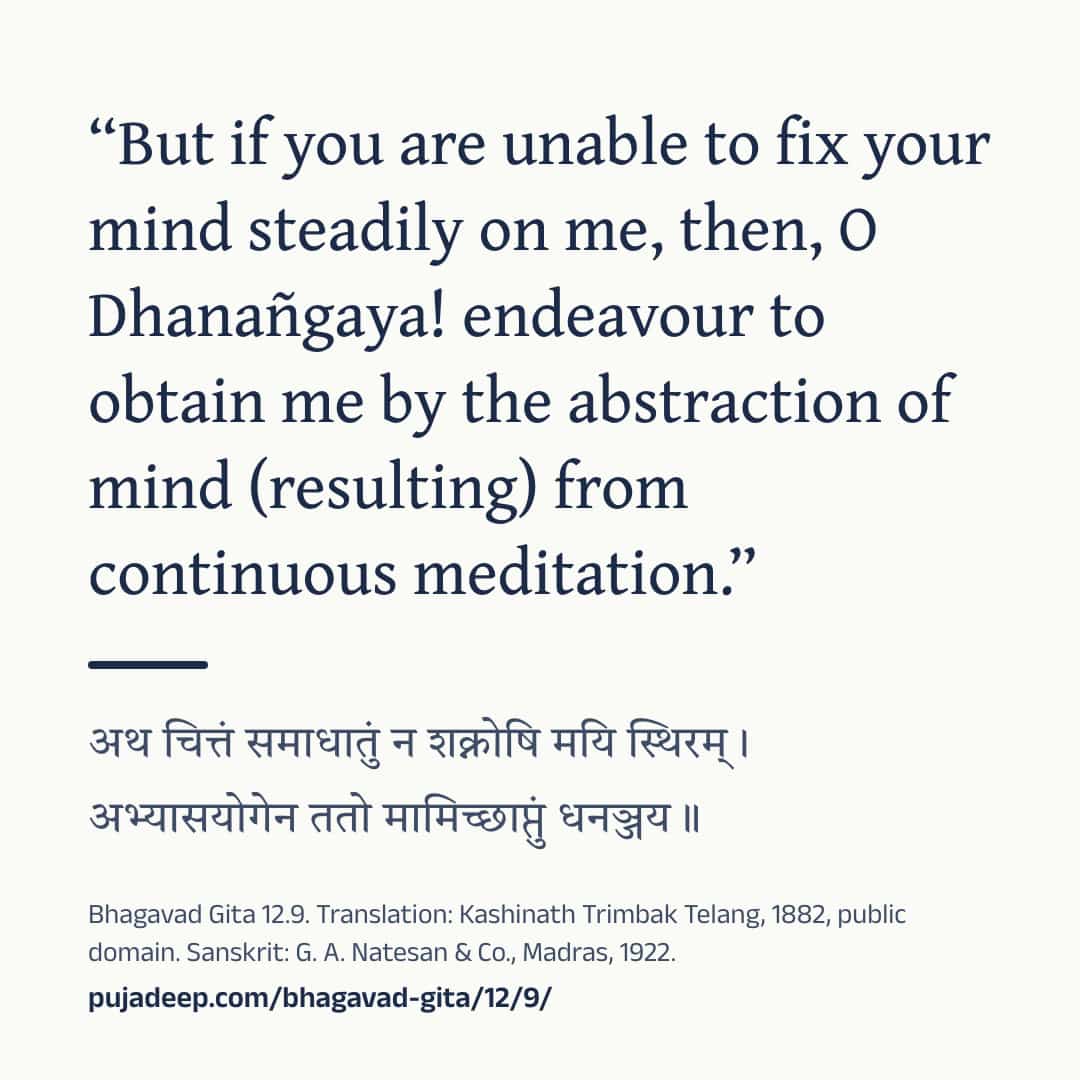
But if you are unable to fix your mind steadily on me, then, O Dhanañgaya! endeavour1 to obtain me by the abstraction of mind (resulting) from continuous meditation2.
Footnotes (the translator’s own) Compare 3 translations
Kashinath Trimbak Telang, 1882. Public domain. Page 100.
But if you are unable to fix your mind steadily on me, then, O Dhanañgaya! endeavour1 to obtain me by the abstraction of mind (resulting) from continuous meditation2.
Footnotes (the translator’s own) You are reading this one
Annie Besant, 1895. Public domain. Page 119.
Yet if thou hast not strength firmly to place thy mind in Me, then by constant practice in Yoga seek to reach Me, O Dhananjaya.
You are reading this one
Swami Swarupananda, 1909 (first printed 1907). Public domain. Page 246.
If thou art unable to fix thy mind steadily on Me, then by Abhyâsa-Yoga do thou seek to reach Me, O Dhananjaya.
You are reading this one
Cite this verse
The translation: K. T. Telang, The Bhagavadgîtâ (The Sacred Books of the East, vol. VIII, Oxford: Clarendon Press, 1882), p. 100. Bhagavad Gita 12.9.
The translation: Annie Besant, The Bhagavad Gîtâ, or The Lord's Song (London: Theosophical Publishing Society, 1895), p. 119. Bhagavad Gita 12.9.
The translation: Swami Swarupananda, Srimad-Bhagavad-Gita (Mayavati: Prabuddha Bharata Press, 1909; first printed in Prabuddha Bharata, 1907–1909), p. 246. Bhagavad Gita 12.9.
Our explanation: “Bhagavad Gita 12.9: meaning and translation.” Pujadeep. Updated October 27, 2026. https://pujadeep.com/bhagavad-gita/12/9/
Pujadeep’s explanations are free to quote with credit: name Pujadeep and link to the page. How to credit
Classical readings, by school
Each reading is named by its school. None is presented as the only meaning.
What Advaita, Vishishtadvaita and Dvaita teach, in short
Madhva Dvaita
Madhva takes the practice (abhyāsa) of this verse to be the practice of drawing the mind back from other things and fixing it on the Lord.
Source: The Bhagavad-Gita: translation and commentaries in English according to Sri Madhwacharya's Bhashyas, by S. Subba Rau (Madras, 1906), commentary on 12.9, p. 240 (leaf n238). Summarised in our own words; none of its text is reproduced.
Share
Show the ways to share
Send one picture or the text to one chat. The picture names its source and the address of this page.
Drawing the picture
See the words
Bhagavad Gita 12.9

अथ चित्तं समाधातुं न शक्नोषि मयि स्थिरम् ।
अभ्यासयोगेन ततो मामिच्छाप्तुं धनञ्जय ॥

“But if you are unable to fix your mind steadily on me, then, O Dhanañgaya! endeavour to obtain me by the abstraction of mind (resulting) from continuous meditation.”
(K. T. Telang, The Bhagavadgîtâ (The Sacred Books of the East, vol. VIII, Oxford: Clarendon Press, 1882), p. 100, public domain)

“Yet if thou hast not strength firmly to place thy mind in Me, then by constant practice in Yoga seek to reach Me, O Dhananjaya.”
(Annie Besant, The Bhagavad Gîtâ, or The Lord's Song (London: Theosophical Publishing Society, 1895), p. 119, public domain)

“If thou art unable to fix thy mind steadily on Me, then by Abhyâsa-Yoga do thou seek to reach Me, O Dhananjaya.”
(Swami Swarupananda, Srimad-Bhagavad-Gita (Mayavati: Prabuddha Bharata Press, 1909; first printed in Prabuddha Bharata, 1907–1909), p. 246, public domain)

Sanskrit: G. A. Natesan & Co., Madras, 1922.
https://pujadeep.com/bhagavad-gita/12/9/ Nothing is sent from this site. Your own app sends it, to the chat you choose. The picture quotes the translation you chose on this page, with its name and year.
Sanskrit text: The Bhagavad-Gita, or The Lord's Song, with the text in Devanagari and an English translation, 1922. Meanings: written for Pujadeep and checked against the cited edition. Source and changes
Questions families ask
Who speaks Bhagavad Gita 12.9?
Krishna speaks this verse, in chapter 12 (Bhakti Yoga).
Where does the Sanskrit text come from?
Sanskrit text: The Bhagavad-Gita, or The Lord's Song, with the text in Devanagari and an English translation, 1922. Meanings: written for Pujadeep and checked against the cited edition. See the source
Is the meaning on this page a translation?
Explanation written for this site from the sources listed here, and checked against the cited edition. It is not a translation and not the only way to read the text. Free to quote with credit.
Source and licence
- Sanskrit text
- The Bhagavad-Gita, or The Lord's Song, with the text in Devanagari and an English translation (Annie Besant, G. A. Natesan & Co., Madras, 1922). Public domain. The Sanskrit on these pages was read from this printing’s page images.
- Translation
- The Bhagavadgîtâ with the Sanatsugâtîya and the Anugîtâ, translated by Kâshinâth Trimbak Telang (The Sacred Books of the East, vol. VIII, ed. F. Max Müller) (Kashinath Trimbak Telang, F. Max Müller, Clarendon Press, Oxford, 1882). Public domain. Shown verbatim, as printed.
- Translation
- The Bhagavad Gîtâ, or The Lord's Song, translated by Annie Besant (Annie Besant, Theosophical Publishing Society, London, 1895). Public domain. Shown verbatim, as printed.
- Translation
- Srimad-Bhagavad-Gita, with Sanskrit Text; Paraphrase with Word-by-word Literal Translation; English Rendering and Comments, Index, &c., by the Swami Swarupananda (Himalayan Series, No. XX) (Swami Swarupananda, The Editors and Publishers, Advaita Ashrama, Mayavati, Prabuddha Bharata Press, Mayavati, Almora, Himalayas, 1909). Public domain. Shown verbatim, as printed.
- Commentary
- The Bhagavad-Gita: translation and commentaries in English according to Sri Madhwacharya's Bhashyas, by S. Subba Rau (Madras, 1906) (Scan uploaded to archive.org (folkscanomy collection)). Summarised in our own words; none of its text is reproduced.
- Common wording
- In this text, 32 words follow today's common wording, checked against sanskritdocuments.org; Sanskrit Wikisource; Gita Press, Gorakhpur; GRETIL, Göttingen and Bhaktivedanta Book Trust.
- Our explanation
- Explanation written for this site from the sources listed here, and checked against the cited edition. It is not a translation and not the only way to read the text. Free to quote with credit.
- Checked
- Checked against the cited edition, October 27, 2026.