Bhagavad Gita 12.20: meaning and translation
Chapter 12: Bhakti Yoga. Krishna says
Krishna closes the chapter.
Click or tap a word for its meaning and its dictionary page.
Text and layers
Text and layers
These choices stay in this browser.
Bhagavad Gita 12.20
ये तु धर्म्यामृतमिदं यथोक्तं पर्युपासते ।श्रद्दधाना मत्परमा भक्तास्तेऽतीव मे प्रियाः ॥
Ye tu dharmyamritamidam yathoktam paryupasateShraddadhana matparama bhaktastetiva me priyah
ye tu dharmyāmṛtamidaṃ yathoktaṃ paryupāsate |śraddadhānā matparamā bhaktāste’tīva me priyāḥ ||
Our explanation Krishna closes the chapter. Those devotees who follow this life-giving teaching of dharma (dharmyāmṛta) as he has set it out, with faith and holding him as their highest goal, are exceedingly dear to him. The schools differ on what “this” teaching refers to (see the views).
हिंदी अर्थ कृष्ण अध्याय को पूरा करते हैं। जो भक्त श्रद्धा के साथ, उन्हें परम लक्ष्य मानकर, इस धर्ममय अमृत (धर्म्यामृत) का, जैसा उन्होंने बताया, पालन करते हैं, वे उन्हें अत्यंत प्रिय हैं। परंपराएँ अलग-अलग ढंग से बताती हैं कि यहाँ “यह” किस उपदेश की ओर संकेत करता है।
Word by word
Every word, with its dictionary page
Word by word
- ये ye · those who (relative pronoun, nominative plural) Dictionary: yad, Monier-Williams 1899, p. 844, col. 2 “who, which, what, whichever, whatever, that”
- तु tu · but, indeed (indeclinable) Dictionary: 2. tu, Monier-Williams 1899, p. 449, col. 3 “but; and; or”
- धर्म्यामृतम् dharmyāmṛtam · life-giving teaching of dharma (compound, accusative singular) Dictionary: dharmyāmṛta, Monier-Williams 1899, p. 513, col. 1 “the nectar of law or faith”; a-mṛta, Monier-Williams 1899, p. 82, col. 2 “the nectar (conferring immortality, produced at the churning of the ocean), ambrosia”
- इदम् idam · this (pronoun, accusative singular) Dictionary: 1. idam, Monier-Williams 1899, p. 165, col. 2 “this, this here, referring to something near the speaker”
- यथोक्तम् yathoktam · as told (accusative singular) Dictionary: yathokta, Monier-Williams 1899, p. 843, col. 3 “as said or told, previously t° or prescribed, above mentioned”
- पर्युपासते paryupāsate · follow, worship (present, 3rd person plural) Dictionary: pary-upās, Monier-Williams 1899, p. 608, col. 3 “to approach respectfully, attend upon, worship”
- श्रद्दधानाः śraddadhānāḥ · having faith (present participle, nominative plural) Dictionary: śrad-dhā, Monier-Williams 1899, p. 1095, col. 3 “to have faith or faithfulness, have belief or confidence, believe”
- मत्परमाः matparamāḥ · holding "me" as highest (compound, nominative plural) Dictionary: mat-para, Monier-Williams 1899, p. 777, col. 2 “devoted to me”
- भक्ताः bhaktāḥ · devotees (nominative plural) Dictionary: bhakta, Monier-Williams 1899, p. 743, col. 1 “attached or devoted to, loyal, faithful, honouring, worshipping, serving”
- ते te · they (pronoun, nominative plural) Dictionary: tad, Monier-Williams 1899, p. 434, col. 1 “m. he, f. she, n. it, that, this”
- अतीव atīva · very, exceedingly (indeclinable) Dictionary: atīva, Monier-Williams 1899, p. 16, col. 2 “exceedingly, very”
- मे me · to "me" (pronoun, genitive singular) Dictionary: 1. mad, Monier-Williams 1899, p. 777, col. 2 “base of the first pers. pron. in the sg. number (esp. in comp.)”
- प्रियाः priyāḥ · dear (nominative plural) Dictionary: priya, Monier-Williams 1899, p. 710, col. 1 “beloved, dear to (gen., loc., dat. or comp.), liked, favourite”
Old translations
Kashinath Trimbak Telang, 1882. Public domain. Page 102.
But those devotees who, imbued with faith, and (regarding) me as their highest (goal), resort to this holy (means for attaining) immortality, as stated, they are extremely dear to me.
Compare 3 translations
Kashinath Trimbak Telang, 1882. Public domain. Page 102.
But those devotees who, imbued with faith, and (regarding) me as their highest (goal), resort to this holy (means for attaining) immortality, as stated, they are extremely dear to me.
You are reading this one
Annie Besant, 1895. Public domain. Page 121.
They verily who according to My teachings partake of that Amrita-Dharma, endued with faith, I their supreme (Object), devotees, they are surpassingly dear to Me.
You are reading this one
Swami Swarupananda, 1909 (first printed 1907). Public domain. Page 251.
And they who follow this Immortal Dharma, as described above, endued with Shraddhá, regarding Me as the Supreme Goal, and devoted,—they are exceedingly dear to Me.
You are reading this one
Cite this verse
The translation: K. T. Telang, The Bhagavadgîtâ (The Sacred Books of the East, vol. VIII, Oxford: Clarendon Press, 1882), p. 102. Bhagavad Gita 12.20.
The translation: Annie Besant, The Bhagavad Gîtâ, or The Lord's Song (London: Theosophical Publishing Society, 1895), p. 121. Bhagavad Gita 12.20.
The translation: Swami Swarupananda, Srimad-Bhagavad-Gita (Mayavati: Prabuddha Bharata Press, 1909; first printed in Prabuddha Bharata, 1907–1909), p. 251. Bhagavad Gita 12.20.
Our explanation: “Bhagavad Gita 12.20: meaning and translation.” Pujadeep. Updated October 27, 2026. https://pujadeep.com/bhagavad-gita/12/20/
Pujadeep’s explanations are free to quote with credit: name Pujadeep and link to the page. How to credit
Classical readings, by school
Each reading is named by its school. None is presented as the only meaning.
What Advaita, Vishishtadvaita and Dvaita teach, in short
Shankara Advaita
Shankara says “this immortal dharma” is the way of life described from 12.13 on, followed by the renunciates who know the Self, and that they are exceedingly dear to the Lord.
Source: The Bhagavad-Gita, with the commentary of Sri Sankaracharya, translated by A. Mahadeva Sastri (2nd ed., Mysore: G. T. A. Printing Works, 1901), commentary on 12.20, p. 276. Summarised in our own words; none of its text is reproduced.
Ramanuja Vishishtadvaita
Ramanuja says the holy, life-giving way meant here is bhakti-yoga itself, set out briefly in 12.2. Those who follow it are the devotees exceedingly dear to the Lord.
Source: Sri Bhagavad-Gita with Sri Ramanujacharya's Visishtadvaita commentary, translated by A. Govindacharya (Madras, 1898), commentary on 12.20, p. 392. Summarised in our own words; none of its text is reproduced.
Madhva Dvaita
Madhva reads the verse as the summing up: the one who has all the virtues named together is the most dear to the Lord. Dharma here, he says, first means the supporter, the Lord; duty and right living are called dharma in a secondary sense. Dharmya is what leads to dharma, and amṛta (nectar) means what leads to immortality.
Source: The Bhagavad-Gita: translation and commentaries in English according to Sri Madhwacharya's Bhashyas, by S. Subba Rau (Madras, 1906), commentary on 12.20, pp. 242–243 (leaves n240–n241). Summarised in our own words; none of its text is reproduced.
Share
Show the ways to share
Send one picture or the text to one chat. The picture names its source and the address of this page.
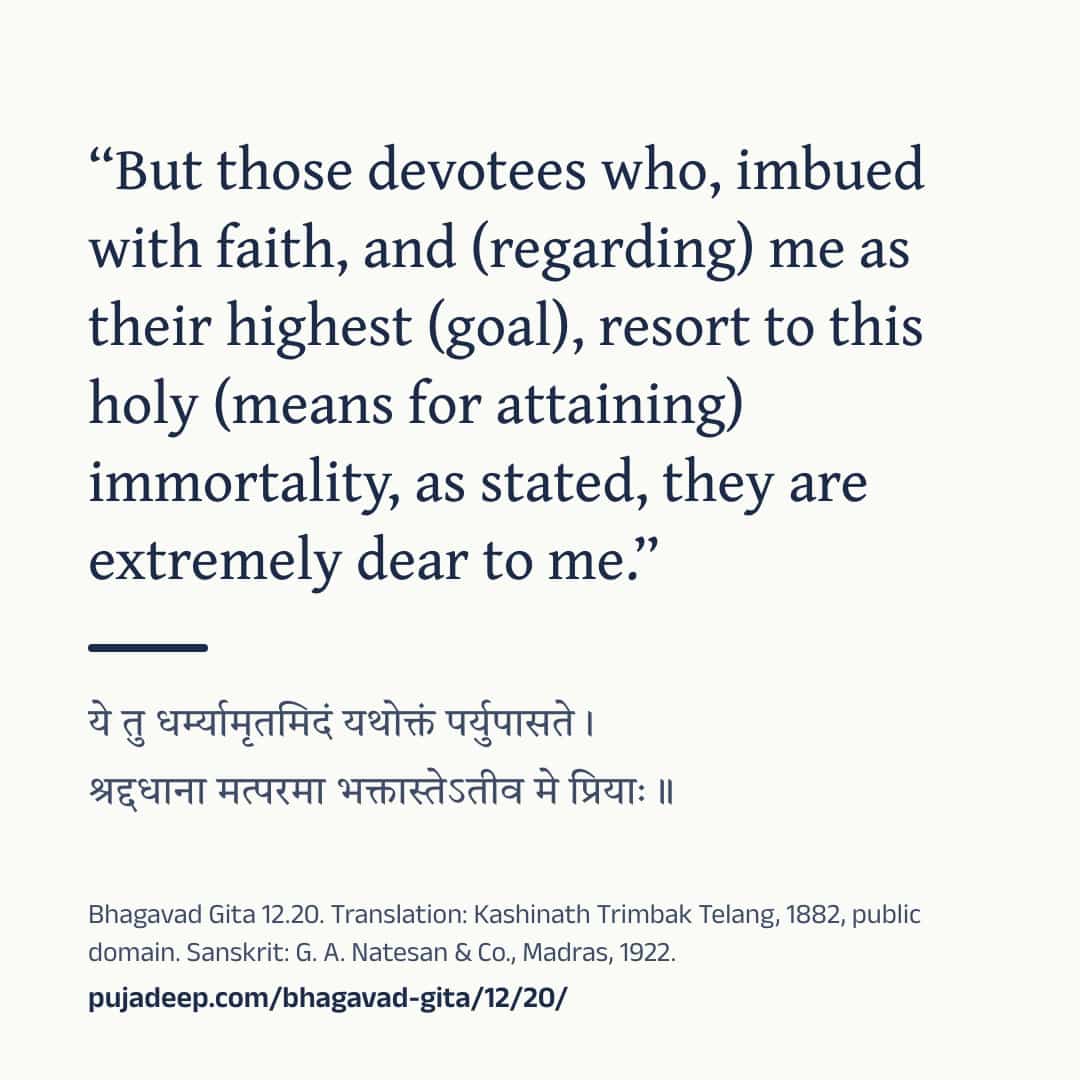
Drawing the picture
See the words
Bhagavad Gita 12.20

ये तु धर्म्यामृतमिदं यथोक्तं पर्युपासते ।
श्रद्दधाना मत्परमा भक्तास्तेऽतीव मे प्रियाः ॥

“But those devotees who, imbued with faith, and (regarding) me as their highest (goal), resort to this holy (means for attaining) immortality, as stated, they are extremely dear to me.”
(K. T. Telang, The Bhagavadgîtâ (The Sacred Books of the East, vol. VIII, Oxford: Clarendon Press, 1882), p. 102, public domain)

“They verily who according to My teachings partake of that Amrita-Dharma, endued with faith, I their supreme (Object), devotees, they are surpassingly dear to Me.”
(Annie Besant, The Bhagavad Gîtâ, or The Lord's Song (London: Theosophical Publishing Society, 1895), p. 121, public domain)

“And they who follow this Immortal Dharma, as described above, endued with Shraddhá, regarding Me as the Supreme Goal, and devoted,—they are exceedingly dear to Me.”
(Swami Swarupananda, Srimad-Bhagavad-Gita (Mayavati: Prabuddha Bharata Press, 1909; first printed in Prabuddha Bharata, 1907–1909), p. 251, public domain)

Sanskrit: G. A. Natesan & Co., Madras, 1922.
https://pujadeep.com/bhagavad-gita/12/20/ Nothing is sent from this site. Your own app sends it, to the chat you choose. The picture quotes the translation you chose on this page, with its name and year.
Sanskrit text: The Bhagavad-Gita, or The Lord's Song, with the text in Devanagari and an English translation, 1922. Meanings: written for Pujadeep and checked against the cited edition. Source and changes
Questions families ask
Who speaks Bhagavad Gita 12.20?
Krishna speaks this verse, in chapter 12 (Bhakti Yoga).
Where does the Sanskrit text come from?
Sanskrit text: The Bhagavad-Gita, or The Lord's Song, with the text in Devanagari and an English translation, 1922. Meanings: written for Pujadeep and checked against the cited edition. See the source
Is the meaning on this page a translation?
Explanation written for this site from the sources listed here, and checked against the cited edition. It is not a translation and not the only way to read the text. Free to quote with credit.
Source and licence
- Sanskrit text
- The Bhagavad-Gita, or The Lord's Song, with the text in Devanagari and an English translation (Annie Besant, G. A. Natesan & Co., Madras, 1922). Public domain. The Sanskrit on these pages was read from this printing’s page images.
- Translation
- The Bhagavadgîtâ with the Sanatsugâtîya and the Anugîtâ, translated by Kâshinâth Trimbak Telang (The Sacred Books of the East, vol. VIII, ed. F. Max Müller) (Kashinath Trimbak Telang, F. Max Müller, Clarendon Press, Oxford, 1882). Public domain. Shown verbatim, as printed.
- Translation
- The Bhagavad Gîtâ, or The Lord's Song, translated by Annie Besant (Annie Besant, Theosophical Publishing Society, London, 1895). Public domain. Shown verbatim, as printed.
- Translation
- Srimad-Bhagavad-Gita, with Sanskrit Text; Paraphrase with Word-by-word Literal Translation; English Rendering and Comments, Index, &c., by the Swami Swarupananda (Himalayan Series, No. XX) (Swami Swarupananda, The Editors and Publishers, Advaita Ashrama, Mayavati, Prabuddha Bharata Press, Mayavati, Almora, Himalayas, 1909). Public domain. Shown verbatim, as printed.
- Commentary
- The Bhagavad-Gita, with the commentary of Sri Sankaracharya, translated by A. Mahadeva Sastri (2nd ed., Mysore: G. T. A. Printing Works, 1901) (Public-domain scan, University of California Libraries). Summarised in our own words; none of its text is reproduced.
- Commentary
- Sri Bhagavad-Gita with Sri Ramanujacharya's Visishtadvaita commentary, translated by A. Govindacharya (Madras, 1898) (Scan uploaded to archive.org (folkscanomy collection)). Summarised in our own words; none of its text is reproduced.
- Commentary
- The Bhagavad-Gita: translation and commentaries in English according to Sri Madhwacharya's Bhashyas, by S. Subba Rau (Madras, 1906) (Scan uploaded to archive.org (folkscanomy collection)). Summarised in our own words; none of its text is reproduced.
- Common wording
- In this text, 32 words follow today's common wording, checked against sanskritdocuments.org; Sanskrit Wikisource; Gita Press, Gorakhpur; GRETIL, Göttingen and Bhaktivedanta Book Trust.
- Our explanation
- Explanation written for this site from the sources listed here, and checked against the cited edition. It is not a translation and not the only way to read the text. Free to quote with credit.
- Checked
- Checked against the cited edition, October 27, 2026.