Bhagavad Gita 13.1: meaning and translation
Chapter 13: Kshetra Kshetrajna Vibhaga Yoga. Arjuna says
In this printing the chapter opens with a question from Arjuna: he wants to know about nature and spirit (prakṛti and puruṣa), the field and the knower of the field (kṣetra and kṣetrajña), and knowledge and what is to be known.
Click or tap a word for its meaning and its dictionary page.
Text and layers
Text and layers
These choices stay in this browser.
Bhagavad Gita 13.1
अर्जुन उवाच ।
प्रकृतिं पुरुषं चैव क्षेत्रं क्षेत्रज्ञमेव च ।एतद्वेदितुमिच्छामि ज्ञानं ज्ञेयं च केशव ॥श्रीभगवानुवाच ।इदं शरीरं कौन्तेय क्षेत्रमित्यभिधीयते ।एतद्यो वेत्ति तं प्राहुः क्षेत्रज्ञ इति तद्विदः ॥
Prakritim purusham chaiva kshetram kshetrajnameva chaEtadveditumichchhami jnanam jneyam cha keshavaShribhagavanuvachaIdam shariram kaunteya kshetramityabhidhiyateEtadyo vetti tam prahuh kshetrajna iti tadvidah
prakṛtiṃ puruṣaṃ caiva kṣetraṃ kṣetrajñameva ca |etadveditumicchāmi jñānaṃ jñeyaṃ ca keśava ||śrībhagavānuvāca |idaṃ śarīraṃ kaunteya kṣetramityabhidhīyate |etadyo vetti taṃ prāhuḥ kṣetrajña iti tadvidaḥ ||
Our explanation In this printing the chapter opens with a question from Arjuna: he wants to know about nature and spirit (prakṛti and puruṣa), the field and the knower of the field (kṣetra and kṣetrajña), and knowledge and what is to be known. Krishna answers. This body, he says, is called the field, and those who know these things call the one who knows it the knower of the field. Telang's and Besant's translations, and the commentaries of Shankara and Ramanuja, do not have Arjuna's question and begin the chapter with Krishna's answer (see the notes).
हिंदी अर्थ इस संस्करण में अध्याय अर्जुन के एक प्रश्न से शुरू होता है: वे प्रकृति और पुरुष, क्षेत्र और क्षेत्रज्ञ (क्षेत्र को जानने वाला), और ज्ञान तथा ज्ञेय (जानने योग्य) के बारे में जानना चाहते हैं। कृष्ण उत्तर देते हैं। वे कहते हैं कि यह शरीर क्षेत्र कहलाता है, और इसे जानने वाले लोग उसे क्षेत्रज्ञ कहते हैं जो इस शरीर को जानता है। तेलंग और बेसेंट के अनुवादों में, और शंकराचार्य तथा रामानुजाचार्य की टीकाओं में, अर्जुन का यह प्रश्न नहीं है और अध्याय कृष्ण के उत्तर से शुरू होता है।
Word by word
Every word, with its dictionary page
Word by word
- प्रकृतिम् prakṛtim · nature (prakṛti) (noun (feminine), accusative singular) Dictionary: pra-kṛti, Monier-Williams 1899, p. 654, col. 1 “the original producer of (or rather passive power of creating) the material world”
- पुरुषम् puruṣam · spirit (puruṣa) (noun (masculine), accusative singular) Dictionary: puruṣa, Monier-Williams 1899, p. 637, col. 1 “the personal and animating principle in men and other beings, the soul or spirit”
- च ca · and (indeclinable) Dictionary: 2. ca, Monier-Williams 1899, p. 380, col. 1 “and, both, also, moreover, as well as”
- एव eva · also (indeclinable) Dictionary: 1. eva, Monier-Williams 1899, p. 232, col. 2 “just, exactly, very, same, only, even, alone, merely”
- क्षेत्रम् kṣetram · the field (noun (neuter), accusative singular) Dictionary: kṣetra, Monier-Williams 1899, p. 332, col. 1 “a field”
- क्षेत्रज्ञम् kṣetrajñam · the knower of the field (noun (masculine), accusative singular) Dictionary: kṣetra-jña, Monier-Williams 1899, p. 332, col. 2 “'knowing the body,' i.e. the soul, the conscious principle in the corporeal frame”
- एव eva · also (indeclinable) Dictionary: 1. eva, Monier-Williams 1899, p. 232, col. 2 “just, exactly, very, same, only, even, alone, merely”
- च ca · and (indeclinable) Dictionary: 2. ca, Monier-Williams 1899, p. 380, col. 1 “and, both, also, moreover, as well as”
- एतत् etat · this (pronoun (neuter), accusative singular) Dictionary: etad, Monier-Williams 1899, p. 231, col. 2 “this, this here, here”
- वेदितुम् veditum · to know (infinitive (to do)) Dictionary: 1. vid, Monier-Williams 1899, p. 963, col. 2 “to know, understand, perceive, learn”
- इच्छामि icchāmi · "I wish" (Arjuna) (present, 1st person singular) Dictionary: 3. iṣ, Monier-Williams 1899, p. 169, col. 1 “to endeavour to obtain, strive, seek for”
- ज्ञानम् jñānam · knowledge (noun (neuter), accusative singular) Dictionary: jñāna, Monier-Williams 1899, p. 426, col. 1 “knowing, becoming acquainted with, knowledge”
- ज्ञेयम् jñeyam · what is to be known (gerundive (to be done) (neuter), accusative singular) Dictionary: jñeya, Monier-Williams 1899, p. 426, col. 2 “to be known”
- च ca · and (indeclinable) Dictionary: 2. ca, Monier-Williams 1899, p. 380, col. 1 “and, both, also, moreover, as well as”
- केशव keśava · O Keshava (Krishna) (noun (masculine), vocative singular) Dictionary: keśava, Monier-Williams 1899, p. 310, col. 3 “N. of Vishṇu or Kṛishṇa”
- इदम् idam · this (pronoun (neuter), nominative singular) Dictionary: 1. idam, Monier-Williams 1899, p. 165, col. 2 “this, this here, referring to something near the speaker”
- शरीरम् śarīram · body (noun (neuter), nominative singular) Dictionary: śarīra, Monier-Williams 1899, p. 1057, col. 3 “the body, bodily frame”
- कौन्तेय kaunteya · O son of Kunti (noun (masculine), vocative singular) Dictionary: kaunteya, Monier-Williams 1899, p. 316, col. 2 “metron. fr. Kuntī”
- क्षेत्रम् kṣetram · the field (noun (neuter), nominative singular) Dictionary: kṣetra, Monier-Williams 1899, p. 332, col. 1 “a field”
- इति iti · so (it is called) (indeclinable) Dictionary: 2. iti, Monier-Williams 1899, p. 165, col. 1 “in this manner, thus”
- अभिधीयते abhidhīyate · is called (present passive, 3rd person singular) Dictionary: 1. abhi-dhā, Monier-Williams 1899, p. 63, col. 2 “to be named or called”
- एतत् etat · this (pronoun (neuter), accusative singular) Dictionary: etad, Monier-Williams 1899, p. 231, col. 2 “this, this here, here”
- यः yaḥ · who (relative pronoun (masculine), nominative singular) Dictionary: yad, Monier-Williams 1899, p. 844, col. 2 “who, which, what, whichever, whatever, that”
- वेत्ति vetti · knows (present, 3rd person singular) Dictionary: 1. vid, Monier-Williams 1899, p. 963, col. 2 “to know, understand, perceive, learn”
- तम् tam · him (pronoun (masculine), accusative singular) Dictionary: tad, Monier-Williams 1899, p. 434, col. 1 “m. he, f. she, n. it, that, this”
- प्राहुः prāhuḥ · they call (perfect, 3rd person plural (present sense)) Dictionary: 1. ah, Monier-Williams 1899, p. 124, col. 1 “to say, speak”
- क्षेत्रज्ञः kṣetrajñaḥ · the knower of the field (noun (masculine), nominative singular) Dictionary: kṣetra-jña, Monier-Williams 1899, p. 332, col. 2 “'knowing the body,' i.e. the soul, the conscious principle in the corporeal frame”
- इति iti · so (it is called) (indeclinable) Dictionary: 2. iti, Monier-Williams 1899, p. 165, col. 1 “in this manner, thus”
- तद्विदः tadvidaḥ · those who know it (compound (masculine), nominative plural) Dictionary: tad-vid, Monier-Williams 1899, p. 434, col. 3 “knowing that, familiar with that”
5 printings differ
Edition differences. Another printing or text reads this place differently.
- The printed edition reads: प्रकृतिं पुरुषं चैव क्षेत्रं क्षेत्रज्ञमेव च ।
ऐतद्वेदितुमिच्छामि ज्ञानं ज्ञेयं च केशव ॥
श्रीभगवानुवाच ।
इदं शरीरं कौन्तेय क्षेत्रमित्यभिधीयते ।
एतद्यो वेत्ति तं प्राहुः क्षेत्रज्ञ इति तद्विदः ॥ The print begins the second line with ऐतद्, an ए carrying the stroke of ऐ (leaf n195); the ए of एतद्यो three lines below has none. Read as a printing flaw and shown as एतद्, the only reading that makes a word here. - Spelling The 1922 Madras printing reads: ऐतद्वेदितुमिच्छामि ज्ञानं ज्ञेयं च केशव The 1922 base printing (leaf n195) puts the stroke of ऐ on the ए of एतद्, a printing flaw; see normalisations.
- Omission A digital text reads Shankara's text, as translated by Sastri (1901, p. 278), has no verse for Arjuna's question; its first verse is इदं शरीरं… (the common 13.1). This is why the common recension counts 34 verses in this chapter.
- Omission A digital text reads Ramanuja's text, as translated by Govindacharya (1898, p. 398), also begins with इदं शरीरं… and has no verse for Arjuna's question.
- Numbering A digital text reads Another digital text has Arjuna's question, like the 1922 edition, and numbers it 13.1; its verse numbers in this chapter are one higher than ours throughout (35 verses). Another digital text does the same.
Old translations
Kashinath Trimbak Telang, 1882. Public domain. Page 102.
The Deity said:
This body, O son of Kuntî! is called Kshetra1, and the learned call him who knows it the Kshetragña2.
Footnotes (the translator’s own) Compare 3 translations
Kashinath Trimbak Telang, 1882. Public domain. Page 102.
The Deity said:
This body, O son of Kuntî! is called Kshetra1, and the learned call him who knows it the Kshetragña2.
Footnotes (the translator’s own) You are reading this one
Annie Besant, 1895. Public domain. Page 122.
The Blessed Lord said:
These bodies, O son of Kuntî, are called the Field; that which knoweth them is called the Knower of the Field by the Sages.
You are reading this one
Swami Swarupananda, 1909 (first printed 1907). Public domain. Page 252–253.
Arjuna said:
Prakriti and Purusha, also the Kshetra and the Knower of the Kshetra, knowledge, and that which ought to be known—these, O Keshava, I desire to learn.
The Blessed Lord said:
This body, O son of Kunti, is called Kshetra, and he who knows it is called Kshetrajna by those who know of them (Kshetra and Kshetrajna).
You are reading this one
Cite this verse
The translation: K. T. Telang, The Bhagavadgîtâ (The Sacred Books of the East, vol. VIII, Oxford: Clarendon Press, 1882), p. 102. Bhagavad Gita 13.1.
The translation: Annie Besant, The Bhagavad Gîtâ, or The Lord's Song (London: Theosophical Publishing Society, 1895), p. 122. Bhagavad Gita 13.1.
The translation: Swami Swarupananda, Srimad-Bhagavad-Gita (Mayavati: Prabuddha Bharata Press, 1909; first printed in Prabuddha Bharata, 1907–1909), pp. 252–253. Bhagavad Gita 13.1.
Our explanation: “Bhagavad Gita 13.1: meaning and translation.” Pujadeep. Updated October 25, 2026. https://pujadeep.com/bhagavad-gita/13/1/
Pujadeep’s explanations are free to quote with credit: name Pujadeep and link to the page. How to credit
Classical readings, by school
No readings by school on this verse yet.
Share
Show the ways to share
Send one picture or the text to one chat. The picture names its source and the address of this page.
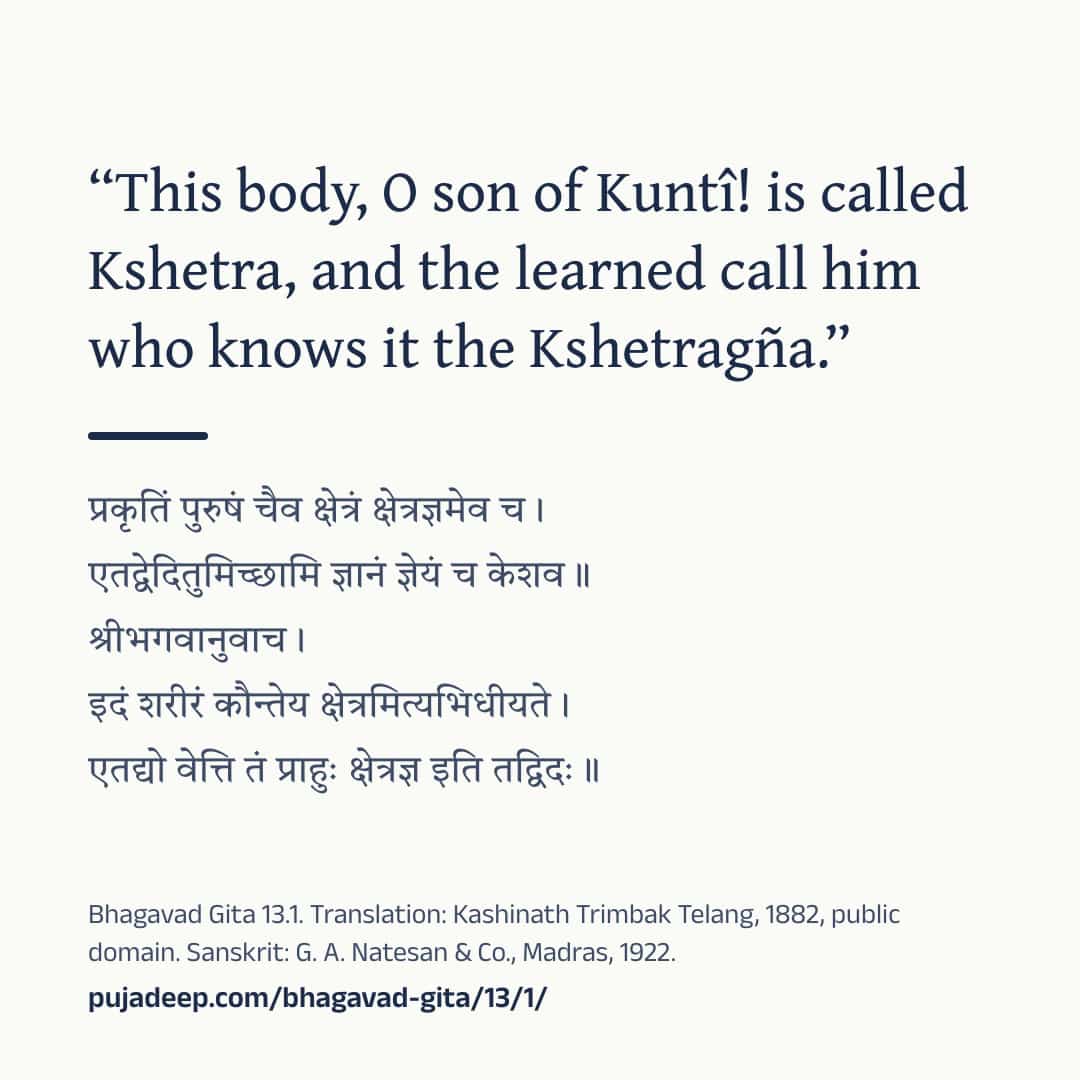
Drawing the picture
See the words
Bhagavad Gita 13.1

प्रकृतिं पुरुषं चैव क्षेत्रं क्षेत्रज्ञमेव च ।
एतद्वेदितुमिच्छामि ज्ञानं ज्ञेयं च केशव ॥
श्रीभगवानुवाच ।
इदं शरीरं कौन्तेय क्षेत्रमित्यभिधीयते ।
एतद्यो वेत्ति तं प्राहुः क्षेत्रज्ञ इति तद्विदः ॥

“This body, O son of Kuntî! is called Kshetra, and the learned call him who knows it the Kshetragña.”
(K. T. Telang, The Bhagavadgîtâ (The Sacred Books of the East, vol. VIII, Oxford: Clarendon Press, 1882), p. 102, public domain)

“These bodies, O son of Kuntî, are called the Field; that which knoweth them is called the Knower of the Field by the Sages.”
(Annie Besant, The Bhagavad Gîtâ, or The Lord's Song (London: Theosophical Publishing Society, 1895), p. 122, public domain)

“Prakriti and Purusha, also the Kshetra and the Knower of the Kshetra, knowledge, and that which ought to be known—these, O Keshava, I desire to learn. The Blessed Lord said: This body, O son of Kunti, is called Kshetra, and he who knows it is called Kshetrajna by those who know of them (Kshetra and Kshetrajna).”
(Swami Swarupananda, Srimad-Bhagavad-Gita (Mayavati: Prabuddha Bharata Press, 1909; first printed in Prabuddha Bharata, 1907–1909), pp. 252–253, public domain)

Sanskrit: G. A. Natesan & Co., Madras, 1922.
https://pujadeep.com/bhagavad-gita/13/1/ Nothing is sent from this site. Your own app sends it, to the chat you choose. The picture quotes the translation you chose on this page, with its name and year.
Sanskrit text: The Bhagavad-Gita, or The Lord's Song, with the text in Devanagari and an English translation, 1922. Meanings: written for Pujadeep and checked against the cited edition. Source and changes
Questions families ask
Who speaks Bhagavad Gita 13.1?
Arjuna speaks this verse, in chapter 13 (Kshetra Kshetrajna Vibhaga Yoga).
Where does the Sanskrit text come from?
Sanskrit text: The Bhagavad-Gita, or The Lord's Song, with the text in Devanagari and an English translation, 1922. Meanings: written for Pujadeep and checked against the cited edition. See the source
Is the meaning on this page a translation?
Explanation written for this site from the sources listed here, and checked against the cited edition. It is not a translation and not the only way to read the text. Free to quote with credit.
Source and licence
- Sanskrit text
- The Bhagavad-Gita, or The Lord's Song, with the text in Devanagari and an English translation (Annie Besant, G. A. Natesan & Co., Madras, 1922). Public domain. The Sanskrit on these pages was read from this printing’s page images.
- Translation
- The Bhagavadgîtâ with the Sanatsugâtîya and the Anugîtâ, translated by Kâshinâth Trimbak Telang (The Sacred Books of the East, vol. VIII, ed. F. Max Müller) (Kashinath Trimbak Telang, F. Max Müller, Clarendon Press, Oxford, 1882). Public domain. Shown verbatim, as printed.
- Translation
- The Bhagavad Gîtâ, or The Lord's Song, translated by Annie Besant (Annie Besant, Theosophical Publishing Society, London, 1895). Public domain. Shown verbatim, as printed.
- Translation
- Srimad-Bhagavad-Gita, with Sanskrit Text; Paraphrase with Word-by-word Literal Translation; English Rendering and Comments, Index, &c., by the Swami Swarupananda (Himalayan Series, No. XX) (Swami Swarupananda, The Editors and Publishers, Advaita Ashrama, Mayavati, Prabuddha Bharata Press, Mayavati, Almora, Himalayas, 1909). Public domain. Shown verbatim, as printed.
- Common wording
- In this text, 32 words follow today's common wording, checked against sanskritdocuments.org; Sanskrit Wikisource; Gita Press, Gorakhpur; GRETIL, Göttingen and Bhaktivedanta Book Trust.
- Our explanation
- Explanation written for this site from the sources listed here, and checked against the cited edition. It is not a translation and not the only way to read the text. Free to quote with credit.
- Checked
- Checked against the cited edition, October 15, 2026.
- Updated
- October 25, 2026