Bhagavad Gita 13.6: meaning and translation
Chapter 13: Kshetra Kshetrajna Vibhaga Yoga. Krishna says
Desire, aversion, pleasure, pain, the body as a whole (saṅghāta), awareness and steadiness: this, Krishna says, is the field with its changes, described in brief.
Click or tap a word for its meaning and its dictionary page.
Text and layers
Text and layers
These choices stay in this browser.
Bhagavad Gita 13.6
इच्छा द्वेषः सुखं दुःखं सङ्घातश्चेतना धृतिः ।एतत्क्षेत्रं समासेन सविकारमुदाहृतम् ॥
Ichchha dveshah sukham duhkham sanghatashchetana dhritihEtatkshetram samasena savikaramudahritam
icchā dveṣaḥ sukhaṃ duḥkhaṃ saṅghātaścetanā dhṛtiḥ |etatkṣetraṃ samāsena savikāramudāhṛtam ||
Our explanation Desire, aversion, pleasure, pain, the body as a whole (saṅghāta), awareness and steadiness: this, Krishna says, is the field with its changes, described in brief.
हिंदी अर्थ इच्छा, द्वेष, सुख, दुःख, संघात (पूरा शरीर), चेतना और धृति (धैर्य): कृष्ण कहते हैं कि यही विकारों सहित क्षेत्र है, जो संक्षेप में बताया गया।
Word by word
Every word, with its dictionary page
Word by word
- इच्छा icchā · desire (noun (feminine), nominative singular) Dictionary: icchā, Monier-Williams 1899, p. 169, col. 1 “wish, desire, inclination”
- द्वेषः dveṣaḥ · aversion (noun (masculine), nominative singular) Dictionary: dveṣa, Monier-Williams 1899, p. 507, col. 1 “hatred, dislike, repugnance, enmity”
- सुखम् sukham · pleasure (noun (neuter), nominative singular) Dictionary: sukha, Monier-Williams 1899, p. 1221, col. 1 “ease, easiness, comfort, prosperity, pleasure, happiness”
- दुःखम् duḥkham · pain (noun (neuter), nominative singular) Dictionary: 1. duḥkha, Monier-Williams 1899, p. 483, col. 2 “uneasiness, pain, sorrow, trouble, difficulty”
- सङ्घातः saṅghātaḥ · the body as a whole (noun (masculine), nominative singular) Dictionary: saṃ-ghāta, Monier-Williams 1899, p. 1130, col. 1 “any aggregate of matter, body”
- चेतना cetanā · awareness (noun (feminine), nominative singular) Dictionary: cetanā, Monier-Williams 1899, p. 397, col. 3 “consciousness, understanding, sense, intelligence”
- धृतिः dhṛtiḥ · steadiness (noun (feminine), nominative singular) Dictionary: dhṛti, Monier-Williams 1899, p. 519, col. 3 “firmness, constancy, resolution”
- एतत् etat · this (pronoun (neuter), nominative singular) Dictionary: etad, Monier-Williams 1899, p. 231, col. 2 “this, this here, here”
- क्षेत्रम् kṣetram · the field (noun (neuter), nominative singular) Dictionary: kṣetra, Monier-Williams 1899, p. 332, col. 1 “a field”
- समासेन samāsena · in brief (noun (masculine), instrumental singular) Dictionary: 1. sam-āsa, Monier-Williams 1899, p. 1158, col. 2 “succinctness, conciseness, condensation”
- सविकारम् savikāram · with its changes (adjective (neuter), nominative singular) Dictionary: sa-vikāra, Monier-Williams 1899, p. 1190, col. 3 “with its developments or derivatives or products”
- उदाहृतम् udāhṛtam · is described (past participle (neuter), nominative singular) Dictionary: ud-āhṛta, Monier-Williams 1899, p. 185, col. 3 “said, declared, illustrated; called, named, entitled”
Old translations
Kashinath Trimbak Telang, 1882. Public domain. Page 102–103.
desire, aversion, pleasure, pain, body, consciousness, courage, thus in brief has been declared the Kshetra with changes1.
This sentence begins in 13.5.
Footnotes (the translator’s own) - See the last page. Changes=development. ↩
Compare 3 translations
Kashinath Trimbak Telang, 1882. Public domain. Page 102–103.
desire, aversion, pleasure, pain, body, consciousness, courage, thus in brief has been declared the Kshetra with changes1.
This sentence begins in 13.5.
Footnotes (the translator’s own) - See the last page. Changes=development. ↩
You are reading this one
Annie Besant, 1895. Public domain. Page 123.
Desire, aversion, pleasure, pain, combination,1 intelligence, firmness, these are cited as illustrations of the Field in characteristic forms.
This sentence begins in 13.5.
Footnotes (the translator’s own) - The body. ↩
You are reading this one
Swami Swarupananda, 1909 (first printed 1907). Public domain.
Swarupananda renders verses 5–6 together; see 13.5. Read it at 13.5
You are reading this one
Cite this verse
The translation: K. T. Telang, The Bhagavadgîtâ (The Sacred Books of the East, vol. VIII, Oxford: Clarendon Press, 1882), pp. 102–103. Bhagavad Gita 13.6.
The translation: Annie Besant, The Bhagavad Gîtâ, or The Lord's Song (London: Theosophical Publishing Society, 1895), p. 123. Bhagavad Gita 13.6.
The translation: Swami Swarupananda, Srimad-Bhagavad-Gita (Mayavati: Prabuddha Bharata Press, 1909; first printed in Prabuddha Bharata, 1907–1909), p. 255. Bhagavad Gita 13.5–6.
Our explanation: “Bhagavad Gita 13.6: meaning and translation.” Pujadeep. Updated October 25, 2026. https://pujadeep.com/bhagavad-gita/13/6/
Pujadeep’s explanations are free to quote with credit: name Pujadeep and link to the page. How to credit
Classical readings, by school
No readings by school on this verse yet.
Share
Show the ways to share
Send one picture or the text to one chat. The picture names its source and the address of this page.
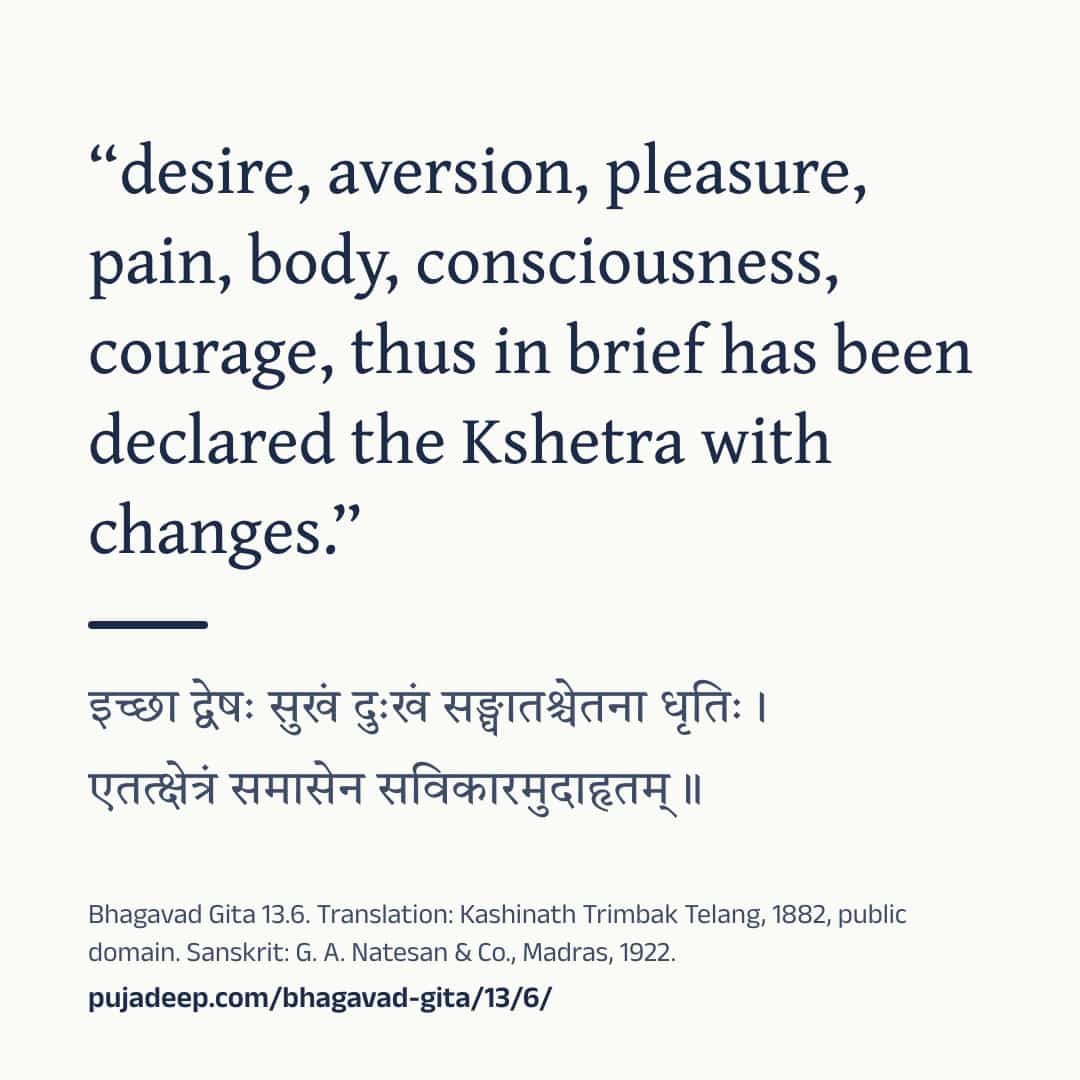
Drawing the picture
See the words
Bhagavad Gita 13.6

इच्छा द्वेषः सुखं दुःखं सङ्घातश्चेतना धृतिः ।
एतत्क्षेत्रं समासेन सविकारमुदाहृतम् ॥

“desire, aversion, pleasure, pain, body, consciousness, courage, thus in brief has been declared the Kshetra with changes.”
(K. T. Telang, The Bhagavadgîtâ (The Sacred Books of the East, vol. VIII, Oxford: Clarendon Press, 1882), pp. 102–103, public domain)
This sentence begins in 13.5.

“Desire, aversion, pleasure, pain, combination, intelligence, firmness, these are cited as illustrations of the Field in characteristic forms.”
(Annie Besant, The Bhagavad Gîtâ, or The Lord's Song (London: Theosophical Publishing Society, 1895), p. 123, public domain)
This sentence begins in 13.5.

Sanskrit: G. A. Natesan & Co., Madras, 1922.
https://pujadeep.com/bhagavad-gita/13/6/ Nothing is sent from this site. Your own app sends it, to the chat you choose. The picture quotes the translation you chose on this page, with its name and year.
Sanskrit text: The Bhagavad-Gita, or The Lord's Song, with the text in Devanagari and an English translation, 1922. Meanings: written for Pujadeep and checked against the cited edition. Source and changes
Questions families ask
Who speaks Bhagavad Gita 13.6?
Krishna speaks this verse, in chapter 13 (Kshetra Kshetrajna Vibhaga Yoga).
Where does the Sanskrit text come from?
Sanskrit text: The Bhagavad-Gita, or The Lord's Song, with the text in Devanagari and an English translation, 1922. Meanings: written for Pujadeep and checked against the cited edition. See the source
Is the meaning on this page a translation?
Explanation written for this site from the sources listed here, and checked against the cited edition. It is not a translation and not the only way to read the text. Free to quote with credit.
Source and licence
- Sanskrit text
- The Bhagavad-Gita, or The Lord's Song, with the text in Devanagari and an English translation (Annie Besant, G. A. Natesan & Co., Madras, 1922). Public domain. The Sanskrit on these pages was read from this printing’s page images.
- Translation
- The Bhagavadgîtâ with the Sanatsugâtîya and the Anugîtâ, translated by Kâshinâth Trimbak Telang (The Sacred Books of the East, vol. VIII, ed. F. Max Müller) (Kashinath Trimbak Telang, F. Max Müller, Clarendon Press, Oxford, 1882). Public domain. Shown verbatim, as printed.
- Translation
- The Bhagavad Gîtâ, or The Lord's Song, translated by Annie Besant (Annie Besant, Theosophical Publishing Society, London, 1895). Public domain. Shown verbatim, as printed.
- Translation
- Srimad-Bhagavad-Gita, with Sanskrit Text; Paraphrase with Word-by-word Literal Translation; English Rendering and Comments, Index, &c., by the Swami Swarupananda (Himalayan Series, No. XX) (Swami Swarupananda, The Editors and Publishers, Advaita Ashrama, Mayavati, Prabuddha Bharata Press, Mayavati, Almora, Himalayas, 1909). Public domain. Shown verbatim, as printed.
- Common wording
- In this text, 32 words follow today's common wording, checked against sanskritdocuments.org; Sanskrit Wikisource; Gita Press, Gorakhpur; GRETIL, Göttingen and Bhaktivedanta Book Trust.
- Our explanation
- Explanation written for this site from the sources listed here, and checked against the cited edition. It is not a translation and not the only way to read the text. Free to quote with credit.
- Checked
- Checked against the cited edition, October 15, 2026.
- Updated
- October 25, 2026