Bhagavad Gita 13.8: meaning and translation
Chapter 13: Kshetra Kshetrajna Vibhaga Yoga. Krishna says
Krishna: The list continues: detachment from the objects of the senses, freedom from ego, and seeing clearly the sorrow and flaw in birth, death, old age and illness.
Click or tap a word for its meaning and its dictionary page.
Text and layers
Text and layers
These choices stay in this browser.
Bhagavad Gita 13.8
इन्द्रियार्थेषु वैराग्यमनहङ्कार एव च ।जन्ममृत्युजराव्याधिदुःखदोषानुदर्शनम् ॥
Indriyartheshu vairagyamanahankara eva chaJanmamrityujaravyadhiduhkhadoshanudarshanam
indriyārtheṣu vairāgyamanahaṅkāra eva ca |janmamṛtyujarāvyādhiduḥkhadoṣānudarśanam ||
Our explanation The list continues: detachment from the objects of the senses, freedom from ego, and seeing clearly the sorrow and flaw in birth, death, old age and illness.
हिंदी अर्थ सूची आगे चलती है: इंद्रियों के विषयों से वैराग्य, अहंकार का न होना, और जन्म, मृत्यु, बुढ़ापे और रोग में दुःख और दोष को साफ़ देखना।
Word by word
Every word, with its dictionary page
Word by word
- इन्द्रियार्थेषु indriyārtheṣu · towards the objects of the senses (compound (masculine), locative plural) Dictionary: indriyārtha, Monier-Williams 1899, p. 167, col. 2 “an object of sense (as sound, smell, &c.)”
- वैराग्यम् vairāgyam · detachment (noun (neuter), nominative singular) Dictionary: vairāgya, Monier-Williams 1899, p. 1025, col. 2 “freedom from all worldly desires, indifference to worldly objects and to life”
- अनहङ्कारः anahaṅkāraḥ · freedom from ego (noun (masculine), nominative singular) Dictionary: an-ahaṃkāra, Monier-Williams 1899, p. 27, col. 2 “non-egotism, absence of self-conceit”
- एव eva · also (indeclinable) Dictionary: 1. eva, Monier-Williams 1899, p. 232, col. 2 “just, exactly, very, same, only, even, alone, merely”
- च ca · and (indeclinable) Dictionary: 2. ca, Monier-Williams 1899, p. 380, col. 1 “and, both, also, moreover, as well as”
- जन्ममृत्युजराव्याधिदुःखदोषानुदर्शनम् janmamṛtyujarāvyādhiduḥkhadoṣānudarśanam · seeing pain, flaw in birth, death, age, illness (compound (neuter), nominative singular) Dictionary: janman, Monier-Williams 1899, p. 411, col. 3 “birth, production”; mṛtyu, Monier-Williams 1899, p. 827, col. 3 “death, dying”; jarā, Monier-Williams 1899, p. 413, col. 3 “the act of becoming old, old age”; vy-ādhi, Monier-Williams 1899, p. 1037, col. 1 “disorder, disease, ailment, sickness”; 1. duḥkha, Monier-Williams 1899, p. 483, col. 2 “uneasiness, pain, sorrow, trouble, difficulty”; 2. doṣa, Monier-Williams 1899, p. 498, col. 2 “fault, vice, deficiency, want”; anu-darśana, Monier-Williams 1899, p. 33, col. 2 “consideration, regard”
Old translations
Kashinath Trimbak Telang, 1882. Public domain. Page 103.
indifference towards objects of sense, and also absence of egoism; perception of the misery and evil of birth, death1, old age, and disease;
This sentence begins in 13.7. This sentence goes on in 13.9.
Footnotes (the translator’s own) - Cf. Sutta Nipâta, pp. 18–95. ↩
Compare 3 translations
Kashinath Trimbak Telang, 1882. Public domain. Page 103.
indifference towards objects of sense, and also absence of egoism; perception of the misery and evil of birth, death1, old age, and disease;
This sentence begins in 13.7. This sentence goes on in 13.9.
Footnotes (the translator’s own) - Cf. Sutta Nipâta, pp. 18–95. ↩
You are reading this one
Cite this verse
The translation: K. T. Telang, The Bhagavadgîtâ (The Sacred Books of the East, vol. VIII, Oxford: Clarendon Press, 1882), p. 103. Bhagavad Gita 13.8.
The translation: Annie Besant, The Bhagavad Gîtâ, or The Lord's Song (London: Theosophical Publishing Society, 1895), p. 123. Bhagavad Gita 13.8.
The translation: Swami Swarupananda, Srimad-Bhagavad-Gita (Mayavati: Prabuddha Bharata Press, 1909; first printed in Prabuddha Bharata, 1907–1909), p. 256. Bhagavad Gita 13.8.
Our explanation: “Bhagavad Gita 13.8: meaning and translation.” Pujadeep. Updated October 25, 2026. https://pujadeep.com/bhagavad-gita/13/8/
Pujadeep’s explanations are free to quote with credit: name Pujadeep and link to the page. How to credit
Classical readings, by school
No readings by school on this verse yet.
Share
Show the ways to share
Send one picture or the text to one chat. The picture names its source and the address of this page.
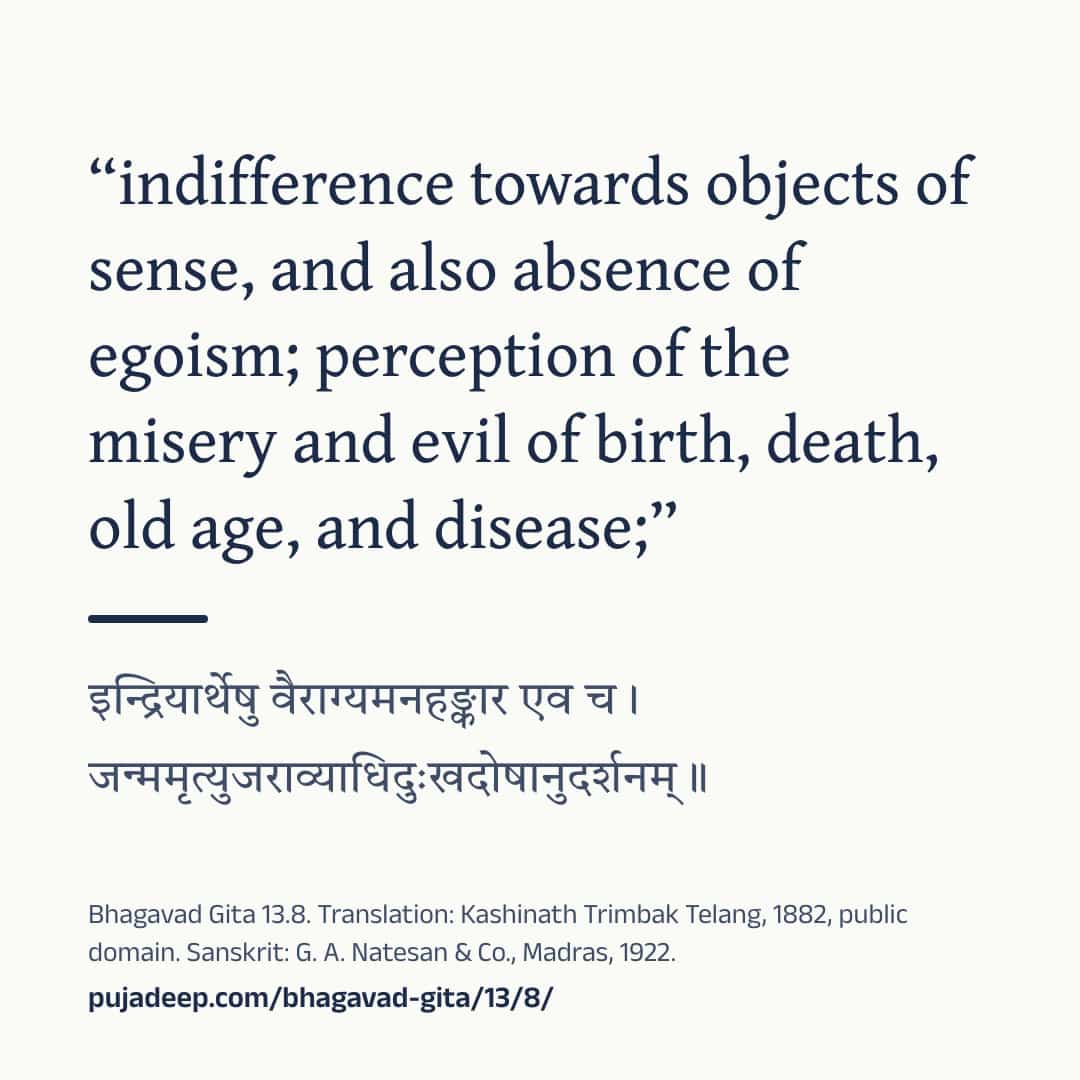
Drawing the picture
See the words
Bhagavad Gita 13.8

इन्द्रियार्थेषु वैराग्यमनहङ्कार एव च ।
जन्ममृत्युजराव्याधिदुःखदोषानुदर्शनम् ॥

“indifference towards objects of sense, and also absence of egoism; perception of the misery and evil of birth, death, old age, and disease;”
(K. T. Telang, The Bhagavadgîtâ (The Sacred Books of the East, vol. VIII, Oxford: Clarendon Press, 1882), p. 103, public domain)
This sentence begins in 13.7. This sentence goes on in 13.9.

“Indifference amid the objects of the senses, and also absence of egoism, understanding of the evil of birth, death, old age, sickness and pain,”
(Annie Besant, The Bhagavad Gîtâ, or The Lord's Song (London: Theosophical Publishing Society, 1895), p. 123, public domain)
This sentence begins in 13.7. This sentence goes on in 13.9.

“The renunciation of sense-objects, and also absence of egoism; reflection on the evils of birth, death, old age, sickness and pain;”
(Swami Swarupananda, Srimad-Bhagavad-Gita (Mayavati: Prabuddha Bharata Press, 1909; first printed in Prabuddha Bharata, 1907–1909), p. 256, public domain)
This sentence begins in 13.7. This sentence goes on in 13.9.

Sanskrit: G. A. Natesan & Co., Madras, 1922.
https://pujadeep.com/bhagavad-gita/13/8/ Nothing is sent from this site. Your own app sends it, to the chat you choose. The picture quotes the translation you chose on this page, with its name and year.
Sanskrit text: The Bhagavad-Gita, or The Lord's Song, with the text in Devanagari and an English translation, 1922. Meanings: written for Pujadeep and checked against the cited edition. Source and changes
Questions families ask
Who speaks Bhagavad Gita 13.8?
Krishna speaks this verse, in chapter 13 (Kshetra Kshetrajna Vibhaga Yoga).
Where does the Sanskrit text come from?
Sanskrit text: The Bhagavad-Gita, or The Lord's Song, with the text in Devanagari and an English translation, 1922. Meanings: written for Pujadeep and checked against the cited edition. See the source
Is the meaning on this page a translation?
Explanation written for this site from the sources listed here, and checked against the cited edition. It is not a translation and not the only way to read the text. Free to quote with credit.
Source and licence
- Sanskrit text
- The Bhagavad-Gita, or The Lord's Song, with the text in Devanagari and an English translation (Annie Besant, G. A. Natesan & Co., Madras, 1922). Public domain. The Sanskrit on these pages was read from this printing’s page images.
- Translation
- The Bhagavadgîtâ with the Sanatsugâtîya and the Anugîtâ, translated by Kâshinâth Trimbak Telang (The Sacred Books of the East, vol. VIII, ed. F. Max Müller) (Kashinath Trimbak Telang, F. Max Müller, Clarendon Press, Oxford, 1882). Public domain. Shown verbatim, as printed.
- Translation
- The Bhagavad Gîtâ, or The Lord's Song, translated by Annie Besant (Annie Besant, Theosophical Publishing Society, London, 1895). Public domain. Shown verbatim, as printed.
- Translation
- Srimad-Bhagavad-Gita, with Sanskrit Text; Paraphrase with Word-by-word Literal Translation; English Rendering and Comments, Index, &c., by the Swami Swarupananda (Himalayan Series, No. XX) (Swami Swarupananda, The Editors and Publishers, Advaita Ashrama, Mayavati, Prabuddha Bharata Press, Mayavati, Almora, Himalayas, 1909). Public domain. Shown verbatim, as printed.
- Common wording
- In this text, 32 words follow today's common wording, checked against sanskritdocuments.org; Sanskrit Wikisource; Gita Press, Gorakhpur; GRETIL, Göttingen and Bhaktivedanta Book Trust.
- Our explanation
- Explanation written for this site from the sources listed here, and checked against the cited edition. It is not a translation and not the only way to read the text. Free to quote with credit.
- Checked
- Checked against the cited edition, October 15, 2026.
- Updated
- October 25, 2026